
DATA REPORT · AGRIFOODV INSIGHTS
Passion fruit juice · Pineapple juice · Banana puree
EU · US · Japan · South Korea · China · UAE · Saudi Arabia
October 2026 · data as of 17 October 2026
Download the PDF reportBook a 30–45 minute online consultation
At a glance
- Executive summary
- 1. Vietnam's supply base
- 2. Import duties by market
- 3. Technical standards and Brix requirements
- 4. Compliance risks
- 5. Prices and competitive position
- 6. Product × market opportunity matrix
- 7. Recommendations for companies and investors
- 8. Methodology and limitations
- 9. How to cite
- Sources
Executive summary
This report compiles import duties, technical standards, compliance risks and price positions for three Vietnamese processed fruit products with export potential: passion fruit juice, pineapple juice and banana puree, across seven markets: the EU, the United States, Japan, South Korea, China, the UAE and Saudi Arabia. Every figure is traced to a primary source: legislation, government agencies or international organisations. Five key findings:
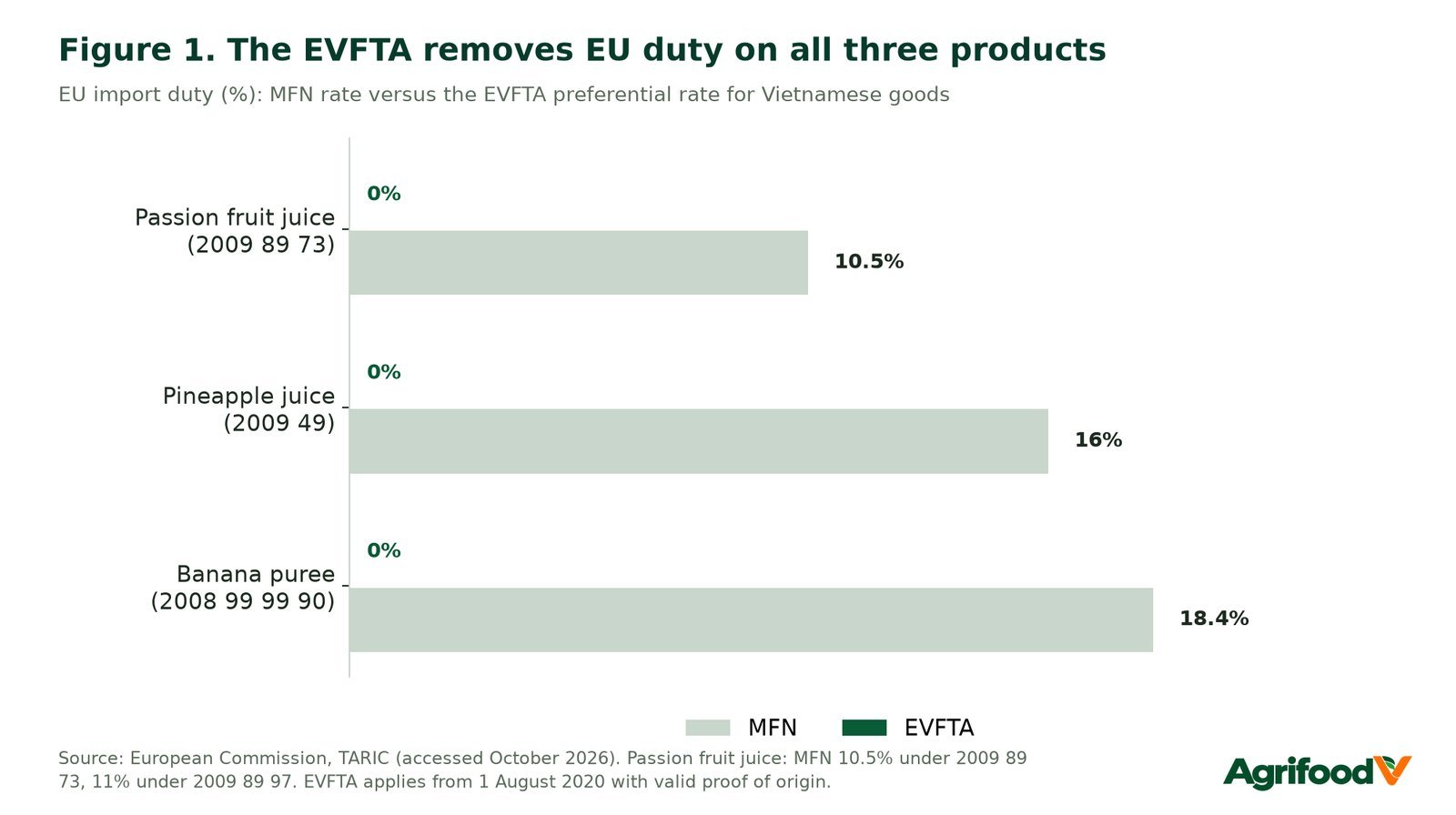
- The EU is the most open market for all three products. The EVFTA brings import duty to 0% for passion fruit juice (MFN 10.5–11%), pineapple juice (16%) and banana puree (18.4%). The preference applies only when the shipment carries valid proof of origin under the agreement.
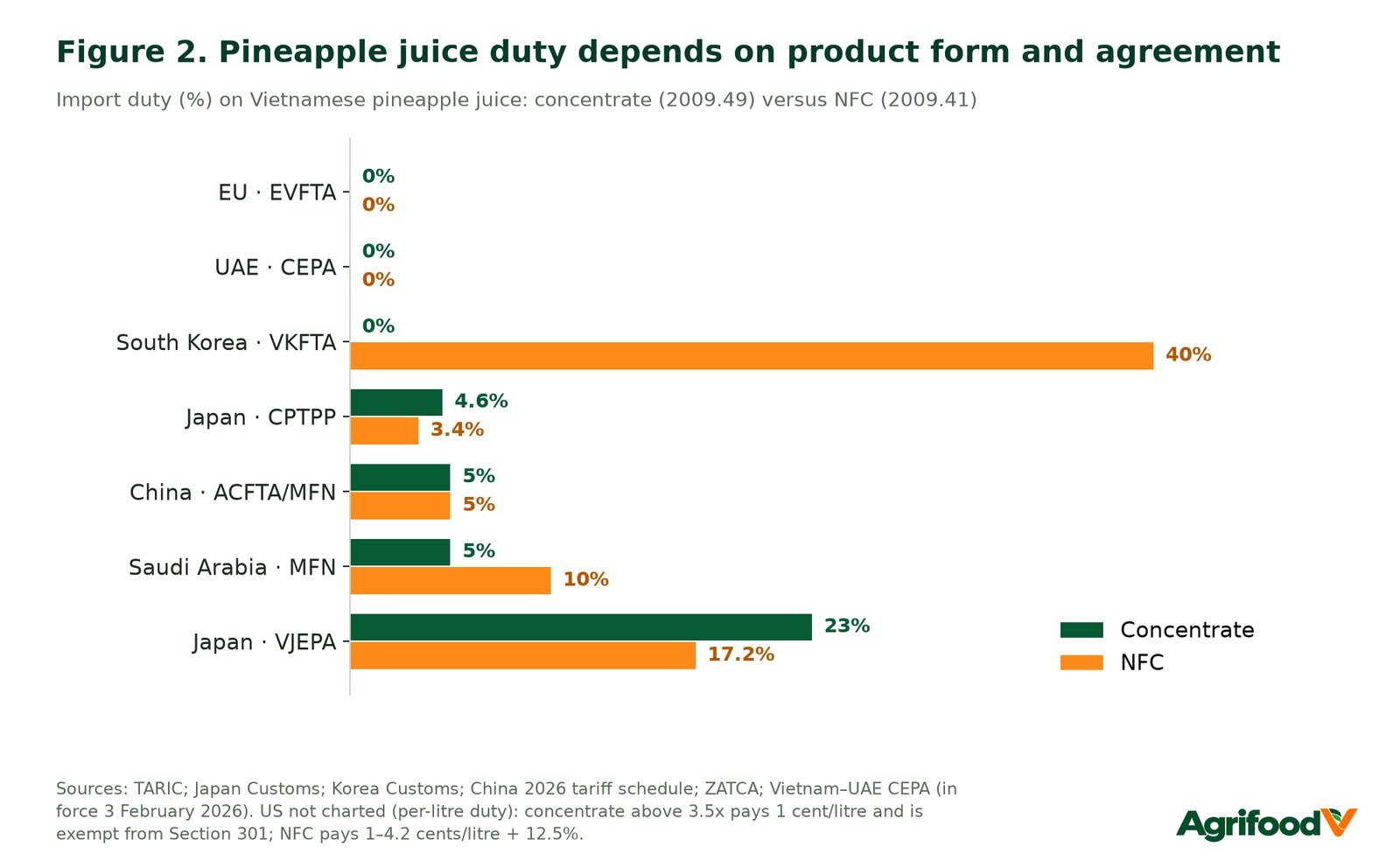
- Product form and proof of origin decide the duty. Pineapple juice concentrate enters South Korea at 0% (VKFTA), NFC at 40%. Into Japan, CPTPP gives 4.6% (concentrate) and 3.4% (NFC), against 23% and 17.2% under VJEPA. Into the US, pineapple juice concentrated more than 3.5 times pays 1 cent/litre and is exempt from Section 301; passion fruit juice and NFC pineapple juice pay an additional 12.5% from 24 July 2026.
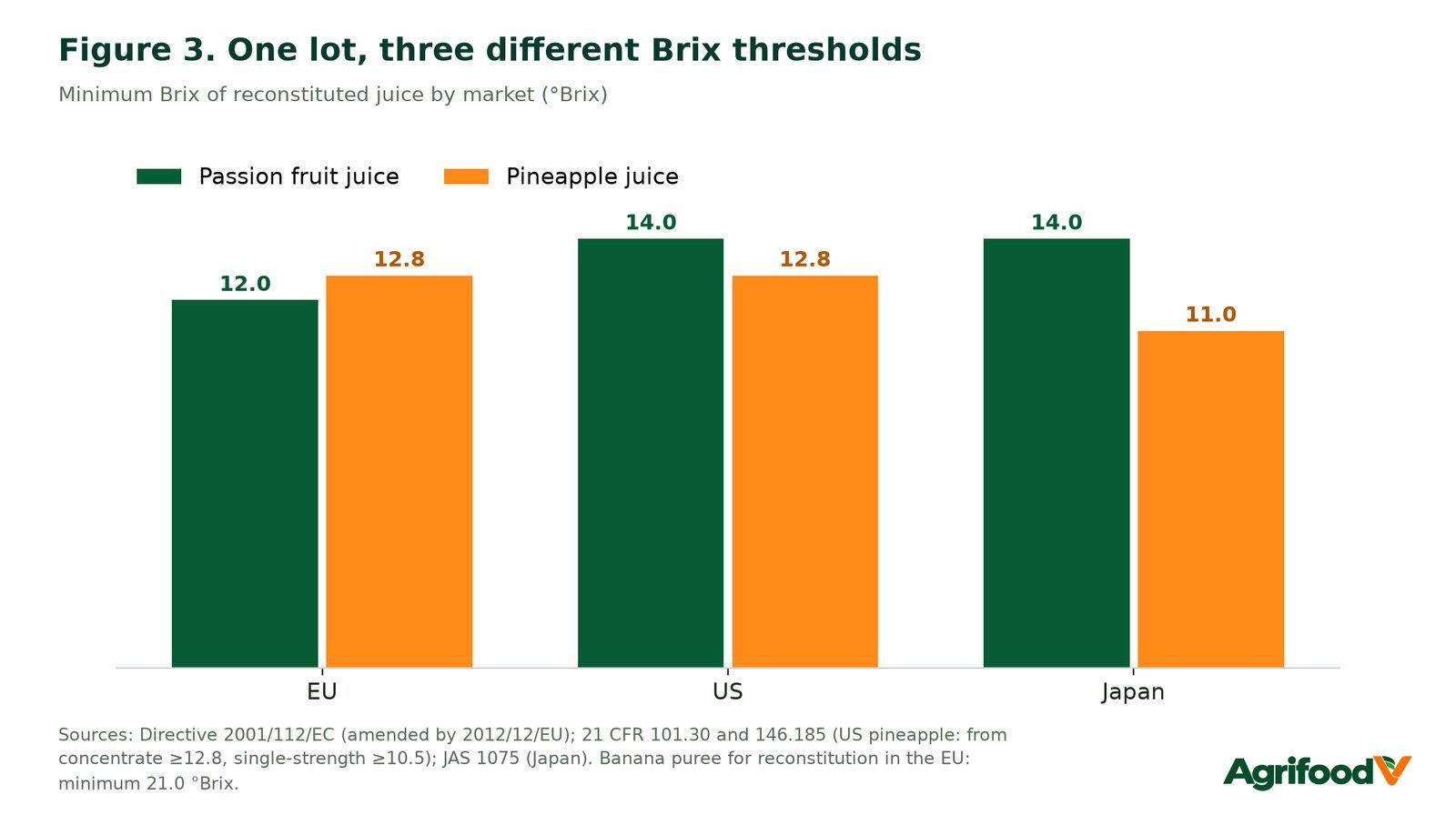
- One lot must meet several quality thresholds. Reconstituted passion fruit juice needs at least 12.0 °Brix in the EU but 14.0 in the US and 14 in Japan. Brix, acidity and dilution ratio must be fixed by destination market at contract stage.
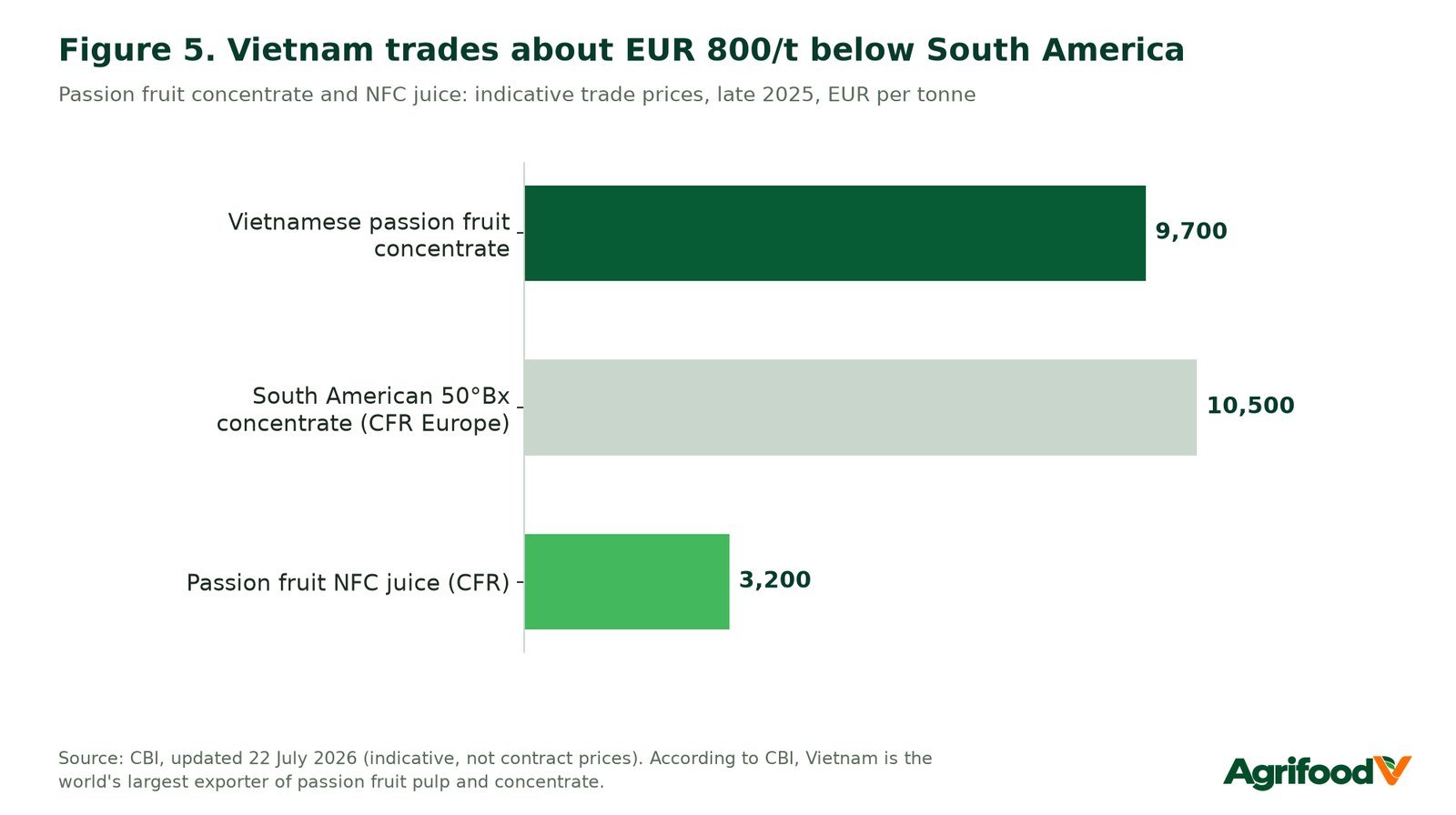
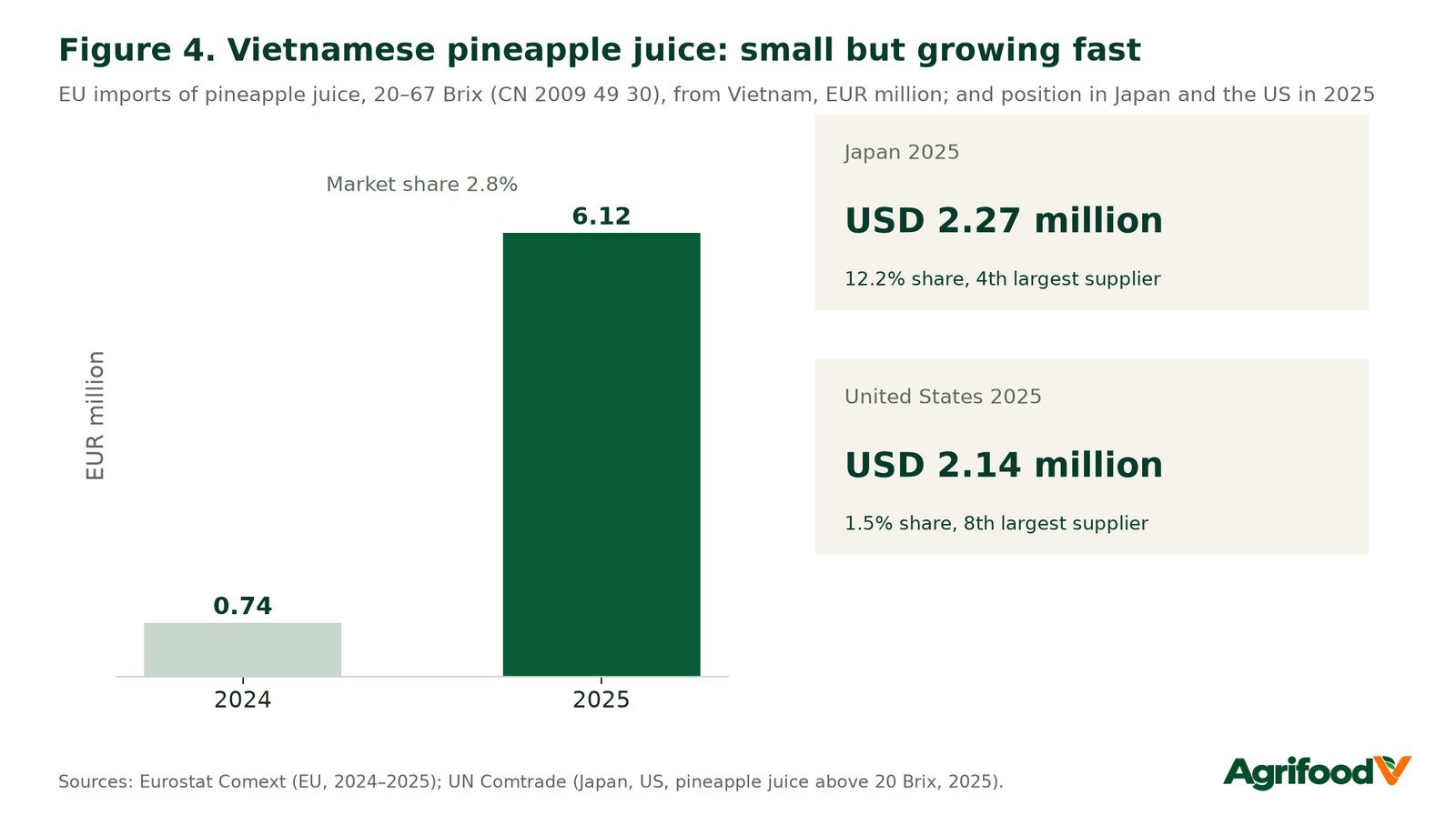
- Each product line starts from a different position. According to CBI, Vietnam is the world's largest exporter of passion fruit pulp and concentrate, trading at around EUR 9,700/t against EUR 10,500/t for South American concentrate. Pineapple juice is small but growing fast: EU imports from Vietnam reached EUR 6.12 million in 2025, up from EUR 0.74 million in 2024. Vietnam grows 2.75 million tonnes of bananas, yet no public source reports an export-scale aseptic banana puree plant in operation.
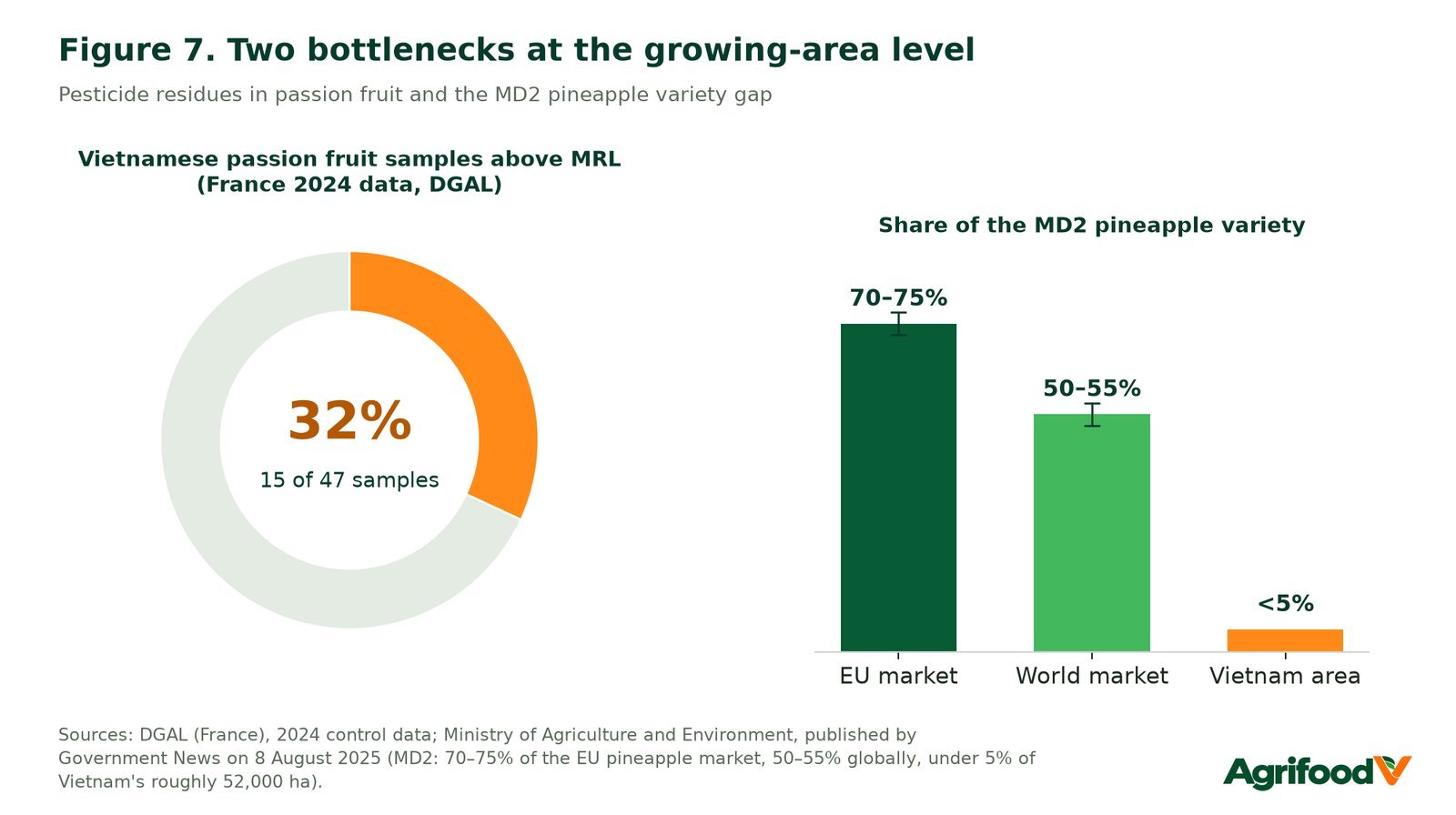
- The bottleneck sits in the growing areas, not the plant. France's 2024 data (DGAL) show 15 of 47 Vietnamese passion fruit samples above maximum residue limits. The MD2 variety covers under 5% of Vietnam's pineapple area, while holding 70–75% of the EU pineapple market (Ministry of Agriculture and Environment, 2025).
1. Vietnam’s supply base
Passion fruit. In 2024 Vietnam had about 10,400 ha of passion fruit producing 163,400 tonnes; the Central Highlands account for 86.4% of the area (Nhan Dan). Average yield is 20.3 t/ha, and 26.1 t/ha in the Central Highlands. By December 2025, Gia Lai had 48 growing-area codes for passion fruit covering more than 1,150 ha, and 6 packhouses qualified for export. According to CBI, passion fruit follows a 3–4 year supply cycle, so a plant needs dispersed growing areas coordinated through cooperatives.
Pineapple. According to the Ministry of Agriculture and Environment (published by Government News on 8 August 2025), Vietnam has about 52,000 ha of pineapple, 48,000 ha harvested, producing more than 860,000 tonnes, with a target of 55,000–60,000 ha by 2030. FAOSTAT 2024 data, used for international comparison, record 806,529 tonnes on 43,800 ha, a yield of 18.4 t/ha, against 58.8 t/ha in Costa Rica and 43.2 t/ha in the Philippines. MD2, the main variety in international trade, covers under 5% of the area.
Banana. In 2025 Vietnam had more than 163,000 ha of bananas producing about 2.75 million tonnes (Department of Crop Production and Plant Protection), with exports of about USD 405 million, mostly as fresh fruit. China took 66.7% of banana export value in the first seven months of 2026. According to the Vietnam Fruit and Vegetable Association, more than 70% of Vietnam’s fruit and vegetables are still exported fresh.
2. Import duties by market
The duty actually paid depends on three factors: the HS code (NFC or concentrate, pulp or juice), the trade agreement claimed on the proof of origin, and additional duties such as US Section 301. The same product can differ by up to 40 percentage points simply through the wrong form or the wrong certificate.
Passion fruit juice
| Market | Form · HS code | MFN duty | Duty on Vietnamese goods | Notes |
|---|---|---|---|---|
| EU | NFC 2009 89 73 (giá trên 30 EUR/100 kg, gồm hầu hết cô đặc và NFC); 2009 89 97 (giá thấp hơn) |
10,5%; 11% | 0% (EVFTA (từ 1/8/2020)) | Không. Preferences apply only with proof of origin under the correct agreement. Article 5733 does not split duties by NFC/concentrate; the same subheading 2009.89 applies to passion fruit juice without added sugar. |
| EU | Concentrate 2009 89 73 (giá trên 30 EUR/100 kg, gồm hầu hết cô đặc và NFC); 2009 89 97 (giá thấp hơn) |
10,5%; 11% | 0% (EVFTA (từ 1/8/2020)) | Không. Preferences apply only with proof of origin under the correct agreement. Article 5733 does not split duties by NFC/concentrate; the same subheading 2009.89 applies to passion fruit juice without added sugar. |
| United States | NFC 2009.89.70.99 (nước) |
0,5 cent/lít | Không có (Việt Nam không có FTA với Mỹ) (—) | +12,5% (Mục 301, từ 24/7/2026). The Section 301 exclusion list does not include passion fruit juice; under line 2009.89.70, the exceptions apply only to coconut water and açaí. Article 5733 does not split duties by NFC/concentrate; the same subheading 2009.89 applies to passion fruit juice without added sugar. |
| United States | Concentrate 2009.89.70.99 (nước) |
0,5 cent/lít | Không có (Việt Nam không có FTA với Mỹ) (—) | +12,5% (Mục 301, từ 24/7/2026). The Section 301 exclusion list does not include passion fruit juice; under line 2009.89.70, the exceptions apply only to coconut water and açaí. Article 5733 does not split duties by NFC/concentrate; the same subheading 2009.89 applies to passion fruit juice without added sugar. |
| Japan | NFC 2009.89 |
19,1–25,5% (tùy hàm lượng đường) | 0% (VJEPA và CPTPP) | Không. Article 5733 does not split duties by NFC/concentrate; the same subheading 2009.89 applies to passion fruit juice without added sugar. |
| Japan | Concentrate 2009.89 |
19,1–25,5% (tùy hàm lượng đường) | 0% (VJEPA và CPTPP) | Không. Article 5733 does not split duties by NFC/concentrate; the same subheading 2009.89 applies to passion fruit juice without added sugar. |
| South Korea | NFC 2009.89-1090 |
50% | 0% (VKFTA) | Không. AKFTA 40%. Article 5733 does not split duties by NFC/concentrate; the same subheading 2009.89 applies to passion fruit juice without added sugar. |
| South Korea | Concentrate 2009.89-1090 |
50% | 0% (VKFTA) | Không. AKFTA 40%. Article 5733 does not split duties by NFC/concentrate; the same subheading 2009.89 applies to passion fruit juice without added sugar. |
| China | NFC 2009.89.13 |
5% | 0% (ACFTA (C/O mẫu E)) | Không. RCEP 10%, less favourable than ACFTA; use C/O Form E. Article 5733 does not split duties by NFC/concentrate; the same subheading 2009.89 applies to passion fruit juice without added sugar. |
| China | Concentrate 2009.89.13 |
5% | 0% (ACFTA (C/O mẫu E)) | Không. RCEP 10%, less favourable than ACFTA; use C/O Form E. Article 5733 does not split duties by NFC/concentrate; the same subheading 2009.89 applies to passion fruit juice without added sugar. |
| UAE | NFC 2009 89 91 0002 / 0003 |
5% | 0% (CEPA Việt Nam – UAE (hiệu lực 3/2/2026)) | Không. Goods transshipped through the UAE to other Gulf countries do not automatically qualify for CEPA treatment. Article 5733 does not split duties by NFC/concentrate; the same subheading 2009.89 applies to passion fruit juice without added sugar. |
| UAE | Concentrate 2009 89 91 0002 / 0003 |
5% | 0% (CEPA Việt Nam – UAE (hiệu lực 3/2/2026)) | Không. Goods transshipped through the UAE to other Gulf countries do not automatically qualify for CEPA treatment. Article 5733 does not split duties by NFC/concentrate; the same subheading 2009.89 applies to passion fruit juice without added sugar. |
| Saudi Arabia | NFC 2009.89 |
5% | 5% (không có ưu đãi) (— (Việt Nam chưa có FTA với Ả Rập Xê Út)) | Không. Article 5733 does not split duties by NFC/concentrate; the same subheading 2009.89 applies to passion fruit juice without added sugar. |
| Saudi Arabia | Concentrate 2009.89 |
5% | 5% (không có ưu đãi) (— (Việt Nam chưa có FTA với Ả Rập Xê Út)) | Không. Article 5733 does not split duties by NFC/concentrate; the same subheading 2009.89 applies to passion fruit juice without added sugar. |
| United States | Pulp 2008.99.80 (pulp chưa đông lạnh) |
9,6% | Không có (Việt Nam không có FTA với Mỹ) (—) | +12,5% (Mục 301, từ 24/7/2026). Unfrozen passion fruit pulp faces a combined 9.6% + 12.5%. |
Pineapple juice
| Market | Form · HS code | MFN duty | Duty on Vietnamese goods | Notes |
|---|---|---|---|---|
| EU | NFC 2009.41 |
16% | 0% (EVFTA) | Không. Without added sugar. NFC = 2009.41 (Brix value not exceeding 20); concentrate = 2009.49 (Brix above 20). |
| EU | Concentrate 2009.49 |
16% | 0% (EVFTA) | Không. Without added sugar. NFC = 2009.41 (Brix value not exceeding 20); concentrate = 2009.49 (Brix above 20). |
| United States | NFC 2009.41 (2009.41.20, .40) |
1–4,2 cent/lít | Không có (Việt Nam không có FTA với Mỹ) (—) | +12,5% (Mục 301). NFC pineapple juice is not exempt from Section 301. |
| United States | Concentrate 2009.49.40 (cô trên 3,5 lần) |
1 cent/lít | Không có (Việt Nam không có FTA với Mỹ) (—) | Miễn Mục 301. Concentrate of more than 3.5 times (about 60°Bx) is on the Section 301 exemption list. |
| United States | Concentrate 2009.49.20 (cô không quá 3,5 lần) |
4,2 cent/lít | Không có (Việt Nam không có FTA với Mỹ) (—) | +12,5% (Mục 301). Concentrate of not more than 3.5 times is not exempt from Section 301. |
| Japan | NFC 2009.41 |
19,1% | 3,4% (CPTPP) | Không. VJEPA 17.2%; using VJEPA by mistake means a duty about five times higher. |
| Japan | Concentrate 2009.49 |
25,5% | 4,6% (CPTPP) | Không. VJEPA 23%. |
| South Korea | NFC 2009.41 |
50% | 40% (VKFTA); 25% (RCEP) (VKFTA; RCEP) | Không. |
| South Korea | Concentrate 2009.49 |
50% | 0% (VKFTA) | Không. The article recommends selling concentrate, not NFC, to South Korea. |
| China | NFC 2009.41 (2009.4100) |
5% | Không (ACFTA không giảm thuế nước dứa) (—) | Không. Rate for Vietnamese goods 5%; the RCEP rate of 7.5% is even higher than MFN. |
| China | Concentrate 2009.49 (2009.4900) |
5% | Không (ACFTA không giảm thuế nước dứa) (—) | Không. Rate for Vietnamese goods 5%; the RCEP rate of 7.5% is even higher than MFN. |
| UAE | NFC 2009.41 |
5% | 0% (có đường: 4,5%) (CEPA Việt Nam – UAE (hiệu lực 3/2/2026)) | Không. |
| UAE | Concentrate 2009.49 |
5% | 0% (CEPA Việt Nam – UAE (hiệu lực 3/2/2026)) | Không. |
| Saudi Arabia | NFC 2009.41 |
10% | 10% (không có ưu đãi) (— (Việt Nam chưa có FTA với Ả Rập Xê Út)) | Không. |
| Saudi Arabia | Concentrate 2009.49 |
5% | 5% (không có ưu đãi) (— (Việt Nam chưa có FTA với Ả Rập Xê Út)) | Không. Duty difference between NFC and concentrate: 5 percentage points. |
Banana puree
| Market | Form · HS code | MFN duty | Duty on Vietnamese goods | Notes |
|---|---|---|---|---|
| EU | Puree 2008 99 99 90 (puree không nấu, không thêm đường); nhóm 2007 nếu puree được "nấu" |
18,4% | 0% (EVFTA (từ 1/8/2020)) | Không. Aseptic puree may be classified under heading 2008 or 2007; apply for BTI before quoting. Whichever heading applies, Vietnamese goods still enjoy 0% under the EVFTA. |
| United States | Puree 2008.99.13.00 "Bananas: Pulp" |
3,4% | Không có; Việt Nam chịu 3,4% (—) | Chưa tính thuế bổ sung (bài không nêu mức). Colombia, Peru, Panama, Central America: 0%. |
Note: US duties on juice are per litre and are not charted together with ad valorem rates. Section 301: an additional 12.5% on Vietnamese goods from 24 July 2026 (code 9903.05.84; Federal Register doc. 2026-15181). Goods transshipped through the UAE to other Gulf states do not automatically qualify for CEPA treatment.
3. Technical standards and Brix requirements
The minimum Brix of reconstituted juice is the legal threshold for the “juice” name on the label. A lot of concentrate can meet EU rules yet fall short of a “100% juice” label in the US or Japan after reconstitution. In the EU, Directive 2001/112/EC (amended by 2012/12/EU) does not allow sugar to be added to “fruit juice”. In the US, Juice HACCP (21 CFR Part 120) covers puree and concentrate, and the HACCP plan must achieve at least a 5-log reduction of pathogens.
| Product | Market | Parameter | Value | Legal basis |
|---|---|---|---|---|
| Passion fruit juice | EU | Minimum Brix of reconstituted passion fruit juice | 12.0 °Brix | Chỉ thị 2001/112/EC (sửa bởi 2012/12/EU) |
| Passion fruit juice | EU | Minimum fruit content of passion fruit nectar | 25 % | Chỉ thị 2001/112/EC (sửa bởi 2012/12/EU) |
| Passion fruit juice | United States | Minimum reconstituted Brix of passion fruit juice | 14.0 °Brix | 21 CFR 101.30(h)(1) |
| Passion fruit juice | Japan | Minimum Brix of reconstituted passion fruit juice | 14 °Brix | JAS 1075 (sửa 2023) |
| Passion fruit juice | Japan | Minimum Brix for passion fruit juice to be called a concentrate | 28 °Brix | JAS 1075 (sửa 2023) |
| Passion fruit juice | United States | Minimum reduction of pathogenic microorganisms (Juice HACCP) | 5 log | 21 CFR Part 120 |
| Passion fruit juice | Japan | Default residue limit (positive list system) | 0.01 ppm | Hệ thống danh sách khẳng định Nhật Bản |
| Passion fruit juice | South Korea | Default residue limit (PLS) | 0.01 mg/kg | Hệ thống PLS Hàn Quốc |
| Pineapple juice | EU | Minimum Brix of reconstituted pineapple juice | 12.8 °Brix | Chỉ thị 2001/112/EC (sửa bởi 2012/12/EU) |
| Pineapple juice | United States | Minimum Brix of single-strength pineapple juice | 10.5 °Brix | 21 CFR 146.185 |
| Pineapple juice | United States | Minimum Brix of pineapple juice from concentrate | 12.8 °Brix | 21 CFR 146.185 |
| Pineapple juice | United States | Maximum acidity of pineapple juice | 1.35 g/100 ml | 21 CFR 146.185 |
| Pineapple juice | Japan | Minimum Brix of reconstituted pineapple juice | 11 °Brix | JAS 1075 |
| Pineapple juice | Japan | Minimum Brix for pineapple juice to be called a concentrate | 27 °Brix | JAS 1075 |
| Pineapple juice | United States | Concentration level for Section 301 exemption (2009.49.40) | trên 3,5 lần (khoảng 60°Bx) lần cô | HTSUS 2009.49.40; khuyến nghị AgrifoodV |
| Pineapple juice | EU | Maximum residue level for ethephon on pineapple (from 19 August 2026) | 1.5 mg/kg | Quy định (EU) 2026/215 |
| Banana puree | EU | Minimum Brix of reconstituted banana puree (not corrected for acid) | 21.0 °Brix | Chỉ thị 2012/12/EU sửa Chỉ thị 2001/112/EC |
| Banana puree | EU | Minimum juice/puree content of banana nectar (Codex and EU) | 25 % | Codex CXS 247-2005; Chỉ thị 2001/112/EC |
4. Compliance risks
- Pesticide residues. DGAL (France) found 15 of 47 Vietnamese passion fruit samples above maximum residue limits (32%), including omethoate (report of February 2026, 2024 data; these are monitoring results, not border rejections). On 28 March 2026, South Korea’s MFDS recalled a 6,970 kg lot of frozen Vietnamese passion fruit for difenoconazole at 0.05 mg/kg, above the 0.01 mg/kg default limit. Residues in puree and concentrate are derived from residues in the fruit through processing factors (Article 20 of Regulation 396/2005), so a fresh-fruit problem is also a plant problem.
- EU increased controls. Vietnamese passion fruit is not listed under Implementing Regulation (EU) 2019/1793, and RASFF recorded no notifications from early 2024 to October 2026. Four Vietnamese entries are under control for residues: fresh durian at 20% of consignments (Annex I); okra 50%, dragon fruit 30%, chilli peppers 50% (Annex II).
- Plant registration. China: GACC Decree 280 in force from 1 June 2026 (replacing Decree 248), residues under GB 2763, Chinese-language labelling. South Korea: foreign manufacturers must register with MFDS before import, with residues under the PLS system and a 0.01 mg/kg default. United States: importers must verify foreign suppliers under FSVP (21 CFR 1.502).
- Additional US duty. Section 301 adds 12.5% from 24 July 2026; exempt are pineapple juice concentrated more than 3.5 times (2009.49.40), processed, frozen and fresh pineapple; passion fruit juice and NFC pineapple juice are not exempt.
- Growing areas. Decree 38/2026/ND-CP (24 January 2026) regulates growing-area codes and requires farm records to be kept (Article 6). The EU maximum residue limit for ethephon on pineapple, a common flowering agent, is 1.5 mg/kg from 19 August 2026 (Regulation (EU) 2026/215).
5. Prices and competitive position
Passion fruit: volume leader with room on price. According to CBI (updated 22 July 2026), Vietnam is the world’s largest exporter of passion fruit pulp and concentrate. Exports of passion fruit juice to Europe in 2025 are estimated at about EUR 31.5 million (CBI, indicative estimate). Under the combined code CN 2009 89 73 (tropical fruit juices, several fruits), the EU imported EUR 71.3 million and 13,463 tonnes from Vietnam in 2025, 52.4% of extra-EU imports (Eurostat). Vietnamese concentrate trades at around EUR 9,700/t, about EUR 800/t below South American 50°Bx concentrate.
Pineapple juice: small but growing fast. Europe imported about 292,500 tonnes of pineapple juice worth EUR 397 million in 2024; between 2020 and 2024 volume fell by 5% a year on average while value rose by 7.5% a year (CBI). In mid-2025, pineapple juice concentrate traded at about USD 4,900/t. Costa Rica supplies 55% of the Netherlands’ imports, the main gateway to Europe. Vietnam’s share is still small: 2.8% of extra-EU imports under 2009 49 30, but already 12.2% in Japan (4th largest supplier).
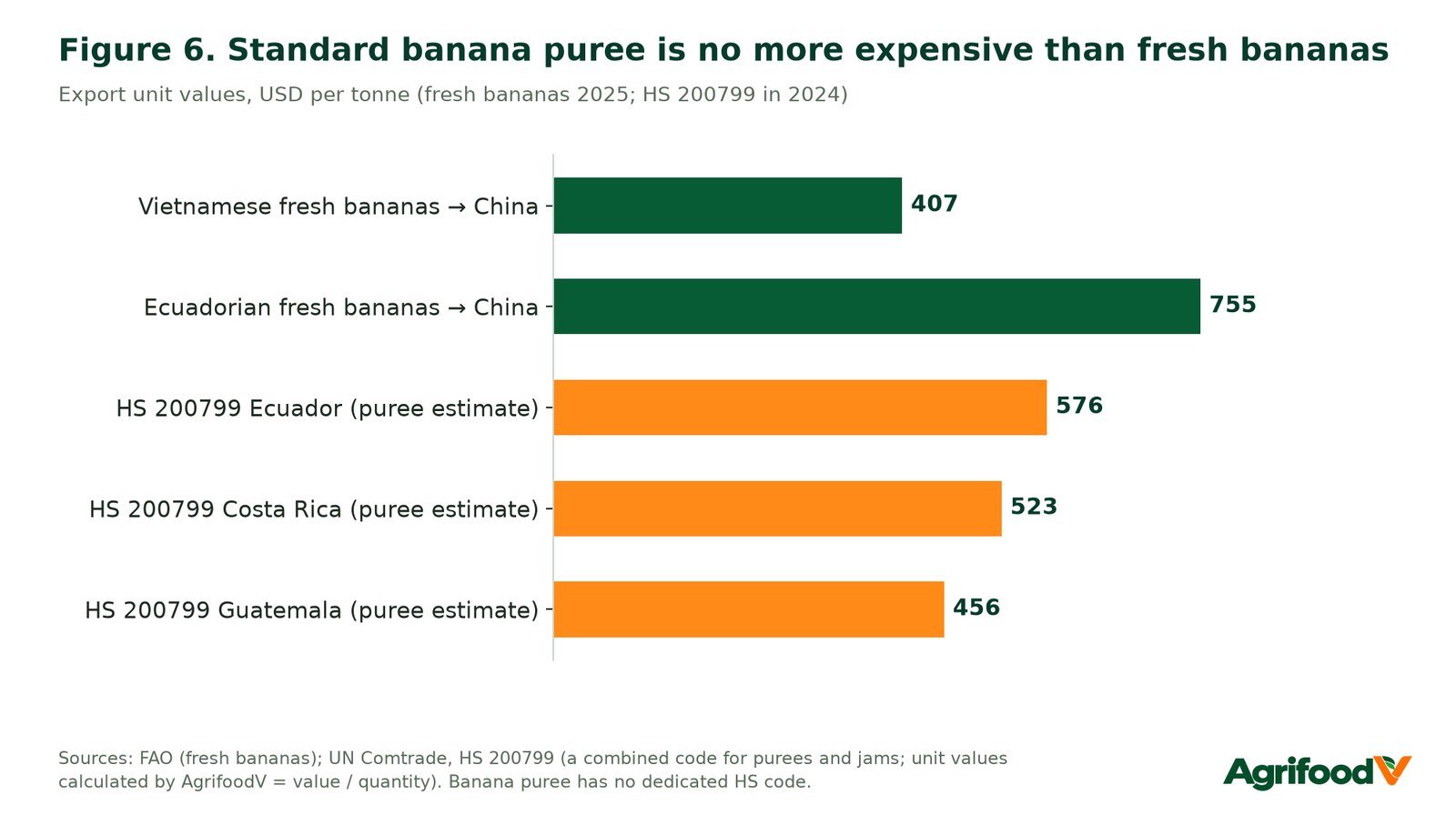
Banana puree: a volume market with thin margins. Banana puree has no dedicated HS code. CBI estimates the European banana pulp market at about 50,000 tonnes in 2024, led by Costa Rica, Guatemala and Ecuador. Using HS 200799 as an indirect measure, in 2024 Ecuador exported about 84,945 tonnes, Costa Rica 52,832 tonnes and Guatemala 46,558 tonnes, at unit values of only USD 456–576/t. Meanwhile China imported 685,579 tonnes of Vietnamese bananas in 2025 (UN Comtrade) at an average of USD 407/t, against USD 755/t for Ecuadorian bananas (FAO).
6. Product × market opportunity matrix
AgrifoodV assessment, based on duties for Vietnamese goods and the registration and standards requirements in sections 2–4. “Open”: 0% or low duty, no specific barrier beyond general standards. “Conditional”: accessible if one specific condition is met (product form, certificate, registration). “Difficult”: stacked duties erode competitiveness. “Not assessed”: the source analyses do not yet cover duties and requirements for that product and market.
| Product | EU | United States | Japan | South Korea | China | UAE | Saudi Arabia |
|---|---|---|---|---|---|---|---|
| Passion fruit juice | Open 0% EVFTA; Brix 12.0 |
Difficult MFN + 12.5% Section 301; Brix 14.0 |
Open 0%; Brix 14 (JAS) |
Conditional 0% VKFTA; MFDS registration, PLS 0.01 mg/kg |
Conditional 0% with Form E; GACC registration (Decree 280) |
Open 0% CEPA |
Conditional 5% (no FTA) |
| Pineapple juice | Open 0% EVFTA; needs MD2 supply |
Conditional Concentrate >3.5x: 1 cent/litre, Section 301 exempt; NFC +12.5% |
Open CPTPP 4.6% / 3.4%; use the right certificate |
Conditional Concentrate 0%; NFC 40% |
Conditional 5% (no ACFTA cut) |
Open 0% CEPA |
Conditional Concentrate 5%; NFC 10% |
| Banana puree | Conditional 0% EVFTA; needs a plant and BTI |
Conditional 3.4%; Latin American rivals 0% |
Not assessed | Not assessed | Not assessed | Not assessed | Not assessed |
7. Recommendations for companies and investors
- Choose the market first, design the plant second. The destination market determines product form (NFC or concentrate), Brix, acidity and dilution ratio; those parameters determine technology and capacity. Fix them in the sales contract before fixing the line.
- Choose the product form by the tariff schedule. For the US, South Korea or Saudi Arabia, pineapple juice should be concentrated more than 3.5 times (about 60°Bx): Section 301 exempt in the US, 0% in South Korea, 5% instead of 10% in Saudi Arabia.
- Claim the right agreement on the proof of origin. Use CPTPP, not VJEPA, for pineapple juice into Japan (about five times lower); use Form E (0%), not RCEP, for passion fruit juice into China. Goods transshipped through the UAE do not automatically qualify for CEPA.
- Control residues in the growing areas. Draw up a list of permitted pesticides for the destination market, give it to growers, keep farm records for each growing-area code and test raw material before it enters the warehouse rather than waiting for finished-product tests.
- Register the plant before the first shipment. GACC under Decree 280 for China, MFDS for South Korea, a Juice HACCP plan and FSVP documentation for US importers.
- Size a pineapple plant on actual MD2 area. Not on a province's total pineapple area; plan flower induction lot by lot and within the new EU ethephon residue limit.
- For banana puree, start from raw material and segment. Use fruit rejected from the fresh-export stream, target premium lines (organic, baby food), and apply for Binding Tariff Information in the EU before quoting, as aseptic puree may be classified under heading 2008 or 2007.
8. Methodology and limitations
This report is compiled from 9 AgrifoodV analyses published in October 2026, each citing primary sources: national tariff databases (TARIC, USITC, Japan Customs, Korea Customs, China’s tariff schedule, ZATCA), legislation (EUR-Lex, eCFR, Federal Register, GACC, MFDS), trade statistics (Eurostat, UN Comtrade, FAO) and market studies (CBI). Every figure was checked against the wording of the source article before inclusion; data are as of 17 October 2026.
Limitations. Duties and regulations change over time; companies should check the legislation in force before signing contracts. Combined codes (CN 2009 89 73, HS 200799) cover several fruits and are only indirect measures. Prices are indicative, not contract prices. MD2’s share in Europe has two figures: 70–75% (Ministry of Agriculture and Environment, 2025) and more than 80% of pineapples imported into Europe (CBI, 2017 data); both refer to fresh pineapple. The opportunity matrix in section 6 is an AgrifoodV assessment, not data. This report is not a substitute for legal advice.
9. How to cite
AgrifoodV (2026). Vietnam Fruit Juice and Puree Exports 2026: Duties, Standards and Market Opportunities. https://agrifoodv.com/en/vietnam-fruit-juice-puree-exports-2026-report/
Media, associations, agencies and companies may quote figures, tables and charts from this report with the attribution “AgrifoodV (2026)” and a link to this report. For the dataset, contact contact@agrifoodv.com.
Sources
Show 67 sources
- Ủy ban châu Âu. TARIC, code 2009 89 97 90, origin Vietnam. https://ec.europa.eu/taxation_customs/dds2/taric/measures.jsp?Lang=en&SimDate=20261010&Area=VN&Taric=2009899700
- USITC. Harmonized Tariff Schedule of the United States 2026 (lines 2008.99.13, 2008.99.80, 2009.41, 2009.49, 2009.89.70, Chapter 99 note 52). https://hts.usitc.gov/
- Hải quan Nhật Bản. Customs tariff schedule, Chapter 20 (version of 8 August 2026). https://www.customs.go.jp/english/tariff/2026_08_08/data/e_20.htm
- Hải quan Hàn Quốc. FTA portal, tariff rate search. https://www.customs.go.kr/ftaportalkor/ad/ftaCnvn/txrtInfo.do?mi=3526
- Ủy ban Thuế quan Quốc vụ viện Trung Quốc. 2026 import and export tariff schedule, Announcement No. 12/2025 (31 December 2025). https://gss.mof.gov.cn/gzdt/zhengcefabu/202512/t20251231_3981044.htm
- Bộ Kinh tế UAE. CEPA tariff preference schedule for goods of Vietnamese origin. https://tradestatfta.moec.gov.ae/superset/dashboard/38/
- ZATCA (Ả Rập Xê Út). Integrated tariff, heading 20.09. https://eservices.zatca.gov.sa/sites/sc/en/tariff/Pages/TariffPages/TariffSearch.aspx
- Ủy ban châu Âu. TARIC, groups 2009 41 and 2009 49, origin Vietnam. https://ec.europa.eu/taxation_customs/dds2/taric/taric_consultation.jsp?Lang=en
- Ủy ban châu Âu. TARIC, code 2008 99 99 90, origin Vietnam, reference date 18 October 2026. https://ec.europa.eu/taxation_customs/dds2/taric/measures.jsp?Lang=en&SimDate=20261018&Area=VN&Taric=2008999990
- Hội đồng EU. Directive 2001/112/EC relating to fruit juices, amended by Directive 2012/12/EU. https://eur-lex.europa.eu/eli/dir/2012/12/oj/eng
- eCFR. 21 CFR 101.30. https://www.ecfr.gov/current/title-21/chapter-I/subchapter-B/part-101/subpart-B/section-101.30
- Bộ Nông Lâm Thủy sản Nhật Bản (MAFF). JAS standard for fruit juice beverages, JAS 1075. https://www.maff.go.jp/j/jas/jas_standard/attach/pdf/index-278.pdf
- eCFR. 21 CFR Part 120 (Juice HACCP). https://www.ecfr.gov/current/title-21/chapter-I/subchapter-B/part-120
- Bộ An toàn Thực phẩm và Dược phẩm Hàn Quốc (MFDS). Registration of foreign food facilities. https://www.mfds.go.kr/eng/wpge/m_11/de011002l001.do
- eCFR. 21 CFR 146.185 (standard of identity for pineapple juice). https://www.ecfr.gov/current/title-21/chapter-I/subchapter-B/part-146/subpart-B/section-146.185
- Codex Alimentarius. Standard for Pineapples, CXS 182-1993. https://www.fao.org/input/download/standards/313/CXS_182e.pdf
- CBI (Bộ Ngoại giao Hà Lan). Entering the European market for fresh pineapples, 10 October 2022. https://www.cbi.eu/market-information/fresh-fruit-vegetables/pineapples/market-entry
- Ủy ban châu Âu. Regulation (EU) 2026/215 amending maximum residue levels for ethephon. https://eur-lex.europa.eu/legal-content/EN/TXT/HTML/?uri=CELEX:32026R0215
- Lu, X.-H. và cộng sự. Molecules 19(6): 8518–8532, 2014. https://doi.org/10.3390/molecules19068518
- Codex Alimentarius. CXS 247-2005 General Standard for Fruit Juices and Nectars. https://www.fao.org/input/download/standards/10154/CXS_247e.pdf
- 12Taste (trang nhà phân phối). Specification sheet for aseptic acidified banana puree (Philippine origin). https://www.12taste.com/product/dole-aseptic-acidified-banana-puree/
- WFLO / Global Cold Chain Alliance. Commodity Storage Manual: Bananas, 2018. https://www.gcca.org/system/files/WFLO-Commodity-Storage-Manual-2018Bananas%5B1%5D_0.pdf
- Palou và cộng sự. Journal of Food Science 64(1):42–45, 1999. https://doi.org/10.1111/j.1365-2621.1999.tb09857.x
- Industrial Biotechnology. Study on Vietnamese banana puree, 2025. https://doi.org/10.1089/ind.2025.0018
- CBI (Bộ Ngoại giao Hà Lan). Entering the European market for passion fruit juice, updated 22 July 2026. https://www.cbi.eu/market-information/processed-fruit-vegetables-edible-nuts/passion-fruit-juice/market-entry
- Eurostat. Comext, extra-EU imports under CN codes 2009 89 73 and 2009 49 30, partner Vietnam (queried 17 October 2026). https://ec.europa.eu/eurostat/web/international-trade-in-goods/database
- Mekong ASEAN (dẫn Bộ Công Thương). Fruit and vegetable exports in the first eight months of 2026 reach nearly USD 6 billion, 1 September 2026. https://mekongasean.vn/xuat-khau-rau-qua-8-thang-dau-nam-2026-dat-gan-6-ty-usd-59134.html
- CBI (Bộ Ngoại giao Hà Lan). The European market potential for pineapple juice, updated 2 December 2025. https://www.cbi.eu/market-information/processed-fruit-vegetables/pineapple-juice/market-potential
- Liên Hợp Quốc (UN Comtrade). UN Comtrade (HS 200949, 0804.30, 080390, 200799; queried 17 October 2026). https://comtradeplus.un.org/
- Báo Chính phủ (đăng lại trên antidumping.vn, dẫn số liệu Bộ NN&MT). Vietnamese pineapple faces a breakthrough opportunity, aiming for a billion-dollar target, 8 August 2025. https://antidumping.vn/vietnamese-pineapple-is-facing-a-breakthrough-opportunity-aiming-for-a-billion-dollar-target-n29072.html
- CBI (Bộ Ngoại giao Hà Lan). Exporting fresh pineapple to Europe (2017 data), republished. https://www.srilankabusiness.com/reports/cbi/fresh-fruit-vegetables/cbi-pineapple.pdf
- FAO. Major Tropical Fruits Market Review – Preliminary results 2025. https://www.fao.org/3/cd8314en/cd8314en.pdf
- Trung tâm WTO và Hội nhập (VCCI), đăng lại Tạp chí Doanh nghiệp và Tiếp thị. Coconut exports earn more than half a billion USD for the first time, 26 January 2026. https://trungtamwto.vn/tin-tuc/31679-xuat-khau-dua-lan-dau-tien-mang-ve-doanh-thu-hon-nua-ty-usd
- FAO. Banana Market Review 2025, September 2026. https://openknowledge.fao.org/handle/20.500.14283/ce1775en
- Báo và Phát thanh, Truyền hình Nghệ An. Article on pineapple prices at the Hoang Mai harvest peak, 29 May 2026. https://truyenhinhnghean.vn/kinh-te/202605/vua-dua-nghe-an-chin-ro-gia-giam-chinh-quyen-vao-cuoc-tim-dau-ra-cho-nong-dan-b921af6/
- Báo Nông nghiệp và Môi trường (bản tiếng Anh). MD2 pineapple partnerships secure markets, sustain farmer incomes, 18 June 2026. https://van.nongnghiepmoitruong.vn/md2-pineapple-partnerships-secure-markets-sustain-farmer-incomes-d816882.html
- Báo Lào Cai. Article on the VietGAP pineapple model in Ban Lau, 3 July 2026. https://baolaocai.vn/kiem-tra-ket-qua-thuc-hien-mo-hinh-trong-giong-dua-moi-theo-tieu-chuan-vietgap-tai-xa-ban-lau-post903135.html
- Báo Văn Hóa. Article on MD2 pineapple growers in Quang Ngai, 9 July 2024. https://baovanhoa.vn/dan-toc-ton-giao/dong-bao-cadong-phat-trien-kinh-te-tu-trong-cay-dua-98594.html
- Báo Nông nghiệp và Môi trường. Article on pineapple prices in Thanh Hoa, 9 June 2026. https://nongnghiepmoitruong.vn/trai-ngot-hoa-dang-tren-dong-dua-d815433.html
- USDA AMS Market News. Miami Shipping Point Fruit Prices, 16 October 2026. https://ams-prod.azureedge.us/mnreports/mh_fv111.pdf
- Nhân Dân. Opening export routes for MD2 pineapple, April 2026. https://nhandan.vn/mo-duong-xuat-khau-khom-md2-post959322.html
- Nhân Dân (dẫn Cục Trồng trọt và Bảo vệ thực vật). Sustainable development of passion fruit, 18 September 2025. https://nhandan.vn/phat-trien-ben-vung-cay-chanh-leo-post908984.html
- Đại biểu Nhân dân. Value chain linkages to upgrade the passion fruit sector, 14 December 2025. https://daibieunhandan.vn/lien-ket-chuoi-gia-tri-de-nang-tam-nganh-chanh-leo-10400446.html
- Báo Văn hóa. Gia Lai sets a sustainable development direction for the passion fruit sector, 12 December 2025. https://baovanhoa.vn/kinh-te/gia-lai-dinh-huong-phat-trien-ben-vung-cho-nganh-hang-chanh-leo-187864.html
- Báo Nông nghiệp và Môi trường. Building value chains for key export fruits, 8 June 2026. https://nongnghiepmoitruong.vn/xay-dung-chuoi-gia-tri-trai-cay-chu-luc-phuc-vu-xuat-khau-d815341.html
- Cổng Thông tin điện tử Hà Tĩnh. 17 communes in Ha Tinh register more than 653 ha of contract pineapple, 6 February 2026. https://hatinh.gov.vn/vi/bai-viet/17-xa-o-ha-tinh-dang-ky-trong-hon-653ha-dua-lien-ket
- Báo Nông nghiệp và Môi trường. A pineapple resolution on the land of Nghe An, 2 March 2026. https://nongnghiepmoitruong.vn/tri-thuc-nong-dan/nghi-quyet-cay-dua-tren-dong-dat-xu-nghe-d799054.html
- Báo Nông nghiệp và Môi trường. Cooperative secures MD2 planting material through tissue culture, August 2026. https://nongnghiepmoitruong.vn/hop-tac-xa-chu-dong-nguon-giong-dua-md2-bang-cong-nghe-nuoi-cay-mo-d825708.html
- FAO (FAOSTAT). FAOSTAT, crop and livestock production dataset (pineapple, code 574), downloaded 17 October 2026. https://www.fao.org/faostat/en/#data/QCL
- Castro, Z.. Acta Horticulturae 1239: 41–50, 2019. https://doi.org/10.17660/ActaHortic.2019.1239.6
- VnEconomy (dẫn Thương vụ Việt Nam tại Pháp, báo cáo DGAL). Vietnamese passion fruit and dragon fruit face the risk of tighter EU controls, 23 March 2026. https://vneconomy.vn/chanh-leo-thanh-long-viet-nam-doi-dien-nguy-co-bi-eu-siet-chat-kiem-soat.htm
- MFDS (tin trên medipharmhealth.co.kr). News on the recall of a frozen passion fruit lot on 28 March 2026. https://www.medipharmhealth.co.kr/news/article.html?no=115120
- Ủy ban châu Âu. Implementing Regulation (EU) 2019/1793, consolidated version of 30 June 2026. https://eur-lex.europa.eu/legal-content/EN/TXT/HTML/?uri=CELEX:02019R1793-20260630
- Cục Trồng trọt và Bảo vệ thực vật. Phytosanitary requirements of importing countries for plant products from Vietnam, updated 3 August 2026. https://www.ppd.gov.vn/tin-moi-nhat-289/mot-so-quy-dinh-cua-cac-nuoc-nhap-khau-ve-kiem-dich-thuc-vat-doi-voi-hang-hoa-co-nguon-goc-thuc-vat-tu-viet-nam.html
- Bartholomew, D. P. (ISHS). 'MD-2' pineapple transforms the world's pineapple fresh fruit export industry. Pineapple News No. 16, 2009. https://ishs.org/?p=2079
- Girres và cộng sự. Study of forest conversion to pineapple in Costa Rica, 2023. https://doi.org/10.5194/ica-adv-4-9-2023
- Ủy ban châu Âu. Commission Implementing Regulation (EU) 2026/1206 of 9 June 2026 amending Implementing Regulation (EU) 2019/1793. https://eur-lex.europa.eu/legal-content/EN/TXT/?uri=CELEX:32026R1206
- USTR. Notice of action under Section 301 on goods from Vietnam (heading 9903.05.84), Federal Register doc. 2026-15181, 28 July 2026. https://ustr.gov/sites/default/files/files/Press/Releases/2026/FLIP%20301%20Investigation%20Final%20Action%20FRN%207-23-26%20FINAL.pdf
- Hải quan Dubai. Notice No. 01/2026 (30 January 2026) on the entry into force of the Vietnam–UAE CEPA. https://www.dubaicustoms.gov.ae/en/PoliciesAndNotices/Notices/CN1_2026.pdf
- Cơ quan Thực phẩm Singapore (SFA). Circular on China's revised registration requirements for overseas food manufacturers (GACC Decree No. 280). https://www.sfa.gov.sg/news-publications/circulars-and-notices/circulars/trade-circular-on-update-on-china-s-revised-registration-requirements-for-overseas-food-manufacturers—gacc-decree-no–280
- Cục Trồng trọt và Bảo vệ thực vật. Signing of the phytosanitary protocol for fresh passion fruit and chilli exported to China. https://www.ppd.gov.vn/tin-moi-nhat-289/ky-ket-nghi-dinh-thu-ve-yeu-cau-kiem-dich-thuc-vat-doi-voi-qua-chanh-leo-va-ot-tuoi-xuat-khau-tu-viet-nam-sang-trung-quoc.html
- Chính phủ Việt Nam. Decree 38/2026/ND-CP of 24 January 2026. https://ppd.gov.vn/FileUpload/Documents/Thanh%20tra/2026/Ngh%E1%BB%8B%20%C4%91%E1%BB%8Bnh%20s%E1%BB%91%2038.2026.pdf
- Chính phủ Việt Nam. Resolution 36/2026/NQ-CP of 31 July 2026. https://datafiles.chinhphu.vn/cpp/files/vbpq/2026/8/36_2026_nq-cp_31072026_3-signed.signed.pdf
- Ủy ban châu Âu. Implementing Regulation (EU) 2019/1793, consolidated version of 30 June 2026 (Articles 10, 11, 12; Annexes I, II). https://eur-lex.europa.eu/legal-content/EN/TXT/?uri=CELEX:02019R1793-20260630
- Ủy ban châu Âu. Delegated Regulation (EU) 2023/2429 on marketing standards for fruit and vegetables, consolidated version of 4 October 2025. https://eur-lex.europa.eu/legal-content/EN/TXT/HTML/?uri=CELEX:02023R2429-20251004
- APHIS (Bộ Nông nghiệp Hoa Kỳ). Federal Register notices on pineapple imports: Indonesia (2025-09657, 29 May 2025). https://www.govinfo.gov/content/pkg/FR-2025-05-29/html/2025-09657.htm
- eCFR. 21 CFR 112.2 (Produce Safety Rule). https://www.ecfr.gov/current/title-21/chapter-I/subchapter-B/part-112/subpart-A/section-112.2
Download the PDF report
The 20-page PDF contains the full duty tables by HS code, 7 charts, the opportunity matrix and the source list, ready to print and share with your team. Fill in the form below: the download link appears on screen and is also sent to your email.
Download the PDF reportBook a 30–45 minute online consultation