Banana puree: market, uses and why Vietnam needs an export plant

Banana puree: market, uses and why Vietnam needs an export plant

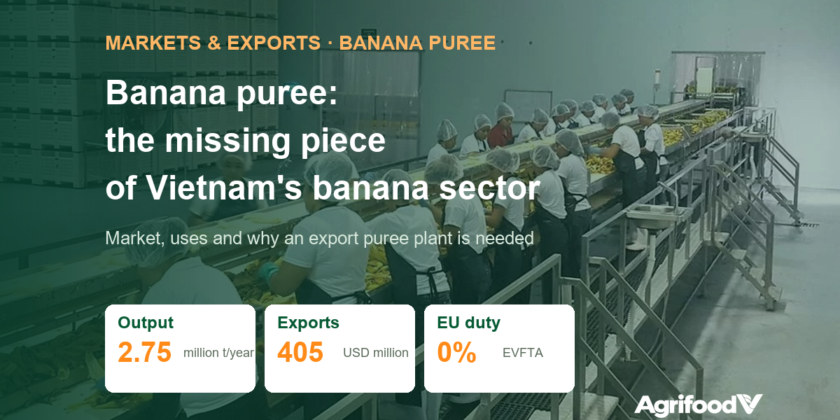
Vietnam grows about 2.75 million tonnes of bananas a year and its fresh banana exports are growing fast, yet almost all of the value still sits in fresh fruit sold to one main market. Meanwhile, Europe, the United States and Japan buy aseptic banana puree for juices, smoothies, yoghurt, ice cream, bakery and baby food, mainly from Latin America. This article brings together the data on banana puree: what the product is, where it is used, what the market looks like, the standards and tariffs, and why Vietnam needs an export banana puree plant. Key points Vietnamese bananas in 2025: about 163,000 ha and 2.75 million tonnes; exports of about USD 405 million, mostly fresh fruit. China bought 685,579 tonnes,…
Tìm hiểu thêm ...
Design brief: the first step in export processing plant design

Design brief: the first step in export processing plant design

The journey of building an export processing plant · Article 1/27 · Stage 1: The market decides the plant. See the full journey Many processing plant projects in Vietnam begin with a set of production-line quotations. The food factory design literature puts the first step somewhere else: a design brief that states clearly what the plant will make, which markets it will sell to, and where its raw material will come from and in what quantity. Without this brief, every drawing that follows may be technically correct yet aimed at the wrong target. This is the opening article of the journey of building an export processing plant. Key points The design brief is the source document for architects, engineers and…
Tìm hiểu thêm ...
Pineapple juice export from Vietnam: duties, standards and MD2 supply

Pineapple juice export from Vietnam: duties, standards and MD2 supply

Vietnam grows about 52,000 ha of pineapple, yet the MD2 variety, which holds 70–75% of the European pineapple market, accounts for less than 5% of that area. Meanwhile, import duties on pineapple juice vary sharply by product form: the same Vietnamese pineapple juice can face 40% or 0% in South Korea, and 23% or 4.6% in Japan. This article brings together the duties, standards and growing-area requirements for exported pineapple juice in seven markets, and explains why MD2 growing areas are the first condition. Key points For pineapple juice, the product form decides the duty rate. Concentrate has the edge over NFC in South Korea (0% versus 40%), Saudi Arabia (5% versus 10%) and the United States (concentrate of more…
Tìm hiểu thêm ...
Vietnam Passion Fruit Juice Exports: Tariffs, Standards, Growing Areas

Vietnam Passion Fruit Juice Exports: Tariffs, Standards, Growing Areas

Vietnam is currently the world's largest exporter of passion fruit pulp and concentrated passion fruit juice, according to CBI, the import promotion agency of the Netherlands Ministry of Foreign Affairs. The advantage is real, but each market sets different barriers: tariffs, minimum Brix, pesticide residues and, increasingly, questions about growing areas. This article brings those requirements together for six markets: the EU, the United States, China, the Middle East, Japan and South Korea. Key points Vietnamese passion fruit juice enters the EU, Japan, South Korea, China and the UAE duty-free (0%) under free trade agreements. The United States applies an additional 12.5% under Section 301 on top of the MFN duty from 24 July 2026; Saudi Arabia applies 5%. The…
Tìm hiểu thêm ...
Plot-level data: the foundation of export MD2 pineapple growing areas

Plot-level data: the foundation of export MD2 pineapple growing areas

An export MD2 pineapple growing area is not judged by the total output of the whole area, but by the questions that processing plants and importing countries ask of each shipment: which plot did this fruit come from, what planting material was used, what was sprayed, on what date was it harvested. Answering those questions requires data at the level of each field plot, not at farm level. Key points Moving from farm-level data to plot-level data changes four things: planning, cost tracking, pest management and harvesting. Under Resolution 36/2026/NQ-CP, growing-area codes are linked to land-parcel identification codes, and the data is connected to the Agricultural Product Traceability System of the Ministry of Agriculture and Environment. Decree 38/2026/ND-CP requires growing…
Tìm hiểu thêm ...
MD2 pineapple pests: why early detection decides crop protection costs

MD2 pineapple pests: why early detection decides crop protection costs

A pest outbreak detected early needs only one well-targeted treatment. Detect it a few days late and the population has already multiplied several times over, so the farm has to spray more often with broader-spectrum products. For export MD2 pineapple growing areas, more spraying also means a higher residue risk when the goods reach the border of the importing country. Key points Populations of many pest species grow exponentially in hot weather; a difference of a few days in detection decides the number of sprays. For pineapple, the threat to watch is the pink pineapple mealybug (Dysmicoccus brevipes), which transmits the virus behind mealybug wilt and is tended and spread by ants. According to the University of Florida, ant control…
Tìm hiểu thêm ...
MD2 pineapple cost per hectare: why the season-end figure is too late

MD2 pineapple cost per hectare: why the season-end figure is too late

Cost per hectare is the figure that decides whether an MD2 pineapple growing area makes money. Yet most farms only arrive at this figure once the season is over, pieced together from input purchase invoices and end-of-period spreadsheets. By then, every cost overrun is already a fact. Key points A true cost per hectare comprises four groups: inputs per application, labour and machinery, irrigation and energy, and management overheads allocated to each plot. The biggest error lies not in the calculation formula but in how data is recorded: recorded late, recorded from memory, inputs allocated by estimate. Recording data at the moment the work is done in the field makes cost per plot visible during the season, while there is…
Tìm hiểu thêm ...
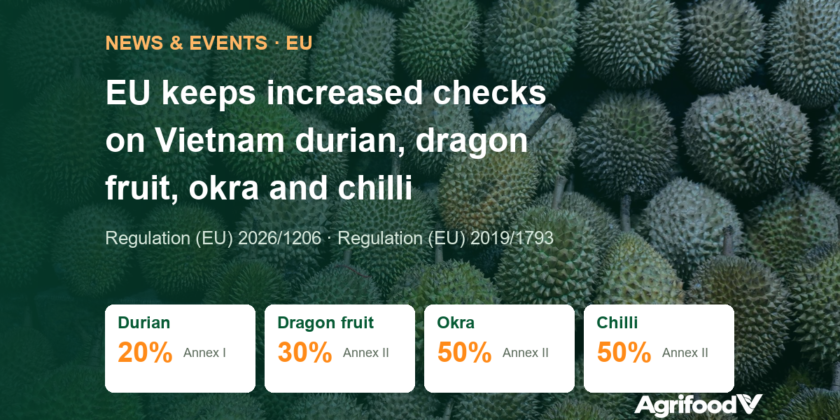
EU keeps increased controls on Vietnamese durian, dragon fruit, okra and chilli

EU keeps increased controls on Vietnamese durian, dragon fruit, okra and chilli

The European Union (EU) has kept increased controls unchanged on four Vietnamese fruit and vegetable products in the latest amendment to Implementing Regulation (EU) 2019/1793. Fresh durian is subject to physical checks on 20% of consignments; okra, dragon fruit and chilli peppers must be accompanied by an official certificate and pesticide residue analysis results for every consignment, and are checked at 30–50% of consignments at EU border control posts. Key points Latest act: Commission Implementing Regulation (EU) 2026/1206 of 9 June 2026, published in the Official Journal of the EU on 10 June 2026, entering into force on the twentieth day following publication. The Vietnamese entries are unchanged from the previous amendment (Implementing Regulation (EU) 2026/194 of 28 January 2026).…
Tìm hiểu thêm ...
Digital technology in MD2 pineapple growing areas: drones, sensors and data

Digital technology in MD2 pineapple growing areas: drones, sensors and data

Drones, sensors, satellite imagery and farm management software are often presented to MD2 pineapple growing areas as the answer to yield and cost. Scientific research on pineapple gives a more cautious picture: the technology can already measure many things with high accuracy, but no study has yet measured how much money it saves in a pineapple field. In Vietnam, drone use has been subject to a new legal framework since 2025–2026. This article separates clearly what has been proven, what has not, and the legal conditions. Key points Drones count inflorescences after flower induction with an error of about 6.4% in commercial fields, and detect ripe fruit to give a yield warning 2–3 months ahead. Drone spraying in pineapple fields…
Tìm hiểu thêm ...
MD2 pineapple export from Vietnam: open markets, standards and the way forward

MD2 pineapple export from Vietnam: open markets, standards and the way forward

The first question when considering MD2 pineapple exports is not price but whether fresh Vietnamese pineapple is permitted to enter the target market at all. As of October 2026, the official list kept by the Department of Crop Production and Plant Protection on importing countries' phytosanitary conditions does not include pineapple for any market. This article sets out which markets are open and which are not, the commercial quality standards for fresh fruit, and why processed pineapple is the more realistic route in the short term. Key points Fresh Vietnamese pineapple is not yet permitted into the United States, China or Australia. For Japan and South Korea there is no written confirmation, although trade data show some small shipments. The…
Tìm hiểu thêm ...