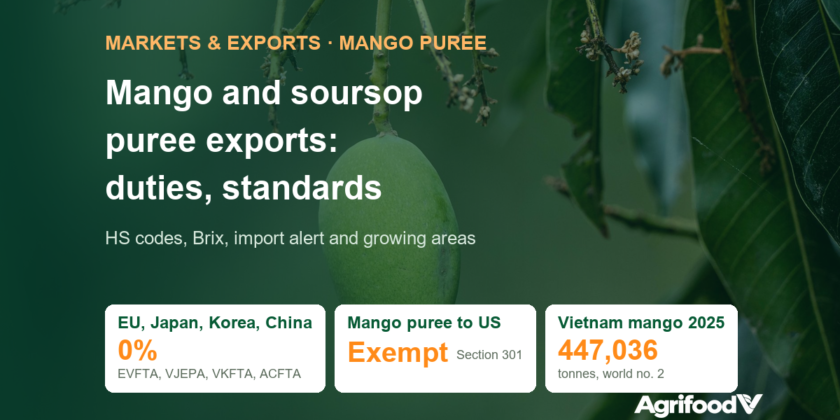
Vietnam Mango and Soursop Puree Exports: Tariffs, Standards and Growing Areas in 7 Markets

Vietnam Mango and Soursop Puree Exports: Tariffs, Standards and Growing Areas in 7 Markets

According to FAO, Vietnam exported about 447,000 tonnes of mango in 2025, ranking second in the world, but almost all of it was fresh fruit. In mango puree, where European buyers import 90,000–100,000 tonnes a year, there is no published figure for Vietnam. Soursop is smaller still and also faces an FDA import alert. This article sets out the HS codes, duties, standards and growing areas for both products in seven markets. Key points Vietnamese mango and soursop puree and juice enter the EU, Japan, Korea, China and the UAE at 0% when the right agreement is used. Saudi Arabia charges 10% on mango juice and 5% on puree. In the US, mango puree (2007.99.50) and prepared mango (2008.99.40) are…
Tìm hiểu thêm ...
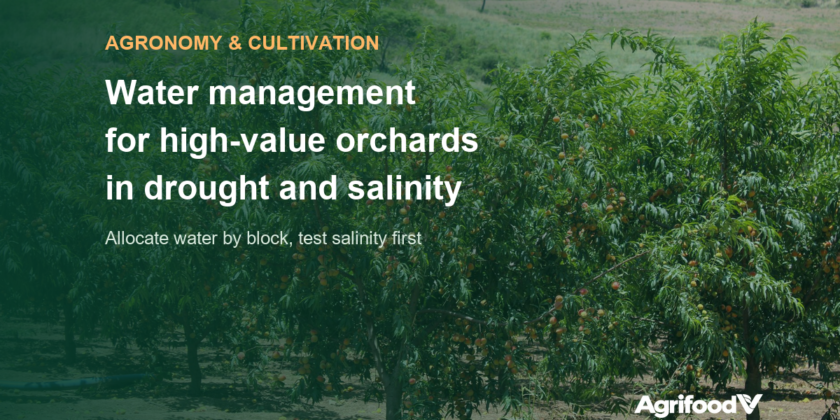
Dry-Season Water Management for High-Value Crops: Drought and Salinity in 2026–2027

Dry-Season Water Management for High-Value Crops: Drought and Salinity in 2026–2027

The Southern Institute for Water Resources Research forecasts that the 2026–2027 dry season in the Mekong Delta will be a low-water year. The 4 g/l salinity line is expected to reach 55–70 km inland on the Cuu Long river mouths in the first half of March 2027. For fruit orchards and raw-material growing areas, what matters is not only how much water can be stored, but which block gets it, when, and based on what data. Key points Average flow into the delta at Kratie for November 2026–January 2027 is forecast at about 4,712 m³/s, 24.7% below the long-term average. The Institute recommends completing water storage before November 2026. According to AGRIVI, farms that irrigate on one schedule for the…
Tìm hiểu thêm ...
China approves 401 Vietnamese durian growing areas in 14 August 2026 batch

China approves 401 Vietnamese durian growing areas in 14 August 2026 batch

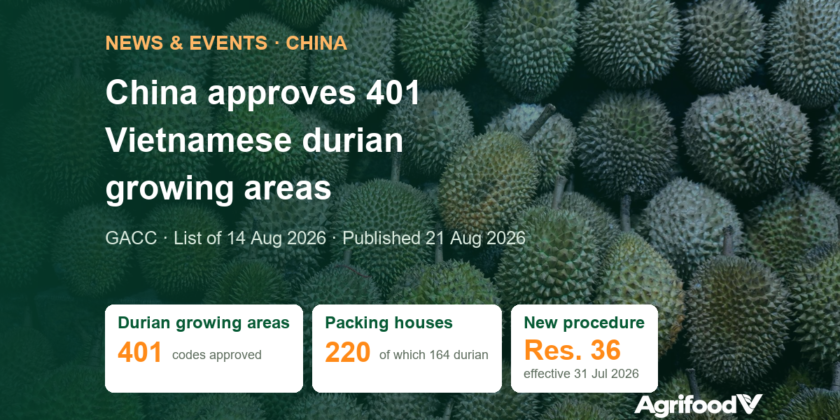
China's General Administration of Customs (GACC) approved on 14 August 2026 a batch of Vietnamese fresh-fruit growing-area codes and packing-house codes, including 401 durian growing areas. The list was published by Vietnam's Department of Crop Production and Plant Protection on 21 August 2026. Around the same time, the Government issued Resolution 36/2026/NQ-CP, moving the issuance of growing-area and packing-house codes to commune-level People's Committees and onto an online process. Key points The 14 August 2026 batch covers 407 growing areas (401 durian, 3 coconut, 3 chili) and 220 packing houses (164 durian, 37 jackfruit, 8 dragon fruit, 6 coconut and a few other fruits). Dak Lak and Lam Dong account for 226 of the 401 approved durian growing areas. Eight…
Tìm hiểu thêm ...
Vietnam Coconut Water Exports: Tariffs, Standards and Growing Areas in 7 Markets

Vietnam Coconut Water Exports: Tariffs, Standards and Growing Areas in 7 Markets

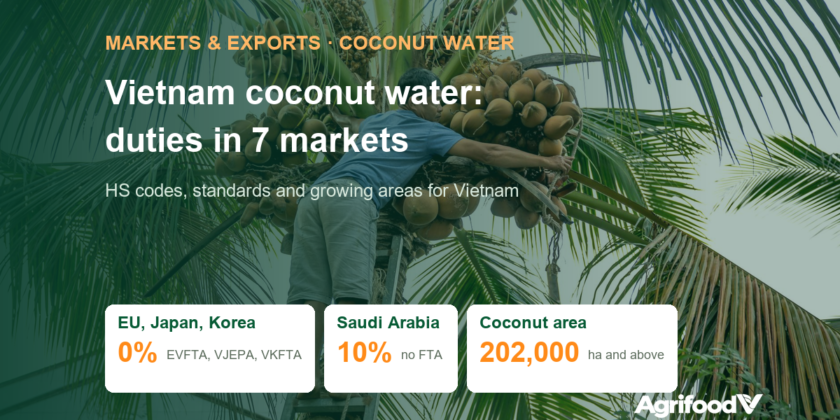
Vietnam has more than 202,000 ha of coconut, and in 2025 it was the second-largest supplier to the United States in the product group that contains coconut water, behind only Thailand. Yet coconut water has no international HS code of its own: each country splits the tariff lines differently, some with a dedicated line and some without, and the same drum of coconut water can face 0% duty in Korea but 10% in Saudi Arabia. This article brings together product codes, duties, standards and growing areas in seven markets. Key points Unsweetened coconut water from Vietnam enters the EU, Japan, Korea, China and the UAE at 0%, provided the right agreement is used. Saudi Arabia charges 10% and has no…
Tìm hiểu thêm ...
US releases pest risk analysis for fresh passion fruit from Vietnam

US releases pest risk analysis for fresh passion fruit from Vietnam

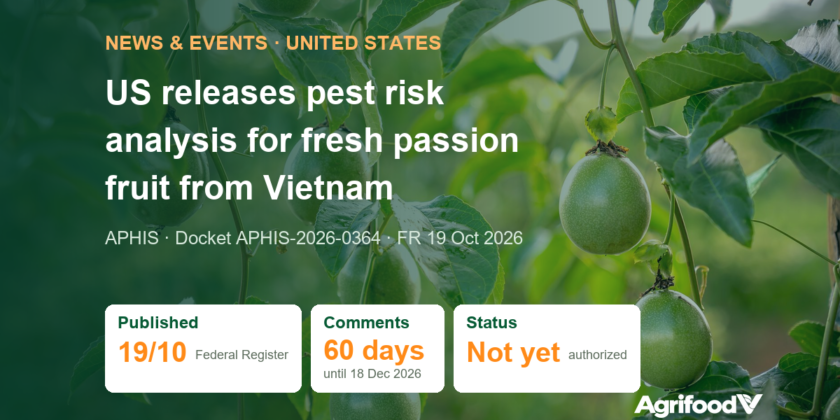
The US Animal and Plant Health Inspection Service (APHIS, part of the US Department of Agriculture) has released a pest risk analysis for fresh passion fruit (Passiflora edulis) imported from Viet Nam, published in the Federal Register on 19 October 2026. APHIS concludes that the pest risk can be mitigated by designated phytosanitary measures. This is a public comment stage that runs until 18 December 2026; fresh passion fruit from Viet Nam is not yet authorized for entry into the United States. Key points Document: APHIS notice, docket No. APHIS-2026-0364, Federal Register document 2026-21311 (91 FR 66072), signed on 14 October 2026 and published on 19 October 2026. Commodity: fresh Passiflora edulis passion fruit for consumption, originating in Viet Nam.…
Tìm hiểu thêm ...
Budget vs Actual by Block: Why Growing Areas See Cost Variances Too Late

Budget vs Actual by Block: Why Growing Areas See Cost Variances Too Late

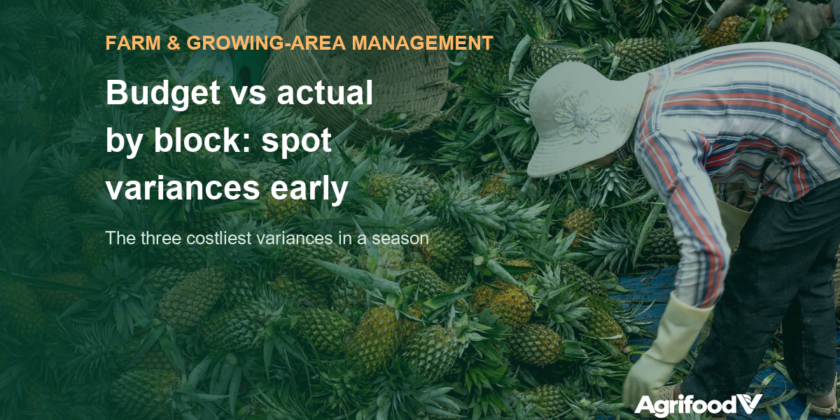
Every raw-material growing area draws up a cost plan at the start of the season. Most only find out how far they have drifted from it once the harvest is over. The delay is not caused by the complexity of farming, but by a plan-versus-actual comparison that runs monthly while conditions in the field change weekly. Key points The value of a budget-versus-actual report lies in when it reaches the manager. If it arrives early, there is still time to correct course; if it arrives late, it only serves as a lesson for next season. According to AGRIVI, the three most costly variances are input application rates that deviate from plan, unscheduled field passes, and labour overruns during peak periods.…
Tìm hiểu thêm ...
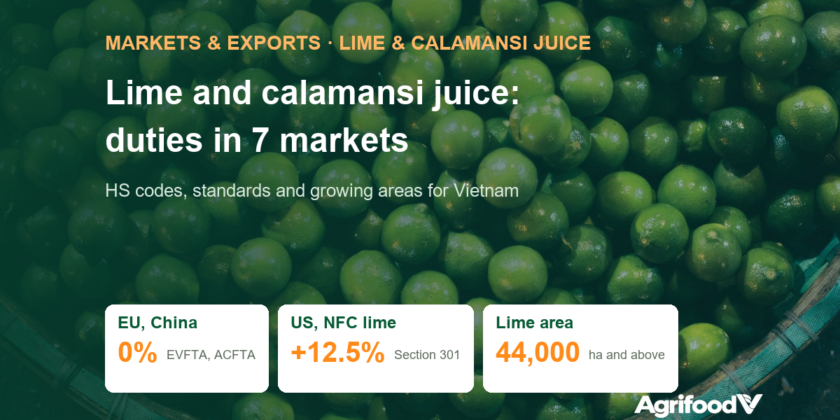
Vietnam Lime and Calamansi Juice Exports: Tariffs, Standards, Growing Areas

Vietnam Lime and Calamansi Juice Exports: Tariffs, Standards, Growing Areas

Vietnam has more than 44,000 ha of lime orchards and is already China's second-largest supplier of single citrus juice after the Philippines. But for seedless lime juice, key lime juice and calamansi juice, duties and standards do not follow one common rule: the same drum of lime juice can face anything from 0% to 15% depending on whether the HS code puts it on the "lemon" line or the "other citrus" line. This article sets out tariff lines, duties, standards and growing-area data for seven markets: the EU, the US, Japan, South Korea, China, the UAE and Saudi Arabia. Key points EU and China: 0% for both lime juice and calamansi juice under EVFTA and ACFTA. Japan is also 0%,…
Tìm hiểu thêm ...
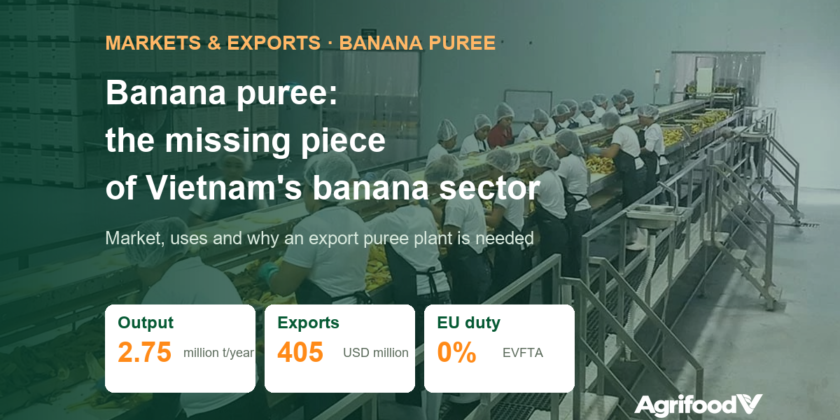
Banana puree: market, uses and why Vietnam needs an export plant

Banana puree: market, uses and why Vietnam needs an export plant

Vietnam grows about 2.75 million tonnes of bananas a year and its fresh banana exports are growing fast, yet almost all of the value still sits in fresh fruit sold to one main market. Meanwhile, Europe, the United States and Japan buy aseptic banana puree for juices, smoothies, yoghurt, ice cream, bakery and baby food, mainly from Latin America. This article brings together the data on banana puree: what the product is, where it is used, what the market looks like, the standards and tariffs, and why Vietnam needs an export banana puree plant. Key points Vietnamese bananas in 2025: about 163,000 ha and 2.75 million tonnes; exports of about USD 405 million, mostly fresh fruit. China bought 685,579 tonnes,…
Tìm hiểu thêm ...
Pineapple juice export from Vietnam: duties, standards and MD2 supply

Pineapple juice export from Vietnam: duties, standards and MD2 supply

Vietnam grows about 52,000 ha of pineapple, yet the MD2 variety, which holds 70–75% of the European pineapple market, accounts for less than 5% of that area. Meanwhile, import duties on pineapple juice vary sharply by product form: the same Vietnamese pineapple juice can face 40% or 0% in South Korea, and 23% or 4.6% in Japan. This article brings together the duties, standards and growing-area requirements for exported pineapple juice in seven markets, and explains why MD2 growing areas are the first condition. Key points For pineapple juice, the product form decides the duty rate. Concentrate has the edge over NFC in South Korea (0% versus 40%), Saudi Arabia (5% versus 10%) and the United States (concentrate of more…
Tìm hiểu thêm ...
Vietnam Passion Fruit Juice Exports: Tariffs, Standards, Growing Areas

Vietnam Passion Fruit Juice Exports: Tariffs, Standards, Growing Areas

Vietnam is currently the world's largest exporter of passion fruit pulp and concentrated passion fruit juice, according to CBI, the import promotion agency of the Netherlands Ministry of Foreign Affairs. The advantage is real, but each market sets different barriers: tariffs, minimum Brix, pesticide residues and, increasingly, questions about growing areas. This article brings those requirements together for six markets: the EU, the United States, China, the Middle East, Japan and South Korea. Key points Vietnamese passion fruit juice enters the EU, Japan, South Korea, China and the UAE duty-free (0%) under free trade agreements. The United States applies an additional 12.5% under Section 301 on top of the MFN duty from 24 July 2026; Saudi Arabia applies 5%. The…
Tìm hiểu thêm ...