AgrifoodV ·
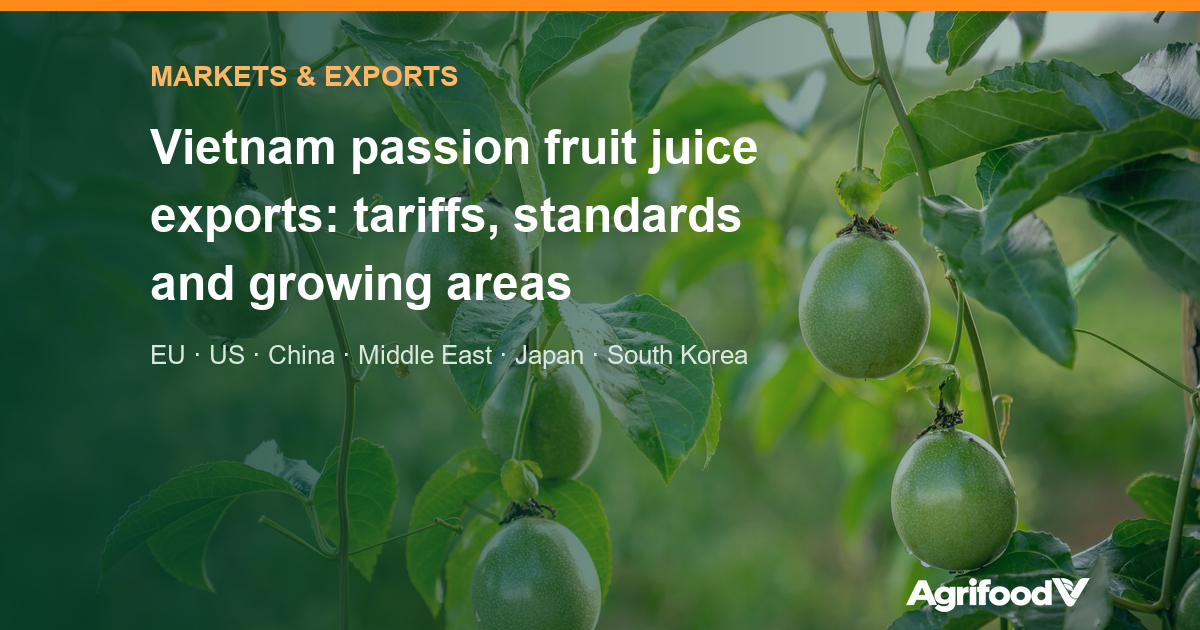
Vietnam is currently the world’s largest exporter of passion fruit pulp and concentrated passion fruit juice, according to CBI, the import promotion agency of the Netherlands Ministry of Foreign Affairs. The advantage is real, but each market sets different barriers: tariffs, minimum Brix, pesticide residues and, increasingly, questions about growing areas. This article brings those requirements together for six markets: the EU, the United States, China, the Middle East, Japan and South Korea.
Key points
- Vietnamese passion fruit juice enters the EU, Japan, South Korea, China and the UAE duty-free (0%) under free trade agreements. The United States applies an additional 12.5% under Section 301 on top of the MFN duty from 24 July 2026; Saudi Arabia applies 5%.
- The minimum Brix for reconstituted passion fruit juice differs: EU 12.0; US 14.0; Japan 14 (JAS), and under JAS a concentrate must reach at least 28°Bx to be called a concentrate.
- The biggest risk lies not in tariffs but in residues: South Korea recalled a lot of frozen Vietnamese passion fruit in March 2026; France recorded 15 of 47 Vietnamese passion fruit samples above the MRL in its 2024 data.
- Residues in the fruit pass straight into puree and concentrate. To hold on to markets, processing plants must exercise control from the growing area: growing-area codes, farm records and a pesticide list matched to the destination market.
Vietnam’s position in the passion fruit juice market
In its European passion fruit juice market report updated on 22 July 2026, CBI ranks Vietnam as the world’s largest exporter of passion fruit pulp and concentrate, and, together with Peru and Ecuador, one of the three main suppliers to Europe. Notable points from the report:
- Vietnam’s passion fruit juice exports to Europe in 2025 are estimated at around EUR 31.5 million. CBI notes that Vietnam’s 2025 figure is an indicative industry estimate, not verified statistics.
- Over 2021–2025, export volumes to Europe fell by an average of 2.3% per year, while value rose by 23.9%. In other words, growth came from price, not from volume.
- EU customs data (Eurostat) give a clearer picture: in 2025 the EU imported EUR 71.3 million (13,463 tonnes) of tropical fruit juice under code 2009 89 73 from Vietnam, accounting for 52.4% of extra-EU imports under this code. The code covers several tropical fruits, so the whole amount cannot be treated as passion fruit juice.
- The Netherlands accounts for 67% of Europe’s passion fruit juice imports and serves as the distribution gateway.
- At the end of 2025, 50°Bx concentrate from South America traded at around EUR 10,500/tonne (CFR Europe), Vietnamese concentrate at around EUR 9,700/tonne, and NFC passion fruit juice at around EUR 3,200/tonne (CFR).
At the industry level, according to Ministry of Industry and Trade data cited by Mekong ASEAN, passion fruit exports (including fresh fruit and processed products) in the first seven months of 2026 reached USD 186.8 million, up 25.6% year on year.
The gap of about EUR 800/tonne between Vietnamese and South American concentrate is room for higher prices, if companies can demonstrate consistent quality and clear growing-area records.
Import duties in six markets
Passion fruit juice without added sugar is usually declared under subheading 2009.89 (juice of any other single fruit). Detailed codes differ from country to country:
| Market | Tariff code | MFN duty | Duty on Vietnamese goods |
|---|---|---|---|
| EU | 2009 89 73 (value above EUR 30/100 kg, covering most concentrate and NFC); 2009 89 97 (lower value) | 10.5%; 11% | 0% (EVFTA, from 1 August 2020) |
| United States | 2009.89.70.99 (juice); 2008.99.80 (pulp, not frozen) | 0.5 cent/litre; 9.6% | MFN + 12.5% (Section 301, from 24 July 2026). Vietnam has no FTA with the United States. |
| Japan | 2009.89 | 19.1–25.5% (depending on sugar content) | 0% (VJEPA and CPTPP) |
| South Korea | 2009.89-1090 | 50% | 0% (VKFTA); AKFTA 40% |
| China | 2009.89.13 | 5% | 0% (ACFTA, C/O Form E); RCEP 10% |
| UAE | 2009 89 91 0002 / 0003 | 5% | 0% (Vietnam–UAE CEPA, in force from 3 February 2026) |
| Saudi Arabia | 2009.89 | 5% | 5% (Vietnam does not yet have an FTA with Saudi Arabia) |
Two points companies often overlook:
- United States: the Section 301 exclusion list includes pineapple juice concentrate and processed mango, but not passion fruit juice. Under line 2009.89.70, the exceptions apply only to coconut water and açaí. Unfrozen passion fruit pulp (2008.99.80) faces a combined 9.6% + 12.5%.
- China: RCEP (10%) is less favourable than ACFTA (0%) for passion fruit juice, so use C/O Form E.
- Preferences apply only with proof of origin under the correct agreement. For the UAE, goods transshipped through the UAE to other Gulf countries do not automatically qualify for CEPA treatment.
Quality and safety standards
| Market | Main requirements for passion fruit juice |
|---|---|
| EU | Directive 2001/112/EC (amended by 2012/12/EU): minimum Brix of reconstituted passion fruit juice 12.0; no sugar may be added to “fruit juice”; passion fruit nectar must contain at least 25% fruit. Residues under Regulation (EC) 396/2005. |
| United States | 21 CFR 101.30(h)(1): minimum reconstituted Brix 14.0. 21 CFR Part 120 (Juice HACCP) applies to both puree and concentrate; the HACCP plan must achieve at least a 5-log reduction of pathogenic microorganisms. |
| Japan | JAS 1075 (amended 2023): reconstituted passion fruit juice ≥14°Bx; concentrate must be ≥28°Bx. Residues under the positive list system, default limit 0.01 ppm. |
| South Korea | Foreign manufacturing facilities must register with MFDS before import. Residues under the PLS system, default limit 0.01 mg/kg. |
| China | Foreign manufacturers must register with the General Administration of Customs (GACC) under Decree 280, in force from 1 June 2026 (replacing Decree 248); already registered plants should review their files. Residues under standard GB 2763; Chinese-language labelling. |
| Middle East | Arabic-language labelling under GSO standards; buyers usually require Halal certification even for plant-based products. |
Because minimum Brix levels differ, the same lot of concentrate may meet EU requirements but fall short of a “100% juice” label in the United States or Japan after reconstitution. Brix, acidity and dilution ratio must be fixed for the destination market from the contract stage.
Pesticide residues: the real risk
Vietnamese passion fruit has not been placed on the EU list of increased official controls under Regulation 2019/1793 (consolidated version of 30 June 2026). From the start of 2024 to October 2026, the EU RASFF alert system also recorded no notifications on passion fruit of Vietnamese origin. Market surveillance signals, however, already exist:
- France: according to a February 2026 report by the French General Directorate for Food (DGAL) covering 2024 data, 15 of 47 samples of Vietnamese passion fruit exceeded maximum residue limits (32%), with omethoate detected. The information was issued by the Vietnam Trade Office in France and reported by VnEconomy on 23 March 2026.
- South Korea: on 28 March 2026, MFDS ordered a sales halt and recall of a lot of frozen passion fruit of Vietnamese origin (6,970 kg) for difenoconazole at 0.05 mg/kg, above the default limit of 0.01 mg/kg.
Two points need to be made clear. DGAL surveillance results are different from border rejections, so it cannot be said that “the EU has issued an alert on Vietnamese passion fruit”. And residues in processed products are calculated from residues in the fruit using processing factors (Article 20 of Regulation 396/2005), so a problem with fresh fruit is also a problem for puree and concentrate.
Growing areas: from China’s requirements to EU buyers’ questions
China. The phytosanitary protocol for fresh passion fruit exported to China was signed by the Ministry of Agriculture and Environment and GACC on 14–15 April 2025 and requires growing-area codes and packing-house codes. The protocol applies only to fresh fruit, not to juice or puree. In Gia Lai, by December 2025 there were 48 passion fruit growing-area codes (more than 1,150 ha) and 6 packing houses eligible for export.
Domestic legal framework. Decree 38/2026/ND-CP (24 January 2026) regulates growing-area codes and requires farm records to be kept and maintained (Article 6). Resolution 36/2026/NQ-CP (31 July 2026) simplifies the procedure: applications are submitted to commune-level People’s Committees via the National Public Service Portal, and growing-area codes are linked to land-parcel identification codes and the traceability system of the Ministry of Agriculture and Environment.
EU buyers. CBI expects suppliers with good traceability, climate risk management and a clear sustainability story to have an advantage; buyers will ask more about support for smallholders, irrigation and farming practices. CBI also notes that passion fruit has a 3–4 year supply cycle, so spreading growing areas and coordinating through cooperatives helps reduce raw-material risk.
Area and yield. According to the Department of Crop Production and Plant Protection (cited by Nhan Dan newspaper on 18 September 2025), Vietnam had about 10,400 ha of passion fruit in 2024, with output of 163,400 tonnes; the Central Highlands account for 86.4% of the area. According to the Agriculture and Environment newspaper (July 2024), the national average passion fruit yield is about 20.3 tonnes/ha and 26.1 tonnes/ha in the Central Highlands, while the potential in the Central Highlands is 50–60 tonnes/ha. There are currently 43 passion fruit varieties approved for circulation (Dai Bieu Nhan Dan, December 2025).
What companies should do
AgrifoodV recommendations:
- Choose the market first, then fix the product specifications: Brix, acidity, NFC or concentrate, with or without added sugar. Each market has different thresholds.
- For the United States, build the full Section 301 duty into the offer price; for China, use C/O Form E rather than RCEP; for the UAE, prepare CEPA proof-of-origin documents and request an advance tariff classification ruling if the product is a blend.
- Draw up a list of pesticides permitted for each destination market (EU, Japan, South Korea), distribute it to farmers and test raw material for residues before it enters the warehouse, rather than waiting to test the finished product.
- Link the processing plant to coded growing areas with lot-by-lot electronic farm records. This is both a legal requirement and the answer EU buyers are looking for.
AgrifoodV supports companies with market analysis and import requirements, processing plant planning and organising coded raw-material growing areas with traceability.
References
- CBI (Netherlands Ministry of Foreign Affairs). Entering the European market for passion fruit juice, updated 22 July 2026. cbi.eu.
- Eurostat. Comext, extra-EU imports under CN code 2009 89 73, 2025, partner Vietnam (API query of 17 October 2026). ec.europa.eu/eurostat.
- European Commission. TARIC, code 2009 89 97 90, origin Vietnam. ec.europa.eu/taxation_customs.
- USITC. Harmonized Tariff Schedule of the United States, lines 2009.89.70 and 2008.99.80. hts.usitc.gov.
- USTR. Notice of action under Section 301 on goods from Vietnam (heading 9903.05.84), Federal Register doc. 2026-15181, published 28 July 2026; notice released 23 July 2026. ustr.gov.
- Japan Customs. Customs tariff schedule, Chapter 20 (version of 8 August 2026). customs.go.jp.
- Korea Customs Service. FTA portal, tariff rate search. customs.go.kr.
- Customs Tariff Commission of the State Council of China. 2026 import and export tariff schedule, issued with Announcement No. 12/2025 (31 December 2025), line 2009.8913. gss.mof.gov.cn.
- Dubai Customs. Notice No. 01/2026 (30 January 2026) on the entry into force of the Vietnam–UAE CEPA. dubaicustoms.gov.ae. UAE Ministry of Economy, CEPA tariff preference schedule for goods of Vietnamese origin: tradestatfta.moec.gov.ae.
- Zakat, Tax and Customs Authority of Saudi Arabia (ZATCA). Integrated tariff, heading 20.09. eservices.zatca.gov.sa.
- Council of the EU. Directive 2001/112/EC relating to fruit juices and certain similar products, amended by Directive 2012/12/EU. eur-lex.europa.eu.
- eCFR. 21 CFR 101.30 and 21 CFR Part 120. 101.30; Part 120.
- Ministry of Agriculture, Forestry and Fisheries of Japan (MAFF). JAS standard for fruit juice beverages, JAS 1075. maff.go.jp.
- Ministry of Food and Drug Safety of Korea (MFDS). Registration of foreign food facilities. mfds.go.kr. News on the recall of a frozen passion fruit lot on 28 March 2026: medipharmhealth.co.kr.
- European Commission. Implementing Regulation (EU) 2019/1793, consolidated version of 30 June 2026. eur-lex.europa.eu.
- VnEconomy. Chanh leo, thanh long Việt Nam đối diện nguy cơ bị EU siết chặt kiểm soát [Vietnamese passion fruit and dragon fruit face the risk of tighter EU controls], 23 March 2026. vneconomy.vn.
- Department of Crop Production and Plant Protection. Signing of the protocol on phytosanitary requirements for fresh passion fruit and chilli exported from Vietnam to China. ppd.gov.vn.
- Government of Vietnam. Decree 38/2026/ND-CP of 24 January 2026 and Resolution 36/2026/NQ-CP of 31 July 2026. ppd.gov.vn; datafiles.chinhphu.vn.
- Nhan Dan. Phát triển bền vững cây chanh leo [Sustainable development of passion fruit], 18 September 2025. nhandan.vn.
- Singapore Food Agency (SFA). Circular on China’s revised registration requirements for overseas food manufacturers (GACC Decree No. 280). sfa.gov.sg.
- Van Hoa newspaper. Gia Lai định hướng phát triển bền vững cho ngành hàng chanh leo [Gia Lai sets a sustainable development direction for the passion fruit sector], 12 December 2025. baovanhoa.vn.
- Dai Bieu Nhan Dan. Liên kết chuỗi giá trị để nâng tầm ngành chanh leo [Value chain linkages to upgrade the passion fruit sector], 14 December 2025. daibieunhandan.vn.
- Mekong ASEAN. Xuất khẩu rau quả 8 tháng đầu năm 2026 đạt gần 6 tỷ USD [Fruit and vegetable exports in the first eight months of 2026 reach nearly USD 6 billion], 1 September 2026. mekongasean.vn.
Article by AgrifoodV, compiled from the sources above (accessed 17 October 2026). Tariff rates and regulations may change; companies should re-check current tariff schedules and legal texts before signing contracts. This content is not a substitute for legal advice. Cover image: Quang Nguyen Vinh / Pexels.
Looking at Vietnam as a sourcing origin or a place to build a value chain?
Tell us your product, target market and expected volumes. In a 30–45 minute online call, AgrifoodV reviews buyers, standards, processing capacity and growing areas with you, starting from the market.
Book a call →Contact us© 2026 AgrifoodV. Nội dung được phép trích dẫn khi ghi rõ nguồn và đặt liên kết tới bài gốc; không sao chép toàn văn. Xem Điều khoản sử dụng nội dung.