Vietnam grows about 2.75 million tonnes of bananas a year and its fresh banana exports are growing fast, yet almost all of the value still sits in fresh fruit sold to one main market. Meanwhile, Europe, the United States and Japan buy aseptic banana puree for juices, smoothies, yoghurt, ice cream, bakery and baby food, mainly from Latin America. This article brings together the data on banana puree: what the product is, where it is used, what the market looks like, the standards and tariffs, and why Vietnam needs an export banana puree plant.
Key points
- Vietnamese bananas in 2025: about 163,000 ha and 2.75 million tonnes; exports of about USD 405 million, mostly fresh fruit. China bought 685,579 tonnes, at an average unit value of about USD 407/tonne according to FAO.
- Banana puree has no HS code of its own. CBI estimates the European banana pulp market at about 50,000 tonnes in 2024, led by Costa Rica, Guatemala and Ecuador.
- In the EU, Vietnamese banana puree enters at 0% duty under the EVFTA (MFN duty 18.4%). In the US, Vietnam pays 3.4% while Colombia, Peru and Central America are exempt.
- Per tonne, standard banana puree is no more expensive than fresh bananas. A puree plant is sustainable only if it uses fruit rejected from the fresh-export stream as raw material, or sells premium lines such as organic and baby food.
Vietnamese bananas: big in fresh fruit, thin in processing
According to the Department of Crop Production and Plant Protection, by 2025 Vietnam’s banana area was estimated at more than 163,000 ha, with output of about 2.75 million tonnes. The plan to 2030 targets 165,000–175,000 ha.
- Export value: about USD 372–378 million in 2024 (sources differ). About USD 405 million in 2025, up 6.6%, according to data from Doanh nghiep va Tiep thi magazine republished by the Center for WTO and International Trade. The first seven months of 2026 reached more than USD 222.6 million; China accounted for 66.7%, South Korea 16.7% and Japan 8.8%.
- Export volume: FAO puts Vietnam’s banana exports in 2025 at about 500,000 tonnes, up 25%.
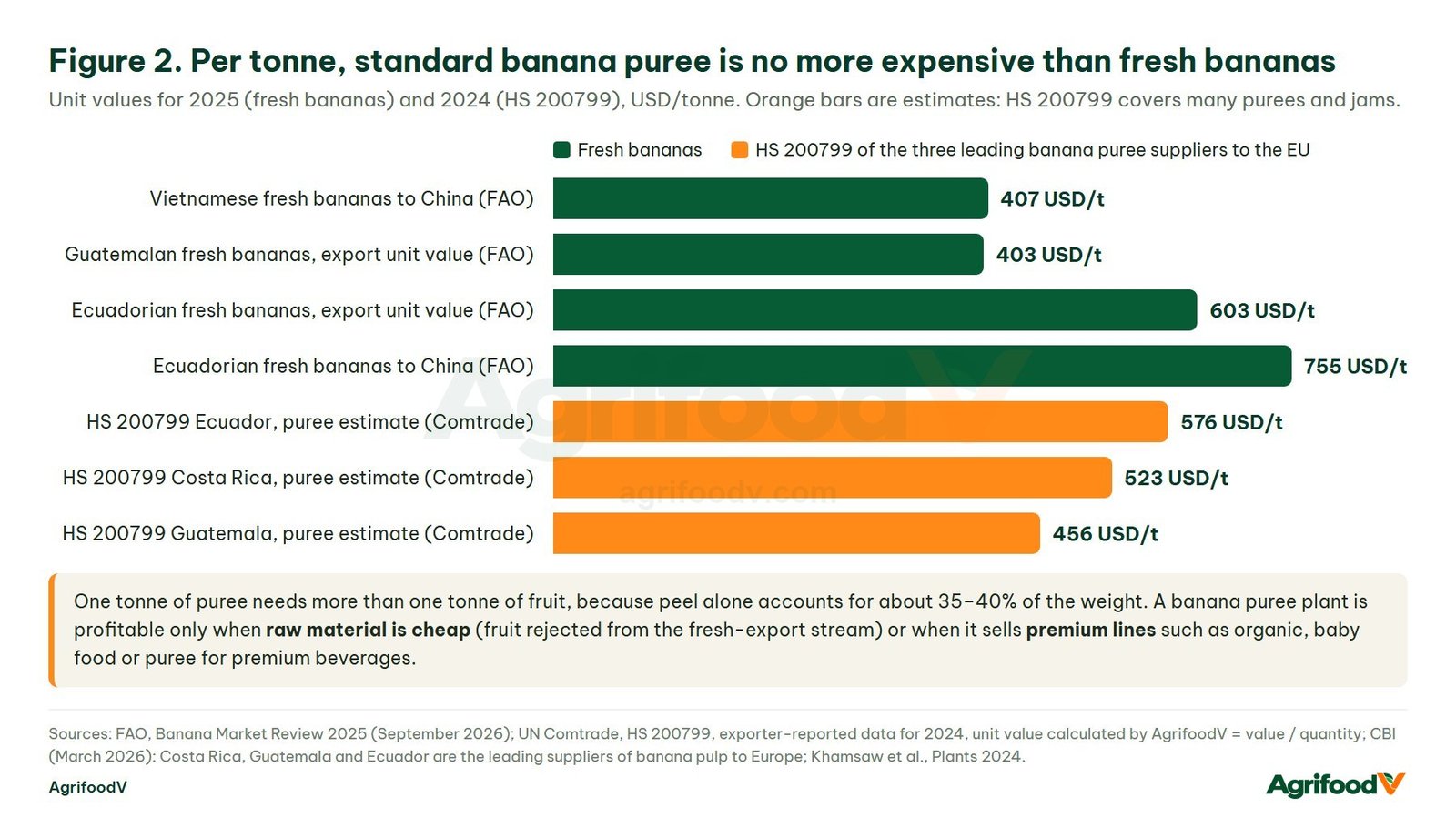
- Dependence on one market: China’s import data on UN Comtrade show that in 2025 it imported 685,579 tonnes of bananas from Vietnam, about 35% of its total banana imports. FAO ranks Vietnam as the largest supplier to China in 2025, but at an average unit value of only USD 407/tonne, compared with USD 755/tonne for Ecuadorian bananas.
- Processing: according to the Vice Chairman of the Vietnam Fruit and Vegetables Association, more than 70% of Vietnam’s fruit and vegetable products are still exported fresh, and deep processing capacity remains limited. For bananas specifically, the local press reports that “the rate of deep processing is still low”, and processed products such as dried bananas remain small in scale.
We have not found any public source reporting an export-scale aseptic banana puree plant in operation in Vietnam. This is a gap in the banana value chain.
What banana puree is and how it is made
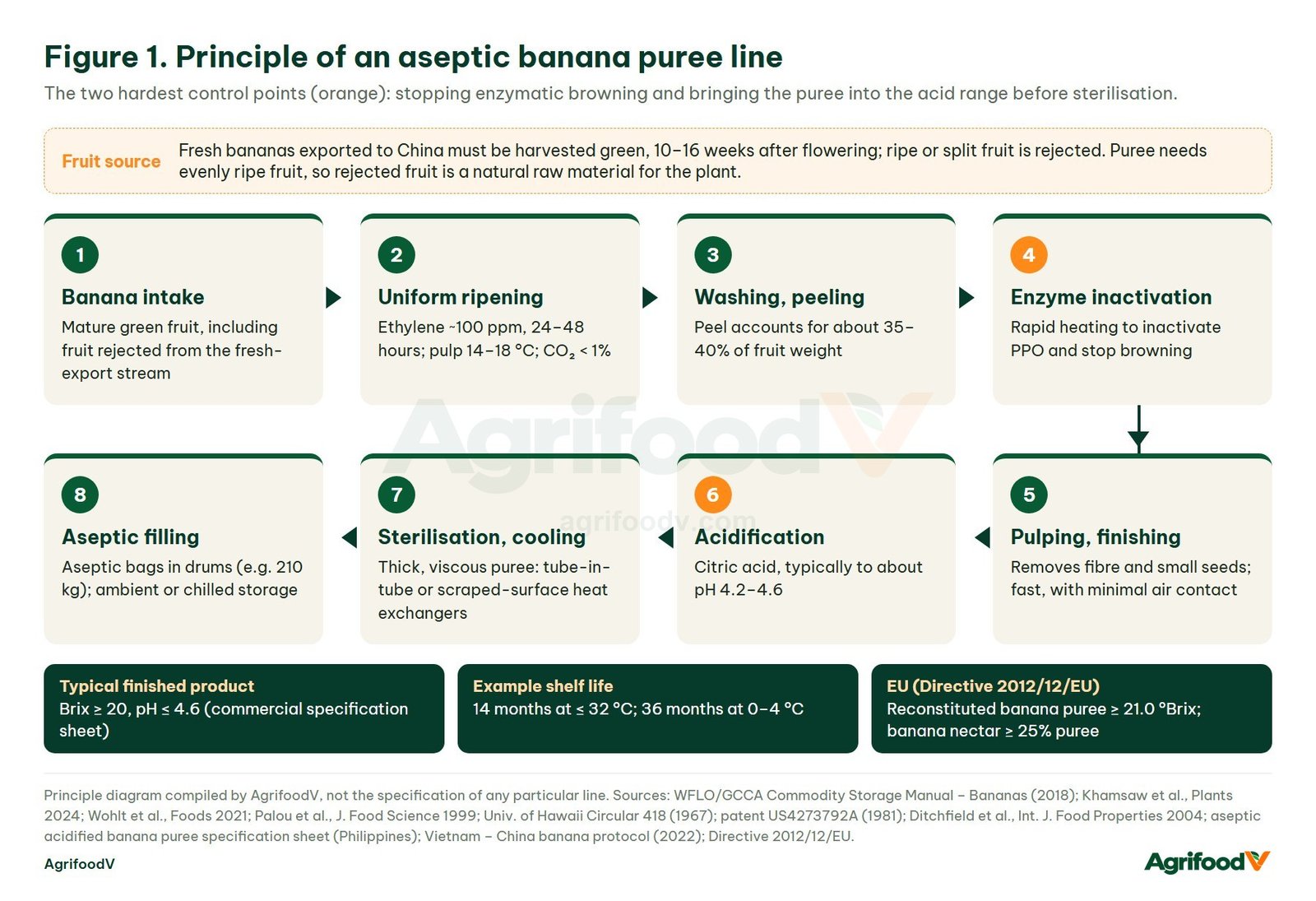
Banana puree is the flesh of ripe bananas finely ground, unfermented and undiluted. The most common export product is aseptic acidified banana puree: the puree is adjusted to a target pH with citric acid, sterilised and then filled into aseptic bags placed in steel drums. A commercial specification sheet from a producer in the Philippines states a minimum Brix of 20, a maximum pH of 4.6 and 210 kg drums. Shelf life is 14 months at ambient temperature up to 32 °C, 30 months at 15–24 °C, or 36 months when chilled at 0–4 °C.
Bananas are harder to turn into puree than many other fruits, for three reasons:
- Very fast browning. The polyphenol oxidase (PPO) enzyme in bananas reacts with phenolic compounds on contact with air. A 1999 study showed that it took 7 minutes of blanching followed by high-pressure processing at 689 MPa for 10 minutes to bring residual PPO activity in the puree below 5%. A 2025 study in Food Chemistry confirmed that banana puree browns easily and loses aroma during processing itself.
- Bananas are low in acid. For safe sterilisation and colour retention, the puree is usually acidified to around pH 4.2–4.6: a 1967 University of Hawaii publication used pH 4.2, a 1981 US patent used pH 4.5, and the commercial specification sheet states a maximum of 4.6.
- Thick, viscous puree. The viscosity of banana puree changes anomalously at 50–60 °C and 110–120 °C. The heating step therefore needs heat exchangers suited to thick products, such as tube-in-tube or scraped-surface types.
The fruit must be evenly ripe before processing. The cold storage industry’s banana storage manual recommends ripening with ethylene at around 100 ppm for 24–48 hours, with pulp temperature at 14–18 °C and CO₂ kept below 1%. Peel accounts for about 35–40% of fruit weight, so each tonne of puree needs more than one tonne of fresh bananas.
Where banana puree is used
- Juices, nectars and smoothies. CBI explains that bananas and mangoes are mainly processed into puree rather than juice, because of the fruit’s cell structure. The puree is usually blended with other juices because on its own it is “too thick to drink”. Industrial smoothie makers often blend mango and pineapple puree with banana puree to build body.
- Baby food, bakery, ice cream. A 1981 banana processing patent from a US baby food company cites banana puree for the bakery, ice cream and baby food industries. This is the segment with the strictest residue and microbiological requirements, and also the one that pays the highest prices.
- Yoghurt and fermented products. Probiotic yoghurt with 7.5% banana reached pH 4.4–4.5 after 24 hours, faster than the control sample at 32 hours. Banana puree has also been studied as a fermentation base for probiotic products.
- Clinical nutrition. A 2024 study used banana puree as a thickener for milk for children with swallowing difficulties, recommending a limit of 15% of meal volume because of its potassium content.
- Clarified banana juice. Puree can be treated with pectinase enzymes to obtain clear banana juice. A 2025 study on Vietnamese banana puree achieved a juice yield of 54.78%, clarity of 98.11% and 28.9 °Brix.
The world banana puree market
Global fresh banana trade in 2025 reached about 21.7 million tonnes, up 10%, according to FAO. Ecuador led with about 6.5 million tonnes, followed by the Philippines, Colombia, Guatemala and Costa Rica. Vietnam exported about 500,000 tonnes.
Banana puree is harder to measure: CBI lists banana pulp as one of two products with growing demand but no official statistical code. What can be said with confidence:
- CBI estimates the European banana pulp market at about 50,000 tonnes in 2024, with Costa Rica, Guatemala and Ecuador as the leading suppliers.
- Ecuador and Costa Rica are among the leading suppliers of organic banana pulp to Europe. CBI considers banana pulp a beverage ingredient that offers good opportunities in Germany for suppliers from developing countries.
- Using HS 200799 (other fruit purees and jams) as an indirect measure, in 2024 Ecuador exported about 84,945 tonnes, Costa Rica 52,832 tonnes and Guatemala 46,558 tonnes. This code covers many products, so these are only estimates. Ecuador’s main markets under this code are the United States, the Netherlands, Latvia and Spain.
The most important point is price. Per tonne, the HS 200799 unit value of these three countries is only about USD 456–576/tonne, on a par with fresh bananas. In other words, standard banana puree is a high-volume, thin-margin commodity.
Standards and import duties
| Market | Tariff code | MFN duty | Duty on Vietnamese goods |
|---|---|---|---|
| EU | 2008 99 99 90 (puree, not cooked, no added sugar); heading 2007 if the puree is “cooked” | 18.4% (2008 99 99 90) | 0% (EVFTA, from 1 August 2020) |
| US | 2008.99.13.00 “Bananas: Pulp” | 3.4% | 3.4%, excluding additional duties (Colombia, Peru, Panama, Central America: 0%) |
- EU classification: aseptic puree may be classified under heading 2008 or 2007, depending on how customs interprets the heating step. Companies should apply for Binding Tariff Information (BTI) before quoting. Whichever heading applies, Vietnamese goods still enjoy 0% under the EVFTA.
- Minimum Brix: Codex (CXS 247-2005) sets no Brix level for bananas, noting “no data available”. The EU sets a minimum of 21.0 °Brix for reconstituted banana puree, measured as Brix not corrected for acid (Directive 2012/12/EU amending Directive 2001/112/EC).
- Banana nectar: both Codex and the EU require a minimum of 25% juice or puree in the finished product.
- In the US, Vietnam faces higher duties than Latin American competitors with trade agreements. The EU and Asia are therefore more logical destinations for a new plant.
Why Vietnam needs an export banana puree plant
- The raw material already exists, and is being wasted. The protocol with China requires bananas to be harvested green, 10–16 weeks after flowering; ripe or split fruit cannot be exported. Puree, by contrast, needs exactly that: evenly ripe fruit. A scientific review estimates that 30–40% of global banana output is rejected for failing quality standards. With 2.75 million tonnes a year, Vietnam’s rejected fruit is a large, cheap source of raw material for a puree plant.
- Less dependence on one fresh-fruit market. Two-thirds of banana export value goes to China, at the lowest unit value of any supplier. Aseptic puree keeps for 14–36 months and ships in standard containers, opening up the EU, Japan, South Korea and the Middle East.
- A tariff advantage in the EU. The EU’s 18.4% MFN duty falls to 0% for Vietnamese goods. Vietnam stands on a par with Latin American suppliers that have agreements, and has an advantage over sources without one.
- Extending an existing value chain. Vietnam’s banana sector already has large-scale growing areas, growing-area codes and packing facilities registered for fresh export. A puree plant can use that same infrastructure instead of building raw-material growing areas from scratch.
But output alone is not enough. Because standard puree is no more expensive than fresh fruit per tonne, a banana puree plant is sustainable only if it can answer three questions before choosing the machines:
- Who is the buyer, and in which segment? Standard puree for beverages, or organic and baby food puree with stricter residue and microbiological requirements and higher prices.
- What does raw material cost, and how stable is supply? Purchase contracts for rejected fruit from packing facilities, together with growing areas whose farm records meet the target market’s list of permitted plant protection products.
- Which technology preserves colour and aroma? Ripening, enzyme inactivation, acidification, sterilisation and aseptic filling must be designed for the specific properties of bananas and for the real operating capacity.
What companies should do
- Start with the buyer: obtain the technical specifications (Brix, pH, viscosity, colour, microbiology, residues, packaging) from target customers in the EU or Asia before designing the plant.
- Confirm the HS code and duties: apply for BTI in the EU; check duties in Japan and South Korea, and any additional US duties, at the time of quoting.
- Run the economics with real raw-material prices: the price of rejected fruit, pulp yield and losses at each step, compared with puree prices by segment.
- Design the plant by market-back planning: market → processing plant → raw-material growing areas. See also the roadmap of 27 decisions in The journey to an export processing plant and the article on passion fruit juice exports to 6 markets.
Considering a banana puree project?
AgrifoodV works with companies and investors from market selection and product specifications through plant design to organising raw-material growing areas. Contact us or write to contact@agrifoodv.com.
References
- Nong nghiep va Moi truong (Agriculture and Environment) newspaper. Phòng trừ bệnh héo vàng, nâng cao giá trị tổng thể của cây chuối [Controlling banana Fusarium wilt and raising the overall value of the banana crop], 17 December 2025. nongnghiepmoitruong.vn.
- VietnamPlus. Vietnam aims for 1 billion USD in banana exports, 13 December 2025. en.vietnamplus.vn.
- Center for WTO and International Trade (VCCI), republished from Doanh nghiep va Tiep thi magazine. Xuất khẩu dừa lần đầu tiên mang về doanh thu hơn nửa tỷ USD [Coconut exports earn more than half a billion USD for the first time], 26 January 2026. trungtamwto.vn.
- Agriculture and Environment Information and Services Centre. Báo cáo thị trường ngành hàng rau quả Quý II/2025 [Fruit and vegetable market report, Q2 2025]. agro.gov.vn.
- Thanh Tra newspaper. Sau “trái cây vua”, bất ngờ với loại quả đứng thứ 2 về kim ngạch xuất khẩu [After the “king of fruits”, a surprise in the fruit ranked second by export value], 19 August 2026. thanhtra.com.vn.
- FAO. Banana Market Review 2025, September 2026. openknowledge.fao.org.
- UN Comtrade. Import data for HS 080390 in 2025 (China, South Korea, Japan) and export data for HS 200799 in 2024. comtradeplus.un.org.
- VOV. Trung Quốc chính thức nhập khẩu chuối tươi từ Việt Nam [China officially imports fresh bananas from Vietnam], 2 November 2022. vov.vn.
- Nong nghiep va Moi truong (Agriculture and Environment) newspaper. Sản phẩm chế biến chiếm thị phần cao trong xuất khẩu rau quả [Processed products take a high share of fruit and vegetable exports], 3 June 2026. nongnghiepmoitruong.vn.
- Gia Lai newspaper. Nâng cao giá trị, mở rộng thị trường xuất khẩu chuối [Raising value and expanding export markets for bananas], 20 July 2026. baogialai.com.vn.
- Nhan Dan. Tăng giá trị cho sản phẩm chuối [Adding value to banana products], 10 January 2026. nhandan.vn.
- CBI. What is the demand for processed fruit and vegetables on the European market?, 26 March 2026. cbi.eu.
- CBI. The European market potential for citrus and tropical juices, 26 March 2025. cbi.eu.
- CBI. Entering the European market for tropical frozen fruit, 30 January 2024. cbi.eu.
- Codex Alimentarius. CXS 247-2005 General Standard for Fruit Juices and Nectars. fao.org.
- Directive 2012/12/EU amending Directive 2001/112/EC relating to fruit juices, Annexes IV and V. eur-lex.europa.eu.
- European Commission. TARIC, code 2008 99 99 90, origin Vietnam, reference date 18 October 2026. ec.europa.eu.
- USITC. Harmonized Tariff Schedule, 2008.99.13.00. hts.usitc.gov.
- Wohlt et al. Foods 10(5):1022, 2021. doi.org/10.3390/foods10051022.
- Palou, López-Malo, Barbosa-Cánovas, Welti-Chanes, Swanson. Journal of Food Science 64(1):42–45, 1999. doi.org.
- Chen et al. Food Chemistry 479:143783, 2025. doi.org.
- Ditchfield, Tadini, Singh, Toledo. International Journal of Food Properties, 2004. doi.org.
- University of Hawaii Cooperative Extension Service. Circular 418: Banana Puree, 1967. scholarspace.manoa.hawaii.edu.
- US patent US4273792A, Banana processing, 1981. patents.google.com.
- WFLO / Global Cold Chain Alliance. Commodity Storage Manual: Bananas, 2018. gcca.org.
- Khamsaw et al. Plants 13(5):593, 2024. doi.org.
- Specification sheet for aseptic acidified banana puree (origin: Philippines), distributor page 12Taste. 12taste.com.
- Muzira Mukisa & Birungi. Journal of Microbiology, Biotechnology and Food Sciences 7(4):343–347, 2018. doi.org.
- Gallo et al. Applied Sciences 11(11):5153, 2021. doi.org.
- Brinker et al. Nutrition in Clinical Practice, 2024. doi.org.
- Lee, Yusof, Hamid, Baharin. Journal of Food Engineering 73:55–63, 2006. doi.org.
- Industrial Biotechnology, 2025 (Vietnamese banana puree). doi.org.
- Hikal et al. Evidence-Based Complementary and Alternative Medicine, 2022. doi.org.
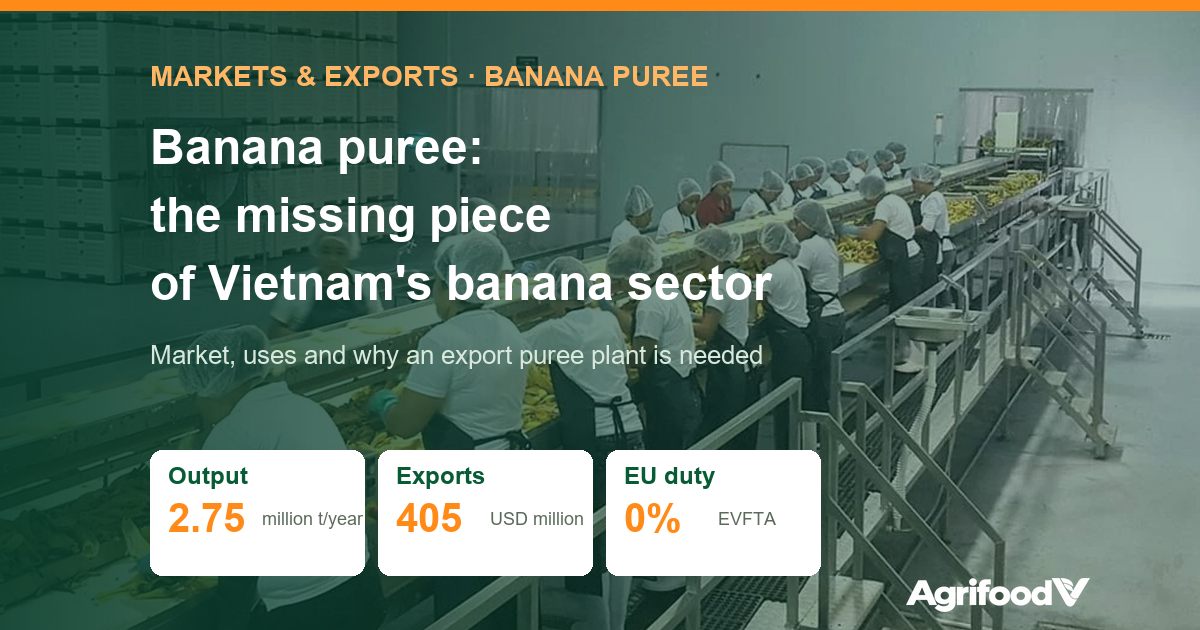
Article by AgrifoodV, compiled from the sources above (accessed 18 October 2026). Export figures published by different sources may differ; the HS 200799 unit values are estimates calculated by AgrifoodV from UN Comtrade. Tariff rates and regulations may change; companies should re-check the current tariff schedules and regulations before signing contracts. This content is not a substitute for legal advice or a feasibility study. Cover image: banana preparation line in a puree plant (illustrative).
© 2026 AgrifoodV. Nội dung được phép trích dẫn khi ghi rõ nguồn và đặt liên kết tới bài gốc; không sao chép toàn văn. Xem Điều khoản sử dụng nội dung.