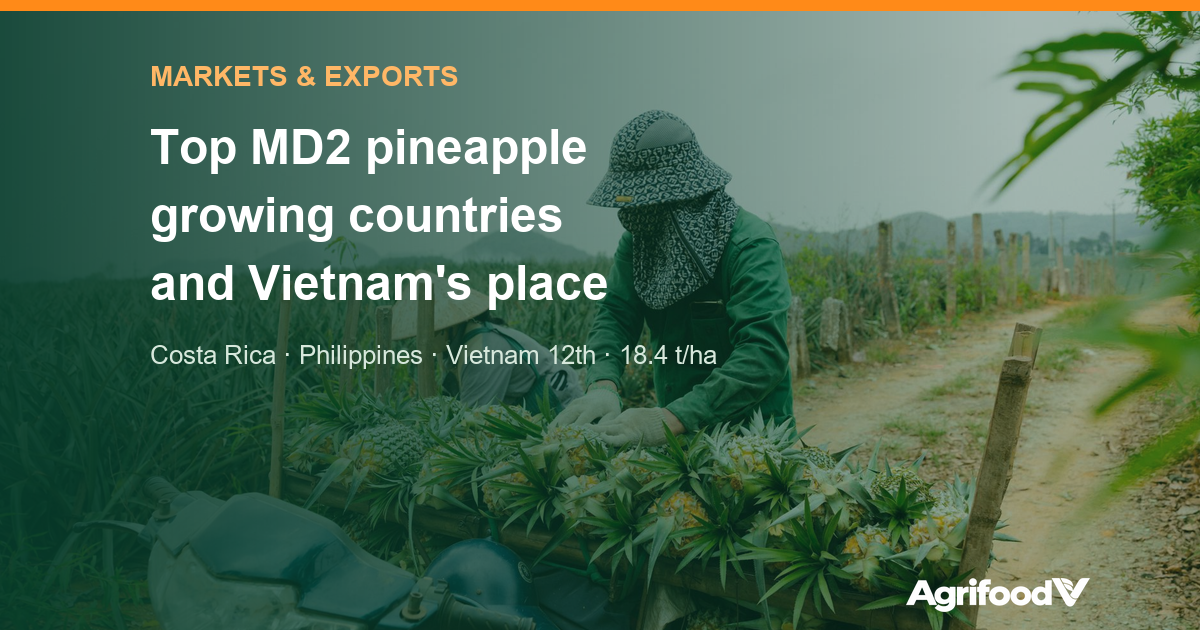
Vietnam is the world’s 12th-largest pineapple producer according to FAOSTAT, yet it does not appear in FAO’s table of pineapple exporting countries. The gap lies in yield, in variety (MD2 accounts for less than 5% of planted area), and in the fact that Vietnamese fresh pineapple has not yet gained access to the major markets. This article places Vietnam alongside the leading pineapple producing and exporting countries, mostly growing MD2, based on FAO data.
Key points
- The world produced 29.37 million tonnes of pineapple in 2024; Costa Rica, the Philippines, Indonesia, Brazil and China lead.
- Exports, by contrast, are highly concentrated: Costa Rica shipped about 2.4 million tonnes (2024), roughly 60% of world exports; the Philippines ranks second.
- Vietnam: about 806,500 tonnes, 43,800 ha, yield 18.4 t/ha (FAOSTAT 2024), compared with 58.8 t/ha in Costa Rica.
- MD2 accounts for more than 80% of pineapple imported into Europe (CBI); in Vietnam, MD2 covers less than 5% of planted area.
Production: the 10 largest countries and Vietnam’s position
| Rank | Country | Production 2024 (tonnes) |
|---|---|---|
| 1 | Costa Rica | 3,118,093 |
| 2 | Philippines | 2,919,940 |
| 3 | Indonesia | 2,740,601 |
| 4 | Brazil | 2,223,204 |
| 5 | Mainland China (estimate) | 2,145,780 |
| 6–10 | India, Nigeria, Mexico, Thailand, Colombia | 0.91–1.73 million |
| 12 | Vietnam | 806,529 |
Source: FAOSTAT, crop production dataset (downloaded 17 October 2026); ranking compiled by AgrifoodV. The Ministry of Agriculture and Environment figure quoted in the press (August 2025) is about 860,000 tonnes from 48,000 ha harvested.
Yields in 2024 according to FAOSTAT: Costa Rica 58.8 t/ha, the Philippines 43.2 t/ha, Thailand 22.8 t/ha, Vietnam 18.4 t/ha. The Vietnamese figure covers all varieties, mainly Queen and Cayenne; linked MD2 growing areas in Vietnam report yields of 40–60 t/ha (see the article economics of MD2 pineapple).
Exports: dominated by Costa Rica and the Philippines
According to FAO (preliminary results 2025), world pineapple exports were about 3.56 million tonnes in 2024. Costa Rica exported about 2.40 million tonnes, estimated to fall to 2.02 million tonnes in 2025 due to heavy rain, heat, delayed harvests and pests and diseases, which pushed world pineapple prices sharply higher because of short supply. The Philippines exported about 682,000 tonnes in 2024, estimated to rise 14% in 2025 to about 775,000 tonnes; its main markets are China, Japan and Korea. Next come Ecuador, Mexico, Honduras, China, Panama, Ivory Coast and Malaysia. Vietnam is not in the table.
Costa Rica is the heartland of MD2: Del Monte brought the variety there in the 1980s (Bartholomew, 2009). Planting density in Costa Rica is 60,000–100,000 plants/ha (Castro, 2019). Pineapple expansion in Costa Rica also carries environmental risk: between 2000 and 2019, more than 6,300 ha of forest in the north were converted to pineapple fields (Girres et al., 2023), which is why European buyers increasingly ask about sustainability standards.
Asian countries competing directly with Vietnam
- Philippines: the main supplier to Japan, Korea and China; according to the Philippine Bureau of Plant Industry, in June 2026 the country sent its first shipment of fresh MD2 to the UAE.
- Thailand: strong in processed pineapple; in 2025 it accounted for about USD 208 million of the USD 494 million of processed pineapple imported by the US.
- Indonesia: large output but fresh exports below 1%; the US opened its market to Indonesian fresh pineapple from 29 May 2025.
- Malaysia: on the list of countries allowed to export fresh pineapple to China; according to the Bernama news agency (June 2026), it has exported fresh MD2 to New Zealand.
For details of which markets are open and which are not yet open to Vietnamese fresh pineapple, see the article exporting MD2 pineapple.
What companies should do
AgrifoodV recommends:
- Compare your growing area’s yield, costs and offer prices with Costa Rica and the Philippines before choosing a market; if you cannot compete in fresh fruit, move into processing.
- Use the period of global short supply to test processed-product markets (concentrate, frozen) with customers on long-term contracts.
- Prepare a sustainability file in advance (no deforestation, pesticide use, labour), because European buyers already ask for one from Costa Rican suppliers.
AgrifoodV helps companies analyse competition and select markets. See also: pineapple juice exports and MD2 growing areas.
References
- FAO. FAOSTAT, crops and livestock products dataset (pineapples, code 574), downloaded 17 October 2026. fao.org/faostat.
- FAO. Major Tropical Fruits Market Review – Preliminary results 2025, 2026. fao.org.
- CBI. The European market potential for fresh pineapples, 10 October 2022. cbi.eu.
- Bartholomew, D. P. Pineapple News No. 16, 2009. ishs.org.
- Castro, Z. Acta Horticulturae 1239: 41–50, 2019. DOI: 10.17660/ActaHortic.2019.1239.6.
- Girres et al. Study of forest conversion to pineapple cultivation in Costa Rica, 2023. DOI: 10.5194/ica-adv-4-9-2023.
- Australian Department of Agriculture, Fisheries and Forestry (DAFF). Risk analysis for de-crowned pineapples from India and Indonesia, 2026. agriculture.gov.au.
- United Nations. UN Comtrade, HS 0804.30 data for 2024 (API query of 17 October 2026). comtradeplus.un.org.
- Government News (baochinhphu.vn), republished on antidumping.vn. Article on Vietnam’s pineapple industry, 8 August 2025. antidumping.vn.
Article by AgrifoodV, compiled from the sources above (accessed 17 October 2026). This content is for reference only and is not a substitute for technical advice for a specific growing area. Cover image: HONG SON / Pexels.
© 2026 AgrifoodV. Nội dung được phép trích dẫn khi ghi rõ nguồn và đặt liên kết tới bài gốc; không sao chép toàn văn. Xem Điều khoản sử dụng nội dung.