
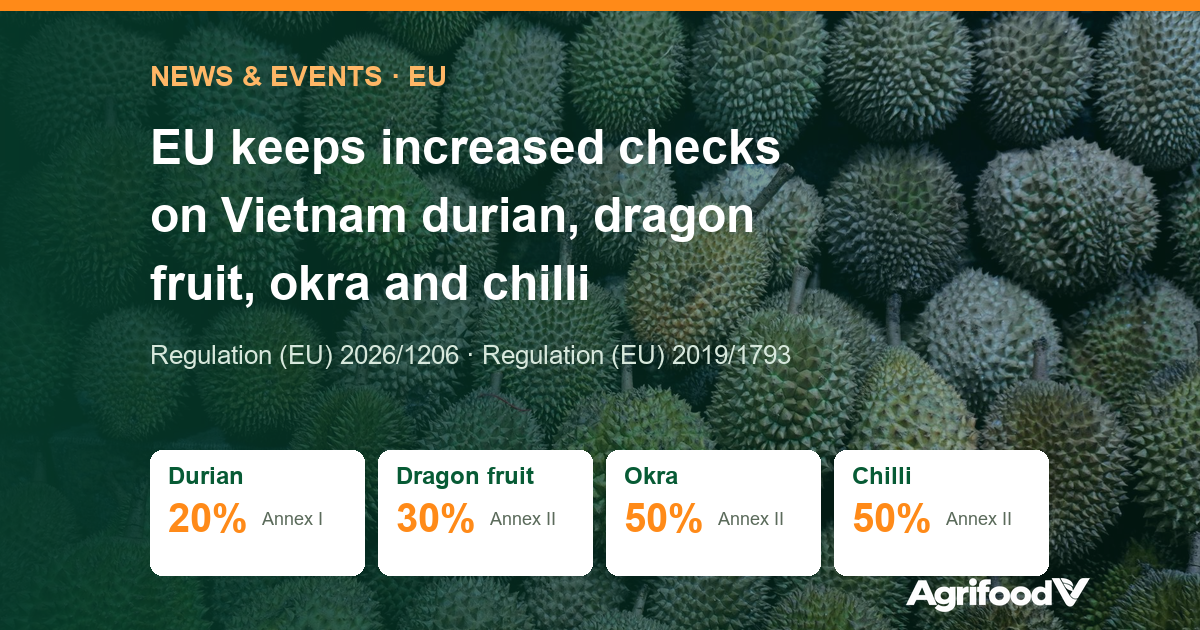
The European Union (EU) has kept increased controls unchanged on four Vietnamese fruit and vegetable products in the latest amendment to Implementing Regulation (EU) 2019/1793. Fresh durian is subject to physical checks on 20% of consignments; okra, dragon fruit and chilli peppers must be accompanied by an official certificate and pesticide residue analysis results for every consignment, and are checked at 30–50% of consignments at EU border control posts.
Key points
- Latest act: Commission Implementing Regulation (EU) 2026/1206 of 9 June 2026, published in the Official Journal of the EU on 10 June 2026, entering into force on the twentieth day following publication.
- The Vietnamese entries are unchanged from the previous amendment (Implementing Regulation (EU) 2026/194 of 28 January 2026).
- The hazard controlled for all four products: pesticide residues.
What is Implementing Regulation (EU) 2019/1793
Commission Implementing Regulation (EU) 2019/1793 sets out two lists of food and feed imported from certain countries that are subject to a higher level of control than usual:
- Annex I: an increased frequency of identity checks and physical checks (sampling and analysis) at EU border control posts.
- Annex II: in addition to checks at the border, every consignment must meet special conditions applied in the exporting country.
Under Article 12 of the Regulation, the European Commission must review these two lists regularly, at intervals not exceeding six months, based on notifications through the Rapid Alert System for Food and Feed (RASFF) and the results of checks reported by Member States. The recitals of Implementing Regulation (EU) 2026/1206 state that this review is based on recent RASFF notifications and the results of official controls in the second half of 2025.
The four Vietnamese products on the lists
| Product | CN code | List | Hazard | Frequency of checks at EU border |
|---|---|---|---|---|
| Durian (Durio zibethinus), fresh or chilled | 0810 60 00 | Annex I | Pesticide residues | 20% of consignments |
| Okra, fresh, chilled or frozen | ex 0709 99 90 ex 0710 80 95 |
Annex II | Pesticide residues | 50% of consignments |
| Dragon fruit (pitahaya), fresh or chilled | ex 0810 90 20 | Annex II | Pesticide residues | 30% of consignments |
| Peppers of the genus Capsicum (other than sweet), fresh, chilled or frozen | ex 0709 60 99 ex 0710 80 59 |
Annex II | Pesticide residues | 50% of consignments |
Source: Annexes I and II, Commission Implementing Regulation (EU) 2026/1206; checked against the consolidated version of Implementing Regulation (EU) 2019/1793 of 30 June 2026 on EUR-Lex. “ex” means that only some products under that CN code are subject to controls.
What Annex II requires for every consignment
For okra, dragon fruit and chilli peppers, under Articles 10 and 11 of Implementing Regulation (EU) 2019/1793 (consolidated version), every consignment entering the EU must:
- Be accompanied by the results of sampling and analysis carried out by the competent authority of the country of origin on that consignment.
- The analyses must be performed in laboratories accredited to ISO/IEC 17025.
- Be accompanied by an official certificate following the model in Annex IV, issued by the competent authority of the country of origin, bearing a signature, a stamp and the identification code of the consignment.
The scope of analysis covers the active substances in the EU control programme under Article 29(2) of Regulation (EC) No 396/2005 that can be analysed by GC-MS and LC-MS multi-residue methods. For the three Vietnamese products, analysis must additionally cover dithiocarbamates (expressed as CS2, including maneb, mancozeb, metiram, propineb, thiram and ziram), phenthoate and quinalphos. The results are assessed against the EU maximum residue levels (MRLs) under Regulation (EC) No 396/2005.
Durian: no certificate required with the consignment, but one in five consignments is physically checked
Durian is listed in Annex I, so the Annex II conditions of an accompanying certificate and analysis results do not apply. However, about 20% of fresh durian consignments from Vietnam entering the EU will undergo identity checks and physical checks (sampling for pesticide residue analysis) at the border. For fresh produce, the time taken for sampling and processing results can affect the quality and cost of the consignment.
What this tells us
Two consecutive reviews (January and June 2026) have both kept the four Vietnamese entries unchanged. Under the Article 12 mechanism, the EU only reduces the frequency of checks or removes a product from the lists when control data show that compliance has improved. In Implementing Regulation (EU) 2026/1206 itself, the EU did exactly that for certain products from other countries. For example, it removed increased aflatoxin controls on chilli peppers from India, and moved Indian cinnamon from Annex II to Annex I because compliance had improved.
In other words, the route for Vietnamese durian, dragon fruit, okra and chilli peppers to come off the lists runs through the compliance record of the export consignments themselves. Under the Regulation, the next review will take place within six months of the previous one.
What exporters should do
The following are AgrifoodV recommendations, not provisions of the legislation.
- Control at the growing area, not only at the packhouse. Check the pesticides currently in use against EU MRLs, especially the substances named specifically: dithiocarbamates (mancozeb, etc.), phenthoate and quinalphos. Keep spray records and pre-harvest intervals for each plot and each growing-area code.
- Analyse before export in laboratories accredited to ISO/IEC 17025, using GC-MS/LC-MS multi-residue methods, so that problems are not discovered for the first time at the EU border.
- Prepare documentation by consignment (for okra, dragon fruit and chilli peppers): a consignment identification code that is consistent across the analysis results, the official certificate and the import documents.
- Monitor the next review of Implementing Regulation (EU) 2019/1793 and RASFF notifications concerning Vietnamese products, and adjust shipment plans accordingly.
AgrifoodV supports companies in building cultivation procedures, growing-area codes and traceability that meet the requirements of import markets.
References
- European Commission. Commission Implementing Regulation (EU) 2026/1206 of 9 June 2026 amending Implementing Regulation (EU) 2019/1793… Official Journal of the EU, L series, 10 June 2026. EUR-Lex CELEX 32026R1206.
- European Commission. Commission Implementing Regulation (EU) 2026/194 of 28 January 2026 amending Implementing Regulation (EU) 2019/1793… EUR-Lex CELEX 32026R0194.
- European Commission. Implementing Regulation (EU) 2019/1793, consolidated version of 30 June 2026 (Articles 10, 11 and 12; Annexes I and II). EUR-Lex CELEX 02019R1793-20260630.
- European Parliament and Council. Regulation (EC) No 396/2005 on maximum residue levels of pesticides in or on food and feed… ELI: data.europa.eu/eli/reg/2005/396/oj.
Article by AgrifoodV, summarising the original English-language legal texts published on EUR-Lex (accessed 17 October 2026). The consolidated versions on EUR-Lex are for reference only; the legally binding versions are those published in the Official Journal of the EU. This content is not a substitute for legal advice on any specific case.
Cover image: Ramadhan Bagaskara Arya P / Pexels.
© 2026 AgrifoodV. Nội dung được phép trích dẫn khi ghi rõ nguồn và đặt liên kết tới bài gốc; không sao chép toàn văn. Xem Điều khoản sử dụng nội dung.