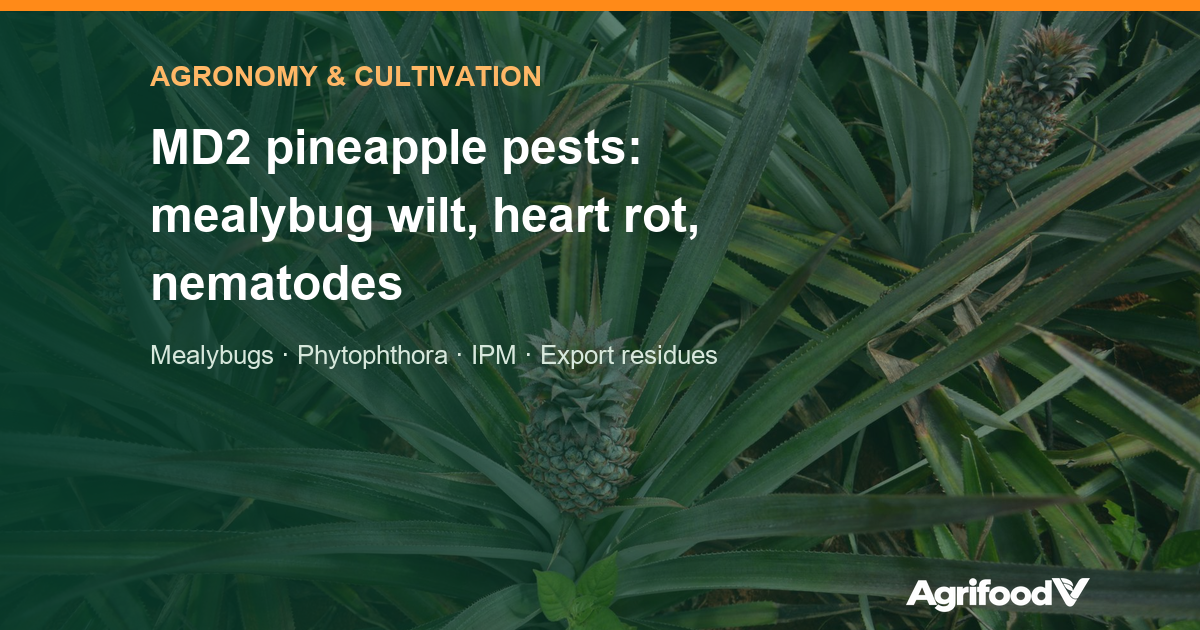
Three pest and disease problems decide whether an MD2 pineapple growing area succeeds or fails: mealybug wilt, caused by a virus spread through mealybugs; heart rot and root rot caused by Phytophthora; and nematodes. MD2 has a strength (resistance to fruitlet core rot) but also a clear weakness (it is more susceptible to heart rot than Cayenne). For export growing areas, every chemical measure must pass one more test: the maximum residue limits of the destination market. This article summarises integrated pest management (IPM) as set out in the scientific sources.
Key points
- Mealybug wilt develops only when a plant is both infected with PMWaV-2 virus and fed on by mealybugs. Virus-free planting material, ant control and mealybug control are the three pillars.
- MD2 is more susceptible than Cayenne to Phytophthora heart rot and to bacterial heart rot; drainage and keeping soil pH moderately low are the foundation measures.
- Reniform nematode can cut yield by 38% in the plant crop and by 60% in the first ratoon crop.
- Use only pesticides on the permitted list, only on the crops named on the label, and check the maximum residue limits of the export market.
Mealybugs and mealybug wilt
Research by Sether and Hu (Phytopathology, 2002) showed that mealybug wilt develops only when two conditions are both met: the plant is infected with PMWaV-2 virus and is fed on by mealybugs. Plants that carry the virus but are free of mealybugs, or that have mealybugs but are not infected with PMWaV-2, do not develop the disease. The virus is transmitted by the pink pineapple mealybug (Dysmicoccus brevipes) and the grey pineapple mealybug (D. neobrevipes). Symptoms: dried, scorched leaf tips, reddened leaves and wilting, which can bring down an entire mature plant. In Hawaii, when wilt appears within the first three months, average fruit weight falls by 55% compared with virus-free plants.
Ants protect mealybugs from their natural enemies. According to CTAHR (University of Hawaii), the disease has been kept under control for three decades through regular ant control. The integrated measures drawn from these sources:
- Virus-free planting material: disease-free tissue-culture plants, suckers treated in hot water at 50 °C for 30 minutes, or suckers taken from fields with less than 10% wilted plants; do not take suckers next to diseased plants.
- Uproot and destroy diseased plants as soon as they are found; keep field margins free of weeds.
- Protect natural enemies (mealybug-eating ladybirds, parasitic wasps) and control ants so that natural enemies can do their work.
- Spray when more than 3% of plants are wilted or mealybugs are widespread (Pacific Pests). The Ha Tinh guidance sets the control threshold at 5% of leaves, flowers or fruit, or 2.5% of roots or stems damaged.
We have not found any publication confirming PMWaV viruses on pineapple in Vietnam. This is why planting material should be tested, especially imported material. See the article on MD2 pineapple planting material standards.
Heart rot, root rot (Phytophthora) and bacterial heart rot
Research in Australia (Anderson et al., 2012) showed that Cayenne resists heart rot better, while MD2 is the most susceptible. Dipping suckers in phosphonate before planting is very effective for the first few months, but does not keep the root system healthy until the plant crop is harvested; high-volume spraying at planting is much less effective than dipping. Young et al. (2022) reported that losses in Australia have risen since low-acid hybrids came into cultivation, and that MD2 is particularly susceptible to bacterial heart rot and fruit collapse.
The foundation measures are cultural: well-drained soil, raised beds, shallow planting, and no soil falling into the plant heart; the Hawaii literature states that a soil pH of 4.5–5.5 reduces soil-borne diseases. The Ha Tinh guidance adds: uproot diseased plants and use antagonistic microbial products (Trichoderma, Bacillus, Streptomyces) composted with farmyard manure; when 30–70% of plants are affected, uproot diseased plants, sprinkle lime into the planting holes, stop nitrogen fertiliser and do not spray growth stimulants; above 70%, destroy the planting. The document explicitly names “susceptible varieties such as Cayenne and MD2”. See also the article on MD2 pineapple growing practices for soil and pH.
Nematodes
According to a CTAHR publication (Wang and Sipes, 2009), reniform nematode (Rotylenchulus reniformis) reduces marketable yield by up to 38% in the plant crop and 60% in the first ratoon crop. A 6–12 month fallow is not enough, because this species can enter a dormant state and survive for months to years. Alternatives to soil fumigants that have been tested:
- A sunn hemp cover crop (Crotalaria juncea), a poor host of reniform and root-knot nematodes; however, sunn hemp grows poorly in soil with a pH below 6.0.
- Solarising soil under plastic film for 6 weeks, reaching 42 °C, kills nematodes in the surface layer, but soil deeper than 15 cm does not get hot enough.
Companies should take soil samples to check nematode density before planting and between cycles.
Fruit diseases and mites
- Fruitlet core rot: research by Barral et al. (Frontiers in Plant Science, 2019) showed that the disease is almost absent in MD2 but a serious concern in Queen, because MD2’s tissue structure and phenolic compounds block the fungus.
- Postharvest black rot infects within 8–12 hours after harvest through cuts and bruises; it is controlled by reducing bruising and cooling quickly.
- Red mites attack the leaf bases and are worse when ripening fruit meets drought; the Ha Tinh guidance recommends control when 5% of plant bases or leaves are affected.
Pesticides and export markets
The list of plant protection products permitted for use in Vietnam is currently set by Circular 75/2025/TT-BNNMT (signed 26 December 2025, effective 10 February 2026), as amended by Circular 28/2026/TT-BNNMT. Companies may use only products on the list, and only on the crops named on the label. For export produce, the maximum residue limits of the destination market must also be checked: in the EU, an active substance with no specific limit is subject to the default level of 0.01 mg/kg; Japan likewise applies a uniform limit of 0.01 ppm under its positive list. An active substance used legally in Vietnam may still fail to meet the requirements of an export market.
What companies should do
AgrifoodV recommendations:
- Draw up a list of permitted active substances for the growing area based on both the Vietnamese list and the residue limits of the destination market; issue it to farming households and check it before harvest.
- Invest in disease-free planting material and in an ant and mealybug control programme from the start, rather than acting once plants are already wilting.
- Keep a log of pest detections and spray applications for each lot (see the articles on early pest detection and lot-level data).
AgrifoodV helps companies build IPM and residue control programmes for export raw-material growing areas.
References
- Sether, D. M.; Hu, J. S. Study of the role of PMWaV-2 virus and mealybugs in pineapple wilt disease. Phytopathology 92: 928–935, 2002. DOI: 10.1094/PHYTO.2002.92.9.928.
- Jackson, G. Pineapple wilt disease, Pacific Pests, Pathogens, Weeds & Pesticides, factsheet 380, 2023. lucidcentral.org.
- Mau, R. F. L.; Martin Kessing, J. L. Dysmicoccus brevipes, Crop Knowledge Master, CTAHR, 2007. ctahr.hawaii.edu.
- Anderson, J. M.; Pegg, K. G.; Scott, C.; Drenth, A. Study of Phytophthora heart rot and phosphonate treatment in pineapple cultivars. Australasian Plant Pathology 41(1): 59–68, 2012. DOI: 10.1007/s13313-011-0090-6.
- Young, A. J. et al. Study of bacterial heart rot of pineapple in Queensland. Australasian Plant Pathology 51: 525–533, 2022. DOI: 10.1007/s13313-022-00880-x.
- Wang, K.-H.; Sipes, B. S. CTAHR publication SCM-29 on soil solarisation and cover crops as alternatives to soil fumigants for nematode control in Hawaii pineapple fields, 2009. sare.org.
- Barral, B. et al. Study of the mechanism of fruitlet core rot resistance in MD-2 pineapple. Frontiers in Plant Science 10: 1065, 2019. DOI: 10.3389/fpls.2019.01065.
- Bartholomew, D. P.; Rohrbach, K. G.; Evans, D. O. Pineapple Cultivation in Hawaii. CTAHR, University of Hawaii, F&N-7, 2002. ctahr.hawaii.edu.
- Paull, R. E.; Chen, C. C. Pineapple: Postharvest Quality-Maintenance Guidelines. CTAHR, University of Hawaii, F_N-32, 2014. ctahr.hawaii.edu.
- Ha Tinh Department of Agriculture and Environment. Công văn hướng dẫn tạm thời một số quy trình kỹ thuật trồng dứa trên địa bàn tỉnh [Official letter providing interim guidance on pineapple growing practices in the province], May 2026. sonnmt.hatinh.gov.vn.
- Ministry of Agriculture and Environment. Circular 75/2025/TT-BNNMT of 26 December 2025: Danh mục thuốc bảo vệ thực vật được phép sử dụng, cấm sử dụng tại Việt Nam [List of plant protection products permitted and banned for use in Vietnam]. datafiles.chinhphu.vn.
Article by AgrifoodV, compiled from the sources above (accessed 17 October 2026). This content is not a substitute for the directions for use on pesticide labels or for plant protection advice for a specific growing area. Cover image: Valeria Drozdova / Pexels.
© 2026 AgrifoodV. Nội dung được phép trích dẫn khi ghi rõ nguồn và đặt liên kết tới bài gốc; không sao chép toàn văn. Xem Điều khoản sử dụng nội dung.