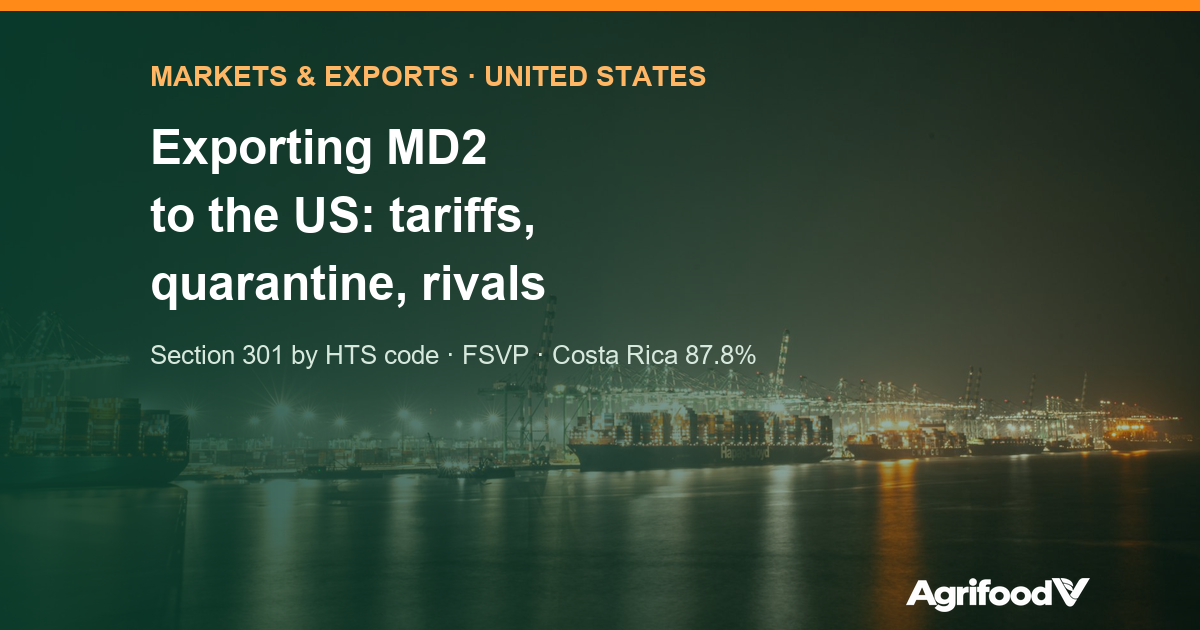
The United States is the world’s largest pineapple importer, at about 1.21 million tonnes in 2024. But Vietnamese fresh MD2 pineapple is currently not allowed into the US. This article separates two routes: processed pineapple, which can be shipped now at clearly defined duty rates; and the path to market access for fresh pineapple, following the exact procedure Indonesia went through in 2024–2025. It also places Vietnam alongside its main competitor, Costa Rica.
Key points
- Vietnamese fresh pineapple is not on the list of products allowed into the US. The US authorises pineapple imports country by country, through a pest risk analysis (PRA) and public consultation.
- The general (MFN) duty on fresh pineapple is very low (0.44–1.1 cents/kg) and exempt from the additional 12.5% Section 301 duty. Frozen pineapple, canned pineapple and pineapple juice concentrated more than 3.5 times are also exempt; NFC pineapple juice is not.
- Costa Rica accounted for 87.8% of the value of US pineapple imports in 2024 and enjoys 0% duty under the CAFTA-DR agreement.
- Fruit and vegetables entering the US are subject to the Produce Safety Rule and to the importer’s Foreign Supplier Verification Program (FSVP).
Fresh pineapple: not yet allowed, and how to gain access
The US regulates imports of fresh fruit and vegetables by “commodity, country of origin” pair, searchable in APHIS’s ACIR database (which replaced the former FAVIR). The official list of the Department of Crop Production and Plant Protection (updated August 2026) shows that for the United States, Vietnam has access conditions for coconut, mango, star apple, dragon fruit, rambutan, longan and lychee, but not pineapple. Among APHIS documents in the Federal Register that mention pineapple, none concerns Vietnamese pineapple.
The market-access procedure under 7 CFR 319.56-4: the national plant protection organisation of the exporting country submits a request; APHIS prepares a pest risk analysis and a risk management document, publishes them in the Federal Register, takes comments for 60 days, and then makes a decision. Indonesia as an example: the draft PRA was published on 30 December 2024, the comment period closed on 28 February 2025, and imports were allowed from 29 May 2025. Conditions differ by country: Thai pineapple entering the US must be irradiated; pineapple from the Philippines and Taiwan is currently allowed only into certain territories, and APHIS is consulting on expanding access (2026).
US import duties
| Product (HTS code) | General (MFN) duty | Section 301 on Vietnamese goods (+12.5% from 24 July 2026) |
|---|---|---|
| Fresh pineapple (0804.30.20, .40, .60) | 0.44–1.1 cents/kg | Exempt |
| Frozen pineapple (0811.90.50) | — | Exempt |
| Prepared or canned pineapple (2008.20.00) | — | Exempt |
| Pineapple juice concentrate above 20 °Brix, concentrated more than 3.5 times (2009.49.40) | 1 cent/litre | Exempt |
| Pineapple juice ≤ 20 °Brix, NFC (2009.41.20, .40) | 1–4.2 cents/litre | Additional 12.5% applies |
Source: HTSUS 2026 tariff schedule (USITC), Chapter 99, note 52; USTR notice in the Federal Register. Rates shown as “—” were outside the scope of this article’s cross-check.
Vietnam has no free trade agreement with the US. Costa Rica enjoys 0% under CAFTA-DR. For fresh pineapple, the general duty rate is already very low, so duty is not the main barrier; the barrier is phytosanitary.
Food safety requirements
- Produce Safety Rule (21 CFR 112): pineapple is not on the “rarely consumed raw” list, so it falls within scope; it is exempt if the fruit goes through commercial processing with a microbial reduction step, backed by documentation and a customer assurance.
- FSVP (21 CFR 1.502): the US importer must verify that the foreign supplier provides the same level of public health protection as the produce safety or preventive controls requirements.
- Traceability (FSMA 204): whole pineapple is not on the list of foods subject to additional traceability requirements; fresh-cut pineapple is.
- Pineapple juice: subject to Juice HACCP (21 CFR 120) and the standard of identity for pineapple juice (21 CFR 146.185).
Competitors: Costa Rica and others
Costa Rica exported about 2.40 million tonnes of pineapple in 2024, estimated to fall to 2.02 million tonnes in 2025 (down 16%) because of weather and pests and diseases; its average export unit value was about USD 595/tonne (FAO). Costa Rica’s yield in 2024 was 58.8 t/ha according to FAOSTAT, compared with 18.4 t/ha for Vietnam (all varieties combined). Mexico (duty-free under USMCA) and Ecuador are increasing their shipments to the US. The average wholesale price of pineapple in the US was about USD 1.85/kg over the first 11 months of 2025 (FAO); the South Florida shipping-point price on 16 October 2026 for Costa Rican pineapple was about USD 10–13 per single-layer carton (USDA AMS).
In processed pineapple, Thailand leads US imports; Vietnam holds about 2.7% (2025). See the article MD2 pineapple prices.
What companies should do
AgrifoodV recommends:
- In the short term, enter the US with processed pineapple that is exempt from Section 301 (frozen, canned, concentrated more than 3.5 times); avoid NFC if margins are thin.
- If you are targeting fresh pineapple, work with the industry association and the Department of Crop Production and Plant Protection to prepare a market-access request: a list of pests, coded growing areas, and treatment measures.
- Prepare documentation for the importer’s FSVP: a food safety plan, GlobalG.A.P. or equivalent certification, and lot-by-lot residue records.
AgrifoodV helps companies assess the US market and compliance documentation, and define the right processing-plant concept.
References
- Department of Crop Production and Plant Protection. Một số quy định của các nước nhập khẩu về kiểm dịch thực vật đối với hàng hóa có nguồn gốc thực vật từ Việt Nam [Selected phytosanitary regulations of importing countries for plant-origin goods from Vietnam], updated 3 August 2026. ppd.gov.vn.
- APHIS (US Department of Agriculture). Federal Register notices on pineapple imports: Indonesia (2025-09657, 29 May 2025), Taiwan (2026-04206, 3 March 2026), Thailand and the Philippines (2026-11636, 10 June 2026). govinfo.gov.
- USITC. Harmonized Tariff Schedule of the United States 2026, headings 0804.30, 2009.41, 2009.49 and Chapter 99 (note 52). hts.usitc.gov.
- USTR. Notice of action under Section 301 on Vietnamese goods, Federal Register doc. 2026-15181, 28 July 2026. ustr.gov.
- eCFR. 21 CFR 112.2 (Produce Safety Rule) and 21 CFR Part 1 Subpart L (FSVP). 112.2; Subpart L.
- FDA. Food Traceability List. fda.gov.
- FAO. Major Tropical Fruits Market Review – Preliminary results 2025, 2026. fao.org.
- United Nations. UN Comtrade, HS 0804.30 data for 2024 (API query of 17 October 2026). comtradeplus.un.org.
- FAO. FAOSTAT, crops and livestock products dataset (pineapples, code 574), downloaded 17 October 2026. fao.org/faostat.
- USDA AMS Market News. Miami Shipping Point Fruit Prices, 16 October 2026. ams.usda.gov.
Article by AgrifoodV, compiled from the sources above (accessed 17 October 2026). This content is for reference only and is not a substitute for technical advice for a specific growing area. Cover image: Oleksiy Yeshtokyn,🌻🇺🇦🌻 / Pexels.
© 2026 AgrifoodV. Nội dung được phép trích dẫn khi ghi rõ nguồn và đặt liên kết tới bài gốc; không sao chép toàn văn. Xem Điều khoản sử dụng nội dung.