MD2 pineapple pests: why early detection decides crop protection costs

MD2 pineapple pests: why early detection decides crop protection costs

A pest outbreak detected early needs only one well-targeted treatment. Detect it a few days late and the population has already multiplied several times over, so the farm has to spray more often with broader-spectrum products. For export MD2 pineapple growing areas, more spraying also means a higher residue risk when the goods reach the border of the importing country. Key points Populations of many pest species grow exponentially in hot weather; a difference of a few days in detection decides the number of sprays. For pineapple, the threat to watch is the pink pineapple mealybug (Dysmicoccus brevipes), which transmits the virus behind mealybug wilt and is tended and spread by ants. According to the University of Florida, ant control…
Tìm hiểu thêm ...
MD2 pineapple Brix: how to measure it, Codex and buyer thresholds

MD2 pineapple Brix: how to measure it, Codex and buyer thresholds

Brix is the first number a pineapple buyer looks at, and also one of the most misunderstood. Many believe MD2 pineapple tastes sweeter because its Brix is higher, that EU law requires 12 °Brix, or that a yellow-skinned fruit is a sweet fruit. According to authoritative sources, none of these three claims is accurate. This article explains what Brix is, how to measure it correctly, which threshold applies to whom, and where MD2 really differs from Cayenne. Key points Brix measures soluble solids (mainly sugars) with a refractometer, under ISO 2173:2003; the sample must be juice representative of the whole fruit. Codex requires fresh pineapple to reach at least 12 °Brix. EU law sets no Brix threshold for pineapple; EU…
Tìm hiểu thêm ...
MD2 vs Cayenne pineapple: quality, cultivation and processing compared

MD2 vs Cayenne pineapple: quality, cultivation and processing compared

Choosing between MD2 pineapple and Cayenne pineapple is not a question of which variety is "better", but of which variety fits the intended market. MD2 dominates the fresh fruit market thanks to its low acidity, high vitamin C and good tolerance of cold storage. Cayenne still has a place in canning and resists some diseases better. The comparison below is based on studies that measured the two varieties under the same conditions, with the location of each measurement stated, because results vary by region. Key points The most consistent difference: MD2 has lower acidity than Cayenne in every season (Hawaii) and much higher vitamin C. Brix, however, is not always higher in MD2. MD2 resists internal browning and tolerates cold…
Tìm hiểu thêm ...
MD2 pineapple pests and diseases: mealybug wilt, heart rot, nematodes

MD2 pineapple pests and diseases: mealybug wilt, heart rot, nematodes

Three pest and disease problems decide whether an MD2 pineapple growing area succeeds or fails: mealybug wilt, caused by a virus spread through mealybugs; heart rot and root rot caused by Phytophthora; and nematodes. MD2 has a strength (resistance to fruitlet core rot) but also a clear weakness (it is more susceptible to heart rot than Cayenne). For export growing areas, every chemical measure must pass one more test: the maximum residue limits of the destination market. This article summarises integrated pest management (IPM) as set out in the scientific sources. Key points Mealybug wilt develops only when a plant is both infected with PMWaV-2 virus and fed on by mealybugs. Virus-free planting material, ant control and mealybug control are…
Tìm hiểu thêm ...
How to grow MD2 pineapple: soil, climate, density, season and mulching

How to grow MD2 pineapple: soil, climate, density, season and mulching

Vietnam has no technical protocol for growing MD2 pineapple issued by the Ministry of Agriculture and Environment or a research institute. The closest government document is the interim pineapple-growing guidance of the Ha Tinh Department of Agriculture and Environment (May 2026), which treats the Cayenne and Queen groups separately and has no section on MD2. Most international technical data, meanwhile, were measured on Cayenne. This article brings together the requirements for climate, soil, planting density, planting season and bed mulching, stating clearly which figures were measured on MD2 and which on other varieties. Key points Pineapple prefers acid, well-drained soil. Hawaii extension material states that a pH of 4.5–5.5 helps reduce soil-borne diseases; MD2, however, is more susceptible to Phytophthora…
Tìm hiểu thêm ...
MD2 pineapple fertiliser: nutrient needs by stage and what to avoid

MD2 pineapple fertiliser: nutrient needs by stage and what to avoid

There is no "standard formula" to copy for fertilising MD2 pineapple. The most authoritative material available comes from the University of Hawaii and was measured on Cayenne; the closest government document in Vietnam is Ha Tinh province's interim guidance, which does not treat MD2 separately. What the two sources agree on is the principle: pineapple needs a lot of nitrogen and potassium, demand rises sharply before floral differentiation, and nitrogen application must stop for a period before flower induction. This article sets out that principle, together with figures that state their source and variety. Key points Pineapple needs a lot of N, K and iron, and little P and calcium. The first five months require little fertiliser; demand peaks 2–4…
Tìm hiểu thêm ...
MD2 pineapple tissue culture: process, advantages and limits

MD2 pineapple tissue culture: process, advantages and limits

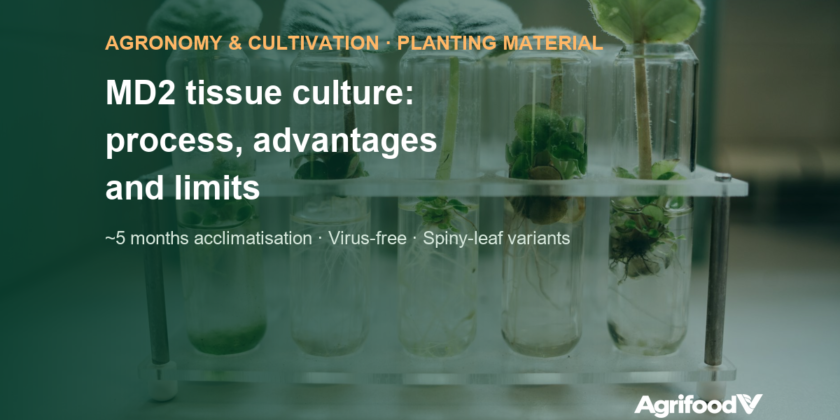
Tissue-cultured MD2 pineapple plants are often presented as the answer to every planting-material problem: disease-free, uniform and fast to multiply. The scientific literature gives a more balanced picture. Tissue culture is a powerful tool for rapidly multiplying a new variety and producing virus-free plants, but it is also costly, carries a risk of variation, and if the mother plant is infected, the plantlets are infected too. This article describes the process, the advantages and the limits, so that companies know what to ask when buying tissue-cultured plants. Key points Commercial pineapple is always propagated vegetatively. Every MD2 plant in the world is a clone of a single original plant selected in Hawaii in 1973. It takes about 90 days from…
Tìm hiểu thêm ...
MD2 pineapple flower induction and harvest: ethephon, natural flowering

MD2 pineapple flower induction and harvest: ethephon, natural flowering

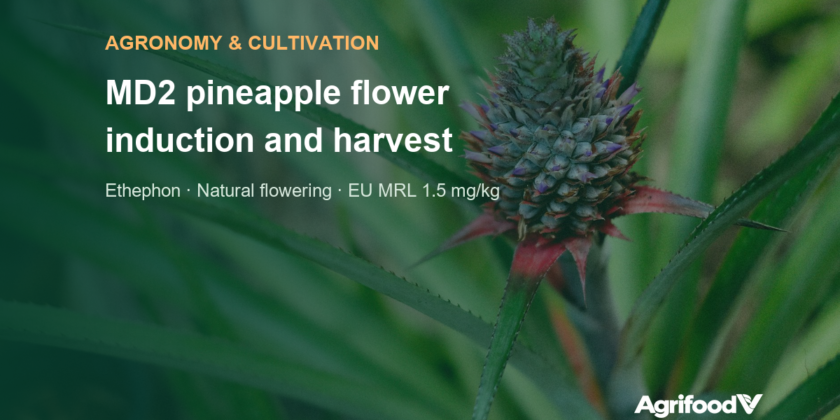
Flower induction is the step that sets the harvest calendar of an entire MD2 pineapple growing area, and therefore also the plant's raw-material intake schedule and the export shipping schedule. MD2 has two traits that must be taken into account: the variety is more prone than Cayenne to unscheduled natural flowering, and the substance used for flower induction, ethephon, is on the list of residue limits that the EU tightened from August 2026. Key points Ethylene is the only substance that triggers flowering in pineapple; ethephon and calcium carbide (acetylene) both act through this mechanism. In Costa Rica, MD2 plants are induced at about 8 months of age, weighing 2.5–3.0 kg; about 21 weeks later the fruit is degreened and…
Tìm hiểu thêm ...
What is MD2 pineapple: origin, traits and role in export growing areas

What is MD2 pineapple: origin, traits and role in export growing areas

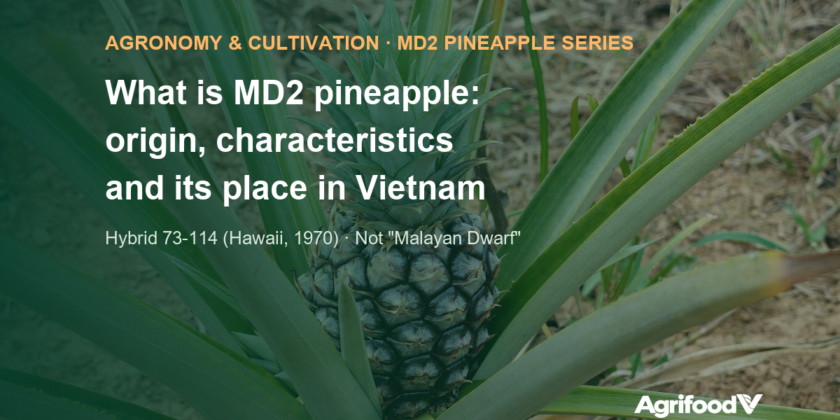
MD2 pineapple (known in southern Vietnam as "thom MD2" or "khom MD2") accounts for more than 80% of the pineapples imported into Europe, yet for less than 5% of Vietnam's pineapple area. Vietnamese-language websites carry a good deal of misinformation about the variety: "MD2 stands for Malayan Dwarf 2", "it was crossed from Queen and Cayenne in the 1980s", "MD2 F1 planting material". This article sets out the origin, characteristics and position of MD2 based on authoritative sources, and serves as the hub page of the MD2 pineapple series on agrifoodv.com. Key points MD2 is hybrid 73-114, bred by the Pineapple Research Institute of Hawaii in 1970 and selected in 1973. "MD" stands for Mrs Millie Dillard, not "Malayan Dwarf".…
Tìm hiểu thêm ...
MD2 pineapple planting material standards: TCVN 9062 and virus testing

MD2 pineapple planting material standards: TCVN 9062 and virus testing

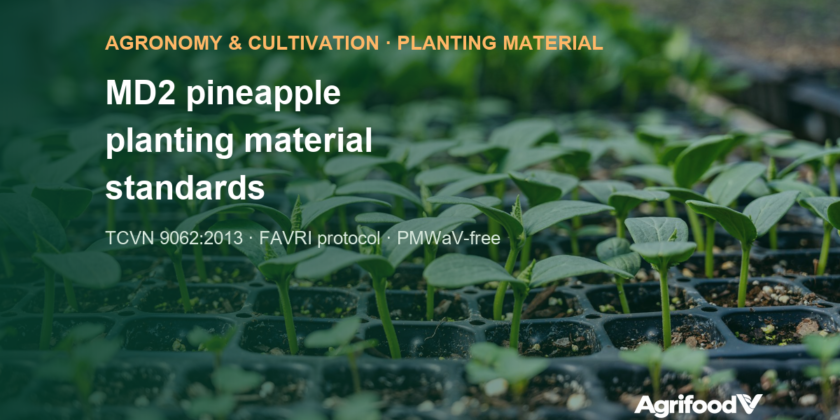
Ask "what makes an MD2 pineapple plant meet the standard?" and the first answer is this: Vietnam has no national standard for MD2 planting material or for tissue-cultured pineapple plants. The only standard for pineapple shoots, TCVN 9062:2013, applies only to the Queen and Cayenne groups, and checks pests and diseases by visual inspection. Companies therefore have to set their own quality requirements when buying planting material, based on the existing standard, the protocol of the Fruit and Vegetable Research Institute and international technical recommendations. Key points TCVN 9062:2013 "Pineapple planting shoots – Technical requirements" sets shoot weight and height for the Queen and Cayenne groups, with no section on MD2 or tissue-cultured plants. The Fruit and Vegetable Research Institute's…
Tìm hiểu thêm ...