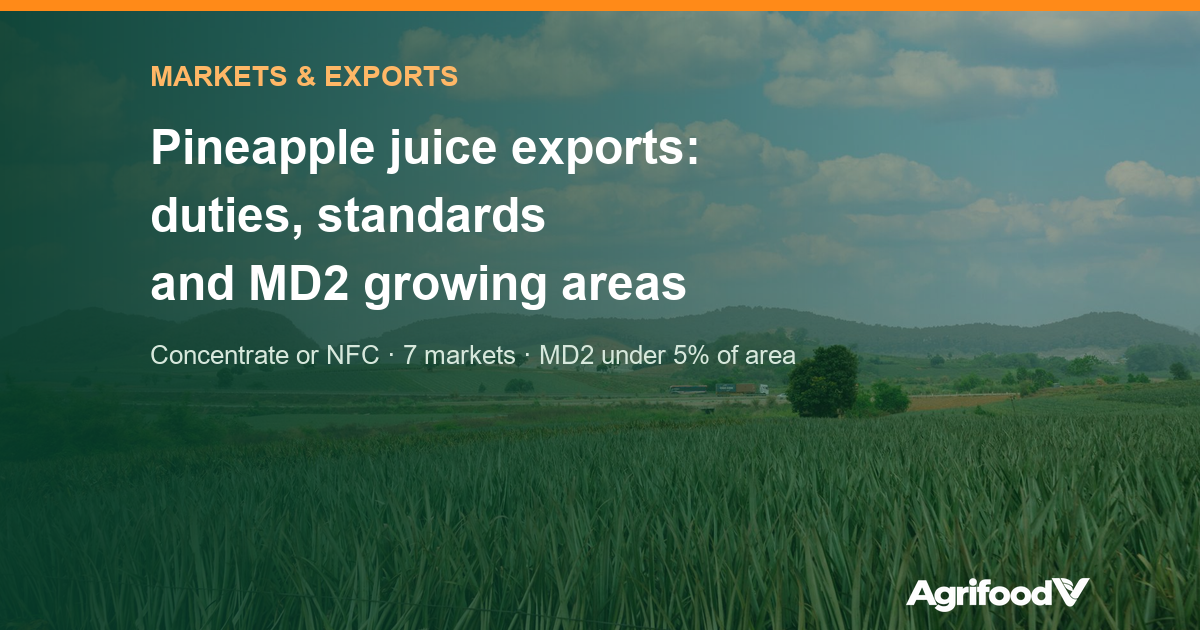
Vietnam grows about 52,000 ha of pineapple, yet the MD2 variety, which holds 70–75% of the European pineapple market, accounts for less than 5% of that area. Meanwhile, import duties on pineapple juice vary sharply by product form: the same Vietnamese pineapple juice can face 40% or 0% in South Korea, and 23% or 4.6% in Japan. This article brings together the duties, standards and growing-area requirements for exported pineapple juice in seven markets, and explains why MD2 growing areas are the first condition.
Key points
- For pineapple juice, the product form decides the duty rate. Concentrate has the edge over NFC in South Korea (0% versus 40%), Saudi Arabia (5% versus 10%) and the United States (concentrate of more than 3.5 times is exempt from Section 301 duties).
- For Japan, use CPTPP (3.4–4.6%), not VJEPA (17.2–23%). For China, pineapple juice does not receive ACFTA preferences: the rate remains 5%.
- Vietnam is still small in the world pineapple juice market but growing fast: EU imports of pineapple juice of 20–67 Brix (code 2009 49 30) from Vietnam rose from EUR 0.74 million to EUR 6.12 million (2024–2025); Vietnam accounted for 12.2% of Japan’s imports of pineapple juice above 20 Brix by value in 2025.
- The bottleneck lies in the growing areas: MD2 covers less than 5% of the area, imported planting suckers are expensive, and MD2 area figures by province have not been published.
The pineapple juice market: large, but Vietnam is only just starting
According to CBI (the import promotion agency of the Netherlands Ministry of Foreign Affairs, updated 2 December 2025), Europe imported about 292,500 tonnes of pineapple juice, worth EUR 397 million in 2024. Over 2020–2024, volume fell by an average of 5% a year while value rose by 7.5% a year. Costa Rica accounts for 55% of the imports of the Netherlands, the main gateway into Europe. In mid-2025, the price of pineapple juice concentrate stood at about USD 4,900/tonne. The CBI report does not mention Vietnam among the suppliers.
On the supply side, FAO recorded that world fresh pineapple exports fell by about 5% in 2025, to 3.4 million tonnes; Costa Rica alone fell by 16%. Pineapple prices rose because of short supply. This is a gap for new sources of supply, provided they can meet buyers’ standards.
Import statistics for 2025 show that Vietnam is entering the market, although on a small scale:
| Market | Tariff code | Imports from Vietnam in 2025 | Vietnam’s share |
|---|---|---|---|
| EU (extra-EU) | 2009 49 30 (Brix 20–67, value above EUR 30/100 kg) | EUR 6.12 million (2024: EUR 0.74 million) | 2.8% |
| Japan | 2009.49 (Brix above 20) | USD 2.27 million (2024: USD 0.60 million) | 12.2%, ranked 4th |
| United States | 2009.49 (Brix above 20) | USD 2.14 million | 1.5%, ranked 8th |
Sources: Eurostat Comext (EU); UN Comtrade, data reported by the importing country (Japan, United States). Queried on 17 October 2026.
Import duties: the product form decides
Pineapple juice falls under two main code groups: 2009.41 (Brix value not exceeding 20, usually NFC) and 2009.49 (Brix above 20, mainly concentrate). Duty rates for Vietnamese goods, without added sugar:
| Market | NFC (2009.41) | Concentrate (2009.49) | Notes |
|---|---|---|---|
| EU | 0% (MFN 16%) | 0% (MFN 16%) | EVFTA |
| United States | 1–4.2 cents/litre + 12.5% (Section 301) | 1 cent/litre, exempt from Section 301 if concentrated more than 3.5 times (2009.49.40) | Concentrated not more than 3.5 times (2009.49.20): 4.2 cents/litre + 12.5% |
| Japan | 3.4% under CPTPP | 4.6% under CPTPP | VJEPA: 17.2% and 23%; MFN 19.1% and 25.5% |
| South Korea | 40% (VKFTA); 25% (RCEP) | 0% (VKFTA) | MFN 50% |
| China | 5% | 5% | ACFTA does not reduce the duty on pineapple juice; the RCEP rate of 7.5% is even higher than MFN |
| UAE | 0% (with added sugar: 4.5%) | 0% | Vietnam – UAE CEPA, in force from 3 February 2026; MFN 5% |
| Saudi Arabia | 10% | 5% | Vietnam has no FTA with Saudi Arabia yet |
Three points to grasp before choosing a processing line:
- South Korea and Saudi Arabia: sell concentrate, not NFC. The duty difference is 40 percentage points in South Korea and 5 points in Saudi Arabia.
- Japan: the proof of origin must be issued under CPTPP. If VJEPA is used by mistake, the shipment faces a duty about five times higher.
- United States: the Section 301 exemption list includes pineapple juice concentrated more than 3.5 times (2009.49.40), prepared pineapple (2008.20) and frozen pineapple (0811.90.50). NFC pineapple juice is not exempt.
Quality standards
| Market | Main requirements for pineapple juice |
|---|---|
| EU | Directive 2001/112/EC, as amended by Directive 2012/12/EU: minimum Brix of reconstituted pineapple juice 12.8; sugar may not be added to “fruit juice”. Residues under Regulation (EC) No 396/2005. |
| United States | 21 CFR 146.185 (standard of identity for pineapple juice): single-strength pineapple juice ≥10.5°Bx; pineapple juice from concentrate ≥12.8°Bx; acidity not more than 1.35 g/100 ml. Juice HACCP (21 CFR Part 120) also applies to concentrate and requires a minimum 5-log reduction of pathogenic microorganisms. |
| Japan | JAS 1075: reconstituted pineapple juice ≥11°Bx; concentrate must be ≥27°Bx to be called concentrate. Residues under the positive list system, with a default limit of 0.01 ppm. |
| South Korea | Registration of the foreign manufacturing facility with MFDS before import; residues under the PLS system. |
| China | Registration of the manufacturer with GACC under Decree 280 (in force from 1 June 2026); residues under GB 2763; Chinese-language labelling. |
The Brix thresholds of the United States (12.8) and the EU (12.8) are higher than Japan’s (11). Raw material with low, uneven Brix raises concentration costs and makes it harder to meet the standard on reconstitution. The quality of pineapple juice therefore starts with the variety and the field, not with the processing plant.
Growing areas: why MD2 is the first condition
According to Ministry of Agriculture and Environment figures published by Government News on 8 August 2025, Vietnam has about 52,000 ha of pineapple (48,000 ha in harvest), with an average yield of 18.4 tonnes/ha and output of more than 860,000 tonnes; the target for 2030 is 55,000–60,000 ha. According to the same source, MD2 accounts for less than 5% of the area, while this variety holds 50–55% of the world pineapple market and 70–75% of the EU market. MD2 suckers imported from Costa Rica cost about VND 11,000 per sucker.
Several provinces are expanding their pineapple areas, but most of this is not yet MD2:
- Dong Thap (including former Tien Giang): about 14,781 ha of pineapple (June 2026), according to the Agriculture and Environment newspaper.
- Ha Tinh: 17 communes registered more than 653 ha of new planting in 2026; the existing area is about 375 ha, mainly Queen and Cayenne varieties, with only about 2 ha of MD2 (Ha Tinh Provincial Portal, 6 February 2026).
- Nghe An: a resolution on developing pineapple, targeting 3,000 ha within two years (March 2026).
- Can Tho: according to Nhan Dan newspaper (April 2026), a company running contract farming of MD2 pineapple advances planting material and inputs of up to VND 170,000,000 per ha, with offtake at VND 7,000–8,000 per kg at the farm gate, under GlobalG.A.P. cultivation.
Planting material. Domestic propagation of MD2 is still slow. A cooperative using tissue culture reports that plantlets need 3–4 months, with a survival rate of 90–95% and more uniform fields (Agriculture and Environment newspaper, August 2026). Standard Brix and acidity values for MD2 grown in Vietnam have not yet been officially published. The same applies to MD2 area by province.
Growing-area codes and cultivation records. Decree 38/2026/ND-CP requires facilities granted a growing-area code to record and keep cultivation records. Resolution 36/2026/NQ-CP simplifies the procedure: applications are submitted to the commune-level People’s Committee via the National Public Service Portal, and the growing-area code is linked to the land-parcel identification code. For a pineapple juice plant, this is the foundation for answering buyers’ questions on traceability and residues.
What companies should do
AgrifoodV’s recommendations:
- Choose the market first, then the product form. If targeting South Korea, Saudi Arabia or the United States, design the plant to produce concentrate of more than 3.5 times (about 60°Bx); if targeting the EU, Japan or the UAE, NFC can also be considered.
- Size plant capacity from the MD2 area actually available and the plot-by-plot flower induction plan, not from the province’s overall pineapple area.
- Invest in planting material before investing in the processing line: tissue-culture MD2 plantlets or suckers of clear origin, planted in plots, with growing-area codes and cultivation logs.
- Measure Brix, acidity and residues of raw material plot by plot from the first season, so that there is data to show buyers instead of relying on general figures.
See also our articles on managing MD2 pineapple growing areas: cost per hectare, early pest detection, plot-level data; and the pillar article on passion fruit juice exports.
AgrifoodV helps companies choose markets and product forms, set the direction for processing plants and organise MD2 raw-material growing areas with growing-area codes and traceability.
References
- CBI (Netherlands Ministry of Foreign Affairs). The European market potential for pineapple juice, updated 2 December 2025. cbi.eu.
- FAO. Major Tropical Fruits – Preliminary results 2025, 28 January 2026. fao.org.
- Eurostat. Comext, extra-EU imports under CN code 2009 49 30, 2024–2025, partner Vietnam (queried on 17 October 2026). ec.europa.eu/eurostat.
- United Nations. UN Comtrade, imports under HS 200949 by Japan and the United States, 2024–2025 (queried on 17 October 2026). comtradeplus.un.org.
- European Commission. TARIC, headings 2009 41 and 2009 49, origin Vietnam. ec.europa.eu/taxation_customs.
- USITC. Harmonized Tariff Schedule of the United States, subheadings 2009.41 and 2009.49. hts.usitc.gov. USTR, Section 301 notice on goods from Vietnam (heading 9903.05.84) and exclusion list, Federal Register doc. 2026-15181, 28 July 2026. ustr.gov.
- Japan Customs. Customs Tariff Schedule, Chapter 20 (version of 8 August 2026). customs.go.jp.
- Korea Customs Service. FTA portal, duty rate lookup. customs.go.kr.
- Customs Tariff Commission of the State Council of China. 2026 Import and Export Tariff Schedule (Announcement No. 12/2025), lines 2009.4100 and 2009.4900. gss.mof.gov.cn.
- UAE Ministry of Economy. CEPA tariff preference schedule for goods originating in Vietnam. tradestatfta.moec.gov.ae. Dubai Customs, Notice No. 01/2026. dubaicustoms.gov.ae.
- ZATCA (Saudi Arabia). Integrated Tariff, heading 20.09. eservices.zatca.gov.sa.
- Council of the EU. Directive 2012/12/EU amending Directive 2001/112/EC. eur-lex.europa.eu.
- eCFR. 21 CFR 146.185 and 21 CFR Part 120. 146.185; Part 120.
- MAFF Japan. Japanese Agricultural Standard for fruit juice beverages, JAS 1075. maff.go.jp.
- Government News (baochinhphu.vn), republished on antidumping.vn. Dứa Việt Nam trước cơ hội bứt phá, hướng tới mục tiêu tỷ USD [Vietnamese pineapple faces a breakthrough opportunity, aiming for a billion-dollar target], 8 August 2025 (citing Ministry of Agriculture and Environment figures). antidumping.vn.
- Agriculture and Environment newspaper (Nong nghiep va Moi truong). Xây dựng chuỗi giá trị trái cây chủ lực phục vụ xuất khẩu [Building value chains for key fruits for export], 8 June 2026. nongnghiepmoitruong.vn.
- Ha Tinh Provincial Portal. 17 xã ở Hà Tĩnh đăng ký trồng hơn 653 ha dứa liên kết [17 communes in Ha Tinh register more than 653 ha of contract-farmed pineapple], 6 February 2026. hatinh.gov.vn.
- Agriculture and Environment newspaper (Nong nghiep va Moi truong). Nghị quyết cây dứa trên đồng đất xứ Nghệ [A pineapple resolution on the land of Nghe An], 2 March 2026. nongnghiepmoitruong.vn.
- Nhan Dan newspaper. Mở đường xuất khẩu khóm MD2 [Opening the export path for MD2 pineapple], April 2026. nhandan.vn.
- Agriculture and Environment newspaper (Nong nghiep va Moi truong). Hợp tác xã chủ động nguồn giống dứa MD2 bằng công nghệ nuôi cấy mô [Cooperative secures its own MD2 pineapple planting material through tissue culture], August 2026. nongnghiepmoitruong.vn.
- Government of Vietnam. Decree 38/2026/ND-CP of 24 January 2026 and Resolution 36/2026/NQ-CP of 31 July 2026. ppd.gov.vn; datafiles.chinhphu.vn.
Article by AgrifoodV, compiled from the sources above (accessed 17 October 2026). Duty rates and regulations may change; companies should re-check the current tariff schedules and legal texts before signing contracts. This content is not a substitute for legal advice. Cover image: HONG SON / Pexels.
© 2026 AgrifoodV. Nội dung được phép trích dẫn khi ghi rõ nguồn và đặt liên kết tới bài gốc; không sao chép toàn văn. Xem Điều khoản sử dụng nội dung.