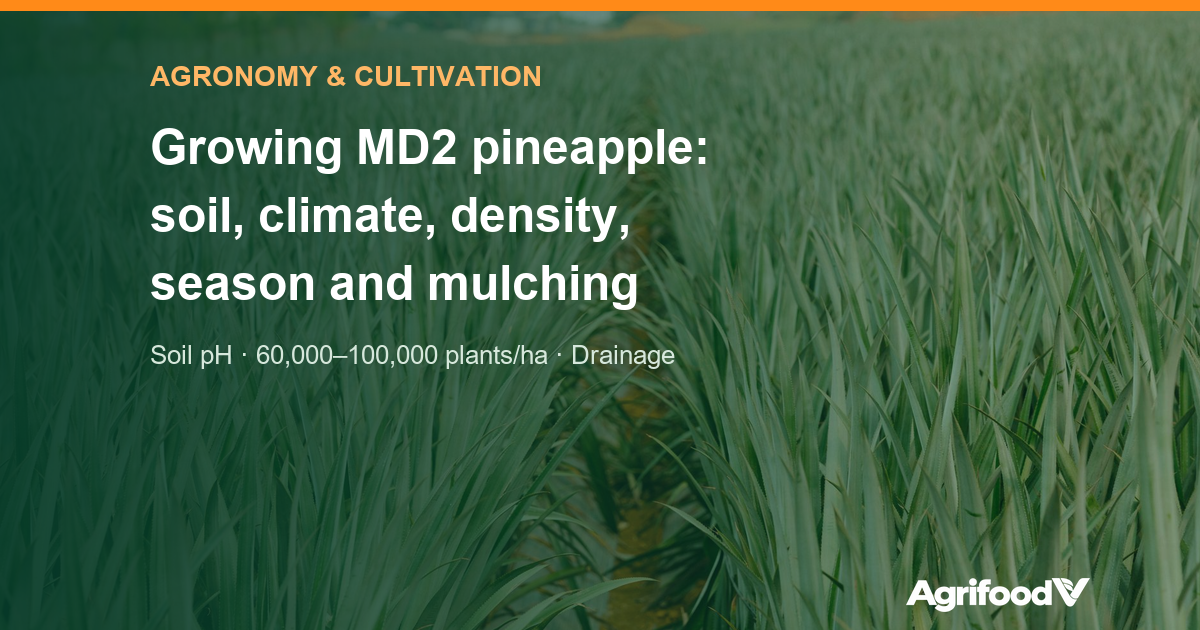
Vietnam has no technical protocol for growing MD2 pineapple issued by the Ministry of Agriculture and Environment or a research institute. The closest government document is the interim pineapple-growing guidance of the Ha Tinh Department of Agriculture and Environment (May 2026), which treats the Cayenne and Queen groups separately and has no section on MD2. Most international technical data, meanwhile, were measured on Cayenne. This article brings together the requirements for climate, soil, planting density, planting season and bed mulching, stating clearly which figures were measured on MD2 and which on other varieties.
Key points
- Pineapple prefers acid, well-drained soil. Hawaii extension material states that a pH of 4.5–5.5 helps reduce soil-borne diseases; MD2, however, is more susceptible to Phytophthora heart rot than Cayenne.
- MD2 planting density in Costa Rica, the world’s largest MD2 region, is 60,000–100,000 plants/ha; irrigated trials in Hawaii used about 68,000 plants/ha. The higher the density, the smaller the fruit.
- Plastic mulch conserves moisture, controls weeds and improves rooting, but Hawaii guidance advises against it in hot, high-rainfall equatorial regions.
- There is no official MD2 planting density or planting season for southern Vietnam or for acid sulphate soils.
Climate and light
- Ha Tinh guidance (not variety-specific): pineapple does well where the mean annual temperature is 20–27 °C, the coldest month is not below 15 °C and the hottest month not above 32 °C; the most suitable rainfall is 1,200–1,500 mm/year. Fruit that ripens at 23–25 °C with little rain has a high Brix; fruit that ripens in cold, wet conditions has a low Brix.
- University of Hawaii extension material (measured on Cayenne): good-quality fruit comes from places with relatively cool nights, many sunny days, daytime temperatures of 21–29.5 °C and not above 32 °C; about 600 mm/year of evenly distributed rainfall is enough for maximum plant growth.
- Fruit is prone to sunburn above 35 °C, and sunburnt areas are easily infected (Paull and Chen, 2014). Ha Tinh guidance recommends shading fruit in strong sun with tied leaves, a straw cover or shade netting.
Soil: pH and drainage
According to the Hawaii material, pineapple is particularly suited to acid soils: a pH of 4.5–5.5 reduces soil-borne diseases, soils above pH 7.0 should be avoided, and good drainage is essential. Where drainage is imperfect, beds should be raised at least 20 cm. Some farms in Hawaii deliberately keep soil pH low to avoid Phytophthora rot (Wang and Sipes, 2009).
This matters for MD2: research in Australia found that Cayenne resists heart rot better, while MD2 is the most susceptible (Anderson et al., 2012). The Ha Tinh guidance also names “susceptible varieties such as Cayenne and MD2”. The recommendation to apply lime across the board (the Ha Tinh guidance specifies 1 tonne of lime powder/ha before land preparation) therefore needs to be weighed carefully: in AgrifoodV’s view, lime should be applied according to soil analysis results, without raising pH excessively in MD2 growing areas.
Do not plant on low-lying land, flat land or poorly drained foothills (Ha Tinh). Fields with nematodes must be treated before planting; see the article on MD2 pineapple pests and diseases.
Planting density and bed layout
| Location, variety | Density | Source |
|---|---|---|
| Costa Rica, MD2 | 60,000–100,000 plants/ha | Castro, Acta Horticulturae 1239, 2019 |
| Hawaii, irrigated MD2 (trial) | 67,925 plants/ha | Bartholomew et al., Acta Horticulturae 902, 2011 |
| Hawaii, Cayenne (double-row beds) | about 58,700 plants/ha; up to 75,000 plants/ha for the fresh market | Bartholomew, Rohrbach, Evans, CTAHR F&N-7, 2002 |
| Lao Cai, MD2 (research project model) | about 60,000 plants/ha | Lao Cai Newspaper, July 2026 |
| Ha Tinh, Queen / Cayenne | 55,000–60,000 / 45,000–50,000 plants/ha | Ha Tinh Department of Agriculture and Environment guidance, May 2026 |
In Hawaii, double-row beds are 122 cm wide (centre to centre), the two rows within a bed are 55–60 cm apart, and plants are spaced 28 cm apart. Within the usual density range, every increase of about 2,470 plants/ha reduces fruit weight by about 45 g (measured on Cayenne). Choosing a density is therefore choosing a fruit size: the fresh fruit market usually wants smaller fruit, while a processing plant needs output in tonnes.
Planting season and planting material
- Ha Tinh: planting is possible year-round, best in April–August; do not plant in rain or on wet soil; shoots should be kept no more than 15 days (spring–summer season) or 30 days (autumn–winter season).
- Equatorial regions, according to the Hawaii material: the first cycle takes only 11–14 months, comprising 6–8 months of vegetative growth and 5–6 months from flower induction to harvest (measured on Cayenne). In Costa Rica, 8-month-old MD2 plants that reach 2.5–3.0 kg are induced to flower (Castro, 2019).
- Planting material should be graded by weight for a uniform field; large ratoon suckers tend to flower early after planting, so Hawaii does not use them. Tissue-cultured plants can be used if the callus stage is avoided, because plants regenerated from callus often show variation. See the articles on MD2 pineapple tissue culture and planting-material standards.
- Official MD2 planting seasons for the Mekong Delta and for acid sulphate soils: no government document exists yet.
Bed mulching and irrigation
Most commercial fields in Hawaii use black polyethylene film about 90 cm wide: the film raises root-zone temperature, conserves moisture, aids rooting and controls weeds. Drip irrigation is laid under the film, with one emitter for every two plants; when there is no rain, about 47,000–94,000 litres/ha/week are applied (Hawaii figures). However, the same material states clearly that mulch film should not be used in hot, high-rainfall equatorial regions. In high-rainfall areas of Vietnam, plastic mulch should be considered in light of drainage conditions and root-zone temperature, not treated as mandatory by default.
What companies should do
AgrifoodV recommendations:
- Analyse the soil (pH, drainage, nematodes) before selecting the area and before deciding on liming; give priority to gently sloping land or raised beds.
- Choose the density according to the end market: export fresh fruit needs a uniform fruit size to the buyer’s requirements, while a plant needs tonnes per hectare; trial 2–3 densities on small lots before scaling up.
- Plant in even-aged lots with the same shoot size, and record the planting date of each lot to plan flower induction and deliveries (see the articles on flower induction and harvesting and fertilising MD2 pineapple).
AgrifoodV supports companies in surveying, planning and organising MD2 pineapple raw-material growing areas.
References
- Bartholomew, D. P.; Rohrbach, K. G.; Evans, D. O. Pineapple Cultivation in Hawaii. CTAHR, University of Hawaii, F&N-7, 2002. ctahr.hawaii.edu.
- Ha Tinh Department of Agriculture and Environment. Official letter providing interim guidance on certain pineapple-growing technical procedures in the province, May 2026. sonnmt.hatinh.gov.vn.
- Castro, Z. Study of the pineapple agro-industrial system in Costa Rica. Acta Horticulturae 1239: 41–50, 2019. DOI: 10.17660/ActaHortic.2019.1239.6.
- Bartholomew, D. P. et al. AVG trial to reduce natural flowering of MD2 pineapple in Hawaii. Acta Horticulturae 902: 211–219, 2011. DOI: 10.17660/ActaHortic.2011.902.21.
- Anderson, J. M.; Pegg, K. G.; Scott, C.; Drenth, A. Study of Phytophthora heart rot and phosphonate treatment in pineapple cultivars. Australasian Plant Pathology 41(1): 59–68, 2012. DOI: 10.1007/s13313-011-0090-6.
- Wang, K.-H.; Sipes, B. S. CTAHR publication SCM-29 on soil solarisation and cover crops as alternatives to soil fumigation for nematode control in Hawaii pineapple fields, 2009. sare.org.
- Paull, R. E.; Chen, C. C. Pineapple: Postharvest Quality-Maintenance Guidelines. CTAHR, University of Hawaii, F_N-32, 2014. ctahr.hawaii.edu.
- Lao Cai Newspaper (Bao Lao Cai). Article on the VietGAP model for a new pineapple variety in Ban Lau commune, 3 July 2026. baolaocai.vn.
Article by AgrifoodV, compiled from the sources above (accessed 17 October 2026). This content is for reference only and is not a substitute for technical advice for a specific growing area. Cover image: HONG SON / Pexels.
© 2026 AgrifoodV. Nội dung được phép trích dẫn khi ghi rõ nguồn và đặt liên kết tới bài gốc; không sao chép toàn văn. Xem Điều khoản sử dụng nội dung.