AgrifoodV · ·
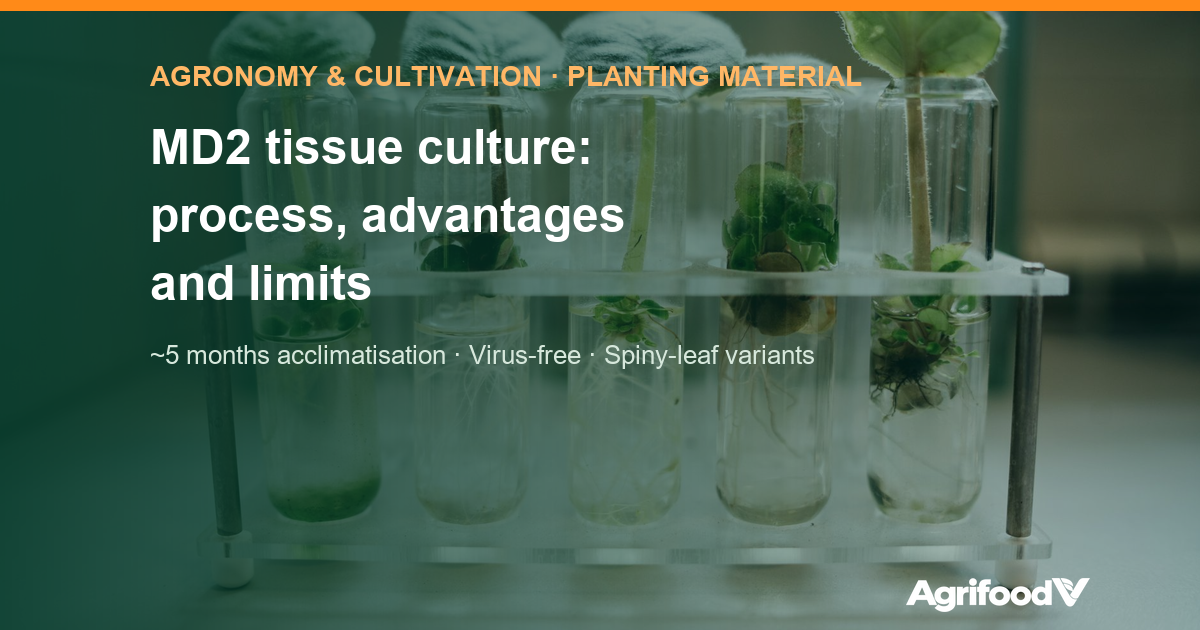
Tissue-cultured MD2 pineapple plants are often presented as the answer to every planting-material problem: disease-free, uniform and fast to multiply. The scientific literature gives a more balanced picture. Tissue culture is a powerful tool for rapidly multiplying a new variety and producing virus-free plants, but it is also costly, carries a risk of variation, and if the mother plant is infected, the plantlets are infected too. This article describes the process, the advantages and the limits, so that companies know what to ask when buying tissue-cultured plants.
Key points
- Commercial pineapple is always propagated vegetatively. Every MD2 plant in the world is a clone of a single original plant selected in Hawaii in 1973.
- It takes about 90 days from placing the explant in vitro to the first shoot; acclimatisation in the nursery takes about 5 months on average and can take up to 8 months.
- Limits: high cost, a first crop that is usually weaker than with conventional planting material, and a risk of somaclonal variation; spiny-leaved plants frequently appear in tissue-cultured MD2.
- Tissue culture is only disease-free if the mother plant is disease-free. Ask for virus test results, the propagation method and the rate of off-type plants.
Why pineapple must be propagated vegetatively
According to the review by Reinhardt, Bartholomew, Souza et al. (Revista Brasileira de Fruticultura, 2018), commercial pineapple must be propagated from vegetative material, which creates no new gene combinations; seed is used only in breeding. MD2 is a single seedling selected in 1973 from a cross made at the Pineapple Research Institute of Hawaii (Bartholomew, Pineapple News No. 16, 2009). Every MD2 plant today is a clone of that plant, propagated from shoots or by tissue culture.
Conventional planting material consists of crowns (on top of the fruit), slips (below the fruit) and suckers (on the stem). The same review notes that MD2 produces many slips in subtropical regions but very few or none in the hot tropics, so in the tropics suckers are the main material, and it takes 2–4 months after fruit harvest to obtain one sucker per plant. This is why the supply of MD2 planting material grows slowly, and why tissue culture attracts interest.
The pineapple tissue culture process
The 2018 review describes the main stages:
- Initiation: shoots are taken from the mother plant, surface-sterilised, trimmed in a sterile laminar-flow cabinet and placed on the culture medium.
- Induction: the shoots swell slowly and must be subcultured several times; growth regulators are added only after about 45 days, with cytokinin being essential.
- Multiplication: the first shoots appear after about 90 days; subculturing then takes place every 45–60 days.
- Rooting on a medium with little or no auxin.
- Acclimatisation in the greenhouse until the plants are large enough for the field: about 5 months on average and up to 8 months. This is the critical and costly step, and in some cases the main limiting factor.
Temporary immersion systems (bioreactors) improve efficiency, reduce cost and raise survival rates during acclimatisation, and have been tested on MD2 (Aragón et al., 2013). On Smooth Cayenne, a study by a Fresh Del Monte team recorded 6,000–8,000 shoots from 2 initial shoots in under 6 months (Firoozabady and Gutterson, 2003).
When reading the figure of “3–4 months per plant” published by some domestic facilities, ask which stage it refers to: the in-vitro phase only, or the whole process until the plant leaves the nursery.
The real advantages
- Rapid multiplication of a new variety. In 2002, the Government of Ghana provided USD 2 million to accelerate production of tissue-cultured MD2 plants as the market shifted to MD2; by the end of 2007 Ghana exported 42,000 tonnes of MD2 (Bartholomew, 2009, citing the Ghana Export Promotion Council).
- Virus-free planting material. Mealybug wilt, caused by PMWaV viruses, spreads mainly through planting material (Massé et al., Viruses, 2024). Virus-tested tissue-cultured plants are one of the recommended options (Pacific Pests, factsheet 380).
Limits to be aware of
- Cost and the first crop: according to the 2018 review, because of the high cost and the usually weaker first crop compared with conventional material, micropropagated plants are in general not yet widely used for commercial pineapple growing, unlike banana.
- Somaclonal variation: MD2 can mutate into spiny-leaved plants, and spiny plants are common where plants are produced by tissue culture (Taniguchi et al., Pineapple News No. 15, 2008). Plants regenerated through a callus phase are more prone to variation (Lin et al., Genes, 2019). The way to limit this is to propagate from stem nodes and avoid callus formation.
- Pathogens follow the mother plant: the health of the mother plant supplying the explants is “extremely important”; multiplying an infected mother plant multiplies the pathogen as well (Reinhardt et al., 2018).
The alternative: field propagation
The 2018 review describes two methods that require no laboratory. Stem sectioning (stem cuttings): buds emerge after 1–2 months, and plantlets go to the field only once they reach 30 cm; the plants are cleaner but smaller and weaker than crowns and suckers, and sectioning also exposes internal symptoms so that affected material can be discarded. Destruction of the growing point: tested on 1.8 kg MD2 plants, it produced about 3.8 shoots of over 200 g per plant within 150 days. Companies can combine the two: virus-free tissue-cultured plants as a mother-plant nursery, followed by controlled field propagation from shoots.
What companies should do
AgrifoodV recommendations:
- When buying tissue-cultured plants, ask for: PMWaV virus test results (RT-PCR) for the mother plant or the plant lot, the propagation method (whether it passes through callus), the number of subcultures, the recorded rate of spiny-leaved or off-type plants, and the date the plants entered the nursery.
- Plant a small trial lot and monitor uniformity and the rate of spiny-leaved plants before ordering large quantities.
- Use virus-free tissue-cultured plants to establish a foundation nursery for the growing area, instead of buying new plants every season. See also the articles on MD2 pineapple planting-material standards and buying MD2 planting material.
AgrifoodV supports companies in building planting-material programmes and nurseries for raw-material growing areas.
References
- Reinhardt, D. H. R. C.; Bartholomew, D. P.; Souza, F. V. D. et al. Advances in pineapple plant propagation. Revista Brasileira de Fruticultura 40(6): e-302, 2018. DOI: 10.1590/0100-29452018302.
- Bartholomew, D. P. “‘MD-2’ pineapple transforms the world’s pineapple fresh fruit export industry”. Pineapple News No. 16, pp. 2–5, 2009. Pineapple Working Group, ISHS. ishs.org.
- Taniguchi, G.; Sanewski, G. M.; Bartholomew, D. P.; Paull, R. E. “Characteristics of the Pineapple Research Institute of Hawaii Hybrids 73-50 and 73-114”. Pineapple News No. 15, pp. 27–34, 2008. ishs.org.
- Firoozabady, E.; Gutterson, N. Cost-effective in vitro propagation methods for pineapple. Plant Cell Reports 21(9): 844–850, 2003. DOI: 10.1007/s00299-003-0577-x.
- Aragón, C. et al. Study on MD-2 pineapple propagation in temporary immersion bioreactors. Plant Cell Reports 32: 1807, 2013. DOI: 10.1007/s00299-013-1493-3.
- Lin, W. et al. Study of DNA methylation in variant pineapple plants derived from callus culture. Genes 10(11): 877, 2019. DOI: 10.3390/genes10110877.
- Massé, D. et al. Phylogenetic study of PMWaV viruses. Viruses 16(7): 1146, 2024. DOI: 10.3390/v16071146.
- Jackson, G. Pineapple wilt disease, Pacific Pests, Pathogens, Weeds & Pesticides, factsheet 380. lucidcentral.org.
Article by AgrifoodV, compiled from the sources above (accessed 17 October 2026). This content is for reference only and is not a substitute for technical advice for a specific growing area. Cover image: Mikhail Nilov / Pexels.
Looking at Vietnam as a sourcing origin or a place to build a value chain?
Tell us your product, target market and expected volumes. In a 30–45 minute online call, AgrifoodV reviews buyers, standards, processing capacity and growing areas with you, starting from the market.
Book a call →Contact us© 2026 AgrifoodV. Nội dung được phép trích dẫn khi ghi rõ nguồn và đặt liên kết tới bài gốc; không sao chép toàn văn. Xem Điều khoản sử dụng nội dung.