AgrifoodV · ·
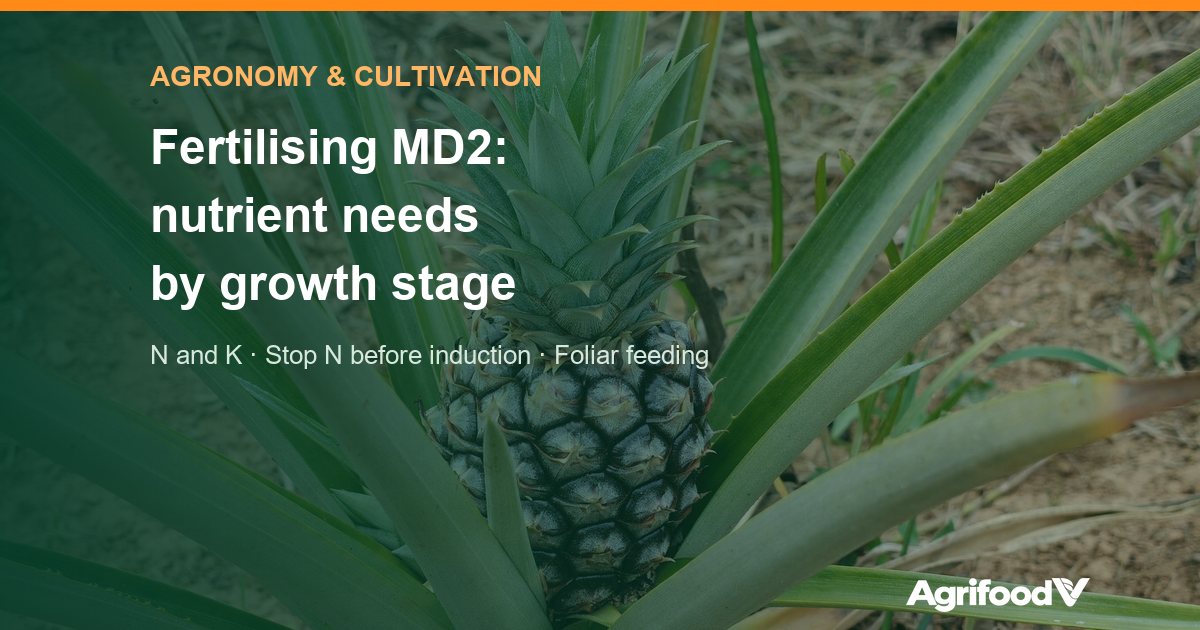
There is no “standard formula” to copy for fertilising MD2 pineapple. The most authoritative material available comes from the University of Hawaii and was measured on Cayenne; the closest government document in Vietnam is Ha Tinh province’s interim guidance, which does not treat MD2 separately. What the two sources agree on is the principle: pineapple needs a lot of nitrogen and potassium, demand rises sharply before floral differentiation, and nitrogen application must stop for a period before flower induction. This article sets out that principle, together with figures that state their source and variety.
Key points
- Pineapple needs a lot of N, K and iron, and little P and calcium. The first five months require little fertiliser; demand peaks 2–4 months before floral differentiation.
- In Hawaii (Cayenne), the plant crop receives about 450 kg N/ha and 400 kg K/ha. The Ha Tinh guidance works out to about 525 kg N and 600 kg K₂O per hectare per cycle.
- Stop nitrogen before flower induction: 4–6 weeks in hot weather in Hawaii; 30–40 days in Ha Tinh.
- Foliar feeding works well on pineapple, but the concentration must be right and the water clean. In Australia, bacterial heart rot has occurred when urea was mixed with dirty water.
What pineapple needs and when
According to University of Hawaii extension material (Bartholomew, Rohrbach and Evans, 2002; measured on Cayenne), pineapple needs a lot of nitrogen (N), potassium (K) and iron (Fe), and little phosphorus (P) and calcium (Ca). In the first five months after planting the plant needs little fertiliser; demand then rises sharply and peaks 2–4 months before floral differentiation. Leaf colour is a practical indicator: in the first five months a pale yellow-green leaf is acceptable; from month 5 to month 8 enough nitrogen should be applied for the leaves to turn progressively dark green; before nitrogen is stopped for flower induction, the plant must have lost all yellow colour.
At the fruit stage, studies show that nitrogen mainly affects fruit size and weight, while potassium has a greater effect on quality parameters such as acidity (studies in Brazil, on varieties other than MD2). A trial on MD2 on acid sulphate soil in Tan Phuoc (former Tien Giang province) recorded the highest yield, 64.85 tonnes/ha, with 5 g K₂O/plant plus a 1% calcium nitrate foliar spray, and the highest Brix, 16.2%, with 10 g K₂O/plant plus 1.5% calcium nitrate (Nguyen Trinh Nhat Hang and Nguyen Khanh Duy, 2022).
Fertiliser rates: two sources, two contexts
| Item | Hawaii (Cayenne, plant crop) | Ha Tinh (not variety-specific, per cycle) |
|---|---|---|
| Nitrogen | about 450 kg N/ha (usually 400–500) | 2.5 tonnes ammonium sulphate/ha, equivalent to about 525 kg N |
| Potassium | about 400 kg K/ha (equivalent to about 482 kg K₂O) | 1.0 tonne potassium chloride/ha, equivalent to about 600 kg K₂O |
| Phosphorus | applied according to soil analysis; about 75 kg P/ha on deficient soils | 2.0 tonnes fused magnesium phosphate/ha, as basal dressing |
| Secondary and micronutrients | 25 kg Mg, 2 kg Zn/ha; iron as repeated foliar sprays | — |
Equivalent figures calculated by AgrifoodV using common nutrient contents (ammonium sulphate 21% N, potassium chloride 60% K₂O, K₂O = K × 1.205); they are not figures stated in the original documents.
The two sources give similar N : K₂O ratios, about 1 : 1.1. The Ha Tinh guidance applies most of the nitrogen, all of the phosphorus and half of the potassium as a basal dressing, followed by top-dressings at 6–8 months after planting and after flowering. The iron, zinc and magnesium rates in the Hawaii material are for severely deficient Hawaiian pineapple soils and should not be applied unchanged in Vietnam.
Stopping nitrogen before flower induction
- Hawaii: in hot weather (nights above 25 °C), stop nitrogen 4–6 weeks before flower induction, to raise the carbohydrate-to-nitrogen ratio in the plant and improve the flowering response. When inducing with ethephon, about 50 kg N/ha can be added as urea; once the heart has opened to about 1.25 cm, fertiliser spraying must stop, because spraying at this stage damages the inflorescence and reduces yield.
- Ha Tinh: stop fertilising 30–40 days before flower induction.
The two sources differ on when this applies: Hawaii applies it only in hot weather, Ha Tinh at all times. See also the article on flower induction and harvesting of MD2 pineapple.
Foliar feeding: the right concentration, clean water
Pineapple absorbs nutrients well through the leaves and leaf axils. The Hawaii material distinguishes three spray volumes: 250–500 litres/ha (targeting the green leaf tissue), 500–2,500 litres/ha (with run-off into the leaf axils, maximum salt concentration 5%), and above 2,500 litres/ha (with run-off to the soil around the base). Urea does not burn leaves at concentrations up to 20% when sprayed only onto green leaf tissue, but the urea must contain less than 1% biuret; spray solutions should contain no more than 1% iron sulphate and 0.1% zinc sulphate.
A warning from Queensland (Australia): bacterial heart rot has occurred when dirty water was used to mix urea. Urease enzymes in the water break urea down into ammonium hydroxide, which damages the heart tissue and opens the way for bacteria (Young et al., 2022). The same study notes that MD2 is particularly susceptible to bacterial heart rot.
Diagnosis with the D-leaf
The D-leaf is the youngest fully mature leaf and usually also the longest; the Pineapple Research Institute of Hawaii regarded analysis of this leaf as the best indicator of nutrient status during vegetative growth. However, we have not found an authoritative table of D-leaf nutrient thresholds for MD2. Companies should sample D-leaves regularly to track trends in their own growing area and compare them with actual yield and quality results, rather than applying a generic threshold.
What companies should do
AgrifoodV recommendations:
- Analyse the soil before planting and sample D-leaves by lot; build a stage-based fertiliser schedule (little fertiliser in the first 5 months, a sharp increase before floral differentiation, nitrogen stopped before induction).
- Record the fertiliser actually applied on each lot so that after one season the growing area has its own data (see the article on cost per hectare).
- In export growing areas, do not use growth stimulants or “fruit-enhancing” products without first checking the maximum residue limits of the destination market.
- Use clean water to prepare spray solutions; do not mix urea with pond or ditch water.
AgrifoodV supports companies in developing cultivation protocols and record-keeping systems for raw-material growing areas. See also: how to grow MD2 pineapple.
References
- Bartholomew, D. P.; Rohrbach, K. G.; Evans, D. O. Pineapple Cultivation in Hawaii. CTAHR, University of Hawaii, F&N-7, 2002. ctahr.hawaii.edu.
- Ha Tinh Department of Agriculture and Environment. Official letter providing interim guidance on certain pineapple-growing technical procedures in the province, May 2026. sonnmt.hatinh.gov.vn.
- Nguyen Trinh Nhat Hang, Nguyen Khanh Duy. Nghiên cứu ảnh hưởng của phân kali, canxi đến năng suất và phẩm chất dứa MD2 trên đất phèn Tân Phước [Effects of potassium and calcium fertilisers on the yield and quality of MD2 pineapple on acid sulphate soil in Tan Phuoc]. Tạp chí Khoa học Công nghệ Nông nghiệp Việt Nam [Vietnam Journal of Agricultural Science and Technology], No. 07(140)/2022, pp. 51–57. tapchi.vaas.vn.
- Young, A. J. et al. Study of bacterial heart rot of pineapple in Queensland. Australasian Plant Pathology 51: 525–533, 2022. DOI: 10.1007/s13313-022-00880-x.
- Englerth, E. J. Jr. PhD dissertation on pineapple nutrition, University of Hawaii, 1969 (definition of the D-leaf). scholarspace.manoa.hawaii.edu.
Article by AgrifoodV, compiled from the sources above (accessed 17 October 2026). This content is for reference only and is not a substitute for technical advice for a specific growing area. Cover image: Joaquin Reyes Ramos / Pexels.
Looking at Vietnam as a sourcing origin or a place to build a value chain?
Tell us your product, target market and expected volumes. In a 30–45 minute online call, AgrifoodV reviews buyers, standards, processing capacity and growing areas with you, starting from the market.
Book a call →Contact us© 2026 AgrifoodV. Nội dung được phép trích dẫn khi ghi rõ nguồn và đặt liên kết tới bài gốc; không sao chép toàn văn. Xem Điều khoản sử dụng nội dung.