AgrifoodV · ·
On the market, MD2 pineapple planting material is often advertised as “MD2 F1”. The label is wrong in substance: pineapple is propagated vegetatively, so there is no F1 or F2 generation when you buy suckers or tissue-culture plantlets. What a buyer really needs to check is whether the material is genuinely MD2, whether it is virus-free, and whether the seller has completed the legal formalities. Vietnam’s legal framework for plant varieties also changed in 2026. This article explains each point and sets out seven criteria for choosing a supplier.
Key points
- Every MD2 plant in the world is a vegetative clone of a single original plant (number 73-114) selected in Hawaii in 1973. “MD2 F1” is a misleading label.
- From 2026, the list of main crop species contains only rice and maize. Pineapple varieties must be self-declared for circulation with the Department of Crop Production and Plant Protection, and may be traded only after the Department has published the declaration.
- Sellers of planting material must ensure traceability of each lot and pay compensation if the material is the wrong variety or fails to meet its declared standard.
- The single most important technical criterion: test results for mealybug wilt virus.
“MD2 F1”: why the label is wrong
According to Bartholomew (Pineapple News No. 16, 2009), MD2 is a seedling grown from a cross between two hybrids, 58-1184 and 59-443, made in 1970 at the Pineapple Research Institute of Hawaii; the plant was selected in 1973 under the number 73-114. Commercial pineapple is propagated vegetatively and does not produce new gene combinations (Reinhardt et al., 2018). Every MD2 plant sold today, whether a sucker or a tissue-culture plantlet, is a copy of that original plant.
“F1” means the first filial generation grown from hybrid seed. In AgrifoodV’s assessment, only the original 73-114 plant of 1973 was an “F1” seedling; the suckers and tissue-culture plantlets on sale are not F1, and there is no “MD2 F2” either. An article in the Agriculture and Environment newspaper (May 2026) still called MD2 an “F1 hybrid pineapple variety”, which shows how widespread the label is. The Law on Crop Production (Article 14) does not accept variety names likely to mislead about a variety’s characteristics and properties, and requires anyone trading propagating material to use the exact variety name that has been recognised or self-declared for circulation.
Also worth knowing: the name “MD2” is not short for “Malayan Dwarf 2”. Del Monte named it in 1981 after Mrs Millie Dillard, wife of the then general manager of Del Monte Hawaii (Bartholomew, 2009).
The legal framework for planting material from 2026
- Pineapple is not a main crop species. Circular 12/2026/TT-BNNMT (effective 24 February 2026) limits the list of main crop species to rice and maize.
- Self-declaration for circulation is mandatory. Under the Law on Crop Production (Articles 13 and 17), varieties outside the main crop species may be produced, traded, exported or imported only once they have been self-declared for circulation. The conditions are: a variety name, cultivation and use value meeting a national standard or an in-house (enterprise) standard, variety information and a production protocol. The declarant is responsible for the accuracy of the information.
- Procedure: the self-declaration dossier is filed with the Department of Crop Production and Plant Protection; within 5 working days the Department publishes it on its website; organisations and individuals may produce and trade the variety only after the information has been published (Circular 07/2026/TT-BNNMT, Article 7).
- Variety labels must show the variety name, characteristics, quantity, production date (for tissue-culture plants, the date of transfer from the test tube to the nursery), the name and address of the producer or importer, and the origin for imported material (Circular 07/2026, Article 9).
- Seller obligations: sellers must have a lawful place of business and ensure traceability of each planting-material lot (Law on Crop Production, Article 22); they must pay compensation when circulating material that is not the declared variety, is counterfeit, or fails to meet the declared standard (Article 32). Users of planting material are entitled to compensation for damage (Article 31).
- Importing planting material: varieties already self-declared for circulation are imported under commercial law; varieties not yet in circulation may be imported only for research and trials and require a permit, now issued by the chairperson of the provincial People’s Committee (Law No. 146/2025/QH15 amending the Law on Crop Production; Circular 07/2026, Article 11).
As of the date of writing, we have not found any self-declaration for circulation of an MD2 pineapple variety on the Department’s website. Companies should check the list on the website of the Department of Crop Production and Plant Protection themselves before signing a contract.
Seven criteria for choosing an MD2 planting-material supplier
- The variety’s self-declaration for circulation has been published on the website of the Department of Crop Production and Plant Protection, under the correct variety name.
- Complete labelling in line with Circular 07/2026; tissue-culture plants show the date they went to the nursery; imported material shows its origin.
- A published in-house standard for planting-material quality (weight, height, freedom from disease), because TCVN 9062:2013 does not apply to MD2. See the article MD2 pineapple planting-material standards.
- RT-PCR test results for PMWaV virus for the mother plants or the plant lot.
- For tissue-culture plants: the propagation method (whether it passes through a callus stage), the number of subcultures, and the recorded rate of spiny-leaf or off-type plants. See the article MD2 pineapple tissue culture.
- For field suckers: taken from fields with a wilt rate below 10%, graded by weight, cured and selected.
- A contract with clauses on lot traceability and compensation if the material is the wrong variety or does not meet the declared standard.
Price of domestic MD2 tissue-culture plantlets: we have not found a reliable published source. A 2025 newspaper article put MD2 suckers imported from Costa Rica at about VND 11,000 per sucker; when comparing prices, compare the same type of material under the same disease-free conditions.
What companies should do
AgrifoodV recommends:
- Do not buy on the strength of an “F1” or “high-yield” label; buy against the seven criteria above and keep records for every planting-material lot.
- Plant a small trial lot and monitor it for one cycle before ordering large quantities; record data by lot (see the article lot-level data).
- For large raw-material growing-area projects, consider self-declaring a variety for circulation and building your own nursery to secure a reliable supply of disease-free planting material.
AgrifoodV helps companies assess planting-material sources and build planting-material programmes for raw-material growing areas. The legal content in this article is for information only and is not a substitute for legal advice.
References
- Bartholomew, D. P. “‘MD-2’ pineapple transforms the world’s pineapple fresh fruit export industry”. Pineapple News No. 16, pp. 2–5, 2009. Pineapple Working Group, ISHS. ishs.org.
- Reinhardt, D. H. R. C.; Bartholomew, D. P.; Souza, F. V. D. et al. Advances in pineapple plant propagation. Revista Brasileira de Fruticultura 40(6): e-302, 2018. DOI: 10.1590/0100-29452018302.
- National Assembly. Law on Crop Production No. 31/2018/QH14, amended by Law No. 146/2025/QH15 (effective 1 January 2026). pbgdpl.cantho.gov.vn.
- Ministry of Agriculture and Environment. Circular 12/2026/TT-BNNMT of 24 February 2026 promulgating the List of main crop species. luatvietnam.vn.
- Ministry of Agriculture and Environment. Circular 07/2026/TT-BNNMT of 23 January 2026 detailing certain articles of the Law on Plant Protection and Quarantine and the Law on Crop Production. datafiles.chinhphu.vn.
- Agriculture and Environment newspaper (Nong nghiep va Moi truong). Video report on pineapple varieties in Ban Lau, 14 May 2026. nongnghiepmoitruong.vn.
- TCVN 9062:2013 Chồi giống dứa – Yêu cầu kỹ thuật [Pineapple planting suckers – Technical requirements] (full text, republished). luatminhkhue.vn.
- Jackson, G. Pineapple wilt disease, Pacific Pests, Pathogens, Weeds & Pesticides, factsheet 380. lucidcentral.org.
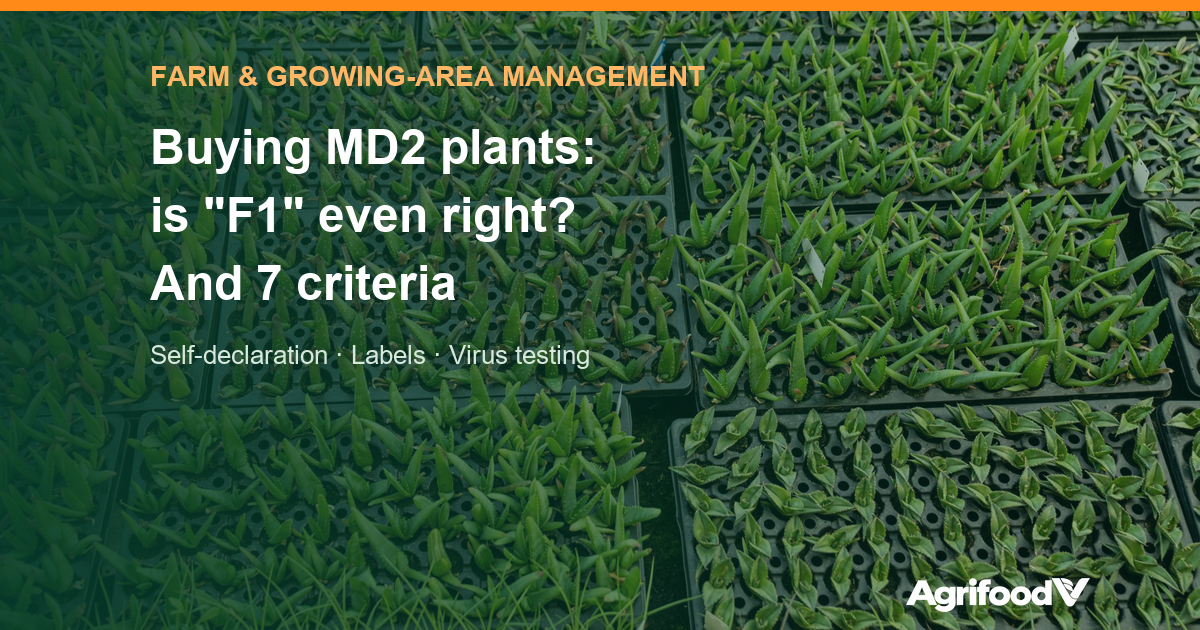
Article by AgrifoodV, compiled from the sources above (accessed 17 October 2026). The legal content is for information only and is not a substitute for legal advice. Cover image: Mark Stebnicki / Pexels.
Looking at Vietnam as a sourcing origin or a place to build a value chain?
Tell us your product, target market and expected volumes. In a 30–45 minute online call, AgrifoodV reviews buyers, standards, processing capacity and growing areas with you, starting from the market.
Book a call →Contact us© 2026 AgrifoodV. Nội dung được phép trích dẫn khi ghi rõ nguồn và đặt liên kết tới bài gốc; không sao chép toàn văn. Xem Điều khoản sử dụng nội dung.