AgrifoodV · ·
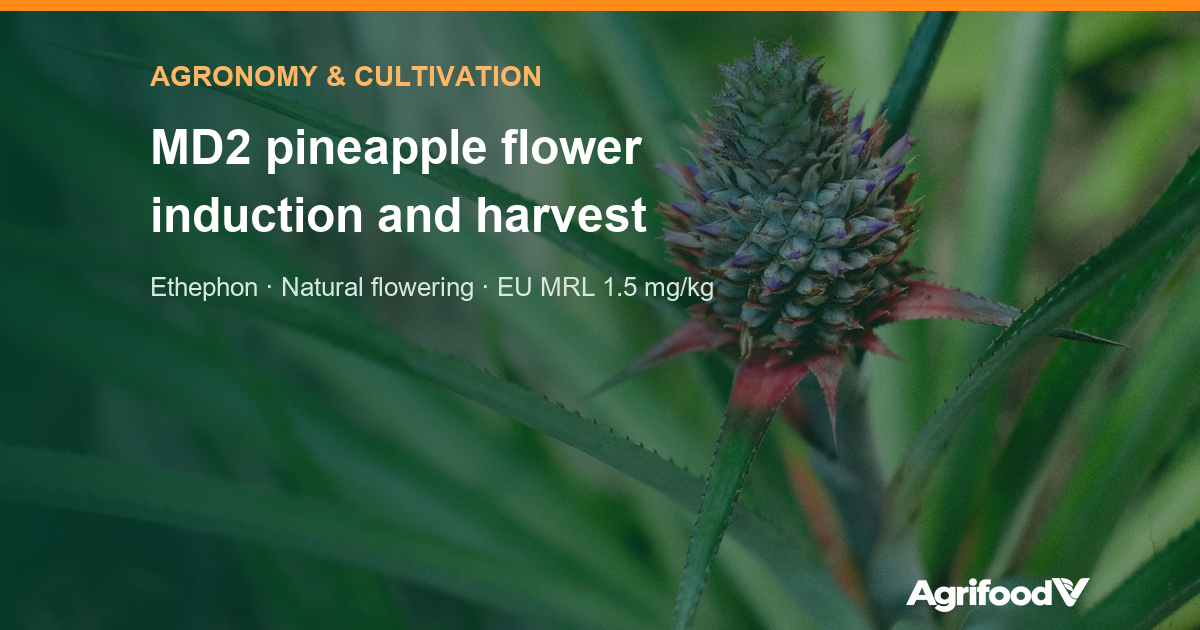
Flower induction is the step that sets the harvest calendar of an entire MD2 pineapple growing area, and therefore also the plant’s raw-material intake schedule and the export shipping schedule. MD2 has two traits that must be taken into account: the variety is more prone than Cayenne to unscheduled natural flowering, and the substance used for flower induction, ethephon, is on the list of residue limits that the EU tightened from August 2026.
Key points
- Ethylene is the only substance that triggers flowering in pineapple; ethephon and calcium carbide (acetylene) both act through this mechanism.
- In Costa Rica, MD2 plants are induced at about 8 months of age, weighing 2.5–3.0 kg; about 21 weeks later the fruit is degreened and harvested all at once.
- Unprotected MD2 fields in Hawaii flowered naturally at rates above 40%; weekly AVG sprays reduced this to 1–15%, but late spraying causes misshapen fruit.
- From 19 August 2026, the EU residue limit for ethephon on pineapple is 1.5 mg/kg. Fruit does not get sweeter after cutting, so harvesting at the right maturity is essential.
Mechanism and conditions for induction
“Ethylene is the only substance that triggers reproductive development in pineapple” (Lin et al., Acta Horticulturae, 2009). Ethephon releases ethylene once it enters plant tissue; calcium carbide produces acetylene gas, which has a similar effect.
- Plant size: in Costa Rica, MD2 plants are induced at 8 months of age when they reach 2.5–3.0 kg (Castro, 2019). For Cayenne, the Hawaii literature states that plants must weigh at least 1.5 kg; the larger the plant at induction, the larger the fruit. The Ha Tinh guidance uses leaf count: 26–28 true leaves for Cayenne, 28–32 leaves for Queen, and 80–95% of plants must meet the standard. There is no official threshold for MD2 in Vietnam yet.
- Weather: ethephon is less reliable in hot weather. Research in Queensland (Turnbull et al., 1999) showed that low-volume spraying was almost ineffective; high-volume spraying worked better because the solution collects in the leaf axils near the growing point; when poured directly into the plant heart, just 20% of the commercial dose was enough for complete flowering. The authors recommend high-volume spraying in the evening and avoiding hot days.
- Nutrition: stop nitrogen fertiliser for a period before induction (see the article on fertilising MD2 pineapple).
Induction methods in use
| Method | Per Ha Tinh guidance (May 2026) | Notes from research |
|---|---|---|
| Ethephon | 10 ml of 39.5% product + 10 litres of water + 20 g of urea, 20–25 ml poured per plant heart, at 5–8 a.m. or 4–6 p.m.; repeat if it rains within 2 hours | Less effective in hot weather; pouring into the heart works better than low-volume spraying |
| Dry calcium carbide | After rain or after watering the plant heart, place 0.8–1 g per heart, 50–60 kg/ha | — |
| Calcium carbide solution | Mix at 1% (1 kg/100 litres), leave for 15–20 minutes, pour 30–40 ml per heart | On the Tainon 17 variety (Taiwan), a 1% solution applied twice 48 hours apart gave complete flowering (Lin et al., 2009) |
Safety warning: mixing calcium carbide can cause explosions. The Ha Tinh guidance advises filling the container with water to no more than two-thirds. Do not mix near open flames and do not seal the container.
Activated charcoal mixed with ethylene is often mentioned, but reviews still question its benefit; trials in Taiwan showed that adding activated charcoal did not change the flowering rate, but only prolonged the release of acetylene. Whether ethephon is registered for use on pineapple in Vietnam’s current list of plant protection products is something companies need to check against the list under Circular 75/2025/TT-BNNMT (as amended by Circular 28/2026) and the product label.
MD2 is prone to unscheduled natural flowering
Pineapple is a short-day plant: short days and cool nights cause the plant to flower on its own, and once reproductive development has begun it cannot be stopped (Paull et al., 2023). Low-acid hybrids such as MD2 flower naturally more readily than Cayenne (Young et al., 2022). Natural flowering disrupts the harvest plan: fruit ripens unevenly and off the plant’s schedule.
A trial on MD2 in Hawaii (Bartholomew et al., 2011): the control plots flowered naturally at rates above 40% in both years. Weekly sprays of AVG (an ethylene synthesis inhibitor) at 100 mg/litre reduced this rate to about 1% in the first year and 15% in the second; spraying every two weeks was less effective. AVG did not reduce fruit weight, but if spraying began after the plants had already been induced, fruit was severely misshapen and almost entirely lost. The Ha Tinh guidance describes tying the leaves to cover the plant heart to limit early flowering; this is local practice and has not been verified by research on MD2.
From induction to harvest and maturity
- Costa Rica: about 21 weeks after induction, the fruit is treated with ethephon so that the shell turns evenly yellow, and is harvested all at once the following week (Castro, 2019). Ha Tinh: harvest 14–18 months after planting, 4–5 months after flowering.
- The fruit does not ripen further or get sweeter after cutting; a more yellow shell does not mean sweeter fruit (Paull and Chen, 2014). Codex CXS 182-1993 for fresh pineapples requires a minimum soluble solids content of 12 °Brix and physiologically mature fruit; this standard does not apply to pineapples for industrial processing. See the article on MD2 pineapple sweetness (°Brix).
- Ha Tinh: harvest when one-third to two-thirds of the fruit has turned yellow from the stalk upwards and the fruitlets are full and rounded; harvest in the early morning or cool late afternoon with a sharp knife, cutting close to the stalk. Black rot infects within 8–12 hours after harvest through cuts and bruises (Paull and Chen, 2014), so bruising must be minimised and the fruit cooled quickly.
- Cold storage: fruit at the colour-break stage keeps for 14–20 days at 7–12 °C. Chilling-induced internal browning only shows 2–3 days after the fruit leaves cold storage; in trials, MD2 was less affected than Cayenne, which is linked to its higher vitamin C content (about 33.6 mg/100 g compared with 5–8 mg in Cayenne, according to Lu et al., 2014).
Ethephon residues: a control point for export produce
Regulation (EU) 2026/215 lowers the maximum residue limit (MRL) for ethephon on pineapple to 1.5 mg/kg, applicable from 19 August 2026. In the Costa Rica-style MD2 export protocol, ethephon is used twice: for flower induction and for degreening about one week before harvest. Because the second application is close to harvest, it is, in our assessment, the higher residue-risk point. The Hawaii literature also notes that in the United States, ethephon is not permitted for postharvest use.
What companies should do
AgrifoodV recommendations:
- Draw up the flower induction schedule lot by lot, working back from the plant’s raw-material intake schedule or the shipping schedule; record the induction date, substance, dose and weather for each lot.
- For growing areas exporting to the EU: test fruit samples for ethephon residues before harvest; consider dropping ethephon degreening if the buyer accepts fruit at natural maturity.
- Have a plan to prevent natural flowering before the season of short days and cool nights; monitor inflorescences after induction to detect lots where induction failed (see the article on digital technology in MD2 pineapple growing areas).
AgrifoodV helps companies plan staggered harvests and manage residues for export raw-material growing areas.
References
- Lin, C. H. et al. Study of pineapple flower induction with ethylene and acetylene. Acta Horticulturae 822: 117–124, 2009. DOI: 10.17660/ActaHortic.2009.822.13.
- Castro, Z. Study of the pineapple agro-industrial system in Costa Rica. Acta Horticulturae 1239: 41–50, 2019. DOI: 10.17660/ActaHortic.2019.1239.6.
- Turnbull, C. G. N. et al. Study of ethephon uptake and flower induction in pineapple. Journal of Plant Growth Regulation 18: 145–152, 1999. DOI: 10.1007/PL00007062.
- Bartholomew, D. P. et al. Trial of AVG to limit natural flowering of MD2 pineapple in Hawaii. Acta Horticulturae 902: 211–219, 2011. DOI: 10.17660/ActaHortic.2011.902.21.
- Paull, R. E. et al. Study of flowering in pineapple. Plant Direct 7(11): e541, 2023. DOI: 10.1002/pld3.541.
- Young, A. J. et al. Study of bacterial heart rot of pineapple in Queensland. Australasian Plant Pathology 51: 525–533, 2022. DOI: 10.1007/s13313-022-00880-x.
- Lu, X. H. et al. Comparison of fruit quality in 26 pineapple genotypes. Molecules 19(6): 8518–8532, 2014. DOI: 10.3390/molecules19068518.
- Bartholomew, D. P.; Rohrbach, K. G.; Evans, D. O. Pineapple Cultivation in Hawaii. CTAHR, University of Hawaii, F&N-7, 2002. ctahr.hawaii.edu.
- Paull, R. E.; Chen, C. C. Pineapple: Postharvest Quality-Maintenance Guidelines. CTAHR, University of Hawaii, F_N-32, 2014. ctahr.hawaii.edu.
- Ha Tinh Department of Agriculture and Environment. Công văn hướng dẫn tạm thời một số quy trình kỹ thuật trồng dứa trên địa bàn tỉnh [Official letter providing interim guidance on pineapple growing practices in the province], May 2026. sonnmt.hatinh.gov.vn.
- Codex Alimentarius. Standard for Pineapples, CXS 182-1993. fao.org.
- European Commission. Regulation (EU) 2026/215 of 29 January 2026 amending the maximum residue levels for dimoxystrobin, ethephon and propamocarb. eur-lex.europa.eu.
Article by AgrifoodV, compiled from the sources above (accessed 17 October 2026). This content is not a substitute for the directions for use on pesticide labels or for technical advice for a specific growing area. Cover image: Alexey Demidov / Pexels.
Looking at Vietnam as a sourcing origin or a place to build a value chain?
Tell us your product, target market and expected volumes. In a 30–45 minute online call, AgrifoodV reviews buyers, standards, processing capacity and growing areas with you, starting from the market.
Book a call →Contact us© 2026 AgrifoodV. Nội dung được phép trích dẫn khi ghi rõ nguồn và đặt liên kết tới bài gốc; không sao chép toàn văn. Xem Điều khoản sử dụng nội dung.