AgrifoodV · ·
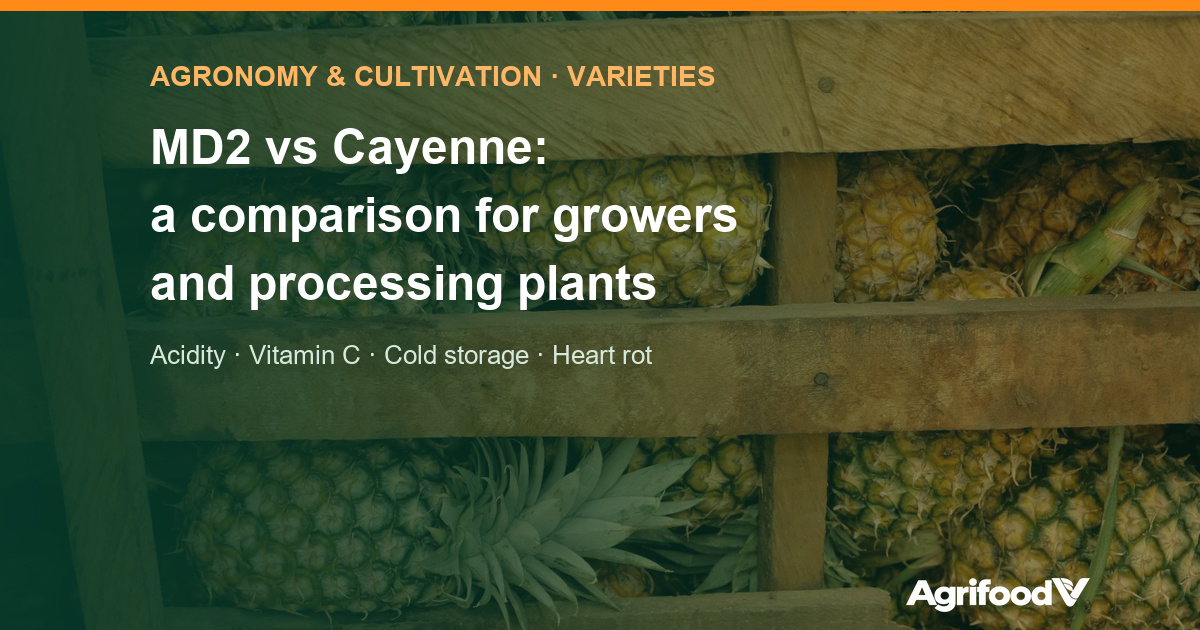
Choosing between MD2 pineapple and Cayenne pineapple is not a question of which variety is “better”, but of which variety fits the intended market. MD2 dominates the fresh fruit market thanks to its low acidity, high vitamin C and good tolerance of cold storage. Cayenne still has a place in canning and resists some diseases better. The comparison below is based on studies that measured the two varieties under the same conditions, with the location of each measurement stated, because results vary by region.
Key points
- The most consistent difference: MD2 has lower acidity than Cayenne in every season (Hawaii) and much higher vitamin C. Brix, however, is not always higher in MD2.
- MD2 resists internal browning and tolerates cold storage best among commercial varieties; this is why it accounts for more than 80% of the pineapples imported into Europe (CBI).
- MD2’s weaknesses: it flowers naturally easily in cool weather and is much more susceptible to Phytophthora heart rot than Cayenne; canned MD2 has poorer flavour than canned Cayenne.
- For juice and concentrate plants: MD2 juice has a higher sugar-to-acid ratio, which must be taken into account if the buyer specifies an acidity range.
Fruit quality
| Parameter (same orchard, Guangdong, 2012) | MD2 | Smooth Cayenne (2 lines) |
|---|---|---|
| Fruit weight | 1,132.8 g | 1,137.6 g and 1,072.5 g |
| Soluble solids | 16.12 °Brix | 16.55 and 14.45 °Brix |
| Acidity (as citric acid) | 0.53% | 0.73% and 1.23% |
| Vitamin C | 33.57 mg/100 g (highest of 26 genotypes) | 5.08 and 7.68 mg/100 g |
Source: Lu et al., Molecules, 2014. One orchard, one year; the figures are for comparison under the same conditions.
In Hawaii, MD2 Brix averages 1–2 points higher than Cayenne when ripened under the same conditions, but this does not hold in Queensland, where both were at about 16% in a summer-crop trial; MD2 acidity is lower than Cayenne’s in every season in Hawaii (Taniguchi et al., Pineapple News No. 15, 2008). MD2 flesh is more yellow, firmer, more fibrous and more translucent than Cayenne; the fruit has “square shoulders” and larger fruitlets. In hot tropical regions such as Ghana, MD2 fruit reaches sufficient Brix but has very low acidity and weak aroma.
Storage and the fresh fruit market
According to Bartholomew (Pineapple News No. 16, 2009), no pineapple variety in international trade tolerates cold storage as well as MD2. MD2 is highly resistant to internal browning, which is common in Cayenne and Queen. Before the mid-1990s, fresh pineapple exports were based mainly on Cayenne; just about 10 years after MD2 was launched on the US and European markets in 1996, the variety had almost entirely replaced Cayenne on the fresh pineapple shelf. CBI reports that more than 80% of the pineapples imported into Europe are MD2 (2017 data).
Cultivation: two varieties, two sets of risks
| Factor | MD2 | Cayenne |
|---|---|---|
| Yield | In Hawaii and Costa Rica, MD2 is reported to yield more; in subtropical Queensland, MD2 yields much less (Pineapple News 15; the source describes this information as partly anecdotal) | |
| Natural flowering in cool weather | Very prone, “a serious physiological weakness” | Much less prone |
| From flower induction to harvest (Ghana) | 130 days | 135 days |
| Phytophthora heart rot and root rot | Highly susceptible, much more so than Cayenne | More resistant |
| Reniform nematode | More tolerant | Less tolerant |
| Recommended density | Up to about 70,000 plants/ha for both (Reinhardt et al., 2018) | |
Two caveats from the sources: on diseases caused by Fusarium fungi, the literature is contradictory (one source reports MD2 as resistant to fruitlet core rot, while a source in Brazil reports MD2 as highly susceptible to fusariosis), so it cannot be stated that MD2 is resistant to Fusarium. On mealybug wilt, no symptoms had been seen on MD2 in Hawaii as of 2008, but the virus has been detected in MD2 fields in Colombia and in mealybugs in Peru. See the articles on MD2 pineapple pests and diseases and flower induction.
The processing plant perspective
- Canning: canned MD2 looks comparable to Cayenne, but its flavour is rated lower (Pineapple News 15). Cayenne has high sugar and acid levels and is very well suited to canning (CBI).
- Juice and concentrate: MD2 juice has a higher sugar-to-acid ratio (based on the measurements of Lu et al., 2014). In our assessment, plants need to take this into account when the contract specifies an acidity range or a Brix-to-acid ratio, and when blending with other raw materials.
- Juice yield and slice recovery of MD2 compared with Cayenne: no peer-reviewed measurements found. The often-quoted figure for better slice recovery than Cayenne refers to 73-50 (MD2’s “sibling”), not to MD2.
See also the pillar article on pineapple juice exports and MD2 growing areas.
What companies should do
AgrifoodV recommendations:
- Choose the variety according to the intended market: MD2 for fresh fruit exports; consider Cayenne for traditional canning; for juice and concentrate, decide according to the specifications the buyer requires.
- If growing MD2, invest early in drainage, heart rot prevention and a plan to prevent natural flowering; these are two risks that are greater than with Cayenne.
- Measure raw-material Brix and acidity lot by lot and season by season within your own growing area, because international figures vary widely with climate.
AgrifoodV helps companies choose markets and products, and then select varieties and organise suitable raw-material growing areas.
References
- Lu, X.-H. et al. Physico-chemical properties, antioxidant activity and mineral contents of pineapple genotypes grown in China. Molecules 19(6): 8518–8532, 2014. DOI: 10.3390/molecules19068518.
- Taniguchi, G.; Sanewski, G. M.; Bartholomew, D. P.; Paull, R. E. “Characteristics of the Pineapple Research Institute of Hawaii Hybrids 73-50 and 73-114”. Pineapple News No. 15, pp. 27–34, 2008. ishs.org.
- Bartholomew, D. P. “‘MD-2’ pineapple transforms the world’s pineapple fresh fruit export industry”. Pineapple News No. 16, pp. 2–5, 2009. Pineapple Working Group, ISHS. ishs.org.
- CBI (Netherlands Ministry of Foreign Affairs). Exporting fresh pineapple to Europe (2017 data), republished copy. srilankabusiness.com.
- Reinhardt, D. H. R. C.; Bartholomew, D. P.; Souza, F. V. D. et al. Advances in pineapple plant propagation. Revista Brasileira de Fruticultura 40(6): e-302, 2018. DOI: 10.1590/0100-29452018302.
- Carvalho, R. A. et al. Article on fusariosis in MD-2 pineapple in Brazil. Pineapple News No. 17, p. 8, 2010. ishs.org.
- Moreno, I. et al. Tropical Plant Pathology, 2023. DOI: 10.1007/s40858-023-00559-8.
Article by AgrifoodV, compiled from the sources above (accessed 17 October 2026). This content is for reference only and is not a substitute for technical advice for a specific growing area. Cover image: LekePOV / Pexels.
Looking at Vietnam as a sourcing origin or a place to build a value chain?
Tell us your product, target market and expected volumes. In a 30–45 minute online call, AgrifoodV reviews buyers, standards, processing capacity and growing areas with you, starting from the market.
Book a call →Contact us© 2026 AgrifoodV. Nội dung được phép trích dẫn khi ghi rõ nguồn và đặt liên kết tới bài gốc; không sao chép toàn văn. Xem Điều khoản sử dụng nội dung.