AgrifoodV · ·
Ask “what makes an MD2 pineapple plant meet the standard?” and the first answer is this: Vietnam has no national standard for MD2 planting material or for tissue-cultured pineapple plants. The only standard for pineapple shoots, TCVN 9062:2013, applies only to the Queen and Cayenne groups, and checks pests and diseases by visual inspection. Companies therefore have to set their own quality requirements when buying planting material, based on the existing standard, the protocol of the Fruit and Vegetable Research Institute and international technical recommendations.
Key points
- TCVN 9062:2013 “Pineapple planting shoots – Technical requirements” sets shoot weight and height for the Queen and Cayenne groups, with no section on MD2 or tissue-cultured plants.
- The Fruit and Vegetable Research Institute’s MD2 protocol for the northern provinces specifies suckers of 250–350 g and crowns of 200–300 g.
- International recommendations: grade shoots by weight, plant each shoot type in a separate block, and sun-dry shoots before planting.
- The most important criterion missing from the current standard: testing for the mealybug wilt viruses (PMWaV).
TCVN 9062:2013: what it covers and what it does not
TCVN 9062:2013 was drafted by the Fruit and Vegetable Research Institute and replaced the sector standard 10TCN 462-2001. It applies to planting shoots of the Queen and Cayenne pineapple groups, with the following main requirements:
- Mother plants supplying shoots come from a planting-material nursery, are vigorous, uniform and free of pests and diseases; shoots are true to variety, with morphological off-types not exceeding 5%.
- Shoot weight: Cayenne crowns 200–300 g, Queen crowns 180–250 g; suckers 200–300 g; Cayenne slips 180–250 g, Queen slips 150–200 g; shoots from stem cuttings 100–150 g.
- Shoot storage time: no more than 15 days in the spring–summer season and no more than 30 days in the autumn–winter season.
- Label: variety name, lot code, name and address of the supplier, main quality parameters, dispatch date and shelf life.
A notable weakness: the standard’s method for checking pests and diseases is visual inspection with the naked eye. There is no virus testing. A shoot that “meets TCVN” is therefore not necessarily virus-free.
Figures for MD2: a protocol, not a standard
The Fruit and Vegetable Research Institute’s technical protocol for planting, tending and harvesting MD2 pineapple in the northern provinces specifies: suckers of 250–350 g and 35–40 cm tall (after the leaf tips are trimmed); crowns of 200–300 g and 20–25 cm tall; smaller shoots must be grown on in a nursery until they reach the standard; shoots must be free of dangerous diseases; planting density of 60,000 shoots/ha. This is a technical protocol, not a national standard, and it does not cover tissue-cultured plants.
On the legal side, from 2026 the list of main crop species includes only rice and maize (Circular 12/2026/TT-BNNMT). The Ministry of Agriculture and Environment has issued quality regulations for rice and maize seed, but there is no technical regulation for pineapple propagation material. The Law on Crop Production requires planting material to be produced to a national standard or, where none exists, to a company standard (Article 23). This means that a supplier selling MD2 planting material must declare its own company standard and take responsibility for it.
International technical recommendations
The review of pineapple propagation by Reinhardt, Bartholomew, Souza et al. (2018) makes the following recommendations:
- Slips and suckers should be at least 30 cm, with an upper limit of 50–60 cm; suckers are usually harvested at 300–500 g.
- Grading by weight is more effective than grading by height, because weight reflects nutrient reserves and gives a more uniform field. Slips and suckers are planted in separate blocks.
- Suckers that are too large may already have initiated flowering before removal and produce small fruit. In Costa Rica, MD2 suckers are often trimmed by cutting off the upper half of the leaves, for easier transport and more uniform weight.
- Sun-drying shoots for a few days, usually no more than 2 weeks, helps the cut surface heal, reduces black rot and lowers mealybug numbers; discard any shoot with rot symptoms or wax (mealybug presence).
- Storing shoots for long periods depletes their reserves and slows growth after planting.
The criterion the standard lacks: virus-free status
Mealybug wilt develops only when a plant is both infected with PMWaV-2 and fed on by mealybugs (Sether and Hu, Phytopathology, 2002), and it reduces yield by about 35% compared with virus-free plants (Sether and Hu, Plant Disease, 2002). A global survey found PMWaV widely distributed in all pineapple-growing regions; in MD2 fields in Colombia, one PMWaV species was detected in 92.6% of plant samples (Moreno et al., 2023). Genetic analysis shows that the virus spreads mainly through people and planting material (Massé et al., 2024).
Recommendations for planting material (Pacific Pests, factsheet 380): use virus-tested tissue-cultured plants, or shoots treated in hot water at 50 °C for 30 minutes; otherwise, take shoots from fields with less than 10% wilt and avoid plants next to diseased ones. Specific RT-PCR primer sets are available for detecting the PMWaV species (Larrea-Sarmiento et al., 2022).
Proposed acceptance criteria for MD2 planting material
| Criterion | Reference basis |
|---|---|
| True to variety, morphologically uniform (off-types ≤ 5%) | TCVN 9062:2013 |
| Weight by shoot type, graded by weight | Fruit and Vegetable Research Institute MD2 protocol; Reinhardt et al. 2018 |
| PMWaV virus test results (RT-PCR) for the plant lot or the mother plants | Sether and Hu 2002; Pacific Pests 380 |
| No mealybugs, no rot symptoms; sun-dried and sorted | Reinhardt et al. 2018 |
| Tissue-cultured plants: date of transfer to the nursery, rate of spiny-leaved plants | Circular 07/2026/TT-BNNMT (labelling); Pineapple News 15 |
| Label and a declared company standard | Law on Crop Production; Circular 07/2026/TT-BNNMT |
What companies should do
AgrifoodV recommendations:
- Include the criteria table above in the planting-material purchase contract; inspect samples on receipt and keep records by lot.
- Test a representative sample from each planting-material lot for viruses, especially material that is imported or sourced from another region.
- For large growing areas, build a virus-free foundation nursery and a dedicated company standard for the area’s planting material. See also the articles on MD2 pineapple tissue culture and MD2 pineapple pests and diseases.
AgrifoodV supports companies in developing company standards and planting-material quality control for raw-material growing areas.
References
- TCVN 9062:2013 Chồi giống dứa – Yêu cầu kỹ thuật [Pineapple planting shoots – Technical requirements] (full text, republished). luatminhkhue.vn.
- Fruit and Vegetable Research Institute (FAVRI). Quy trình kỹ thuật trồng, chăm sóc và thu hoạch dứa MD2 các tỉnh phía Bắc [Technical protocol for planting, tending and harvesting MD2 pineapple in the northern provinces]. favri.org.vn.
- Reinhardt, D. H. R. C.; Bartholomew, D. P.; Souza, F. V. D. et al. Advances in pineapple plant propagation. Revista Brasileira de Fruticultura 40(6): e-302, 2018. DOI: 10.1590/0100-29452018302.
- Sether, D. M.; Hu, J. S. Phytopathology 92: 928–935, 2002, DOI: 10.1094/PHYTO.2002.92.9.928; and Plant Disease 86: 867–874, 2002, DOI: 10.1094/PDIS.2002.86.8.867.
- Jackson, G. Pineapple wilt disease, Pacific Pests, Pathogens, Weeds & Pesticides, factsheet 380. lucidcentral.org.
- Moreno, I. et al. Study of PMWaV viruses in MD-2 pineapple fields in Valle del Cauca. Tropical Plant Pathology, 2023. DOI: 10.1007/s40858-023-00559-8.
- Massé, D. et al. Viruses 16(7): 1146, 2024. DOI: 10.3390/v16071146.
- Larrea-Sarmiento, A. E. et al. RT-PCR primer sets for detecting pineapple viruses. Pathogens 11: 1470, 2022. DOI: 10.3390/pathogens11121470.
- Ministry of Agriculture and Environment. Circular 12/2026/TT-BNNMT of 24 February 2026 issuing the List of main crop species. luatvietnam.vn.
- Ministry of Agriculture and Environment. Circular 07/2026/TT-BNNMT of 23 January 2026 detailing certain articles of the Law on Plant Protection and Quarantine and the Law on Crop Production. datafiles.chinhphu.vn.
- National Assembly. Law on Crop Production No. 31/2018/QH14, amended by Law No. 146/2025/QH15 (effective 1 January 2026). pbgdpl.cantho.gov.vn.
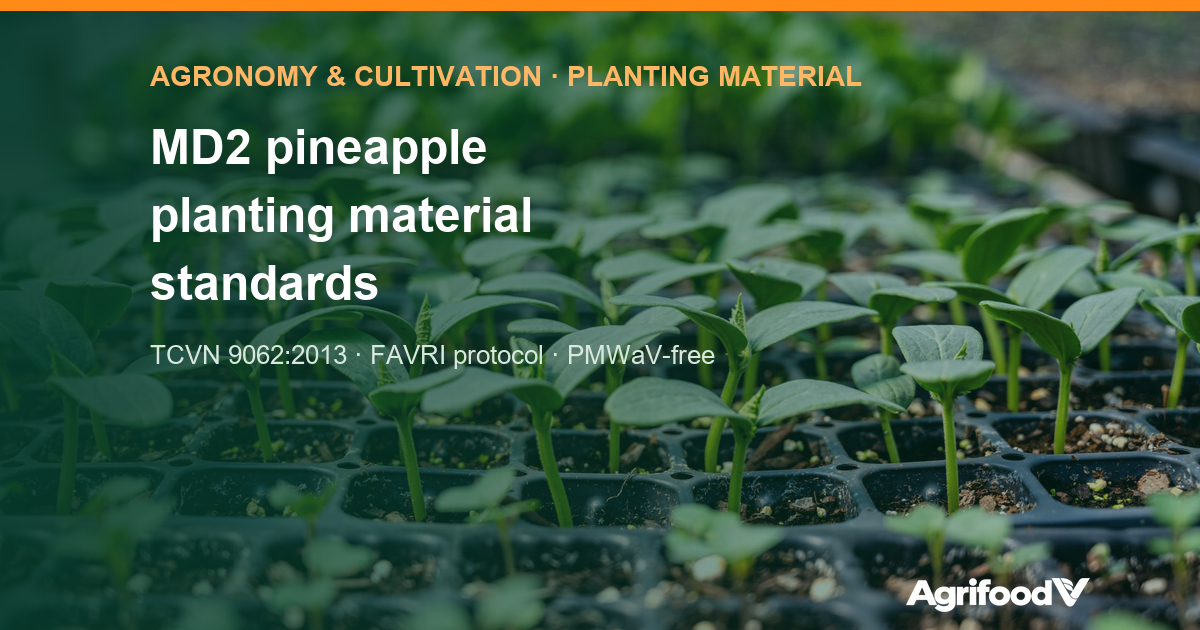
Article by AgrifoodV, compiled from the sources above (accessed 17 October 2026). This content is for reference only and is not a substitute for technical advice for a specific growing area. Cover image: Alfo Medeiros / Pexels.
Looking at Vietnam as a sourcing origin or a place to build a value chain?
Tell us your product, target market and expected volumes. In a 30–45 minute online call, AgrifoodV reviews buyers, standards, processing capacity and growing areas with you, starting from the market.
Book a call →Contact us© 2026 AgrifoodV. Nội dung được phép trích dẫn khi ghi rõ nguồn và đặt liên kết tới bài gốc; không sao chép toàn văn. Xem Điều khoản sử dụng nội dung.