AgrifoodV ·
An export oyster plant is not judged by how many machines it has, but by whether it can prove three things: oysters move one way from the dirty zone to the clean zone, the product never leaves its permitted temperature band, and every carton can be traced back to its growing area, harvest day and production shift. This article walks through the six stages from farm raft to container, with the target temperature at each stage and the regulation behind it, so that investors know what to ask when they review a plant layout.
Key points
- Six stages: growing area and harvest; receiving; washing, grading, depuration; shucking; freezing, glazing, packing; cold store and container.
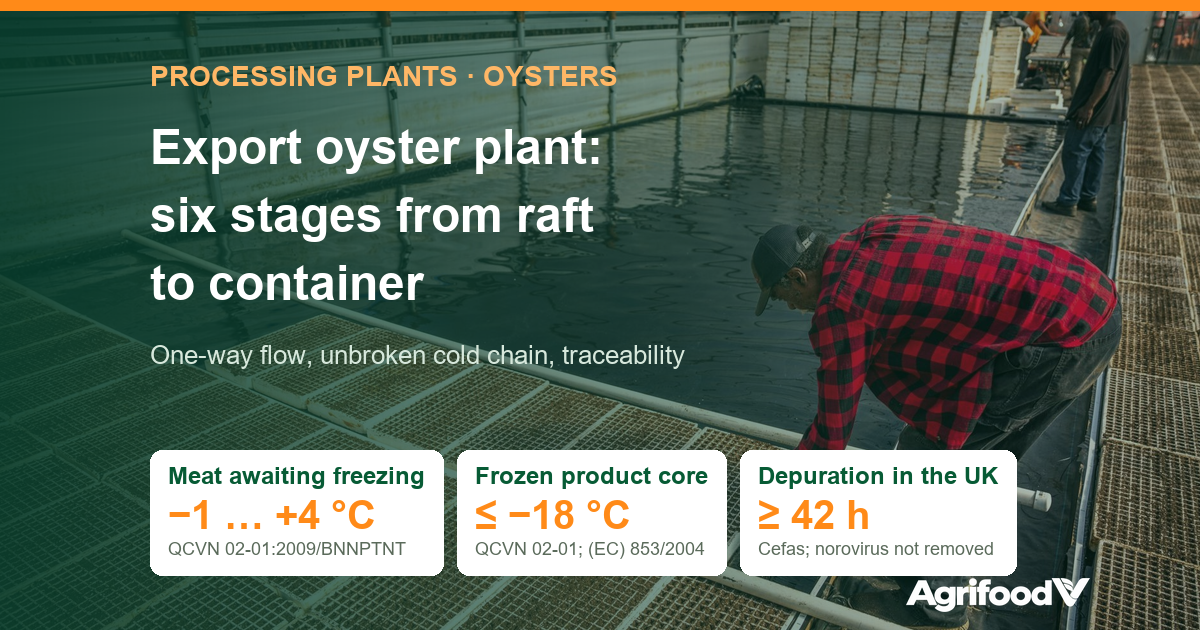
- The first three stages handle live oysters: the goal is to keep them alive and free of mud, not to chill them hard. Once shucked, oyster meat is a fresh fishery product and must be held between −1 °C and +4 °C until frozen (Vietnam’s QCVN 02-01:2009/BNNPTNT).
- Frozen product must reach −18 °C at the core before leaving the freezer, and stay no warmer than −18 °C in all parts in storage and in transport (QCVN 02-01; Regulation (EC) 853/2004).
- Depuration reduces bacteria but does not remove norovirus or marine biotoxins. A monitored growing area is the first condition, and no equipment can replace it.
Three principles every layout must prove
One-way flow. QCVN 02-01:2009/BNNPTNT requires separate flows for workers, raw material, semi-finished goods, finished goods, ice, packaging and waste, and states that “each later step must be cleaner than the one before”. In an oyster plant the clearest boundary is the shucking table: before it are oysters in shell, mud, barnacles and crates coming in from the rafts; after it is oyster meat, an edible product. The two sides do not share walkways, tools or freezing rooms.
Unbroken cold chain. Each stage has its own temperature band. The usual failure is not the freezing equipment but the waiting points: oyster meat left on the table for lack of trays, or frozen product waiting to be packed outside the chilled room.
Traceability. QCVN 02-07:2009/BNNPTNT (bivalve mollusc establishments) requires numbered soaking tanks, records for every lot, and acceptance only of lots carrying a bivalve mollusc certificate of origin issued by the local fisheries authority, kept for at least 2 years. The same lot code must follow the product all the way to the carton label.
Six stages and their target temperatures
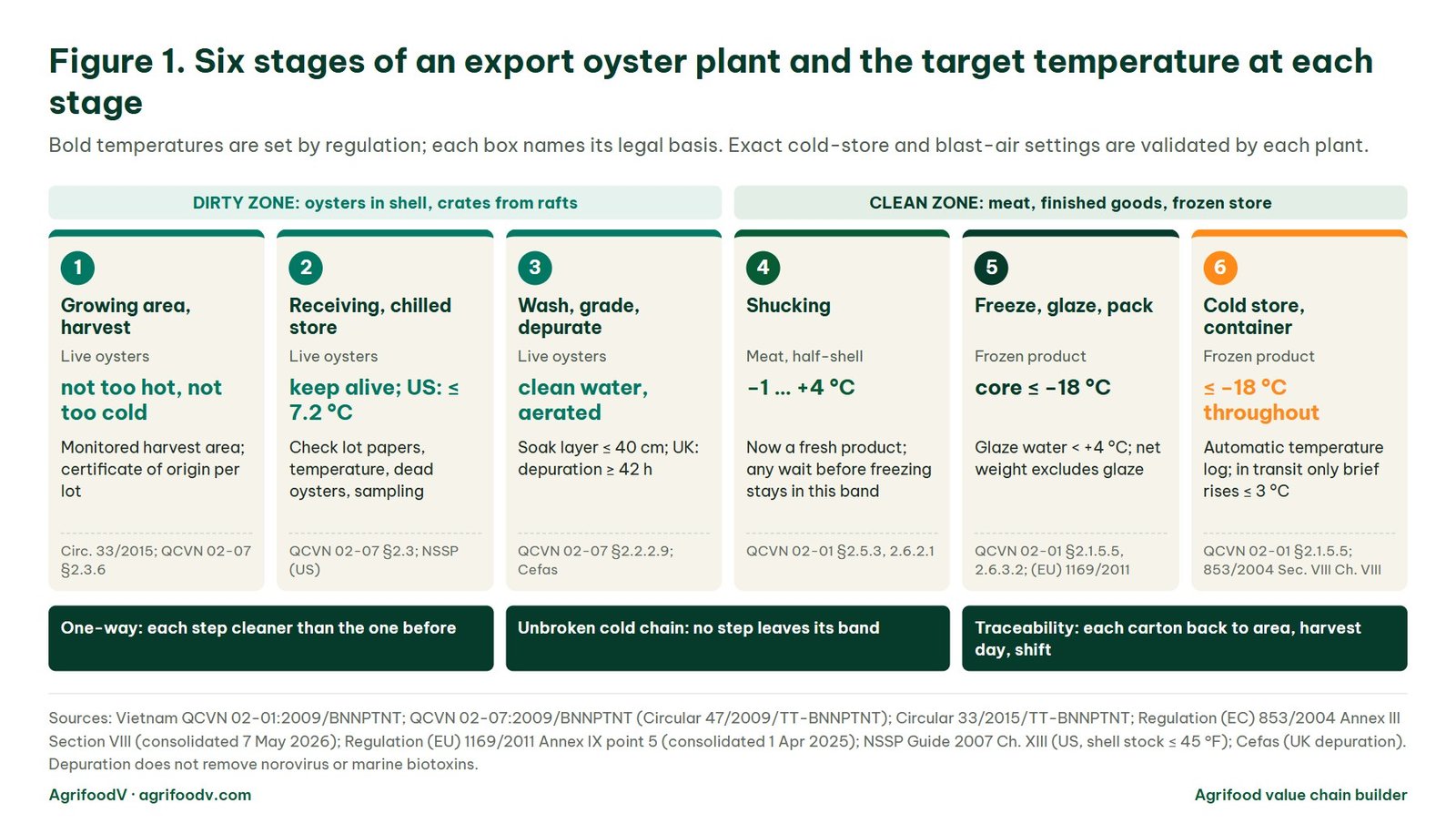
Stage 1, growing area and harvest. Oysters for export must come from harvest areas covered by the bivalve mollusc food safety monitoring programme under Circular 33/2015/TT-BNNPTNT; a plant may not accept oysters from an area whose harvesting has been suspended. For carrying live oysters from the rafts, QCVN 02-07 sets no figure but requires that oysters not be exposed to excessive heat, cold or large temperature swings, using insulated trucks or boxes when the weather is hot or the journey long.
Stage 2, receiving. Each lot is checked for its certificate of origin, temperature, share of dead oysters (shells that do not close), sensory condition, and sampled for microbiology, biotoxins and heavy metals according to plan. As a numerical reference, the US National Shellfish Sanitation Program (NSSP) requires shell stock to be iced or stored at no more than 45 °F, about 7.2 °C.
Stage 3, washing, grading, depuration. QCVN 02-07 requires mud to be washed off with clean water or clean seawater before soaking, the soaking layer to be no deeper than 40 cm, and aeration to be used. Depuration (holding oysters in recirculated clean seawater so they purge themselves) is only required for raw-consumption product from areas below the cleanest class; in the United Kingdom, Cefas describes a minimum of 42 hours. EFSA concluded that common depuration practices do not effectively reduce norovirus. Small or off-size oysters from grading go to the meat line or to processed products.
Stage 4, shucking. There are three methods: knife, steam heat shock to make the shell gape, and high-pressure processing (HPP), which detaches the adductor muscle from the shell. The shucking method determines meat yield, the risk of shell fragments and even which markets are open, and will be covered in a separate article. From this point oyster meat is a fresh fishery product: QCVN 02-01 requires product to be chilled to +4 °C or lower, but not below −1 °C, before packing, and held between −1 °C and +4 °C if it has to wait for freezing. Regulation (EC) 853/2004 uses the wording “a temperature approaching that of melting ice”. Shell fragments in the meat are the most frequent buyer complaint, so meat washing is usually followed by candling or X-ray inspection.
Stage 5, freezing, glazing, packing. Belt IQF freezing equipment is used for meat, air-blast freezing equipment for half-shell and whole oysters. QCVN 02-01 forbids taking product out of the freezer before its core reaches −18 °C and forbids using the cold store for freezing. Glazing water must be clean water chilled below +4 °C. For the EU, Regulation (EU) 1169/2011 (Annex IX, point 5) requires the declared net weight to exclude the glaze; buyers will deglaze and weigh to check.
Stage 6, cold store and container. The cold store must hold the product core no warmer than −18 °C even when fully loaded, log temperature automatically, use thermometers accurate to 0.5 °C, and place the sensor at the warmest point of the room. In transport, Regulation (EC) 853/2004 requires frozen product to be kept at an even temperature of no more than −18 °C in all parts, with only brief upward fluctuations of up to 3 °C. Many plants set their stores a few degrees lower to keep a safety margin when doors open for loading.
What records each stage leaves behind
Audit teams from importing countries and buyers do not stand watching the line all day; they read the records. A plant that runs well but keeps incomplete records will not pass an audit.
| Stage | Records required | Weak point |
|---|---|---|
| 1. Growing area, harvest | Certificate of origin per lot; status of the harvest area on the harvest day | Accepting oysters from a suspended area; papers that lump several rafts together |
| 2. Receiving | Receiving sheet: temperature, mortality, sensory check; sample results | Crates and trays from the rafts going straight into processing without washing |
| 3. Washing, depuration | Tank number, soaking time, microbiology of supply water, microbiology of raw-consumption product | Mixing lots from different areas or days in one tank |
| 4. Shucking | Meat temperature, waiting time, shell-fragment checks | Meat waiting on the table above +4 °C |
| 5. Freezing, packing | Core temperature at freezer exit, glaze rate, metal detection, allergen labelling | Net weight that includes the glaze |
| 6. Cold store, container | Automatic cold-store temperature chart; container temperature at loading | Product waiting outside the store door while the container is loaded |
These control points go into the HACCP plan under QCVN 02-02:2009/BNNPTNT: receiving (approved area, temperature), depuration where used, meat temperature and waiting time, heating for cooked products, metal detection or X-ray, and allergen labelling. Each point needs a critical limit, monitoring method, corrective action, verification and records.
The market decides which stage to invest in first
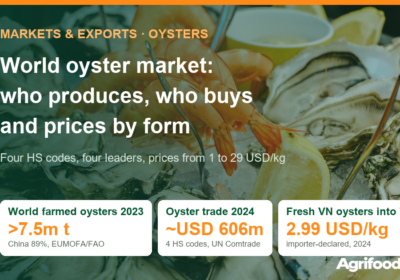
Not every plant needs all the equipment from day one, but the floor plan must leave room for it. For the EU, Vietnam can currently export bivalve molluscs only frozen or processed, not live oysters; Regulation (EC) 853/2004 applies the fishery product requirements (Section VIII) to oysters not placed on the market alive, provided the raw material comes from areas meeting the bivalve mollusc requirements (Section VII). In other words, stages 1, 5 and 6 are mandatory, while depuration is needed only if the plant later makes raw-consumption product for other markets. Prices and buyers for each product form are covered in World Oyster Market: Who Produces, Who Buys and Prices by Product Form; tariffs and standards by country are in the pillar article Oyster Processing in Vietnam: Markets, Tariffs, Standards and Value-Added Products.
What companies should do
AgrifoodV recommendations:
- Draw the oyster’s path before drawing the building: mark the dirty-clean boundary on the floor plan and check that no route crosses it, including the routes of crates, trays, ice and shell waste.
- Size the temperature bands for the waiting points, not just for the equipment: the number of trays and the capacity of the pre-freezing room and chilled packing room must cover the peak hours of the harvest season.
- Leave room for later phases: a depuration tank position with a seawater connection, space for HPP equipment, a separate crate-washing area, and a shell-handling area downwind.
- Design the lot code together with the line: the code on the certificate of origin must print onto the carton label without being copied by hand.
AgrifoodV helps companies review processing plant layouts, procedures and records against the requirements of their target markets. Read more: The journey of building an export processing plant.
References
- Ministry of Agriculture and Rural Development (Vietnam). QCVN 02-01:2009/BNNPTNT, Cơ sở sản xuất kinh doanh thực phẩm thủy sản – Điều kiện chung đảm bảo an toàn thực phẩm [Fisheries food business operators – General conditions for food safety] (issued with Circular 47/2009/TT-BNNPTNT of 31 July 2009), sections 2.1.3.4, 2.1.5.5, 2.1.12.1, 2.5, 2.6. thuvienphapluat.vn.
- Ministry of Agriculture and Rural Development (Vietnam). QCVN 02-07:2009/BNNPTNT, Cơ sở sản xuất nhuyễn thể hai mảnh vỏ – Điều kiện đảm bảo vệ sinh an toàn thực phẩm [Bivalve mollusc establishments – Conditions for food hygiene and safety] (Circular 47/2009/TT-BNNPTNT), sections 2.2.2, 2.3. Full text: chicucclcbpttt.lamdong.gov.vn.
- Ministry of Agriculture and Rural Development (Vietnam). QCVN 02-02:2009/BNNPTNT, Chương trình đảm bảo chất lượng và an toàn thực phẩm theo nguyên tắc HACCP [HACCP-based programme for quality and safety assurance] (Circular 47/2009/TT-BNNPTNT). chicucclcbpttt.lamdong.gov.vn.
- Ministry of Agriculture and Rural Development (Vietnam). Circular 33/2015/TT-BNNPTNT on inspection and monitoring of food safety in the harvest of bivalve molluscs. moj.gov.vn.
- European Union. Regulation (EC) 853/2004, Annex III Section VIII (Chapters VII, VIII), consolidated version of 7 May 2026. eur-lex.europa.eu.
- European Union. Regulation (EU) 1169/2011 on the provision of food information to consumers, Annex IX point 5, consolidated version of 1 April 2025. eur-lex.europa.eu.
- ISSC/FDA. National Shellfish Sanitation Program, Guide for the Control of Molluscan Shellfish 2007, Section II Chapter XIII. issc.org.
- Cefas (United Kingdom). Shellfish depuration advice. cefas.co.uk.
- EFSA. Scientific Opinion on Norovirus (NoV) in oysters: methods, limits and control options. EFSA Journal 2012;10(1):2500. efsa.europa.eu.
Article by AgrifoodV, compiled from the sources above (accessed 29 October 2026). Temperatures given in this article are regulatory limits; specific operating settings (blast-air temperature, cold-store set point, depuration time) are validated by each plant for its product and the requirements of the importing country. Readers should check that the regulations cited are still in force before applying them. This content is not a substitute for legal advice. Cover image: Mark Stebnicki / Pexels.
Looking at Vietnam as a sourcing origin or a place to build a value chain?
Tell us your product, target market and expected volumes. In a 30–45 minute online call, AgrifoodV reviews buyers, standards, processing capacity and growing areas with you, starting from the market.
Book a call →Sourcing from Vietnam© 2026 AgrifoodV. Nội dung được phép trích dẫn khi ghi rõ nguồn và đặt liên kết tới bài gốc; không sao chép toàn văn. Xem Điều khoản sử dụng nội dung.