AgrifoodV ·
In 2025, Vietnam’s pepper and spice exports passed USD 2 billion for the first time, yet more than four-fifths of the pepper still left port whole and unground. Premium buyers in the EU, the US and Japan do not buy spices on appearance; they buy on microbiology, contaminants, cleanliness, the decontamination method used and a documented file for every lot. This article sets out the value ladder, buyer specifications, import duties by processing tier and the legal gates for herbal products, so that investors choose the market before they choose the plant.
Key points
- Vietnam supplied 57.5% of world pepper export volume in 2025, but 80.5% of the pepper it shipped was unground. Vietnamese cinnamon (cassia) accounted for about 36% of the volume the EU imported from outside the bloc in 2024, but only about 26% of the value.
- The real risk today sits in the growing areas and in decontamination: all RASFF notifications on Vietnamese pepper in 2026 concerned pesticide residues, and 11 of the 23 notifications on Vietnamese cinnamon concerned lead or mercury.
- Steam sterilisation is the microbial reduction method accepted in the EU, the US and Japan alike; ethylene oxide and irradiation follow different rules in each market.
- Duties move in opposite directions by processing tier: the EU charges 0% on ground spices with EVFTA proof of origin, while the US, from 24 July 2026, exempts raw spices from the additional duty but adds 12.5% on essential oils, oleoresins and extracts.
Vietnam sells a lot of spice, but mostly at the lowest tier
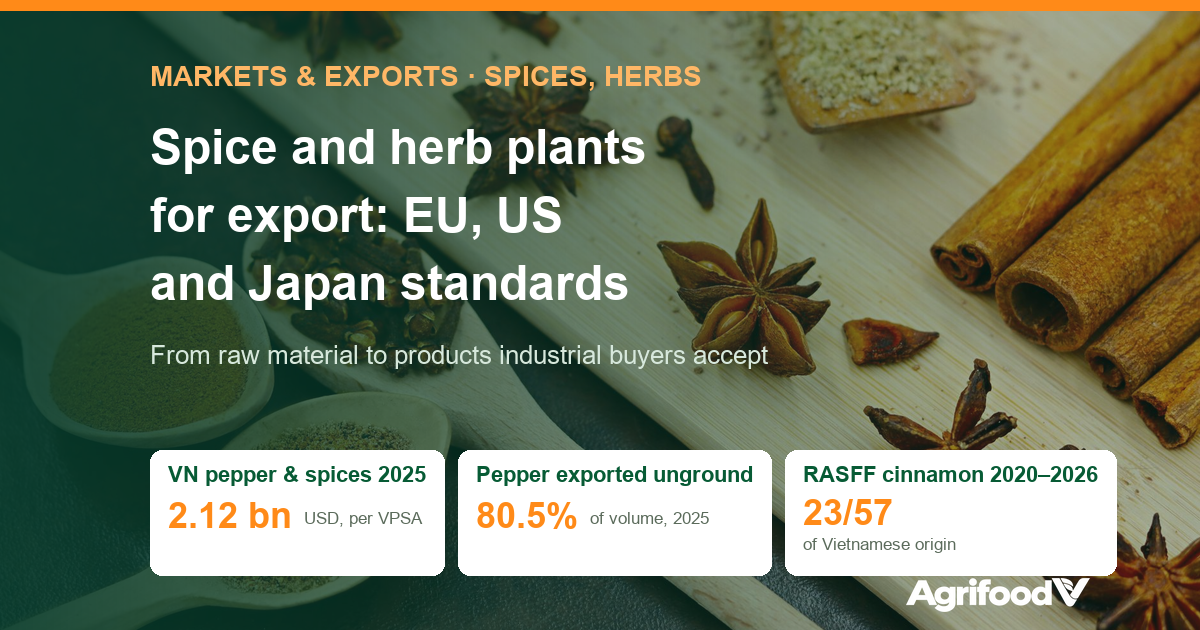
According to the Vietnam Pepper and Spice Association (VPSA), the pepper and spice sector exported USD 2.124 billion in 2025, up 20.1%, with pepper accounting for more than 78%. Vietnam Customs data for the same year: 246,132 tonnes of pepper worth USD 1,660.9 million. According to the International Pepper Community (IPC), Vietnam’s pepper equalled 57.5% of global pepper export volume in 2025.
The scale is large but the product mix is thin. According to VPSA, whole black pepper made up 70.3% of 2025 export volume and whole white pepper 10.2%, meaning 80.5% was unground. In the first nine months of 2026, pepper export volume rose 15.4% but value only 10.2%. The ginger, turmeric and other spices group is starker still: volume up 50.1%, value down 5.0%. Growth is coming from selling more, not from selling at higher prices.
Cinnamon shows the same picture. In 2025 Vietnam exported 120,295 tonnes of cassia worth USD 300.2 million, its highest year on record. Yet in the EU market in 2024, calculated from UN Comtrade, Vietnamese cinnamon entered at a unit value of about USD 3,370 per tonne, against about 5,500 for Indonesian and about 10,300 USD per tonne for Sri Lankan cinnamon.
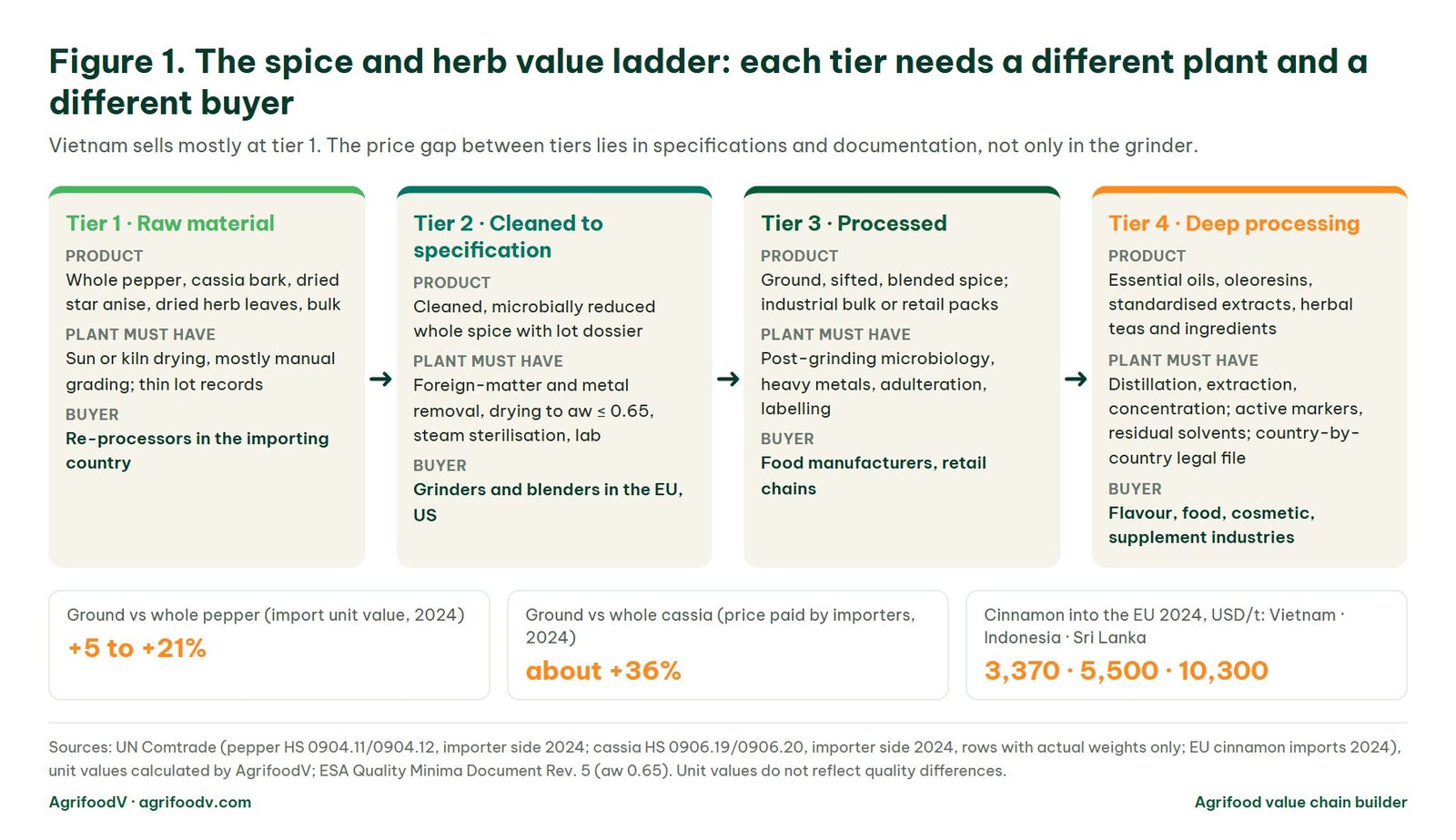
The point to note in Figure 1: at bulk level, importers paid only about 5–21% more for ground Vietnamese pepper than for whole pepper (2024), and ground cassia only about 36% more than whole cassia (prices reported by importing countries, 2024, rows with actual weights only). A grinder on its own does not create value; the value lies in microbiological specification, cleanliness, documentation and buyers willing to pay for them.
Industrial buyers buy on specification, not on appearance
European grinders, blenders and food manufacturers buy against the European Spice Association’s Quality Minima Document (Rev. 5, adopted in 2015, reviewed in 2018, with no newer version) plus EU contaminant and residue law. The limits a plant has to be designed to meet:
| Parameter | Limit | Basis |
|---|---|---|
| Extraneous and foreign matter | Spices max. 1%, herbs max. 2% by weight; no hazardous foreign matter (glass, metal, stone, wood) larger than 2 mm, no visible insects or rodent contamination | ESA QMD Rev. 5 |
| Water activity | Recommended max. 0.65 | ESA QMD Rev. 5 |
| Microbiology | ESA sets no numerical limits; specific limits are contractual. A lot contaminated with Salmonella is treated as unsafe food | ESA; Article 14, Regulation (EC) 178/2002 |
| Aflatoxins | B1 5.0 µg/kg, total 10.0 µg/kg (chilli, pepper, nutmeg, turmeric, dried ginger) | Regulation (EU) 2023/915 |
| Ochratoxin A | Dried spices 15 µg/kg; dried chilli 20 µg/kg | Regulation (EU) 2023/915 |
| PAHs | Benzo(a)pyrene 10, sum of 4 PAHs 50 µg/kg (dried spices, except cardamom and smoked Capsicum) | Regulation (EU) 2023/915 |
| Pyrrolizidine alkaloids | Dried herbal infusions 200; dried herbs and plant-based food supplements 400; tea 150 µg/kg. No general limit for spices (cumin alone 400) | Regulation (EU) 2023/915 |
| Ethylene oxide (EtO) | 0.1 mg/kg for spices, tea and herbal infusions, equal to the limit of quantification (sum of EtO and 2-chloroethanol) | Regulation (EU) 2015/868 amending Regulation 396/2005 |
In the US, the FDA risk profile on spices found Salmonella in about 6.6% of imported spice shipments in 2007–2009 and filth in about 12%. Import Alert 99-19 (Salmonella) currently lists 57 Vietnamese companies, 21 of the entries for pepper. For a US buyer, one listing means every subsequent lot must be shown to be clean before it clears.
Decontamination: one technology decision, three sets of rules
Spices are field-dried crops with high initial microbial loads, so almost every industrial buyer requires a microbial reduction step. The method chosen decides who the plant can sell to:
| Market | Ethylene oxide fumigation | Irradiation | Steam sterilisation |
|---|---|---|---|
| EU | Not accepted; ESA states that material fumigated with EtO before entering the EU is also prohibited | Max. 10 kGy, only at EU-approved facilities; the list currently contains no facility in Vietnam | Accepted; supported by ESA |
| US | Permitted (7 ppm EtO, 940 ppm 2-chloroethanol); EPA allows fumigation of pepper until 1 January 2032 | Max. 30 kGy, Radura labelling | Accepted; FSMA allows shipment of untreated spice if the US customer commits in writing to treat it |
| Japan | Not accepted | Irradiation of spices prohibited | Accepted |
The consequence for plant design: steam sterilisation is the only route that works for all three markets. The EU-funded SPICED research project recorded that steam treatment at 108–125 °C for 20–120 seconds reduced microbial counts from 1.8×10⁵ to 6.0×10² cfu/g. This step must come with a segregated post-treatment area, because sterilised spice that is recontaminated during grinding or packing loses the whole benefit of the treatment. For details on raw-material intake and retention samples, see raw-material intake, residue testing and retention samples.
Duties by processing tier: the EU and the US move in opposite directions
The rates below apply to goods of Vietnamese origin, checked on 25 October 2026 in TARIC (EU), HTSUS 2026 (US) and Japan’s tariff schedule of 1 April 2026.
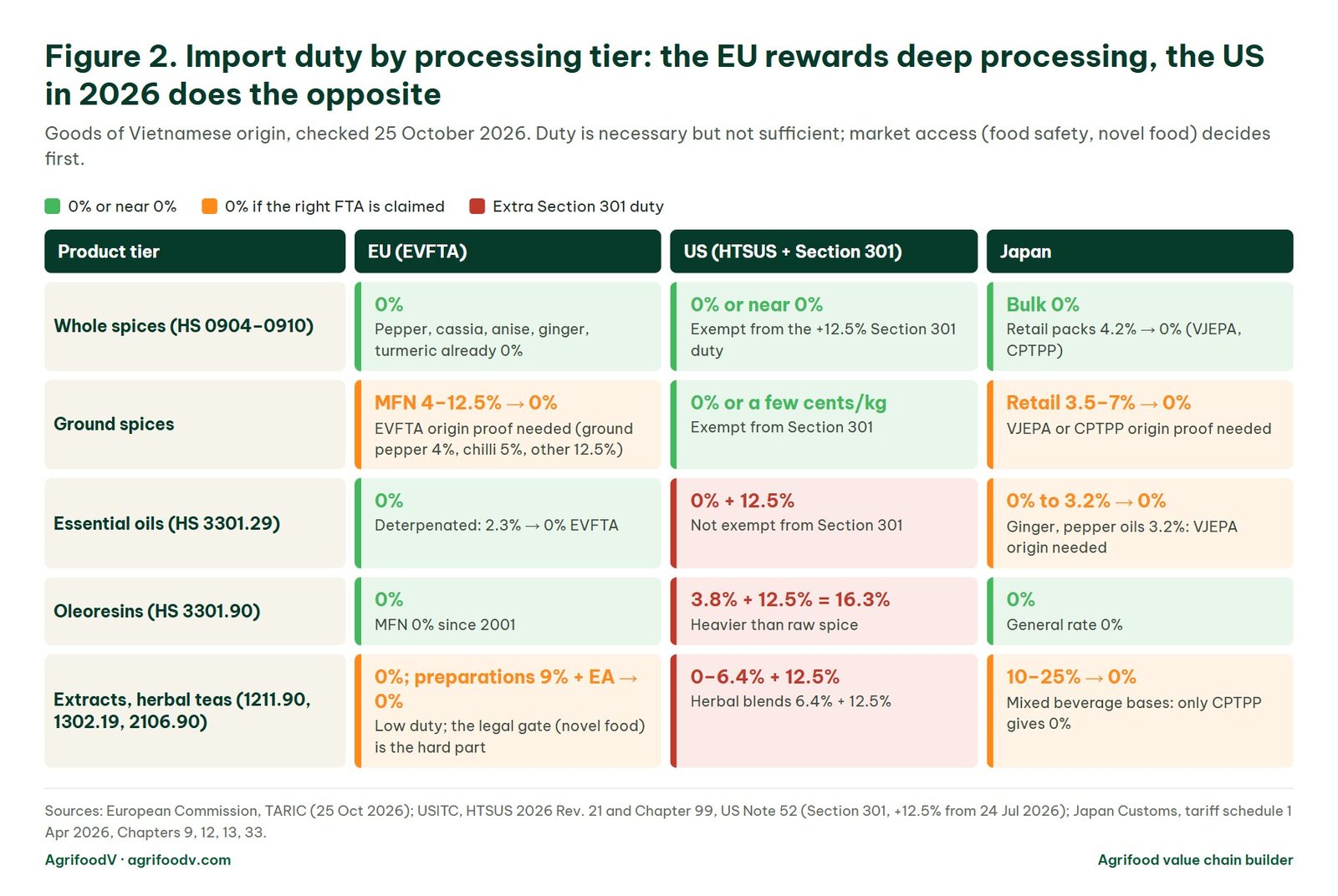
- The EU rewards deep processing. Most whole spices are already at 0%. The difference lies in ground products: ground pepper MFN 4%, ground chilli 5%, other ground spices 12.5%, all falling to 0% with EVFTA proof of origin. Non-deterpenated essential oils and oleoresins are already at 0%.
- The US in 2026 does the opposite. From 24 July 2026, Vietnamese goods bear an additional 12.5% under Section 301, but tea and all spices of headings 0904–0910 are exempt. Essential oils, oleoresins, plant extracts, medicinal plants and herbal teas are not: pepper oleoresin from Vietnam pays 3.8% + 12.5% = 16.3%. The argument “process more deeply to pay less duty” does not hold for the US market at present.
- Japan requires claiming the right agreement. Retail-packed spices and ginger and pepper essential oils fall to 0% under VJEPA or CPTPP; mixed herbal beverage bases (1302.19-120, MFN 25%) have no VJEPA preference and must be declared under CPTPP.
Herbal products: food, health supplement or medicine
For herbal products, duty is rarely the barrier; the legal gate is. The same plant can be a food in one country, a food supplement in another and a medicine in a third. In the EU, food not consumed to a significant degree before 15 May 1997 is a novel food under Regulation (EU) 2015/2283 and needs authorisation before sale; traditional herbal medicines registered under Directive 2004/24/EC must show at least 30 years of use, including 15 years in the EU. In the US, a new dietary ingredient must be notified to the FDA at least 75 days before marketing (21 CFR 190.6), and plants operate under the cGMP of 21 CFR 111. Two typical Vietnamese medicinal plants show the differences:
| Medicinal plant | EU (Novel Food Catalogue) | Japan (MHLW, 5 August 2026) |
|---|---|---|
| Jiaogulan (Gynostemma pentaphyllum) | Leaves: not novel when used in food supplements. Extract standardised to 80% gypenosides: novel food not yet authorised (entry created 22 January 2026) | On the list of materials not regarded as medicines unless medicinal claims are made; can be sold as food |
| Ca gai leo (Solanum procumbens) | No entry; selling it as food requires proof of consumption history in the EU or an Article 4 consultation | On neither list; the related species Solanum lyratum is on the list of materials used exclusively as medicines |
Two common traps. First, in Vietnam the name “giao co lam” is used for several plant forms distinguished by leaf count (three, five, seven leaves), and the genus Gynostemma has several close species; the regulatory entries above apply only to G. pentaphyllum, so export files must identify the species analytically. Second, Vietnam has three distinct standards that cannot be merged into a single “GMP”: GACP for growing and collecting medicinal plants (Circular 19/2019/TT-BYT), GMP for herbal medicines (Annex V of Circular 35/2018/TT-BYT, amended by Circular 12/2022/TT-BYT) and GMP for health supplements (Circular 18/2019/TT-BYT, amended by Circular 29/2020/TT-BYT). An extraction plant has to decide from the start which category its products fall into, and for which market.
Domestic demand is also a market: at a workshop organised by the Vietnam Institute of Oriental Medicine in September 2026, experts stated that Vietnam has more than 5,117 species of medicinal plants and fungi but meets only about 25–30% of its annual demand for 60,000–80,000 tonnes of medicinal raw materials. These are workshop statements, not official statistics.
Growing areas: where it is decided whether a lot is rejected
Notification data show that the risk for Vietnamese spices in the EU has moved from the plant to the farm. A RASFF search for January 2020 to October 2026 finds 11 notifications on Vietnamese pepper, against 236 on Brazilian pepper (almost all Salmonella), and all 4 notifications on Vietnamese pepper in 2026 concerned pesticide residues. For cinnamon, Vietnam was the origin of 23 of 57 notifications EU-wide, 11 of them for lead or mercury. Fresh and frozen Vietnamese chilli is currently checked at 50% of consignments at the EU border for pesticide residues under Implementing Regulation (EU) 2019/1793; dried and ground chilli is not on the list. See also EU increased controls on Vietnamese products in 2026.
The advantages are equally clear: Vietnamese pepper, cinnamon, star anise, ginger and turmeric are not currently under increased EU controls, whereas Brazilian pepper (Salmonella) and Indian pepper, dried chilli and cinnamon (EtO) are. The EU Deforestation Regulation (EUDR) does not apply to spices of headings 0904–0910. Some areas already have the provenance foundations that premium buyers pay for: Lao Cai had 24,241.5 ha of organic cinnamon by the end of 2025, and Bac Ha cassia bark received geographical indication No. 00158 on 25 September 2026. An export spice plant therefore has to work with growing areas that keep spray records, reference samples and lot-level traceability, as discussed in raw-material growing areas for processing plants.
What companies should do
AgrifoodV’s recommendations:
- Choose the product tier and market first: sterilised whole spices for EU and US grinders; ground and blended spices for food manufacturers; essential oils and oleoresins for the flavour industry. Each choice brings a different plant configuration and a different set of documents.
- Design steam-based decontamination and a segregated post-treatment area if the aim is to sell to the EU, the US and Japan; do not build a strategy on EtO or irradiation when the target markets are the EU and Japan.
- Write buyer specifications into sourcing contracts with growing areas: permitted pesticides, pre-harvest intervals, heavy metals for cinnamon, mycotoxins for chilli, ginger and turmeric; sample every lot before it enters the warehouse.
- Calculate duties by the right agreement and the right tier: ground spices into the EU need EVFTA proof of origin; mixed herbal beverage bases into Japan are declared under CPTPP; essential oils, oleoresins and extracts into the US must carry the 12.5% Section 301 duty in the offer price.
- For herbal products, check the EU Novel Food Catalogue, Japan’s MHLW lists and China’s rules before writing the business plan; identify the species analytically; establish whether the product is a food, a health supplement or a medicine in each country.
- Do not buy extraction equipment before there is a buyer and a regulatory file: a compliant oleoresin line whose product is not yet allowed in the target market is idle capital.
AgrifoodV supports companies with market analysis and import requirements, processing plant direction and organising monitored, traceable raw-material growing areas. Further reading: the design brief for an export processing plant.
Spices and herbs sector series
In-depth articles on individual products, buyer specifications, deep processing and raw-material areas for spices and medicinal plants, updated as new articles are published:
References
- VPSA via VnEconomy. Hồ tiêu Việt Nam lập đỉnh kim ngạch, bước vào giai đoạn tăng trưởng theo chiều sâu [Vietnamese pepper hits record export value, enters a phase of deeper growth], 15 January 2026. vneconomy.vn.
- VietnamBiz. Báo cáo thị trường hồ tiêu năm 2025 [Pepper market report 2025] (compiled from Vietnam Customs, VPSA, IPC), 29 January 2026. vietnambiz.vn (PDF).
- VPSA. Exports of pepper, cassia and other spices, January to September 2026, 5–9 October 2026. vpsaspice.org.
- Thue & Hai quan Online. Xuất khẩu quế đem lại 300 triệu USD [Cinnamon exports bring in USD 300 million], 8 January 2026. thuehaiquan.tapchikinhtetaichinh.vn.
- UN Comtrade. Data for HS 0904.11, 0904.12, 0906.19, 0906.20, 2022–2024 (queried 10 and 17 October 2026; unit values calculated by AgrifoodV). comtradeplus.un.org.
- European Spice Association. Quality Minima Document, Rev. 5 (adopted 27 October 2015, reviewed 26 March 2018, republished 11 February 2026). esa-spices.org (PDF).
- European Union. Regulation (EU) 2023/915 on maximum levels for certain contaminants in food, consolidated version CELEX 02023R0915-20260819. eur-lex.europa.eu.
- European Union. Implementing Regulation (EU) 2019/1793 on increased official controls, consolidated version CELEX 02019R1793-20260630. eur-lex.europa.eu.
- European Union. Regulation (EC) 396/2005 on maximum residue levels of pesticides (amended by Regulation (EU) 2015/868 for ethylene oxide), consolidated version CELEX 02005R0396-20260819; DG SANTE MRL database (checked 25 October 2026). eur-lex.europa.eu.
- European Union. Regulation (EC) 178/2002, Article 14 (unsafe food), consolidated version CELEX 02002R0178-20260101. eur-lex.europa.eu.
- European Union. Directive 1999/3/EC (list of foods authorised for irradiation), CELEX 01999L0003-19990313; Decision 2002/840/EC (list of approved irradiation facilities), consolidated version CELEX 02002D0840-20220128. eur-lex.europa.eu.
- FDA. Questions and Answers: Improving the Safety of Spices (risk profile on pathogens and filth in spices), updated 2 March 2018; Import Alert 99-19. fda.gov; accessdata.fda.gov.
- United States. 21 CFR 179.26 (irradiation of food); 40 CFR 180.151 (ethylene oxide); 21 CFR 117.136 (FSMA); 21 CFR 190.6 and Part 111 (dietary supplements). EPA, Ethylene Oxide Interim Registration Review Decision, January 2025. law.cornell.edu; epa.gov (PDF).
- Ministry of Health, Labour and Welfare of Japan (MHLW). Imported foods monitoring plan for FY2026 (revised 8 October 2026); lists of materials “used exclusively as medicines” and “not regarded as medicines” (Annexes 1 and 2), updated 5 August 2026. mhlw.go.jp; mhlw.go.jp (PDF).
- EU SPICED project (FP7, grant 312631). Results on steam treatment for microbial reduction in spices, 2016. cordis.europa.eu.
- European Commission. TARIC, codes 0904, 0906, 0910, 1211, 1302, 2106, 3301, origin Vietnam (checked 25 October 2026). ec.europa.eu.
- USITC. Harmonized Tariff Schedule of the United States 2026 Rev. 21, Chapter 99, US Note 52 (Section 301, headings 9903.05.84 and 9903.05.86). hts.usitc.gov.
- Japan Customs. Customs tariff schedule of 1 April 2026, Chapters 9, 12, 13, 33. customs.go.jp.
- European Union. Regulation (EU) 2015/2283 on novel foods, consolidated version CELEX 02015R2283-20210327; Novel Food Catalogue (checked 25 October 2026). eur-lex.europa.eu; ec.europa.eu.
- European Commission. Herbal medicinal products (Directive 2004/24/EC). health.ec.europa.eu.
- RASFF Window, European Commission. Notifications on pepper, cinnamon and chilli of Vietnamese origin, January 2020 – 25 October 2026 (AgrifoodV search by title keywords). webgate.ec.europa.eu.
- Frontiers in Chemistry. Review of the genus Gynostemma, 2023, doi 10.3389/fchem.2023.1203418. frontiersin.org.
- Ministry of Health of Vietnam. Circular 19/2019/TT-BYT on GACP for medicinal plants; Circular 35/2018/TT-BYT (amended by Circular 12/2022/TT-BYT) on GMP for medicines and pharmaceutical materials; Circular 18/2019/TT-BYT (amended by Circular 29/2020/TT-BYT) on GMP for health supplements. hoatieu.vn.
- VietnamPlus. Khoa học công nghệ: chìa khóa nâng tầm giá trị dược liệu của Việt Nam [Science and technology: the key to raising the value of Vietnam’s medicinal plants], 4 September 2026. vietnamplus.vn.
- Lao Cai Newspaper. 100 sản phẩm quế của Lào Cai sẽ được truy xuất nguồn gốc, số hóa vào năm 2030 [100 Lao Cai cinnamon products to be traceable and digitised by 2030], 28 January 2026; Intellectual Property Office of Vietnam. Protection of the Bac Ha geographical indication for cassia bark, 2026. baolaocai.vn; ipvietnam.gov.vn.
Article by AgrifoodV, compiled from the sources above (accessed 10–25 October 2026). Export figures from Vietnam Customs and VPSA differ slightly; RASFF counts come from AgrifoodV’s own search by title keywords, may miss some notifications and do not allow violation rates to be inferred. Unit values calculated from UN Comtrade are declared value divided by net weight and do not reflect quality differences. Duty rates and market rules may change, and the US Section 301 duty may be adjusted; companies should check the regulations in force before setting export targets. This content is not a substitute for legal advice. Cover image: Marta Branco / Pexels.
Looking at Vietnam as a sourcing origin or a place to build a value chain?
Tell us your product, target market and expected volumes. In a 30–45 minute online call, AgrifoodV reviews buyers, standards, processing capacity and growing areas with you, starting from the market.
Book a call →Sourcing from Vietnam© 2026 AgrifoodV. Nội dung được phép trích dẫn khi ghi rõ nguồn và đặt liên kết tới bài gốc; không sao chép toàn văn. Xem Điều khoản sử dụng nội dung.