AgrifoodV ·
When an importing country flags a container of fruit juice, the first question is always the same: which plot did this fruit come from, what was sprayed, when was it harvested, and under which lot did it enter the plant. Most growing areas already keep records, and most plants already number their finished lots, but the two sets of records rarely talk to each other. In 2026, the Vietnamese government began requiring them to connect.
Key points
- Decision 25/QD-BNNMT of 7 January 2026 issued the Plan for traceability of agricultural, forestry and fishery products 2026–2030: a pilot with durian, roll-out to most important food crops from 1 July 2026, and recording of every stage from growing area to distribution in 2027–2030.
- Resolution 36/2026/NQ-CP ties growing-area codes to land-parcel identifiers and connects growing-area code data with the Agricultural Product Traceability System of the Ministry of Agriculture and Environment.
- Buyers in the EU must be able to trace their immediate suppliers (Regulation 178/2002, Article 18). In the United States, the FSMA 204 traceability rule has been pushed back to 20 July 2028 and also applies to foreign facilities.
- The break usually occurs at collection and intake: the field lot code does not travel with the fruit into the plant.
The government has set the framework: Decision 25/QD-BNNMT
On 7 January 2026, the Minister of Agriculture and Environment signed Decision 25/QD-BNNMT issuing the Plan for implementing traceability of agricultural, forestry and fishery products for 2026–2030, with a vision to 2035. The decision took effect on signing and replaces Decision 4164/QD-BNN-KHCN of 2021. Its scope covers agricultural, forestry and fishery products and farm inputs, from production, harvesting, preliminary processing and processing to sale, with priority for key products, high-risk products and export products.
| Milestone | What the plan sets out |
|---|---|
| By end of 2026 | Pilot the Agricultural Product Traceability System, starting with durian; issue data and information-exchange standards applied uniformly nationwide; pilot growing-area and cultivation logs with input control (fertilisers, plant protection products, chemicals, etc.) |
| 1 July 2026 | Put the system into use for most important food crops, with minimum data: households in the chain; growing area or production facility, production and harvest dates; the stages within the plan’s scope; authentication and traceability labels with QR-code lookup |
| 2027–2030 | Record information at every main stage: growing area, purchasing, preliminary processing and packing, transport, distribution; connect with the National Traceability Portal; issue a list of key products that must be traced |
| Vision 2035 | Bring all products under the Ministry’s remit into the system and form complete traceability chains |
Two details matter for owners of raw-material growing areas. First, the plan calls for research into remote-sensing data, drone imagery and radar to verify production areas over time, adding independent evidence to logs and certifications. Logs kept only for show will become easier to check against reality. Second, the plan provides for guidance that integrates traceability with importing-country rules and with growing-area, farming-area and packing-facility codes. AgrifoodV has not found any published document listing which specific products have been running on the system since the 1 July 2026 milestone; companies should ask the provincial competent authority directly.
The growing-area code is the first link
Resolution 36/2026/NQ-CP (signed and effective on 31 July 2026) simplifies the procedure for issuing growing-area codes and packing-facility codes, but at the same time ties them more closely to data:
- The location of a growing area is identified by the land-parcel identifier in the national land database (Article 3, clause 2).
- Code data are managed centrally, published on the Ministry’s portal and connected with the Agricultural Product Traceability System (Article 3, clause 3).
- The procedure follows the principle of self-declaration and self-responsibility, linked to post-inspection and traceability; pre-inspection applies only where the importing country requires codes (Article 2, clause 2).
The resolution suspends several provisions of Decree 38/2026/ND-CP, including the minimum area in Article 6, clause 1. The record-keeping obligations are not on the suspended list: growing areas must record and keep information on production and harvesting (Article 6, clause 3); packing facilities must keep information on product origin and on packing, export or sale (Article 7, clause 3). The Ministry itself has acknowledged the gaps: at a conference in May 2026, production logs were described as “a formality”, and code renting and misuse were reported.
How far foreign buyers need to trace
| Market | Rule | What it means for a Vietnamese plant |
|---|---|---|
| EU | Regulation (EC) 178/2002, Article 18: food business operators must be able to identify their suppliers and their business customers, and have systems to provide this information to the authorities on request | The obligation sits with the EU importer, but when an alert occurs the importer will ask the plant for the original raw-material lot |
| United States | FSMA 204 (21 CFR Part 1, Subpart S): records for harvesting, cooling, initial packing, shipping, receiving and transformation events; records provided to FDA within 24 hours. Congress directed FDA not to enforce before 20 July 2028 | Applies to foreign facilities too. The list covers fresh tropical tree fruits (mango, papaya, lychee, jackfruit, starfruit, guava) and all fresh-cut fruits; it excludes pineapple, passion fruit, soursop, banana, coconut and lime |
For a fruit juice plant, neither rule requires each orchard plot to appear on the label. But when a lot is found to exceed a residue limit, the ability to isolate the right raw-material lots decides whether the company recalls one lot or a whole month of production.
Where the link breaks between growing area and plant
In AgrifoodV’s observation, data are usually lost not in the field but at three hand-over points:
- Collection: fruit from many households and plots goes into one truck; the weighing slip shows only the seller’s name, not the growing-area code or lot code.
- Intake at the plant gate: the plant assigns a new raw-material lot number without storing the growing-area code and spray log of that lot.
- Blending in production: several raw-material lots go into one batch, but the batch record does not show the input lot numbers and ratios.
The fix does not start with expensive software. It needs a single lot code, assigned at the orchard plot, that follows the fruit through the collection slip, the intake slip and the batch record. Lot coding was covered in the article Block-level data; the same code set also supports budget-versus-actual tracking by block. Growing-area scale and growing-area codes from the plant’s perspective are discussed in the article Raw-material growing areas for a processing plant.
What companies should do
The following are AgrifoodV’s recommendations.
- List the plots of the growing area by land-parcel identifier and growing-area code; the plant should keep a plot ledger, not just a list of households.
- Add growing-area and lot codes to collection and intake slips from the next season. Lots without codes should be received separately and not blended with documented lots.
- Record input raw-material lot numbers and blending ratios in every batch record, then run a traceability drill at least once a year: from one carton of finished product, trace back to the orchard plots and time how long it takes.
- Choose data formats that can be converted to the data standard the Ministry will issue under Decision 25/QD-BNNMT; for goods bound for the United States, check before 2028 whether the product is on the FSMA 204 list.
AgrifoodV helps companies organise growing-area records, lot coding and traceability from growing area to plant.
References
- Ministry of Agriculture and Environment. Quyết định số 25/QĐ-BNNMT ngày 07/01/2026 ban hành Kế hoạch triển khai truy xuất nguồn gốc nông, lâm, thủy sản giai đoạn 2026–2030, tầm nhìn đến năm 2035 [Decision 25/QD-BNNMT of 7 January 2026 on the Plan for traceability of agricultural, forestry and fishery products 2026–2030, vision to 2035]. mae.gov.vn.
- Government of Vietnam. Nghị quyết số 36/2026/NQ-CP ngày 31/7/2026 quy định đơn giản hóa thủ tục hành chính về mã số vùng trồng, mã số cơ sở đóng gói [Resolution 36/2026/NQ-CP of 31 July 2026 simplifying administrative procedures for growing-area and packing-facility codes], Articles 2, 3, 5. datafiles.chinhphu.vn.
- Government of Vietnam. Nghị định số 38/2026/NĐ-CP ngày 24/01/2026 [Decree 38/2026/ND-CP of 24 January 2026], Articles 6 and 7. Published on the portal of the Department of Crop Production and Plant Protection: ppd.gov.vn; summary by the Can Tho Department of Justice, 27 January 2026: pbgdpl.cantho.gov.vn.
- Agriculture and Environment Newspaper. Quản lý mã số vùng trồng, cơ sở đóng gói đi vào thực chất [Managing growing-area and packing-facility codes in substance], 15 May 2026. nongnghiepmoitruong.vn.
- European Union. Regulation (EC) No 178/2002, Article 18, consolidated version. EUR-Lex CELEX 02002R0178-20260101.
- U.S. FDA. FSMA Final Rule on Requirements for Additional Traceability Records for Certain Foods (updated 8 October 2026) and Food Traceability List (updated 24 July 2026). fda.gov; fda.gov/food-traceability-list.
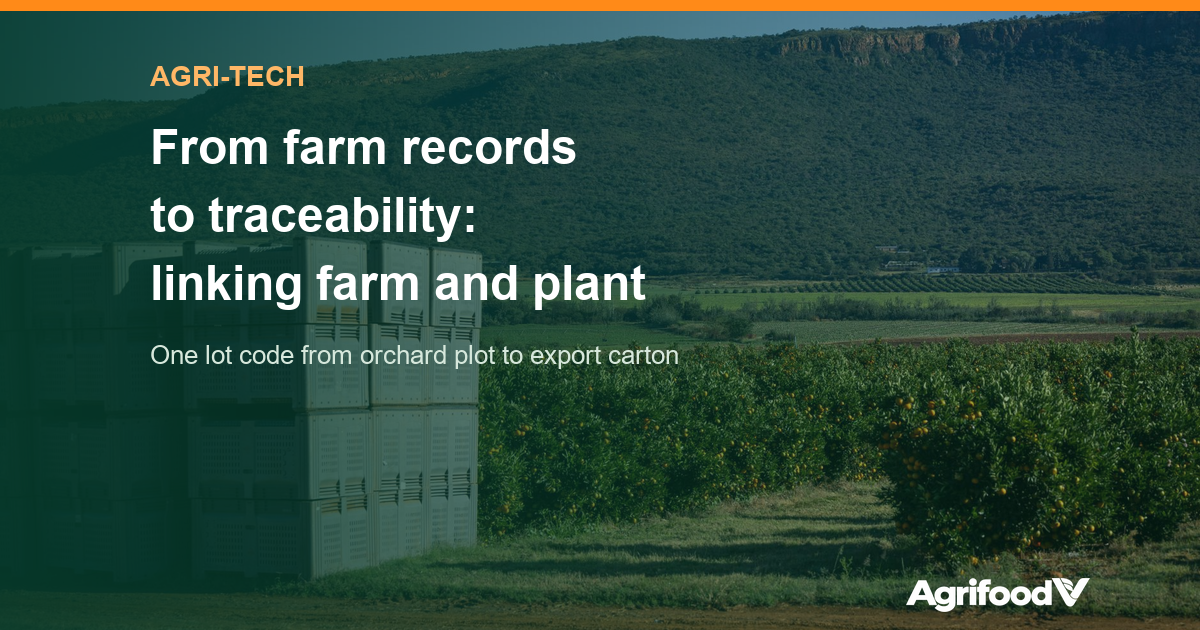
Article by AgrifoodV, compiled from the sources above (accessed 26 October 2026). The section “Where the link breaks between growing area and plant” and the recommendations are AgrifoodV’s assessment. This content is not a substitute for legal advice. Cover image: Magda Ehlers / Pexels.
Looking at Vietnam as a sourcing origin or a place to build a value chain?
Tell us your product, target market and expected volumes. In a 30–45 minute online call, AgrifoodV reviews buyers, standards, processing capacity and growing areas with you, starting from the market.
Book a call →Sourcing from Vietnam© 2026 AgrifoodV. Nội dung được phép trích dẫn khi ghi rõ nguồn và đặt liên kết tới bài gốc; không sao chép toàn văn. Xem Điều khoản sử dụng nội dung.