AgrifoodV ·
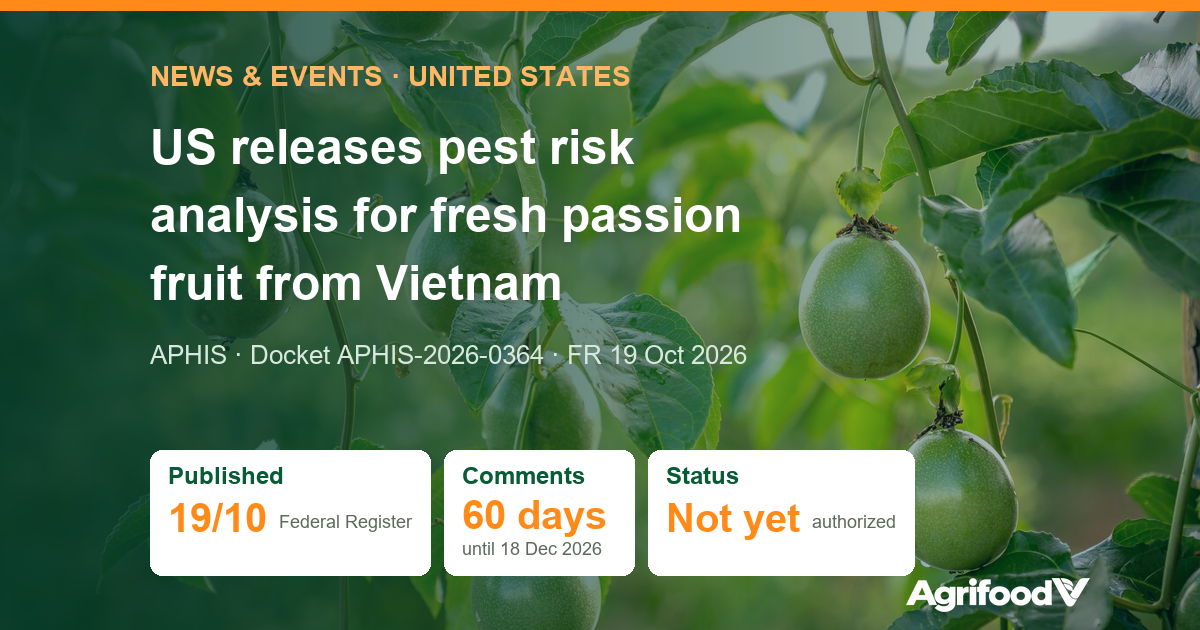
The US Animal and Plant Health Inspection Service (APHIS, part of the US Department of Agriculture) has released a pest risk analysis for fresh passion fruit (Passiflora edulis) imported from Viet Nam, published in the Federal Register on 19 October 2026. APHIS concludes that the pest risk can be mitigated by designated phytosanitary measures. This is a public comment stage that runs until 18 December 2026; fresh passion fruit from Viet Nam is not yet authorized for entry into the United States.
Key points
- Document: APHIS notice, docket No. APHIS-2026-0364, Federal Register document 2026-21311 (91 FR 66072), signed on 14 October 2026 and published on 19 October 2026.
- Commodity: fresh Passiflora edulis passion fruit for consumption, originating in Viet Nam. The market access request was submitted by Viet Nam’s national plant protection organization.
- Comment deadline: 18 December 2026 (60 days), via Regulations.gov or by postal mail.
- After reviewing the comments, APHIS will announce its final decision in a subsequent notice.
What APHIS has published
According to the notice, APHIS has prepared two documents for fresh passion fruit from Viet Nam: a pest risk assessment, which identifies the quarantine pests that could follow the fruit into the United States; and a risk management document (RMD), which sets out the phytosanitary measures to be applied to the fruit to mitigate that risk. A description of the economic considerations associated with the imports is also provided.
Based on this analysis, APHIS has determined that applying one or more designated phytosanitary measures is sufficient to mitigate the risk of introducing or spreading plant pests and noxious weeds through imports of fresh passion fruit from Viet Nam. Both documents are posted on Regulations.gov (docket APHIS-2026-0364) for public review and comment.
The Federal Register notice does not list each measure in detail. The specific conditions (for example requirements for orchards, packinghouses, post-harvest treatment or inspection) are set out in the RMD. Companies should read that document directly rather than rely on second-hand information.
How fresh fruit gains access to the US market
Imports of fresh fruits and vegetables into the United States are governed by Subpart L, Section 319.56 of the Code of Federal Regulations (7 CFR 319.56-1 through 319.56-12). Section 319.56-4 sets out an approval process based on pest risk analysis, in three steps:
- APHIS analyzes the pest risk and concludes that the risk posed by each quarantine pest can be reasonably mitigated by phytosanitary measures.
- APHIS makes the analysis available for public comment for at least 60 days through a notice in the Federal Register. Vietnamese passion fruit is currently at this step.
- The APHIS Administrator announces the decision to authorize imports in a subsequent notice, together with the required phytosanitary measures.
According to the notice of 19 October 2026, if the conclusions of the analysis remain unchanged after the comments have been considered, APHIS will authorize imports of fresh passion fruit from Viet Nam subject to the requirements specified in the RMD. The notice does not state when the final decision will be made.
Five groups of phytosanitary measures that may apply
Section 319.56-4(b) lists five groups of designated phytosanitary measures. The passion fruit RMD will select one or more of these groups:
| Group | Examples given in the regulation |
|---|---|
| 1. Phytosanitary treatments | Pest control treatments in the field or growing site, post-harvest treatments |
| 2. Growing-area pest mitigations | Detection surveys, trapping, pest exclusionary structures, field inspections |
| 3. Safeguarding and movement mitigations | Safeguarded transport, box labeling, limited distribution, insect-proof boxes, commercial consignments only |
| 4. Administrative mitigations | Registered orchards, registered packinghouses, inspection in the country of origin by the national plant protection organization, operational workplan monitoring |
| 5. Other measures | Any other measures deemed appropriate by the APHIS Administrator |
Source: 7 CFR 319.56-4(b), eCFR. The table shows only the general framework; the measures specific to passion fruit from Viet Nam are set out in the RMD in docket APHIS-2026-0364.
What this means for Viet Nam’s passion fruit sector
The notice is one step in the process, not an authorization. Even so, the conclusion that the risk can be mitigated is a precondition for APHIS to move on to an authorization decision. Once authorized, the list of permitted fruits and vegetables and their import conditions will be updated in the APHIS ACIR database, under Section 319.56-4(c).
The scope should be read precisely: the notice covers only fresh fruit for consumption. Processed passion fruit products such as puree, juice and juice concentrate are not covered by this notice and are subject to other US rules.
What companies should do
The following are recommendations from AgrifoodV, not part of the legal text.
- Read the RMD directly on Regulations.gov (docket APHIS-2026-0364) to see the exact requirements for orchards, packing, treatment and inspection. Investment plans should rest only on the original document.
- Review growing areas against phytosanitary requirements: growing-area codes, cultivation records, pest survey records and packinghouse files. If the RMD requires registered orchards and packinghouses, growing areas with complete files will move first.
- Track the comment deadline of 18 December 2026. Companies with technical comments should coordinate through the plant protection authority and industry associations so that comments reach the right docket on time.
- Work out the product question before the fresh-fruit question. Long-haul fresh fruit to the US depends on the cold chain and the cost of phytosanitary compliance; puree and concentrate are a different channel with different rules. Choose the market and product form first, then invest in growing areas or a processing plant.
AgrifoodV supports companies in building cultivation procedures, growing-area codes and traceability records that meet the requirements of import markets.
References
- Animal and Plant Health Inspection Service, USDA. Notice of Availability of a Pest Risk Analysis for the Importation of Fresh Passion Fruit From Viet Nam Into the United States. Docket No. APHIS-2026-0364, FR Doc. 2026-21311, 91 FR 66072, Federal Register, 19 October 2026. federalregister.gov/d/2026-21311; public inspection PDF: public-inspection.federalregister.gov/2026-21311.pdf.
- US Code of Federal Regulations. 7 CFR 319.56-4, Authorization of certain fruits and vegetables for importation. eCFR, 7 CFR 319.56-4.
- Regulations.gov. Docket APHIS-2026-0364 (pest risk assessment, RMD, comment portal). regulations.gov/docket/APHIS-2026-0364.
- APHIS. Agricultural Commodity Import Requirements (ACIR) database. acir.aphis.usda.gov.
Cover image: Quang Nguyen Vinh / Pexels.
Article by AgrifoodV, compiled from the sources above (accessed 19 October 2026). This content is not a substitute for legal advice.
Looking at Vietnam as a sourcing origin or a place to build a value chain?
Tell us your product, target market and expected volumes. In a 30–45 minute online call, AgrifoodV reviews buyers, standards, processing capacity and growing areas with you, starting from the market.
Book a call →Sourcing from Vietnam© 2026 AgrifoodV. Nội dung được phép trích dẫn khi ghi rõ nguồn và đặt liên kết tới bài gốc; không sao chép toàn văn. Xem Điều khoản sử dụng nội dung.