AgrifoodV ·
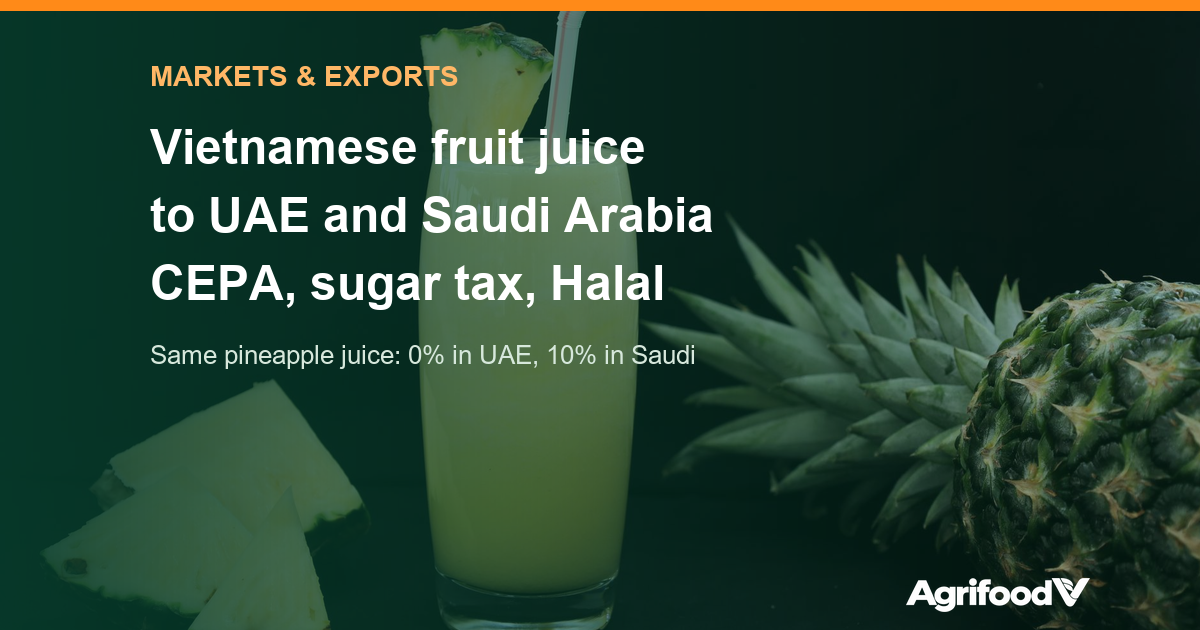
The same lot of unsweetened pineapple juice enters Dubai duty-free under the Vietnam – UAE CEPA, but pays 10% in Riyadh. Since 1 January 2026, both the UAE and Saudi Arabia have also changed how they levy excise tax on sweetened drinks, now based on grams of sugar per 100 ml.
Key points
- The Vietnam – UAE CEPA has been in force since 3 February 2026. Most Vietnamese fruit juice lines entering the UAE are now at 0% (MFN 5%); a few are being phased down, such as sweetened pineapple juice at 4.5% and unsweetened concentrated other citrus juice at 4.2%.
- Saudi Arabia has no FTA with Vietnam and does not apply a flat 5%: not-from-concentrate pineapple juice, mango juice and coconut water pay 10%; lemon juice 15%; pineapple concentrate and other single-fruit juices 5%.
- Tiered sugar tax from 1 January 2026: AED 0.79 and 1.09 per litre in the UAE, SAR 0.79 and 1.09 per litre in Saudi Arabia. 100% fruit juice with no added sugar falls outside the UAE definition of a “sweetened drink”.
- Vietnamese goods imported into the UAE and then re-exported to Saudi Arabia do not carry the CEPA preference with them. Labels must include Arabic.
Import duties: CEPA in the UAE, MFN in Saudi Arabia
The UAE Ministry of Economy confirms that the Vietnam – UAE CEPA was signed on 28 October 2024 and entered into force on 3 February 2026; Dubai Customs applies it from the same date under Notice 01/2026. The tariff schedule uses the MFN rate of 15 July 2023 as the base rate: category E0 is eliminated immediately, category E5 reaches 0% on 1 January 2031 and category E10 reaches 0% on 1 January 2036. Saudi Arabia applies the integrated tariff of the Zakat, Tax and Customs Authority (ZATCA), where many fruit juice lines are above the general Gulf rate of 5%.
| Product (12-digit code) | UAE: CEPA 2026 (MFN 5%) | Saudi Arabia: MFN |
|---|---|---|
| Pineapple juice ≤20°Bx, unsweetened (2009.41.10) | 0% | 10% |
| Pineapple juice ≤20°Bx, sweetened (2009.41.20) | 4.5% (E10; 0% from 1 January 2036) | 10% |
| Pineapple juice concentrate >20°Bx (2009.49) | 0% | 5% |
| Mango juice, concentrated or not (2009.89.22–25) | 0% | 10% |
| Coconut water, unsweetened (2009.89.50) | 0% | 10% |
| Other single-fruit juice, unsweetened (2009.89.91; the line usually used for passion fruit) | 0% | 5% |
| Lemon juice “ليمون” ≤20°Bx (2009.31.1x) | 0% | 15% |
| Other citrus ≤20°Bx, unsweetened (2009.31.91; calamansi, kumquat) | 4.5% (E10) | 5% |
| Other citrus concentrate >20°Bx, unsweetened (2009.39.10) | 4.2% (E5; 0% from 1 January 2031) | 5% |
Three points are easy to get wrong when quoting prices. First, in Saudi Arabia the sweetened sub-lines carry the same rate as their parent line, so adding sugar does not lower the import duty. Second, the word “ليمون” in the tariff can mean lemon or lime: the line chosen for seedless lime juice decides whether the duty is 15% or 5% in Saudi Arabia, and 0% or 4.5% in the UAE. Third, the UAE has no separate line for passion fruit; classifying it as “other single-fruit juice” is common practice, not a classification ruling. For pineapple the arithmetic is clear: in Saudi Arabia, sell concentrate (5%) rather than not-from-concentrate juice (10%). Duties for each product in other markets are covered in the pillar articles on pineapple juice and MD2 growing areas and seedless lime and calamansi juice.
Market size for context: according to Saudi Arabia’s reporting to UN Comtrade, in 2025 the country imported USD 79.3 million of other single-fruit juice (HS 200989), of which USD 2.17 million came from Vietnam, ranking 8th. The UAE has only reported up to 2023: USD 38.5 million under the same code, with Vietnam’s share at USD 0.48 million. The WTO and Integration Center (VCCI) recorded that Vietnam’s fruit and vegetable exports to the UAE fell 36.1% in the first nine months of 2026, so the tariff preference has not yet turned into orders on its own.
CEPA origin: the conditions for 0%
Circular 24/2026/TT-BCT of 5 May 2026 issued by the Ministry of Industry and Trade sets out the rules of origin under the CEPA. For Chapter 20 (preparations of vegetables and fruit, including juices and purees), Annex I allows either of two criteria: a change of tariff sub-heading at the 6-digit level (CTSH) or a qualifying value content (QVC) of no less than 35% of the ex-works price. Juice made entirely from fruit grown in Vietnam qualifies because it uses only originating materials (Articles 5 and 6); the risk lies in blended products with imported inputs, for example imported concentrate that is reconstituted.
- Vietnamese goods entering the UAE receive the CEPA rate with a certificate of origin Form UAE-VN, or a self-certification for consignments worth no more than USD 500. The document is issued in English and is valid for one year (Article 22).
- Goods must be shipped directly to the UAE; if they transit or are stored in a third country, they must remain under customs supervision and undergo no operations other than unloading, reloading, labelling, splitting of consignments and preservation. The importer may be asked for a through bill of lading or a certificate from the customs authority of the transit country (Article 20).
- Invoices issued by a company in a third country are still accepted, but “non-party invoicing” and the name and country of the invoicing company must appear on the certificate of origin (Article 31).
The CEPA is a bilateral agreement between Vietnam and the UAE. A consignment imported into the UAE and then re-exported to Saudi Arabia or another Gulf country does not carry this preference with it; in Saudi Arabia, Vietnamese goods still pay the MFN rates shown above.
Sugar tax from 1 January 2026: where 100% juice stands
The UAE dropped the 50%-of-retail-price excise on sweetened drinks and moved to fixed amounts based on sugar content, under Cabinet Decision 197/2025 issued on 27 November 2025 and effective 1 January 2026. Saudi Arabia amended the Implementing Regulations of its Excise Tax Law along the same model, published in the Official Gazette on 29 December 2025 and also effective 1 January 2026 (according to KPMG Saudi Arabia’s summary).
| Total sugar and sweeteners / 100 ml of drink | UAE | Saudi Arabia |
|---|---|---|
| Below 5 g, or artificial sweeteners only | 0 | 0 |
| 5 g to below 8 g | AED 0.79/litre | SAR 0.79/litre |
| 8 g or more | AED 1.09/litre | SAR 1.09/litre |
Under the UAE text, a “sweetened drink” is a product to which a source of sugar or sweetener has been added, whether ready-to-drink, concentrate, powder, gel or extract. The guidance page of the UAE Federal Tax Authority (FTA) lists 100% natural fruit and vegetable juices with no added sugar or sweeteners among the exclusions. Conversely, once a drink contains added sugar, the fruit’s natural sugar is counted in the total: a mango nectar with added sugar can easily exceed the 8 g threshold. For sweetened concentrates and syrups, sugar is calculated on the drink after dilution according to the producer’s instructions. Without a laboratory report accepted by the FTA, the product is taxed at the highest tier.
In Saudi Arabia, the summaries by KPMG and EY show the same thresholds and amounts, with the scope covering drinks with added sources of sugar or sweeteners. AgrifoodV has not yet checked the Arabic text of the Regulations for the exclusion of 100% juice, so companies should confirm with their importer before pricing.
Arabic labels, product registration and Halal
The Saudi Food and Drug Authority (SFDA) is explicit: under technical regulation SFDA.FD/GSO 9 on the labelling of prepackaged food, labels must be in Arabic; if another language is used, it must sit alongside the Arabic and its content must be identical. For the UAE, the U.S. Department of Commerce market guide (updated 25 August 2025) states that labels must be in Arabic or Arabic/English; additional stickers must be approved by UAE authorities in advance and applied before export, not at entry; and UAE health authorities require label approval and product registration before sale. The common Gulf standard for fruit juices, nectars and fruit drinks is GSO 1820:2021 (the current edition in the GSO catalogue); it is a paid document, and the original should be purchased to check Brix and additive requirements.
On Halal, AgrifoodV has not found any UAE or Saudi text that makes Halal certification mandatory specifically for purely plant-based fruit juice; the mandatory requirement is tied to ingredients of animal origin. Even so, Gulf buyers often include a Halal certificate in their purchasing documents. If you obtain one, choose a certification body recognised by the importing country; for the UAE, the list is published by the Emirates International Accreditation Centre (EIAC).
What companies should do
The following are AgrifoodV’s recommendations.
- Split the product range by market: for the UAE, prioritise unsweetened juices (most lines at 0% under the CEPA); for Saudi Arabia, prioritise concentrates and other single-fruit juices (5%) and avoid not-from-concentrate pineapple, mango and coconut juice (10%).
- Agree the tariff classification in advance with the importer for seedless lime, calamansi and passion fruit juice before quoting: the difference can reach 10 percentage points.
- Build an origin file for each lot from the moment raw materials are purchased, and choose shipping routes with a through bill of lading to the UAE; do not use the UAE as a transshipment point to “obtain the preference” for Saudi Arabia.
- Keep a 100% juice line with no added sugar for Gulf retail channels; for nectars and sweetened drinks, prepare sugar test reports to avoid being taxed at the highest tier.
AgrifoodV supports companies in checking HS codes, duties and market conditions before quoting. Purees for the Gulf are discussed further in the article on mango and soursop puree.
References
- UAE Ministry of Economy. UAE – Vietnam Comprehensive Economic Partnership Agreement (CEPA page and agreement text, Annex 2A Section A General Notes). moet.gov.ae; tariff concessions for Vietnamese goods: CEPA Market Access Dashboard.
- Dubai Customs. Customs Notice No. 01/2026, 30 January 2026. dubaicustoms.gov.ae; 12-digit tariff HSCodeMaster v3.2, 23 July 2025.
- Ministry of Industry and Trade of Vietnam. Thông tư số 24/2026/TT-BCT ngày 05/5/2026 quy định Quy tắc xuất xứ hàng hóa trong Hiệp định CEPA Việt Nam – UAE [Circular 24/2026/TT-BCT of 5 May 2026 on rules of origin under the Vietnam – UAE CEPA], Articles 7, 20, 22, 31 and Annex I. moit.gov.vn.
- ZATCA (Saudi Arabia). Integrated Customs Tariff, heading 2009 (read on 17 October 2026). eservices.zatca.gov.sa.
- UAE Cabinet. Cabinet Decision No. 197 of 2025 on Excise Goods, Tax Rates…, issued 27 November 2025, effective 1 January 2026 (translation published by the Ministry of Finance), Article 7. tax.gov.ae; UAE Federal Tax Authority, Calculating excise tax according to a tiered-volumetric model for sweetened drinks and Public Clarification EXTP013, 29 December 2025. tax.gov.ae.
- KPMG Saudi Arabia. Amendments to the Excise Tax Implementing Regulations primarily impact sweetened beverages. kpmg.com; EY, Saudi Arabia to implement new excise tax method for sweetened beverages, 3 December 2025. taxnews.ey.com.
- U.S. International Trade Administration. United Arab Emirates – Labeling/Marking Requirements, 25 August 2025. trade.gov.
- SFDA. Is it allowed to write the food product label in English (only)?, 20 February 2024. sfda.gov.sa; GSO, GSO 1820:2021 General Standard for fruit juices, Fruit drink and Nectars. gso.org.sa.
- UN Comtrade. Import data for HS 200989 reported by Saudi Arabia (2025) and the UAE (2023), public API query on 17 October 2026. comtradeplus.un.org.
- WTO and Integration Center (VCCI). Xuất khẩu rau quả tăng tốc, mốc kỷ lục 10 tỷ USD đã rất gần [Fruit and vegetable exports accelerate, record USD 10 billion mark within reach], 15 October 2026. trungtamwto.vn.
Article by AgrifoodV, compiled from the sources above (accessed 17 October 2026 and 28 October 2026). Saudi duty rates were read on the ZATCA tariff on 17 October 2026; the rates and scope of the Saudi sugar tax are taken from KPMG and EY summaries and have not been checked against the original Arabic text. The recommendations are AgrifoodV’s assessment. This content is not a substitute for legal advice. Cover image: Shameel mukkath / Pexels.
Looking at Vietnam as a sourcing origin or a place to build a value chain?
Tell us your product, target market and expected volumes. In a 30–45 minute online call, AgrifoodV reviews buyers, standards, processing capacity and growing areas with you, starting from the market.
Book a call →Sourcing from Vietnam© 2026 AgrifoodV. Nội dung được phép trích dẫn khi ghi rõ nguồn và đặt liên kết tới bài gốc; không sao chép toàn văn. Xem Điều khoản sử dụng nội dung.