AgrifoodV ·
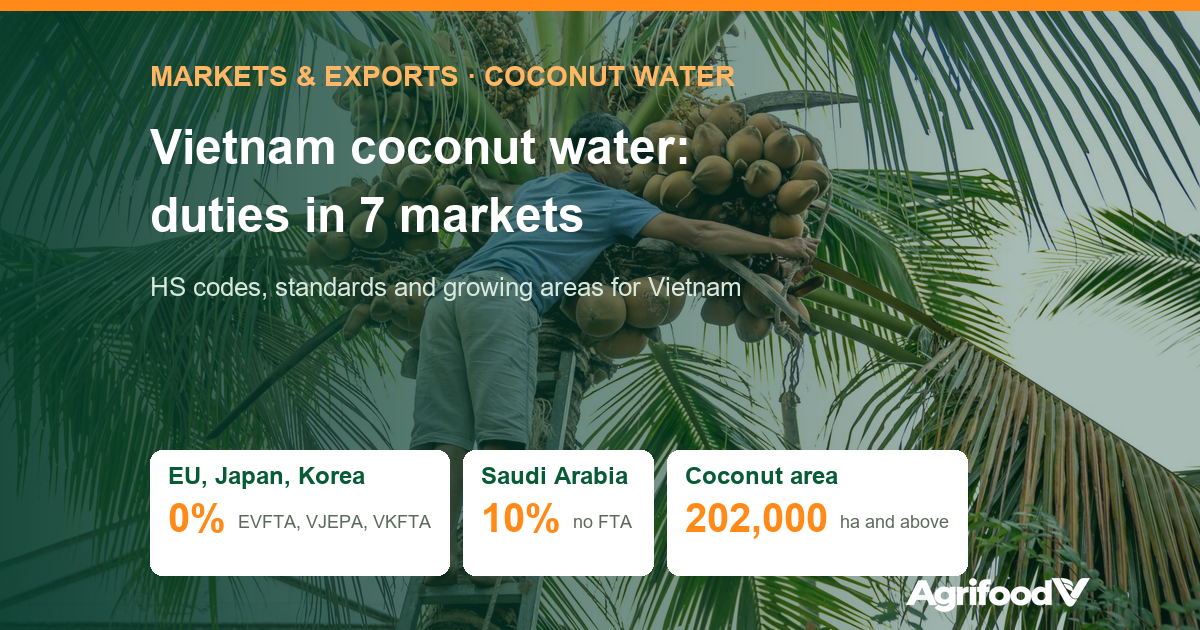
Vietnam has more than 202,000 ha of coconut, and in 2025 it was the second-largest supplier to the United States in the product group that contains coconut water, behind only Thailand. Yet coconut water has no international HS code of its own: each country splits the tariff lines differently, some with a dedicated line and some without, and the same drum of coconut water can face 0% duty in Korea but 10% in Saudi Arabia. This article brings together product codes, duties, standards and growing areas in seven markets.
Key points
- Unsweetened coconut water from Vietnam enters the EU, Japan, Korea, China and the UAE at 0%, provided the right agreement is used. Saudi Arabia charges 10% and has no FTA with Vietnam.
- The US charges 0.5 cents per litre and exempts coconut water from the 12.5% Section 301 duty, while passion fruit and mango juice under the same code 2009.89.70 remain subject to it.
- In the EU, coconut water in packs of 20 litres or more benefits from a 0% duty suspension for all origins from 1 January 2026, so Vietnam’s EVFTA advantage is now clear only for retail packs.
- No authority publishes separate export figures for coconut water. All trade figures below refer to HS 200989, which combines coconut water with passion fruit and many other juices.
Where coconut water sits in the tariff schedule
Heading 20.09 explicitly covers “fruit or nut juices (including coconut water)”; at the six-digit level, coconut water falls under 2009.89, together with passion fruit, mango, soursop and many other juices. The differences appear at national tariff-line level:
- A dedicated line for coconut water: Vietnam (2009.89.20 coconut water and 2009.89.30 coconut water concentrate, under the AHTN 2022 schedule), the US (statistical lines 2009.89.70.95 for certified organic and 2009.89.70.97 for other), Korea (2009.89-1030 “coconut juice, including coconut water”), and the UAE and Saudi Arabia (“coconut juice, not containing added sugar” in the common Gulf tariff).
- The EU has TARIC subdivision 2009 89 99 96 for coconut water that is unfermented, contains no added sugar and is packed in containers of 20 litres or more. Coconut water in smaller packs goes to the “other” line 2009 89 99 99.
- Japan and China have no dedicated coconut water line. In Japan, coconut water may be classified as “fruit juice” or as “other” under 2009.89; in China it most likely falls under 2009.8919 “other”, while coconut drinks with added sugar or flavouring may move to 2202.99. This is an inference from the structure of the tariff schedules; no public classification ruling exists.
Import duties in seven markets
The table below applies to coconut water with no added sugar and was read directly from each country’s current tariff schedule (accessed 17–20 October 2026).
| Market | Tariff line | Standard duty | Goods from Vietnam |
|---|---|---|---|
| EU | 2009 89 99 96 (packs of 20 litres or more); 2009 89 99 99 (smaller packs) | 17.6%; packs of 20 litres or more suspended to 0% from 1 January 2026 | 0% EVFTA (since 1 August 2020) |
| US | 2009.89.70.95 / .97 | 0.5 cents/litre | 0.5 cents/litre, exempt from Section 301 (no FTA) |
| Japan | 2009.89.123 (fruit juice) or 2009.89.990 (other) | WTO 19.1% or 9.6% | 0% VJEPA on both lines (sucrose not exceeding 10%) |
| Korea | 2009.89-1030 | 50% | 0% VKFTA (AKFTA also 0%) |
| China | 2009.8919 (inferred) | 5% | 0% ACFTA (RCEP 10%) |
| UAE | 200989500000 | 5% | 0% CEPA (since 3 February 2026); sweetened products also 0% |
| Saudi Arabia | 200989500000 | 10% (since 1 January 2025) | 10%, no FTA |
Points that are often missed:
- EU: the EVFTA advantage is levelled out for bulk packs. TARIC lists an autonomous tariff suspension of 0% for subdivision 2009 89 99 96 from 1 January 2026, applying to all origins except Belarus and Russia, and not applicable where the goods are processed by retail or catering undertakings. This means bulk packs from Thailand or the Philippines also enter the EU at 0%. Retail packs (line 99) still face 17.6%, unless a preference such as the EVFTA applies.
- US. The Section 301 exemption list covers only the coconut water and açaí portion of code 2009.89.70 (“Ex”). Coconut water blended with other juices goes to heading 2009.90; prepared beverages go to heading 2202 and do not benefit from this exemption.
- Japan. The 0% VJEPA rate on the fruit juice line applies to products with no added sugar and sucrose not exceeding 10%. For sweetened products classified under “other” (2009.89.910), VJEPA offers no preference and the goods must be declared under the CPTPP.
Quality standards: naming, Brix and food safety
| Market | Main requirements for coconut water |
|---|---|
| Codex | CXS 247-2005: “coconut water” is the product directly extracted from the coconut without expressing the coconut meat. The minimum Brix for reconstituted coconut water is 5.0; coconut nectar must contain at least 25% coconut water. |
| EU | Directive 2001/112/EC (consolidated version of 14 June 2026, including the amendments of Directive 2024/1438): “coconut water” is a synonym for coconut juice, reserved for the product directly extracted without expressing the coconut meat. The minimum Brix for reconstituted coconut water is 4.5. Sugar may not be added to products sold under the name fruit juice. |
| US | 21 CFR 120.1 defines “juice” as the aqueous liquid expressed or extracted from fruits or vegetables; in our reading, packaged coconut water falls within the scope of Juice HACCP (Part 120, which requires a process achieving a 5-log reduction of the target pathogen). In addition, under 21 CFR 113.3, a food with a finished equilibrium pH above 4.6 and a water activity above 0.85 is a low-acid food; if it is hermetically sealed and stored at ambient temperature, the establishment must register and file its process with the FDA (Part 108, Part 113). |
| Korea | MFDS Food Code (Notice 2026-55, effective 1 October 2026): “fruit and vegetable juice” must contain at least 95% juice, and “fruit and vegetable beverage” at least 10%. No specific provision for coconut water was found. |
| China | GB 7101-2022 (beverages) sets sensory, chemical, contaminant and microbiological requirements, with no specific juice content or Brix for coconut water. |
| Gulf | The general regulation GSO 1820:2021 on fruit juices and nectars applies (a paid document; we have not read its content). No GSO standard specific to coconut water was found. |
The practical consequence: coconut water mixed with liquid pressed from coconut meat cannot be called “coconut water” in the EU or under Codex.
Markets: the US, China and Korea buy the most from Vietnam
2025 import data as reported by the importing countries themselves to UN Comtrade, HS 200989 (juice of any other single fruit, including coconut water):
| Importing country | Total imports 2025 | Imports from Vietnam | Vietnam’s rank |
|---|---|---|---|
| US | USD 1,328 million | USD 212.1 million, 158,261 tonnes (2024: USD 122.3 million) | 2nd, 16% (after Thailand, USD 332.4 million) |
| China | USD 497.8 million | USD 96.6 million, 66,842 tonnes | 2nd, 19.4% (Thailand 62%) |
| Korea | USD 67.2 million | USD 13.5 million, 10,055 tonnes | 1st, 20.1% |
| Japan | USD 142.0 million | USD 5.1 million | 9th, 3.6% |
| Saudi Arabia | USD 79.3 million | USD 2.2 million | 8th, 2.7% |
These figures need careful reading. The unit value of Vietnamese goods entering the US is about USD 1.34 per kg, in line with goods from Thailand, a major coconut water exporter; most of the USD 212 million is therefore likely coconut water. That is an inference from unit values, not a separate statistic. In the EU the opposite applies: Vietnam ranks first under HS 200989 with USD 111.5 million, but most of it is passion fruit concentrate and should not be called coconut water. For CN8 line 2009 89 99 alone (other single fruit juice, unsweetened, which includes coconut water), Eurostat records EU imports from Vietnam of EUR 22.7 million and 23,219 tonnes in 2025, a unit value of about EUR 0.98 per kg.
According to CBI (the Dutch import promotion agency, updated 6 August 2025), Europe imports more than 50 million litres of coconut water a year, about 95% of it pure; consumption grew by 15–20% a year over the past five years. CBI mentions Vietnam only as a small supplier, mainly to France and Spain.
At sector level, the Vietnam Coconut Association reports that exports of the whole coconut sector reached about USD 1.25 billion in 2025. According to the Agency of Foreign Trade (Ministry of Industry and Trade), processed coconut products exceeded USD 259 million in the first nine months of 2025. Fresh coconuts alone reached about USD 534 million in 2025, up about 37%.
Growing areas: large acreage, but processing plants compete with fresh coconut for raw material
Acreage. According to the Department of Crop Production and Plant Protection (cited by Dai bieu Nhan dan newspaper, 6 November 2025), Vietnam has more than 202,000 ha of coconut, of which 181,000 ha are harvested, with a yield of 12.56 tonnes per ha and output of 2.28 million tonnes; the Mekong Delta accounts for 178,000 ha and 1.95 million tonnes.
Vinh Long (including former Ben Tre and Tra Vinh) has more than 122,000 ha, about 61% of the national area, with more than 270,000 growing households and about 151 coconut processing companies. The province has 222 growing-area codes for fresh coconut and 29 packing facilities approved for export to China, and targets about 44,000 ha of organic coconut in 2026 (Director of the Vinh Long Department of Agriculture and Environment, Nhan Dan newspaper, 3 August 2026). Dong Thap (including former Tien Giang) has 24,912 ha of coconut (June 2026).
No published figures yet: the national area of certified organic coconut and the output of packaged coconut water. Vietnam Customs has dedicated tariff lines for coconut water, but we have not found export statistics published by these lines.
Legal framework. Decree 38/2026/ND-CP (24 January 2026) regulates growing-area codes and packing-facility codes; growing areas for perennial crops must be at least 10 ha. The codes mainly serve fresh coconut exports to China, but the accompanying farming records are also what a coconut water plant needs to answer buyers on residues and origin.
AgrifoodV’s assessment: as fresh coconut has an official channel to China and is growing strongly in the US, coconut water plants will compete directly with fresh coconut traders for raw material. Plant projects need to secure supply in advance by variety, nut age and contract farming, rather than relying on spot market prices.
What companies should do
AgrifoodV recommendations:
- Choose the market by duty before choosing the line: Korea (0% instead of 50%) and Japan (0% under VJEPA) are where FTAs make the biggest difference; in the EU, only retail packs clearly benefit from the EVFTA; for China, use Form E (0%) rather than RCEP (10%).
- Request advance classification rulings (binding rulings) for coconut water in Japan and China, where there is no dedicated line, and for any blended or sweetened product, as these may move out of the coconut water line and lose the preference.
- Fix the product name and specifications according to the importing country’s law: only water directly extracted without expressing the meat may be called “coconut water” in the EU; minimum Brix is 4.5 in the EU and 5.0 under Codex for reconstituted products; for the US, determine the finished product’s pH to know whether low-acid food filing is required.
- Link the plant to growing areas with codes and farming records, and sign raw-material contracts by variety and nut age, because raw material must compete with fresh coconut exports.
AgrifoodV supports companies with market and import requirement analysis, processing plant planning and organising coded, traceable raw-material growing areas. Read more in the same pillar series: Vietnam passion fruit juice exports, pineapple juice exports and MD2 growing areas and seedless lime and calamansi juice.
References
- European Commission. TARIC, subdivision 2009 89 99 96 (Coconut water), origin Viet Nam, reference date 20 October 2026 (updated 19 October 2026). ec.europa.eu/taxation_customs.
- USITC. Harmonized Tariff Schedule of the United States 2026, subheading 2009.89 (queried 20 October 2026). hts.usitc.gov.
- USTR. Notice of actions under Section 301, Federal Register doc. 2026-15181, published 28 July 2026. federalregister.gov.
- Japan Customs. Import tariff schedule, Chapter 20 (version of 8 August 2026). customs.go.jp.
- Korea Customs Service. CLIP portal (UNI-PASS), 2026 tariff rate search for line 2009.89-1030 (accessed 20 October 2026). unipass.customs.go.kr.
- Customs Tariff Commission of the State Council of China. Import and Export Tariff 2026, issued with Notice No. 12/2025 (31 December 2025), heading 20.09. gss.mof.gov.cn.
- Dubai Customs. Notice No. 01/2026 (30 January 2026) on the entry into force of the Vietnam–UAE CEPA. dubaicustoms.gov.ae. UAE Ministry of Economy, CEPA preferential tariff dashboard for goods of Vietnamese origin: tradestatfta.moec.gov.ae.
- Zakat, Tax and Customs Authority of Saudi Arabia (ZATCA). Integrated tariff, heading 20.09. eservices.zatca.gov.sa.
- Codex Alimentarius. CXS 247-2005, General Standard for Fruit Juices and Nectars, annex on minimum Brix levels. fao.org.
- EU. Directive 2001/112/EC relating to fruit juices, consolidated version CELEX 02001L0112-20260614 (including the amendments of Directive (EU) 2024/1438 of 14 May 2024). eur-lex.europa.eu.
- eCFR. 21 CFR 120.1 (Juice HACCP), 21 CFR 113.3 and Part 108 (low-acid canned foods). Part 120; Part 113; Part 108.
- Ministry of Food and Drug Safety of Korea (MFDS). Standards and Specifications for Food (Food Code), section on fruit and vegetable beverages. foodsafetykorea.go.kr.
- China National Center for Food Safety Risk Assessment. GB 7101-2022 Beverages. sppt.cfsa.net.cn.
- GSO. GSO 1820:2021, General Standard for fruit juices, Fruit drink and Nectars. gso.org.sa.
- United Nations. UN Comtrade, imports under HS 200989 in 2025 by reporting country (API query of 17 October 2026). comtradeplus.un.org.
- Eurostat. Comext, dataset DS-045409, extra-EU imports under CN8 2009 89 99 in 2025 (updated 16 October 2026). ec.europa.eu/eurostat.
- CBI (Netherlands Ministry of Foreign Affairs). The European market potential for coconut water, updated 6 August 2025. cbi.eu.
- WTO and Integration Center (VCCI). Sản xuất và xuất khẩu dừa: hướng đi nào cho ngành hàng tỷ đô [Coconut production and exports: which way for a billion-dollar sector]. trungtamwto.vn. Bao Dau tu, 24 January 2026: baodautu.vn.
- Doanh nghiep Hoi nhap. Processed fruit and vegetable exports in the first nine months of 2025 (citing the Agency of Foreign Trade, Ministry of Industry and Trade), 3 November 2025. doanhnghiephoinhap.vn.
- Dai bieu Nhan dan newspaper. Bảo vệ sức khỏe cho cây dừa Việt Nam [Protecting the health of Vietnam’s coconut trees] (citing the Department of Crop Production and Plant Protection), 6 November 2025. daibieunhandan.vn.
- Nhan Dan newspaper. Hoàn thiện chuỗi giá trị [Completing the value chain] (citing the Vinh Long Department of Agriculture and Environment), 3 August 2026. nhandan.vn. Agriculture and Environment newspaper, 8 June 2026 (Dong Thap): nongnghiepmoitruong.vn.
- Government of Vietnam. Decree 38/2026/ND-CP of 24 January 2026 on growing-area codes and packing-facility codes. ppd.gov.vn.
- Vietnam Export and Import Tariff (AHTN 2022, Circular 31/2022/TT-BTC), lines 2009.89.20 and 2009.89.30, via Caselaw.vn. caselaw.vn.
Article by AgrifoodV, compiled from the sources above (accessed 17–20 October 2026). The classification of coconut water into specific tariff lines in Japan and China, and the share of coconut water within HS 200989, are inferences from the structure of the tariff schedules and from unit values; there is no classification ruling or separate official statistic. Tariff rates and regulations may change; companies should re-check the current tariff schedules and legislation before signing contracts. This content is not a substitute for legal advice. Cover image: Quang Nguyen Vinh / Pexels.
Looking at Vietnam as a sourcing origin or a place to build a value chain?
Tell us your product, target market and expected volumes. In a 30–45 minute online call, AgrifoodV reviews buyers, standards, processing capacity and growing areas with you, starting from the market.
Book a call →Sourcing from Vietnam© 2026 AgrifoodV. Nội dung được phép trích dẫn khi ghi rõ nguồn và đặt liên kết tới bài gốc; không sao chép toàn văn. Xem Điều khoản sử dụng nội dung.