AgrifoodV ·
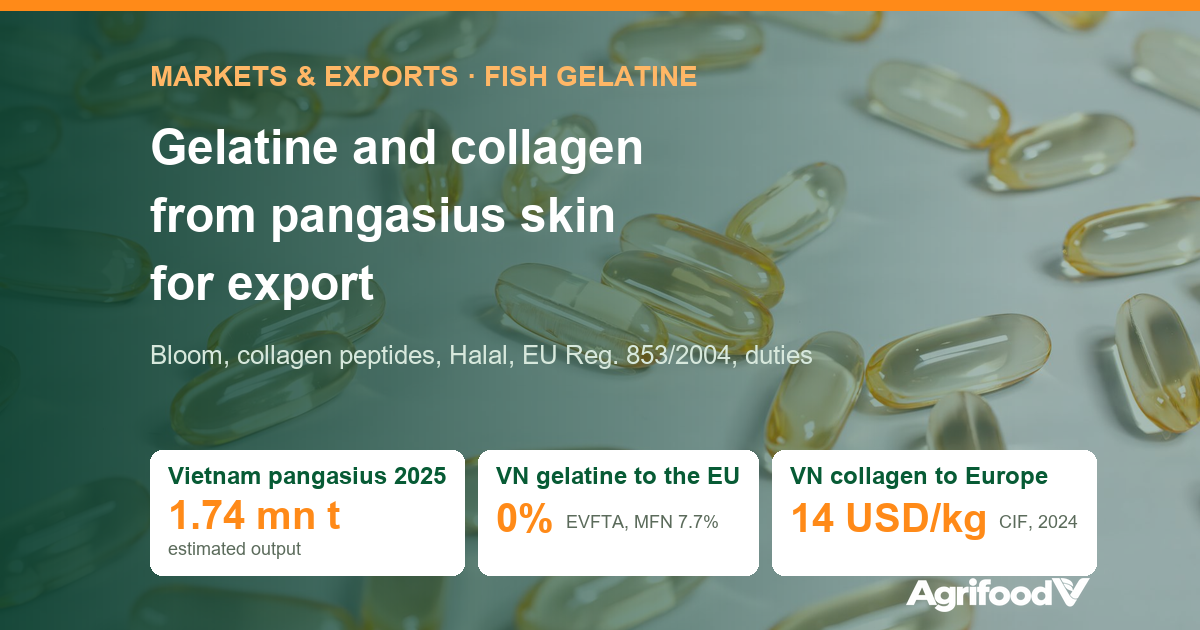
In 2025 Vietnam farmed about 1.74 million tonnes of pangasius and exported USD 2.19 billion worth, but fillets account for only 30–40% of the weight of the fish; the rest is by-products, including the skin. Most pangasius skin is currently sold raw for animal feed, at about USD 0.5/kg for fresh skin. According to VASEP, the same raw material reaches USD 25–40/kg once made into collagen. The gap lies not in the raw material but in the technology chain, certification and market access. This article brings together the markets, duties, standards and raw-material requirements for gelatine and collagen peptides from Vietnamese catfish skin.
Key points
- Gelatine (sold by Bloom strength) and collagen peptides (sold by molecular weight, typically 3–6 kDa) share the front end of the line but are sold to two different customer groups, with two different sets of certifications.
- Most of the world’s gelatine is made from pig skin and bovine hide. Fish gelatine can enter Halal markets, where pork gelatine is excluded entirely. But pangasius is a scaleless catfish, so pangasius skin gelatine does not automatically qualify as Kosher.
- The EU allows fish skin and bones to be used for food gelatine and collagen (Regulation (EC) 853/2004), provided the raw material is transported and stored chilled or frozen unless it is processed within 24 hours, and the finished product meets the limits of As 1, Pb 5, Cd 0.5 and Hg 0.15 ppm.
- Duties: Vietnamese gelatine and collagen enter the EU at 0% under EVFTA (MFN 7.7% and 3.4%). In Japan, edible gelatine must claim CPTPP (7.4%) because VJEPA keeps the rate at 17%. In the US, an extra 12.5% applies under Section 301 from 24 July 2026.
Gelatine and collagen peptides: two products, two customer groups
Gelatine is partially hydrolysed collagen that can still form a gel. Its main sales parameter is Bloom strength (gel firmness): commercial gelatine ranges from 100 to 300 g Bloom, with 250–260 g the most sought after. Collagen peptides are collagen hydrolysed further by enzymes into short chains of low molecular weight, usually about 3–6 kDa; they do not gel and dissolve in cold water.
| Criterion | Gelatine | Collagen peptides (hydrolysed collagen) |
|---|---|---|
| What the buyer pays for | Bloom strength, viscosity, colour, odour | Molecular weight, solubility, odour, microbiology |
| Main applications | Confectionery, soft and hard capsules, food, pharmaceuticals | Functional foods, beverages, cosmetics |
| Distinctive process step | Temperature-controlled extraction to preserve Bloom | Enzymatic hydrolysis, membrane filtration, spray drying |
| Required capability | Bloom measurement by the standard method for every batch | Laboratory able to measure molecular weight, with repeatable results between batches |
A study on pangasius skin showed that thorough defatting alone (6 times versus none) raised gelatine yield by about 40% and Bloom strength from 234 to 292 g. Raw-material quality decides the selling price before the machinery has a chance to.
Markets: fish gelatine is small, but it stands where pork gelatine cannot go
Members of Gelatine Manufacturers of Europe (GME) account for about 68% of global gelatine output. In Europe, about 80% of food gelatine is made from pig skin, 15% from bovine hide and the remaining 5% from pig bones, bovine bones and fish. World gelatine output figures exist only in commercial reports, which differ from one another by about a third, and no association has published the current share of fish gelatine.
On UN Comtrade, exports under HS 3503 (gelatine, gelatine derivatives and animal glues) were about USD 2.03 billion in 2024, based on the 89 countries that reported. The leaders were Germany (USD 310.7 million), Brazil (288.3 million), China (244.6 million) and France (186.2 million). Vietnam is a small supplier but already has customers in demanding markets:
| Code | Imports from Vietnam in 2024 (as reported by importers) | Average CIF unit price | Main markets |
|---|---|---|---|
| 3503 gelatine | USD 22.82 million | USD 7.29/kg | Korea USD 10.75/kg; China USD 4.75/kg; Italy USD 9.50/kg |
| 3504 other proteins (including hydrolysed collagen) | USD 14.25 million | USD 14.02/kg | UK, Spain, Denmark, Korea, Ireland: USD 14–15/kg |
Two notes on reading the table. Code 3503 also includes animal glues, and code 3504 also includes milk and plant proteins, so these are not prices for fish gelatine or fish collagen alone. The price gap between China on one side and Korea and Italy on the other shows that, although all of it is gelatine, the segments are very different. The Vietnam Institute of Fisheries Science states that collagen from fish skin can reach USD 15–20/kg, consistent with the price range of Vietnamese collagen entering Europe.
Halal, Kosher and animal origin: the real advantage and its limits
Under the Codex Halal guidelines (CAC/GL 24-1997), pigs and all pig products and derivatives are not permitted, including additives from non-permitted sources; aquatic animals are excluded only when they are poisonous or hazardous. For Kosher, fish must have fins and scales, and gelatine made from non-kosher species is not kosher. For medicinal products in the EU, raw materials from cattle, sheep and goats must follow the guidance on minimising the risk of transmitting spongiform encephalopathies via medicinal products (EMA/410/01 rev.3); fish do not belong to this group of species.
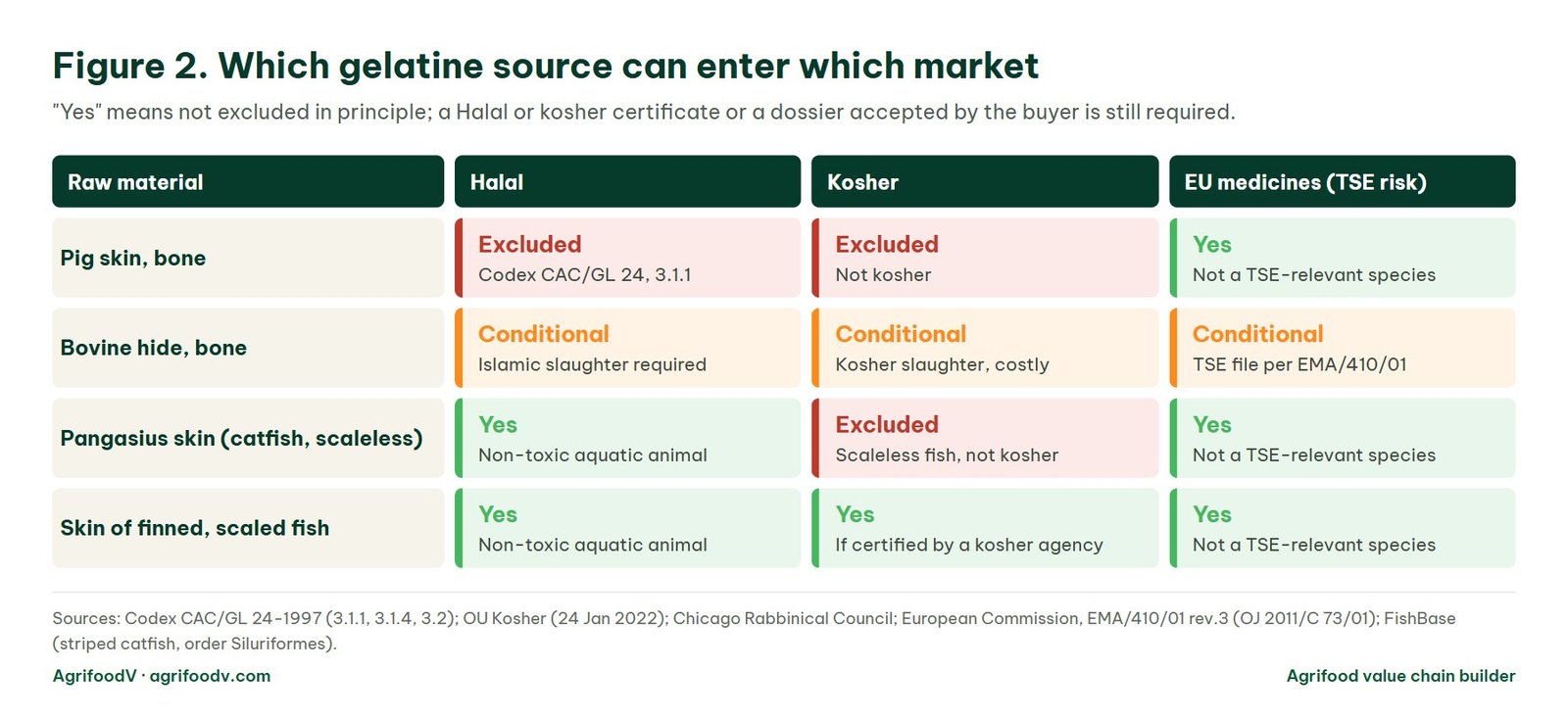
The Halal advantage only turns into money with genuine certification. Codex requires that Halal food not be processed, transported or stored using equipment that has been in contact with non-permitted substances, unless it has been cleaned as required. For a fish gelatine plant, the usual sticking points are enzymes, additives and processing aids of unsuitable origin, shared pipework, and warehousing. These points must be on the design drawings, not applied for after the plant is built. On timing: Indonesia, a large Muslim market in the region, has announced that mandatory Halal certification for imported food is postponed to 18 October 2028 (announced 17 October 2026; the number of the amending instrument has not yet been seen), so companies still have time to prepare the right dossier from the outset.
Import duties in the main markets
Duty rates for goods of Vietnamese origin, checked on 25 October 2026. Collagen peptides are usually declared under heading 3504; if blended into a food supplement they may move to heading 2106 with a different duty, so classification must be determined for each specific product.
| Market | Edible gelatine (3503) | Hydrolysed collagen (3504) |
|---|---|---|
| EU (EVFTA) | MFN 7.7% → 0% | MFN 3.4% → 0% |
| US (no FTA) | 2.8 cents/kg + 3.8% +12.5% Section 301 | 4% +12.5% Section 301 |
| Japan | WTO 17%; VJEPA 17% (no preference); CPTPP 7.4% | WTO 5.1% → 0% (VJEPA, CPTPP) |
| China (ACFTA, RCEP) | MFN 12% → 0%* | MFN 8% → 0%* |
| Korea | MFN 8%; VKFTA rate to be checked by tariff line | MFN 8% |
| UAE, Saudi Arabia | 5% | 5% |
* China’s preferential rates are taken from a commercial tariff look-up site; the MFN rates match the UNCTAD TRAINS database. Rates for Korea, the UAE and Saudi Arabia are 2023 MFN rates (WITS). The Section 301 exemption list does not include headings 3503 and 3504.
EU standards: fish skin is allowed, but both raw material and finished product are checked
Annex III to Regulation (EC) 853/2004 (consolidated version of 7 May 2026), Section XIV (gelatine) and Section XV (collagen), sets four groups of requirements:
- Raw material. Fish skin and bones are on the list of permitted raw materials. Raw material that has undergone no treatment other than chilling or freezing must come from registered or approved establishments. Tanned hides and skins are prohibited.
- Transport and storage. Raw material must be transported and stored chilled or frozen unless it is processed within 24 hours of leaving the establishment; each consignment must be accompanied by documents stating the establishment of origin.
- Processing. Raw materials other than ruminant bones are treated with acid or alkali, rinsed and pH-adjusted; gelatine is extracted by heating once or several times, then purified by filtration and heat treatment.
- Finished product. Gelatine and collagen must meet residue limits: As 1 ppm, Pb 5 ppm, Cd 0.5 ppm, Hg 0.15 ppm, Cr 10 ppm, Cu 30 ppm, Zn 50 ppm, SO₂ 50 ppm, H₂O₂ 10 ppm. Packaging must be labelled “gelatine fit for human consumption” or “collagen fit for human consumption”.
On country listing, Article 18(3) of Implementing Regulation (EU) 2021/405 (consolidated version of 3 September 2026) allows gelatine and collagen made from fishery products to enter the EU if they come from a country in Annex IX, the list of countries authorised to export fishery products; Vietnam is listed in this annex. Each consignment must be accompanied by a certificate following the GEL (gelatine) or COL (collagen) model in Implementing Regulation (EU) 2020/2235, and the production establishment must be on the list of EU-approved establishments. Note: Annex XII to Regulation 2021/405 is the list for gelatine and collagen from livestock; misreading this annex easily leads to the wrong conclusion that Vietnam cannot export gelatine to the EU.
Raw material: plenty of pangasius skin, but it spoils fast
In 2025 Vietnam stocked more than 5,500 ha of pangasius, with output of about 1.74 million tonnes. According to the Vietnam Institute of Fisheries Science, prime fillets account for only about 30–40% of the weight of the fish, and 60–70% is by-products. One study on commercially farmed pangasius measured skin at 8.0 ± 1.3% of fish weight; another study cites about 6%. AgrifoodV’s rough estimate: if skin is 6–8%, 2025 output corresponds to about 100,000–140,000 tonnes of fresh skin a year, before deducting what cannot be collected. The raw material is ample for several plants; what is scarce is skin that is collected chilled, well defatted and traceable.
Fish skin is rich in protein and fat and decomposes quickly at Vietnamese temperatures. The time from skinning to processing is measured in hours. Residual fat is the direct cause of fishy odour in the finished product; raw material held too long and overheated extraction make matters worse. The cold collection chain and the contracts with fillet plants (chilling standards, delivery times, fat, scale and meat-trim content) are therefore as important as the processing line itself.
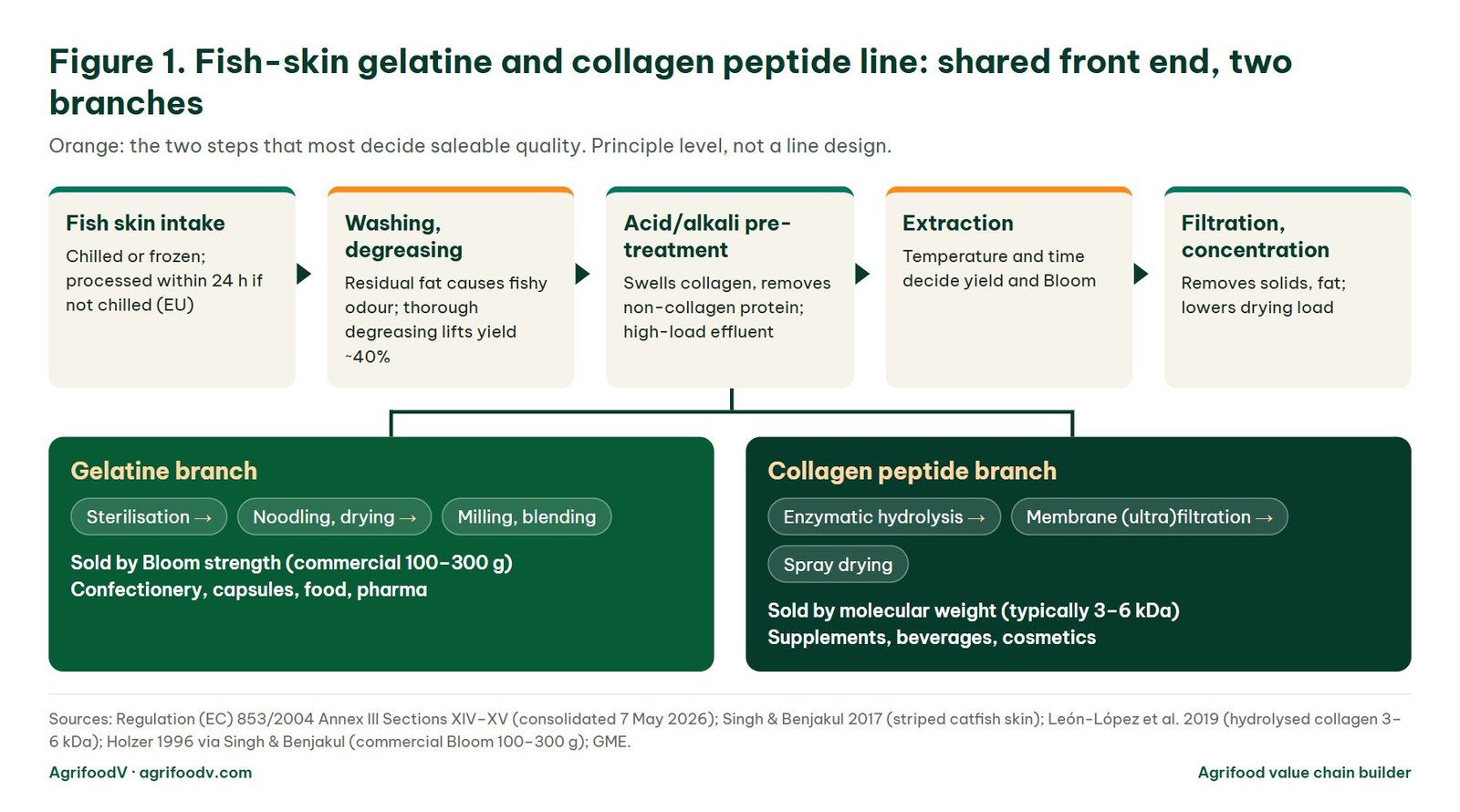
At the level of principle, the line consists of receiving, washing and defatting; acid or alkali pretreatment; extraction; filtration; concentration; and then a split into two branches. The gelatine branch is sterilised, extruded into noodles and dried, and is sold by Bloom. The collagen peptide branch goes through enzymatic hydrolysis, membrane filtration and spray drying, and is sold by molecular weight. Pretreatment generates high-load wastewater, which must be built into the environmental plan from the start.
What companies should do
AgrifoodV recommendations:
- Settle the product first: gelatine (at what target Bloom) or collagen peptides (at what target molecular weight), sold to the food, functional food or pharmaceutical sector. Each choice brings different equipment, laboratory and certification needs.
- Settle the market and certification: Halal (which certification body the buyer accepts), the EU dossier under Regulation 853/2004, and establishment registration with the importing country. Do not position pangasius skin gelatine as a Kosher product before consulting a certification body.
- Secure the raw material: sign contracts with fillet plants covering the cold chain, delivery within 24 hours or freezing, and fat and impurity content; make every batch of skin traceable.
- Run pilot-scale trials to obtain Bloom, molecular weight and odour data on your own skin supply before investing at industrial scale.
- Do not compete on price with pork and bovine gelatine. Fish gelatine wins by entering markets that pork gelatine cannot, through consistent quality, complete documentation and on-time delivery.
AgrifoodV supports companies with market analysis and import requirements, processing plant direction and organising traceable raw-material supply chains. Further reading: The journey of building an export processing plant.
Fish-skin gelatine and collagen series
In-depth articles on products, certification, markets and raw materials, updated as new articles are published:
References
- VASEP. News item on a collagen and gelatine project using pangasius skin, 1 July 2021: fresh fish skin at about USD 0.5/kg; USD 25–40/kg once made into collagen. seafood.vasep.com.vn.
- Singh P., Benjakul S. Extraction and characterisation of gelatin from the skin of striped catfish (Pangasianodon hypophthalmus) and studies on its colour improvement. African Journal of Biotechnology 16(1): 1–9, 2017, DOI 10.5897/AJB2013.13121. doi.org.
- León-López A. et al. Hydrolyzed Collagen — Sources and Applications. Molecules 24(22): 4031, 2019, DOI 10.3390/molecules24224031. doi.org.
- Gelatine Manufacturers of Europe (GME). Gelatine — Manufacturing. gelatine.org.
- European Union. Regulation (EC) 853/2004, Annex III Section XIV (gelatine) and Section XV (collagen), consolidated version CELEX 02004R0853-20260507. eur-lex.europa.eu.
- Codex Alimentarius. General Guidelines for Use of the Term “Halal”, CAC/GL 24-1997. fao.org.
- OU Kosher. Kosher Fish Production: Getting Into the Stream of Things, 24 January 2022; Chicago Rabbinical Council. Kosher Fish for the Kosher Consumer. oukosher.org; crcweb.org.
- European Commission. Note for guidance on minimising the risk of transmitting animal spongiform encephalopathy agents via human and veterinary medicinal products (EMA/410/01 rev.3), Official Journal of the EU 2011/C 73/01. ema.europa.eu.
- FishBase. Pangasianodon hypophthalmus (striped catfish, pangasius), order Siluriformes (catfishes). fishbase.se.
- VnEconomy. Ngành cá tra chuyển tư duy từ “sản lượng” sang “giá trị cao” [The pangasius sector shifts its mindset from “volume” to “high value”] (data from the Ministry of Agriculture and Environment), 31 December 2025. vneconomy.vn.
- VASEP. Review of seafood exports in 2025 (via Vietnam Law Newspaper, 5 January 2026); Cá tra Việt Nam tìm động lực tăng trưởng từ Anh, Nhật Bản và EU [Vietnamese pangasius seeks growth drivers in the UK, Japan and the EU], 20 October 2026. vasep.com.vn.
- Ministry of Agriculture and Environment. Khai mở “mỏ vàng” phụ phẩm cá tra bằng công nghệ [Unlocking the “gold mine” of pangasius by-products with technology] (report by the Vietnam Institute of Fisheries Science), 28 April 2026. mae.gov.vn.
- Islami S.N.-E. et al. Rigor index, fillet yield and proximate composition of cultured striped catfish (Pangasianodon hypophthalmus). Journal of Fisheries 2(3): 157–162, 2014. journal.bdfish.org.
- GME. Presentation at the 14th Animal Task Force Seminar, 20 November 2024. animaltaskforce.eu.
- UN Comtrade. HS 3503 and 3504 in 2024: world exports, and imports from Vietnam as reported by importing countries (queried 25 October 2026; unit prices calculated by AgrifoodV). comtradeplus.un.org.
- European Commission. TARIC, codes 3503 00 10 and 3504 00, origin Vietnam (checked 25 October 2026). ec.europa.eu/taxation_customs.
- USITC. HTSUS 2026, 3503.00.55 and 3504.00.50. hts.usitc.gov. USTR. Notice of Actions in Section 301 Investigations, Federal Register 2026-15181, 28 July 2026. federalregister.gov.
- Japan Customs. Customs tariff schedule as of 1 April 2026, Chapter 35. customs.go.jp.
- World Bank, UNCTAD. WITS/TRAINS, 2023 MFN rates of China, Korea, the UAE and Saudi Arabia. wits.worldbank.org. China’s 2026 tariff schedule via the hsbianma.com look-up site. hsbianma.com.
- European Union. Implementing Regulation (EU) 2021/405, Article 18 and Annex IX, consolidated version CELEX 02021R0405-20260903; Implementing Regulation (EU) 2020/2235, Articles 19–20, consolidated version CELEX 02020R2235-20260312. eur-lex.europa.eu (2021/405); eur-lex.europa.eu (2020/2235).
- Indonesia. Announcement postponing mandatory Halal certification for foreign products to 18 October 2028 (RCTI+, 17 October 2026, citing the Coordinating Ministry for Economic Affairs). rctiplus.com.
Article by AgrifoodV, compiled from the sources above (accessed 21 September–25 October 2026). The fish skin and collagen prices are figures cited by VASEP in 2021 and are used only to illustrate the value gap. Duty rates and regulations may change; companies should check the current tariff schedules, legislation and certification body requirements before signing contracts. This content is not a substitute for legal advice. Cover image: Supplements On Demand / Pexels.
Looking at Vietnam as a sourcing origin or a place to build a value chain?
Tell us your product, target market and expected volumes. In a 30–45 minute online call, AgrifoodV reviews buyers, standards, processing capacity and growing areas with you, starting from the market.
Book a call →Sourcing from Vietnam© 2026 AgrifoodV. Nội dung được phép trích dẫn khi ghi rõ nguồn và đặt liên kết tới bài gốc; không sao chép toàn văn. Xem Điều khoản sử dụng nội dung.