AgrifoodV ·
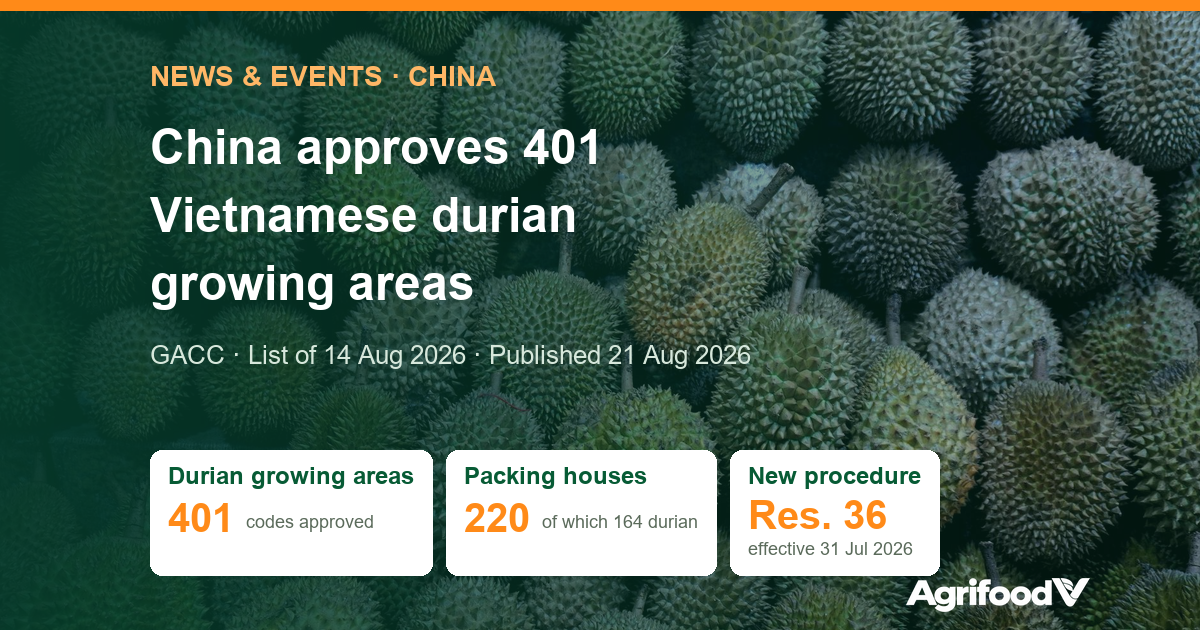
China’s General Administration of Customs (GACC) approved on 14 August 2026 a batch of Vietnamese fresh-fruit growing-area codes and packing-house codes, including 401 durian growing areas. The list was published by Vietnam’s Department of Crop Production and Plant Protection on 21 August 2026. Around the same time, the Government issued Resolution 36/2026/NQ-CP, moving the issuance of growing-area and packing-house codes to commune-level People’s Committees and onto an online process.
Key points
- The 14 August 2026 batch covers 407 growing areas (401 durian, 3 coconut, 3 chili) and 220 packing houses (164 durian, 37 jackfruit, 8 dragon fruit, 6 coconut and a few other fruits).
- Dak Lak and Lam Dong account for 226 of the 401 approved durian growing areas. Eight codes in Dak Lak are annotated as issued by GACC with an incorrect address, pending GACC’s response.
- Appearing on a “submitted, awaiting approval” list is not yet a basis for exporting to China.
- Resolution 36/2026/NQ-CP (31 July 2026): applications go through the National Public Service Portal; the commune inspects and issues a notice within a maximum of 10 working days for markets that require codes.
What the 14 August 2026 batch contains
According to the notice from the Department of Crop Production and Plant Protection, GACC approved on 14 August 2026 a list of growing-area codes and packing-house codes for fresh durian, coconut, jackfruit and chili exported to China. The list file attached to the notice has two tables: growing areas and packing houses. Every line carries the review conclusion “approved” (通过).
AgrifoodV counted directly from the original list file. Besides the four fruits named in the notice, the packing-house table also includes a few dragon fruit, banana, mango and lychee facilities.
| Fruit | Growing areas | Packing houses |
|---|---|---|
| Durian | 401 | 164 |
| Jackfruit | 0 | 37 |
| Dragon fruit | 0 | 8 |
| Coconut | 3 | 6 |
| Chili | 3 | 1 |
| Banana, mango, lychee | 0 | 4 |
| Total | 407 | 220 |
Source: list of codes approved by GACC on 14 August 2026, published by the Department of Crop Production and Plant Protection on 21 August 2026; counted by AgrifoodV by fruit column.
Durian: where the approved codes are
Of the 401 durian growing areas, Dak Lak has 140 codes, Lam Dong 86, Dong Thap 44, Dong Nai 41, Gia Lai 35, Can Tho 28, An Giang 13, Vinh Long 9, Tay Ninh 3 and Ho Chi Minh City 2. Of the 164 durian packing houses, Lam Dong has 61, Dong Thap 45, Dak Lak 31, Dong Nai 9, Gia Lai 7, Tay Ninh 5, Vinh Long 4 and Can Tho 2.
The list file notes that 8 durian growing-area codes in Dak Lak were issued by GACC with an incorrect address. The Department says it will notify again once it receives GACC’s response. Owners of growing areas in this group should follow up before packing shipments.
For coconut, a product directly linked to the coconut water industry, this batch includes 3 growing areas in Vinh Long and 6 packing houses (Dong Thap 3, Tay Ninh 2, Can Tho 1).
A waiting list is not a permit
On 23 July 2026, the Department published two groups of lists: fresh-fruit growing areas and packing houses submitted to GACC in June and July 2026; and durian growing areas and packing houses that had supplied the questionnaires, photos or videos requested by GACC. The Department stated clearly that being named on these lists does not mean approval and is not yet a basis for exporting to China.
AgrifoodV cross-checked by code: 556 of the 725 codes on the durian waiting list (published 23 July 2026) appear in the 14 August batch; the rest are not found in this batch. The most reliable check is still to look up each code in the approved list, not to rely on the fact that a dossier has been submitted.
New code procedure under Resolution 36/2026/NQ-CP
Resolution 36/2026/NQ-CP of 31 July 2026 amends certain provisions of Decree 38/2026/ND-CP of 24 January 2026 on growing-area codes and packing-house codes. The main points:
- Applications are submitted to the commune-level People’s Committee where the growing area or packing house is located, via the National Public Service Portal. Applicants self-declare and take responsibility; pre-inspection applies only when the importing country requires codes.
- No registration for markets requiring codes: the commune issues a code notice within a maximum of 3 working days.
- Registration for markets requiring codes: the commune inspects and issues a notice within a maximum of 10 working days. If the importing country must approve, the province sends the list to the Ministry of Agriculture and Environment within 3 working days, and the Ministry forwards it to the importing country within the next 3 working days.
- The location of a growing area is determined by the land-parcel identification code. A growing-area code does not establish or replace land-use rights.
- Codes issued and approved before the Resolution took effect remain valid in their issued format. Growing areas that already hold a code and want to add a market keep the same code.
The Resolution takes effect from the date of signing until a decree amending Decree 38/2026/ND-CP takes effect. The domestic procedure is faster, but the time GACC takes to review remains a decision of the Chinese side.
What companies should do
The following are AgrifoodV’s recommendations, not the content of the legal documents.
- Look up codes in the approved list file before signing contracts or sourcing for shipments to China. A code that is only on the waiting list cannot yet be exported.
- Re-check addresses and entity names of growing areas and packing houses. Mismatched information between the two sides can delay clearance, as in the case of the 8 codes annotated with an incorrect address.
- Standardize land-parcel records against the identification codes in the land database, since Resolution 36 uses these codes to locate growing areas.
- Keep technical records ready (cultivation logs, pest surveys, traceability back to the growing area). Post-inspection is central to the new mechanism, and codes can be suspended or revoked in case of violations.
AgrifoodV supports companies in building cultivation procedures, growing-area code dossiers and traceability systems that meet the requirements of importing markets.
References
- Department of Crop Production and Plant Protection. Danh sách vùng trồng và cơ sở đóng gói các loại quả tươi Tổng cục Hải quan Trung Quốc phê duyệt (cập nhật ngày 14/8/2026) [List of fresh-fruit growing areas and packing houses approved by GACC (updated 14 August 2026)], published 21 August 2026, with list file. ppd.gov.vn.
- Department of Crop Production and Plant Protection. Danh sách vùng trồng và cơ sở đóng gói đã được gửi sang Trung Quốc tháng 6/2026 và tháng 7/2026 chờ nước nhập khẩu xem xét và phê duyệt [Growing areas and packing houses submitted to China in June and July 2026, awaiting review and approval], published 23 July 2026. ppd.gov.vn.
- Department of Crop Production and Plant Protection. Danh sách vùng trồng, cơ sở đóng gói sầu riêng đã bổ sung bảng câu hỏi, hình ảnh, video theo yêu cầu của GACC và đang chờ phê duyệt [Durian growing areas and packing houses that supplied questionnaires, photos and videos requested by GACC, awaiting approval], published 23 July 2026. ppd.gov.vn.
- Government of Vietnam. Nghị quyết số 36/2026/NQ-CP ngày 31/7/2026 quy định đơn giản hóa thủ tục hành chính về mã số vùng trồng, mã số cơ sở đóng gói [Resolution 36/2026/NQ-CP of 31 July 2026 simplifying administrative procedures for growing-area and packing-house codes] (full text, PDF). ppd.gov.vn; introductory article of 3 August 2026: ppd.gov.vn.
Cover image: Ramadhan Bagaskara Arya P / Pexels.
Article by AgrifoodV, compiled from the sources above (accessed 21 October 2026). This content is not a substitute for legal advice.
Looking at Vietnam as a sourcing origin or a place to build a value chain?
Tell us your product, target market and expected volumes. In a 30–45 minute online call, AgrifoodV reviews buyers, standards, processing capacity and growing areas with you, starting from the market.
Book a call →Sourcing from Vietnam© 2026 AgrifoodV. Nội dung được phép trích dẫn khi ghi rõ nguồn và đặt liên kết tới bài gốc; không sao chép toàn văn. Xem Điều khoản sử dụng nội dung.