AgrifoodV ·
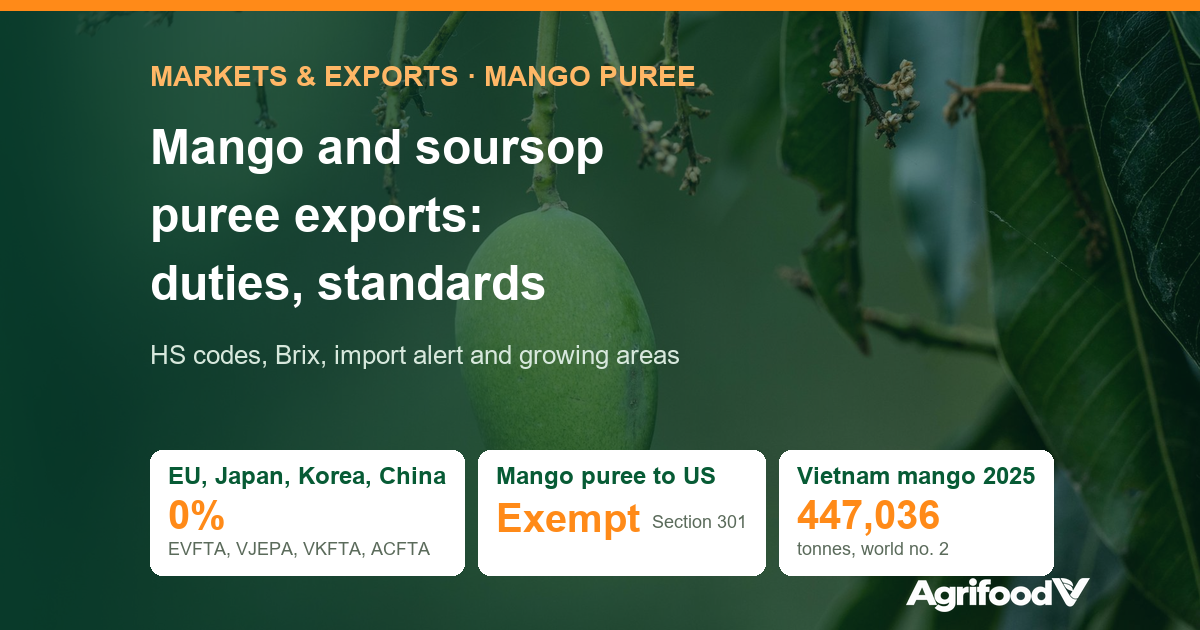
According to FAO, Vietnam exported about 447,000 tonnes of mango in 2025, ranking second in the world, but almost all of it was fresh fruit. In mango puree, where European buyers import 90,000–100,000 tonnes a year, there is no published figure for Vietnam. Soursop is smaller still and also faces an FDA import alert. This article sets out the HS codes, duties, standards and growing areas for both products in seven markets.
Key points
- Vietnamese mango and soursop puree and juice enter the EU, Japan, Korea, China and the UAE at 0% when the right agreement is used. Saudi Arabia charges 10% on mango juice and 5% on puree.
- In the US, mango puree (2007.99.50) and prepared mango (2008.99.40) are exempt from the 12.5% Section 301 duty; mango juice, soursop juice and prepared soursop (2008.99.23) are not.
- FDA Import Alert 31-03 (updated 16 September 2026) allows detention without physical examination of soursop juice, puree and pulp from firms on its red list, which includes three Vietnamese companies. The reason is the acetogenin toxin in the seeds.
- Cooked puree falls under heading 20.07 and uncooked puree under 20.08: the production method decides the tariff line and the duty.
Puree or juice: the tariff line depends on how it is made
The two products can fall into four groups of codes, and duties differ between them:
- Fruit juice (heading 20.09). Mango juice and soursop juice belong to 2009.89. China, the UAE and the US have a separate line for mango juice (China 2009.8912; US statistical line 2009.89.70.70). None of the seven markets below has a separate line for soursop.
- Cooked puree (heading 20.07). Under Note 5 to Chapter 20, heading 20.07 covers only products “obtained by cooking”. The US has a separate line, 2007.99.50, for guava and mango pastes and purees.
- Uncooked puree (heading 20.08). The US has separate lines for prepared mangoes (2008.99.40) and for the soursop, sapodilla and cashew apple group (2008.99.23). In the EU, uncooked unsweetened mango puree has no line of its own; based on the structure of the tariff, it most likely falls under the “other” line 2008 99 99 90.
- Uncooked frozen pulp (heading 08.11). The US separates frozen mangoes (0811.90.52) and frozen soursop (0811.90.25).
The EU has one more trap: the tariff’s list of “tropical fruit” includes mango, guava, passion fruit, papaya, lychee, jackfruit and dragon fruit, but not soursop. Soursop juice therefore goes to the “juice of any other single fruit” line, with a standard duty of 17.6%, higher than mango juice (11%).
Import duties in seven markets
The table applies to products without added sugar and is read from each country’s current tariff schedule (accessed 10–24 October 2026). “A → B” means standard duty A, rate for Vietnamese goods B.
| Market | Mango juice | Mango puree | Soursop juice and puree |
|---|---|---|---|
| EU (EVFTA) | 2009 89 97: 11% → 0% | uncooked 2008 99 99: 18.4% → 0%; cooked 2007 99 93: 15% → 0% | juice 2009 89 99: 17.6% → 0%; uncooked puree 18.4% → 0% |
| US (no FTA) | 2009.89.70.70: 0.5 cents/litre +12.5% | cooked 2007.99.50: 1.3%; uncooked 2008.99.40: 1.5 cents/kg; both exempt from Section 301 | juice 2009.89.70.99: 0.5 cents/litre +12.5%; prepared 2008.99.23: 1.3% +12.5%; frozen 0811.90.25: 3.2%, exempt from Section 301 |
| Japan (VJEPA) | WTO 19.1% (concentrate 25.5%) → 0% | uncooked 2008.99: WTO 15% → 0%; cooked 2007.99 → 0% | same as other juices and purees: 0% |
| Korea (VKFTA) | 2009.89-1090: 0% (AKFTA 40%) | 2008.99-9000 and 2007.99-9000: 0% | 0% |
| China (ACFTA) | 2009.8912: 5% → 0% (RCEP 13.3%) | 2008.9990, 2007.99: 5% → 0% | juice 2009.8919: 5% → 0% (RCEP 10%) |
| UAE (CEPA) | 200989220000–250000: 5% → 0% | 200799900000, 200899900000: 5% → 0% | other single-fruit juice line: 5% → 0% |
| Saudi Arabia (no FTA) | 10% | 5% | other single-fruit juice 5%; puree 5% |
Points that are often missed:
- US. Section 301 adds 12.5% to Vietnamese goods from 24 July 2026 (heading 9903.05.84). The exemption list in note 52(b) of Chapter 99 includes 2007.99.50, 2008.99.40, 0811.90.52 and 0811.90.25, but not 2008.99.23 and not juice under 2009.89.70 (that line exempts only coconut water and açaí). For mango, puree or frozen pulp is exempt while mango juice is not.
- China. Use a Form E certificate of origin (ACFTA, 0%), not RCEP: for mango juice the RCEP rate is 13.3%, higher even than the 5% standard duty.
- Saudi Arabia. Mango juice pays 10%, twice the rate for puree. According to the ZATCA tariff, the sweetened sub-lines of mango juice also pay 10%.
- UAE. The Vietnam–UAE CEPA has been in force since 3 February 2026. Soursop has no line of its own; placing it under “juice of any other single fruit” is our inference, so request an advance classification ruling for the first shipment.
Standards: minimum Brix and Import Alert 31-03
| Market | Mango | Soursop |
|---|---|---|
| Codex CXS 247-2005 | Minimum reconstituted Brix 13.5; nectar at least 25% puree | Brix 14.5; nectar at least 25% |
| EU (Directive 2001/112/EC, consolidated 14 June 2026) | 13.5 (uncorrected Brix reading because it is produced as a puree); nectar at least 25% | Not listed in Annex V: Brix is that of the juice as extracted from the fruit; nectar at least 25% |
| US (21 CFR 101.30) | 13.0 (used to calculate the juice percentage on the label) | 16.0 (guanabana) |
| Japan (JAS 1075:2023) | reconstituted juice ≥13; called concentrate at ≥26 | — |
In the EU, products sold as fruit juice may not contain added sugar. In the US, the definition of “juice” in 21 CFR 120.1 covers purees and puree concentrates, so mango and soursop purees fall within the scope of Juice HACCP (Part 120).
Import Alert 31-03. The alert dates from 1990; the current version was published on 16 September 2026. FDA states that soursop fruit, leaves and bark contain acetogenins, which are neurotoxic, and that the seeds contain levels high enough to make them inedible. The scope covers soursop drinks, juices, nectars, pulp and puree. Products of firms on the red list are detained without physical examination; to release an individual shipment, the owner must submit laboratory results showing the product contains no natural toxins. The red list currently includes three Vietnamese companies, one of them added on 16 September 2026 for soft dried soursop with seeds; the two older cases are recorded as toxic material from the seed incorporated into the finished product, including frozen soursop paste.
Market: mango is large as fresh fruit, puree remains open
| Indicator | Figure | Source |
|---|---|---|
| World mango exports 2025 (estimate) | 2.75 million tonnes; Mexico 449,526 t, Vietnam 447,036 t, Brazil 308,948 t | FAO, 28 January 2026 (mango, mangosteen and guava group) |
| Vietnam mango export value | 2025: USD 409 million (+10.4%); 7 months of 2026: USD 265 million (−2.5%) | Vietnam Customs, Ministry of Industry and Trade (via press) |
| European mango puree market | 90,000–100,000 t (2022), about a quarter concentrate; India holds more than 70% | CBI, 13 August 2024 |
| EU imports of cooked tropical fruit puree (CN 2007 99 93) from Vietnam | EUR 0.13 million, 55 t (2025); total extra-EU EUR 5.13 million | Eurostat Comext |
These figures need careful reading. FAO’s figure combines mango with mangosteen and guava; Vietnam’s exports are almost entirely mango. According to CBI, Indian Totapuri puree sold at about USD 650 per tonne FOB at the end of 2023 and Alphonso at about USD 1,600 per tonne; CBI has not published newer prices. That is the price level Vietnamese mango puree has to compete with, and CBI names Vietnam only among “other important suppliers”, without volumes.
No published figures: Vietnam’s export value for mango puree and soursop puree (there is no separate HS code and Customs does not publish one), and US import data for soursop puree, a product consumed by communities of Latin American origin. The CN code 0811 90 85 (frozen tropical fruit), under which the EU imported EUR 59.8 million from Vietnam in 2025, combines many fruits, mostly passion fruit, so it is not used as a mango figure.
Growing areas: mango has codes, soursop has no data
Mango. There is no official figure for Vietnam’s total mango area in 2025; the figures cited in the press differ, so we do not use them. Provincial figures: Dong Thap (including former Tien Giang) has 16,845 ha (June 2026), mainly Cat Hoa Loc, Cat Chu and Tuong da xanh varieties. Son La has more than 16,400 ha of mango, with output above 97,000 tonnes (to the end of 2025) and exports of 9,350 tonnes in 2025; the province has 216 growing-area codes across all fruits (Son La Department of Agriculture and Environment, April 2026).
Soursop. The crop is not included in the statistics for main fruit crops, so there is no national area figure and no count of growing-area codes. Production is concentrated in Dong Thap (Tan Phu Dong, former Tien Giang) and Can Tho (former Hau Giang), but the available area figures come only from secondary sources.
Legal framework. Decree 38/2026/ND-CP (24 January 2026) regulates growing-area codes and cultivation records. Resolution 36/2026/NQ-CP (31 July 2026) simplifies procedures and suspends several provisions of Decree 38, including the minimum area in Article 6(1), until the decree is amended.
AgrifoodV’s view: for soursop puree, the critical control point is seed removal, not the growing area. A plant needs to design the seed removal, screening and seed-fragment testing steps for the finished product before considering the US market.
What companies should do
AgrifoodV recommendations:
- Fix the product form by market before ordering a line: for the US, mango puree or pulp (exempt from Section 301) is better than mango juice (+12.5%); for Saudi Arabia, puree (5%) is better than mango juice (10%).
- State clearly in the technical file whether the puree has been cooked, because this decides heading 20.07 or 20.08; request advance classification rulings for soursop in the UAE and the EU.
- Set release Brix by the importing country’s rules: at least 13.5 for mango in the EU and under Codex; US labelling uses Brix 13.0 for mango and 16.0 for soursop.
- For soursop to the US: establish a validated seed-removal process, keep independent laboratory results for each lot, and include this in the Juice HACCP plan before offering product.
- Link the plant to mango growing areas that already hold codes and cultivation records; competing on price with Indian mango puree is difficult, so select variety and ripeness to sell on quality, not on low price.
AgrifoodV supports companies with market and import requirement analysis, processing plant planning and coded, traceable raw-material growing areas. Read the other pillar articles in this series: Vietnamese passion fruit juice exports, coconut water exports and seedless lime and calamansi juice.
References
- European Commission. TARIC, codes 2009 89 97 90, 2008 99 99 90, 2007 99 93, 2009 89 99 99, origin Vietnam, reference date 24 October 2026 (updated 23 October 2026). ec.europa.eu/taxation_customs.
- USITC. Harmonized Tariff Schedule of the United States 2026 Revision 21, subheadings 0811.90, 2007.99, 2008.99, 2009.89 and Chapter 99, U.S. note 52 (queried 24 October 2026). hts.usitc.gov.
- USTR. Notice of actions in Section 301 investigations, Federal Register doc. 2026-15181, published 28 July 2026. federalregister.gov.
- Japan Customs. Customs tariff schedule, Chapters 8 and 20 (8 August 2026 edition). customs.go.jp.
- Korea Customs Service. FTA portal (yesFTA), VKFTA 2026 rates for 2007.99, 2008.99, 2009.89 (accessed 10 October 2026). customs.go.kr.
- Customs Tariff Commission of the State Council, China. 2026 Import and Export Tariff, issued with Announcement No. 12/2025 (31 December 2025), headings 20.07–20.09. gss.mof.gov.cn.
- Dubai Customs. Notice No. 01/2026 (30 January 2026) on the entry into force of the Vietnam–UAE CEPA. dubaicustoms.gov.ae. UAE Ministry of Economy, CEPA concessions for Vietnam-origin goods: tradestatfta.moec.gov.ae.
- Zakat, Tax and Customs Authority of Saudi Arabia (ZATCA). Integrated tariff, headings 20.07–20.09. eservices.zatca.gov.sa.
- Codex Alimentarius. CXS 247-2005, General Standard for Fruit Juices and Nectars, annex on minimum Brix. fao.org.
- EU. Directive 2001/112/EC on fruit juices, consolidated text CELEX 02001L0112-20260614, Annexes I, IV, V. eur-lex.europa.eu.
- eCFR. 21 CFR 101.30 (Brix for calculating juice percentage) and 21 CFR 120.1 (definition of juice, Juice HACCP), version of 1 October 2026. 101.30; Part 120.
- Ministry of Agriculture, Forestry and Fisheries of Japan (MAFF). JAS 1075 for fruit beverages, amended by Notification No. 606 of 25 May 2023. maff.go.jp.
- FDA. Import Alert 31-03, Detention Without Physical Examination of Guanabana (Soursop), published 16 September 2026 (accessed 24 October 2026). accessdata.fda.gov.
- FAO. Major Tropical Fruits Market Review – Preliminary results 2025, 28 January 2026, Annex Table 1. fao.org.
- CBI (Netherlands Ministry of Foreign Affairs). Mango puree: market entry and market potential, updated 13 August 2024. cbi.eu (market entry); cbi.eu (market potential).
- Eurostat. Comext, dataset DS-045409, extra-EU imports of CN8 2007 99 93 and 0811 90 85 in 2025 (updated 16 October 2026). ec.europa.eu/eurostat.
- Báo Đầu tư. Fruit and vegetable exports in 2025 (citing Vietnam Customs), 24 January 2026. baodautu.vn. Mekong ASEAN, 1 September 2026 (7-month 2026 figures): mekongasean.vn.
- Nông nghiệp và Môi trường newspaper. Dong Thap fruit value chains, 8 June 2026: nongnghiepmoitruong.vn. Son La prepares for the 2026 fruit season (citing the Son La Department of Agriculture and Environment), 7 April 2026: nongnghiepmoitruong.vn.
- Government of Vietnam. Decree 38/2026/ND-CP of 24 January 2026 and Resolution 36/2026/NQ-CP of 31 July 2026. ppd.gov.vn; datafiles.chinhphu.vn.
Article by AgrifoodV, compiled from the sources above (accessed 10–24 October 2026). The classification of uncooked mango puree under EU line 2008 99 99 90 and of soursop juice under the “other single fruit juice” lines in the UAE and Saudi Arabia is inferred from the structure of the tariffs; no customs classification ruling has been issued. Duty rates and regulations may change; companies should check the current tariff and legislation before signing contracts. This content is not a substitute for legal advice. Cover image: Rajesh S Balouria / Pexels.
Looking at Vietnam as a sourcing origin or a place to build a value chain?
Tell us your product, target market and expected volumes. In a 30–45 minute online call, AgrifoodV reviews buyers, standards, processing capacity and growing areas with you, starting from the market.
Book a call →Sourcing from Vietnam© 2026 AgrifoodV. Nội dung được phép trích dẫn khi ghi rõ nguồn và đặt liên kết tới bài gốc; không sao chép toàn văn. Xem Điều khoản sử dụng nội dung.