AgrifoodV ·
Vietnamese lychee ripens over roughly eight weeks a year, and most of what is exported goes to one neighbouring market as fresh fruit. Higher-paying markets such as the United States, Japan, Australia and the EU are open, but each sets its own phytosanitary gate, its own specifications and its own duty for each product form. This article brings together supply, phytosanitary conditions, duties, processing specifications and competitors, so that investors choose the product stream and the market before they choose the plant.
Key points
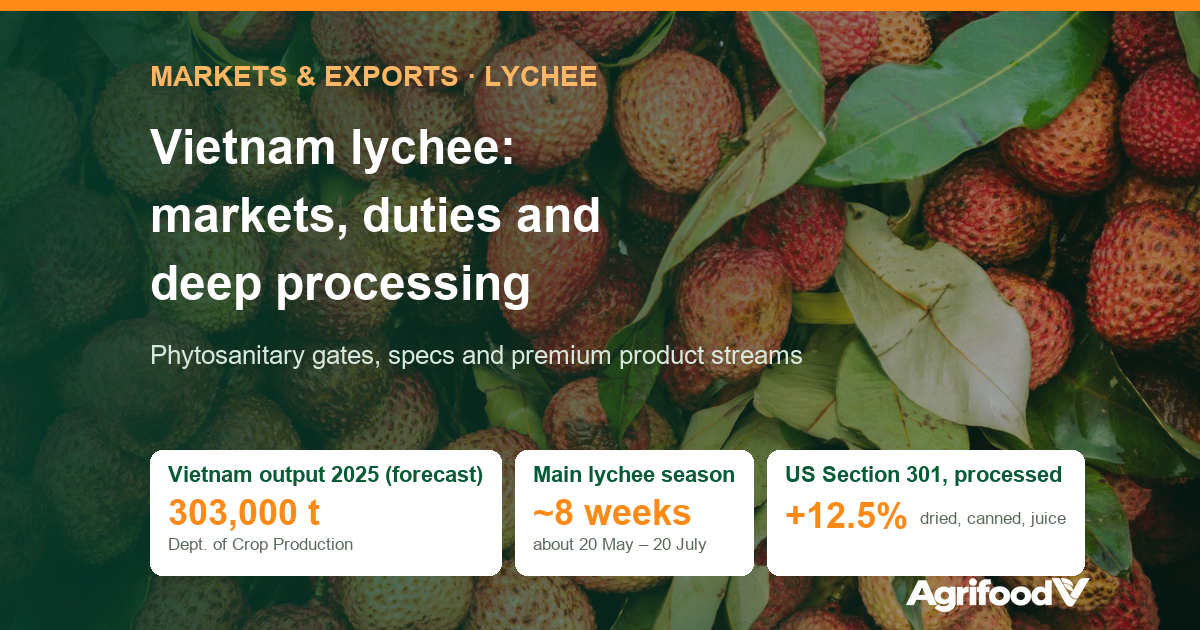
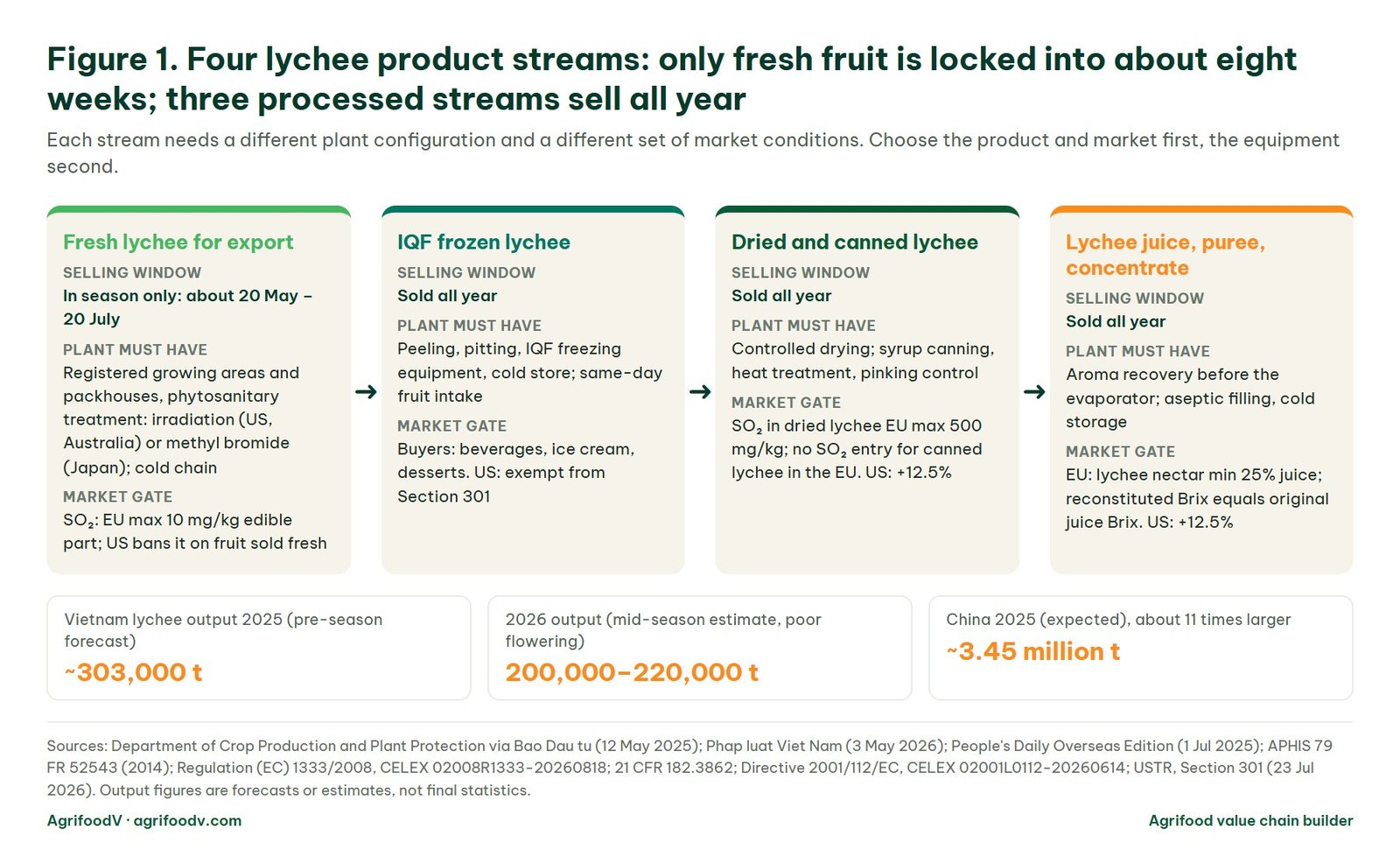
- Lychee output swings sharply from year to year: about 303,000 tonnes forecast for 2025, only an estimated 200,000–220,000 tonnes in 2026 because of poor flowering. The main season runs from about 20 May to 20 July.
- Fresh fruit for the US and Australia must be irradiated; for Japan it must be fumigated with methyl bromide; no document opening South Korea to fresh Vietnamese lychee has been found. A 0% duty only matters once the phytosanitary gate is passed.
- From 24 July 2026 the US exempts fresh and frozen lychee from the additional Section 301 duty, but charges an extra 12.5% on dried lychee, canned lychee and lychee juice. The EU, Japan, South Korea and China go to 0% when the right trade agreement is claimed.
- Deep processing (IQF freezing, drying, canning, juice, concentrate) is the only way to sell lychee outside May–July, but each stream has its own specifications: SO₂, Brix, aroma.
A short season, volatile output and one dominant market
According to the Department of Crop Production and Plant Protection (Ministry of Agriculture and Environment), Vietnam’s 2025 lychee output was forecast at about 303,000 tonnes, up 30% on the previous year. Early lychee is harvested from about 20 May to 15 June, main-season lychee from 10 June to 20 July. The country has 469 growing-area codes covering more than 19,300 ha, 55 packhouse codes, 3 irradiation facilities and 3 fumigation facilities serving exports; China takes about 90% of lychee export volume.
2026 shows the risk of a weather-dependent crop: main-season flowering reached only 40–50% (normally 70–80%), and national output was estimated at about 200,000–220,000 tonnes. In Bac Ninh province (the Luc Ngan lychee area, formerly part of Bac Giang), the 2025 season sold more than 205,400 tonnes, of which about 78,200 tonnes were exported and China bought about 77,200 tonnes. By 23 June 2026 the province had exported about 30,000 tonnes: China about 29,000 tonnes, Japan about 260 tonnes, Canada 170 tonnes and the EU 110 tonnes. The premium markets are open, but volumes remain very small.
One detail shows where processing stands today: according to the Bac Ninh Department of Industry and Trade, in 2025 lychee certified to VietGAP or GlobalG.A.P. sold for VND 25,000–35,000/kg, while uncertified lychee fetched only VND 5,000–15,000/kg and went mainly to drying, juicing, peeling and freezing. In other words, raw material for processing is whatever is left after the fresh market, with no dedicated growing area. Industrial buyers in demanding markets do not accept that model, because residue, microbiological and colour specifications for processed products start in the orchard.
Fresh lychee: the phytosanitary gate comes first
For fresh fruit, the first question is not the duty rate but whether the fruit may enter at all, and which treatment it needs. Current conditions for Vietnamese lychee:
| Market | Conditions for fresh Vietnamese lychee | Basis |
|---|---|---|
| United States | Open since 6 October 2014 under a systems approach: irradiation against insects, inspection, no distribution into Florida. Detailed current conditions are listed in APHIS’s fruit and vegetable import database | APHIS, 79 FR 52543 (4 September 2014); 7 CFR Part 305 |
| Australia | Irradiation at a minimum of 400 Gy at a facility approved by Vietnam; the phytosanitary certificate states the dose and treatment facility; sealed packaging or vents covered with mesh | BICON import conditions, version of 25 April 2020, republished by Vietnam’s Plant Protection Department |
| Japan | Open since December 2019; registered growing areas, methyl bromide fumigation at facilities approved by both sides. According to the Department of Crop Production and Plant Protection (May 2025), Japan has authorised Vietnam to supervise the treatment itself | Department of Crop Production and Plant Protection; Viet Nam News (18 December 2019) |
| South Korea | No document opening the market to fresh Vietnamese lychee has been found; treat fresh export as not yet possible | AgrifoodV search, 25 October 2026 |
| EU | No specific treatment requirement; Vietnamese lychee is not on the increased-controls list. SO₂ on fresh lychee max 10 mg/kg, measured on the edible part | Implementing Regulation (EU) 2019/1793; Regulation (EC) 1333/2008, consolidated version |
| China | The main market, under registered growing-area and packhouse codes | Department of Crop Production and Plant Protection |
Two points are often confused. First, Japan does not require vapour heat or cold treatment for Vietnamese lychee; the condition is methyl bromide fumigation. Second, the US does not allow SO₂ on fruit sold fresh (21 CFR 182.3862), so the sulphur fumigation some countries use to hold skin colour for the European market cannot go to the US. The red colour of lychee skin fades quickly after harvest as anthocyanins break down, linked to polyphenol oxidase activity as the skin loses water; SO₂ blocks this process but can leave sulphur residues in the flesh. Holding colour is therefore a cold-chain and time problem, not a chemistry problem.
Duties by product form: the US is the exception
The duty rates below apply to goods of Vietnamese origin, checked on 25 October 2026 in TARIC (EU), the HTSUS and the Section 301 notice (US), the Japan Customs tariff schedule and the yesFTA portal of the Korea Customs Service; figures for China come from a secondary lookup site.
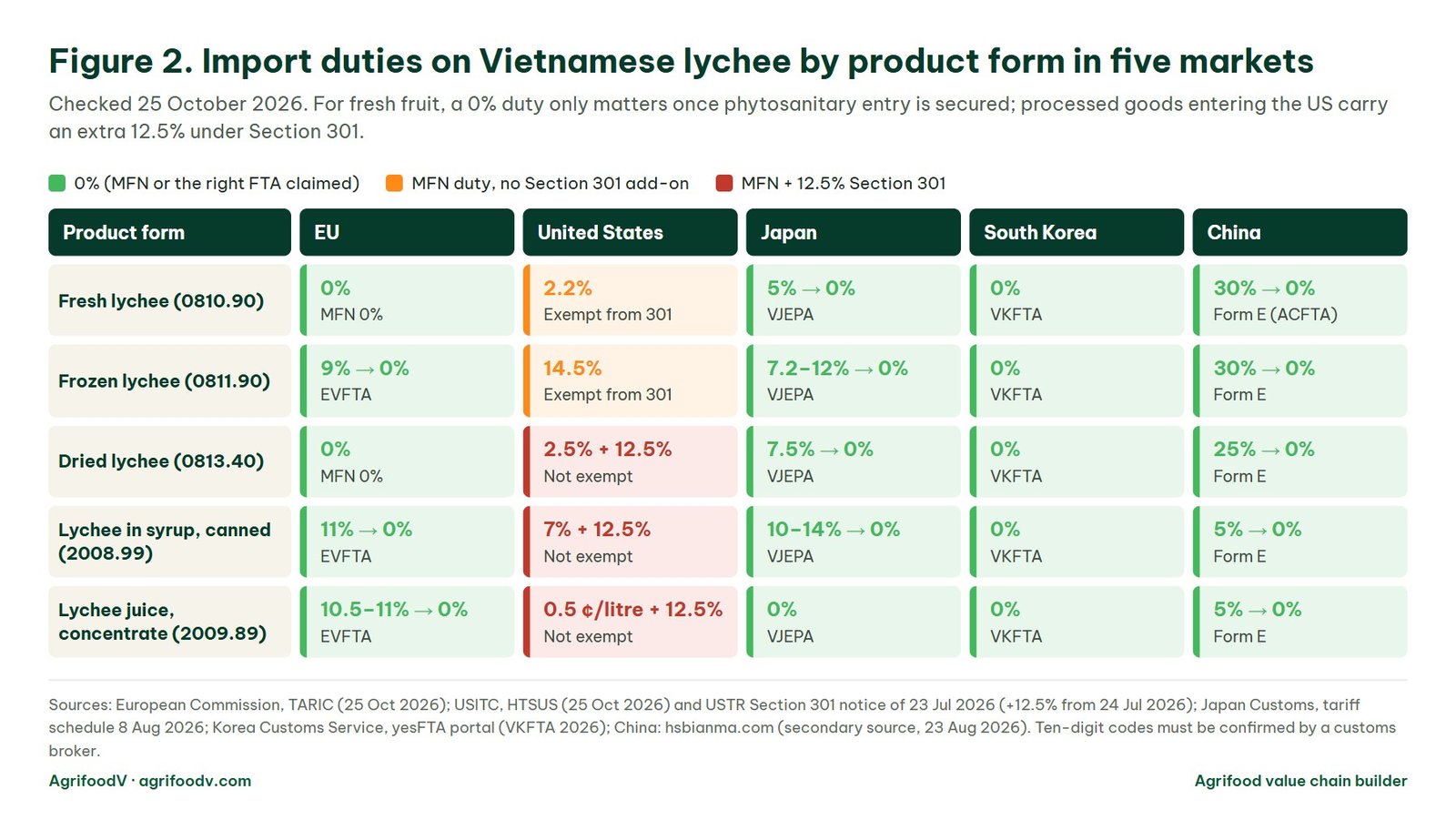
- The EU, Japan and South Korea go to 0% for every form with proof of origin under the right agreement (EVFTA, VJEPA, VKFTA). In the EU the biggest difference is on processed goods: frozen lychee MFN 9%, lychee in syrup 11%, lychee juice 10.5–11%, all reduced to 0%. TARIC classes lychee as a “tropical fruit”.
- China: use Form E. Fresh lychee carries an MFN rate of 30%, 0% under ACFTA; claimed under RCEP it is still 22.5%.
- The US goes the other way. From 24 July 2026 Vietnamese goods carry an extra 12.5% under Section 301, but fresh lychee (0810.90.46) and frozen tropical fruit (0811.90.80) are exempt. Dried lychee (2.5% + 12.5%), canned lychee in syrup (7% + 12.5%) and lychee juice (0.5 cents/litre + 12.5%) are not exempt. In the US market in 2026, frozen is the only processed form without the additional duty.
Deep processing: each product stream is its own technical problem
IQF frozen lychee. The fruit is peeled, pitted and individually quick frozen in IQF freezing equipment, then sold all year to beverage, ice-cream and dessert manufacturers. It is the only processed stream exempt from Section 301 in the US. AgrifoodV’s view: the decisive technical condition is the time from orchard to freezer, so fruit should reach the plant on the day of harvest and the plant should sit inside the growing area. Line capacity has to be sized for a short peak season, as discussed in the article on processing plant capacity for seasonal crops.
Dried lychee. In the EU, dried lychee falls under “other dried fruit”, with SO₂ capped at 500 mg/kg in total from all sources; the 2,000 mg/kg limit applies only to apricots, peaches, grapes, prunes and figs, not to lychee. In the US, sulphites are treated as insignificant only when they cannot be detected; if detected they must be labelled (21 CFR 101.100). Hand-dried lychee without control of sulphur residues will struggle to enter either market.
Canned lychee in syrup. Regulation (EC) 1333/2008 has no SO₂ entry for canned lychee, so product for the EU must hold its colour through the process, not through sulphites. A study published in RSC Advances (2020) found that heat treatment at 121 °C made canned lychee darker and softer than at 70 °C, although it raised phenolic content. Pinking of canned lychee has been studied in relation to ripeness, can type and sterilisation regime (Chulalongkorn University), which means it has to be controlled from procurement, not only at the retort. Codex standard CXS 196-1995 applies only to fresh lychee; AgrifoodV has not found a separate Codex standard for canned lychee.
Lychee juice, puree, concentrate. Under Directive 2001/112/EC (consolidated version), lychee is not in the minimum Brix list, so reconstituted lychee juice must have the same Brix as the juice extracted from the fruit used to make the concentrate; lychee nectar must contain at least 25% juice or puree. In the US, lychee is not in the Brix table of 21 CFR 101.30. The value of lychee juice lies in its aroma, and lychee aroma is easily lost on heating; the general principle is to pass the juice through aroma recovery equipment first, and only then into the evaporator. Aroma recovery data specific to lychee have not been published in a form AgrifoodV could verify.
Competitors and the seasonal window
China is both the largest competitor and the largest buyer. According to People’s Daily (Overseas Edition), China’s 2025 lychee output was expected at about 3.45 million tonnes, double 2024, or about 11 times Vietnam’s forecast for the same year; Guangdong alone produced about 1.68 million tonnes. Lychee in the two countries ripens at the same time, so Vietnam has no seasonal advantage with fresh fruit in that market.
In Europe, the Christmas season belongs to Southern Hemisphere lychee. Madagascar opened its 2025 season on 20 November 2025 with an expected 15,000–20,000 tonnes, most of it going to Europe in December and January, fumigated with SO₂ and shipped in reefer vessels; according to FreshPlaza, the country’s lychee sector is testing sulphur-free treatment and looking for markets in Asia and the US because Europe is saturated. AgrifoodV’s view: with fresh fruit, Vietnam is squeezed between China’s season and the Southern Hemisphere season; frozen, canned and concentrated products are the way to sell Vietnamese lychee outside May–July.
The advantage competitors cannot copy is origin. “Thanh Ha lychee” received a geographical indication in 2007, “Luc Ngan lychee” in 2008, and Luc Ngan lychee was protected as a geographical indication by Japan’s Ministry of Agriculture, Forestry and Fisheries on 12 March 2021, the first Vietnamese product with a GI in Japan. A geographical indication only turns into price when it comes with coded growing areas and residue records that meet the importing market’s standards, as in the article on growing areas for processing plants.
What companies should do
AgrifoodV recommendations:
- Choose the product stream and the market first: irradiated fresh lychee for the US and Australia; methyl-bromide-fumigated fresh lychee for Japan; IQF frozen lychee for beverage and ice-cream plants in the US and EU; juice and concentrate for the beverage industry in the EU and Japan. Each choice leads to a different plant configuration.
- Do not design a plant for lychee alone. A line that runs about eight weeks a year cannot carry its depreciation; design it from the start to run longan and other fruit outside the lychee season.
- Build a dedicated growing area for processing, with growing-area codes, plant protection product records and purchase contracts based on specifications, instead of using fruit that could not be sold fresh.
- Calculate duties by the right form and the right agreement: Form E for China, EVFTA for the EU; for the US, add the 12.5% Section 301 duty to quotes for dried, canned and juice products, and consider the frozen stream if the US is the main market.
- Control SO₂ to the destination market’s law from the process design stage: none on fresh fruit for the US, no more than 500 mg/kg on dried lychee for the EU, none on canned lychee for the EU.
- For juice and concentrate, invest in aroma recovery before the evaporator and trial it on raw material from your own growing area before fixing the technology.
AgrifoodV supports companies with market analysis and import requirements, processing plant direction and supervised, traceable growing areas. Further reading: the design brief for an export processing plant.
Lychee sector series
In-depth articles on phytosanitary treatment, freezing, drying, canning, juice, growing areas and competitors, updated as new articles are published:
References
- Department of Crop Production and Plant Protection via Bao Dau tu. Tập trung chế biến sâu, nâng cao chuỗi giá trị cho vải thiều [Focusing on deep processing to raise the lychee value chain], 12 May 2025. baodautu.vn.
- Phap luat Viet Nam (Doanh nhan). Giá vải leo đỉnh, sản lượng lao dốc: nghịch lý mùa vụ 2026 [Lychee prices peak as output falls: the 2026 season paradox], 3 May 2026. doanhnhan.baophapluat.vn.
- Bac Ninh Department of Industry and Trade via Tuoi Tre (KTSG). Bắc Ninh dự kiến tiêu thụ vải thiều kỷ lục với hơn 205.000 tấn [Bac Ninh expects record lychee sales of over 205,000 tonnes], 24 August 2025. tuoitre.vn.
- Dai bieu Nhan dan. Bắc Ninh thu gần 6.000 tỷ đồng nhờ giá vải thiều cao [Bac Ninh earns nearly VND 6,000 billion on high lychee prices], 23 June 2026. daibieunhandan.vn.
- APHIS, US Department of Agriculture. Importation of Litchi and Longan Fruit From Vietnam Into the Continental United States, 79 FR 52543, 4 September 2014 (effective 6 October 2014). federalregister.gov.
- Australian Department of Agriculture, Fisheries and Forestry. BICON import conditions “Fresh longan and lychee for human consumption”, version of 25 April 2020, republished by Vietnam’s Plant Protection Department. ppd.gov.vn.
- Viet Nam News. Japan to import Vietnamese lychees, 18 December 2019. vietnamnews.vn.
- European Union. Implementing Regulation (EU) 2019/1793 on increased official controls, consolidated version CELEX 02019R1793-20260630. eur-lex.europa.eu.
- European Union. Regulation (EC) 1333/2008 on food additives, Annex II Part E, consolidated version CELEX 02008R1333-20260818. eur-lex.europa.eu.
- European Union. Directive 2001/112/EC on fruit juices and nectars, consolidated version CELEX 02001L0112-20260614. eur-lex.europa.eu.
- United States. 21 CFR 182.3862 (sulfur dioxide), 21 CFR 101.100(a)(4) (sulphite labelling), 21 CFR 101.30(h)(1) (juice Brix), eCFR as of 1 October 2026. ecfr.gov.
- European Commission. TARIC, codes 0810 90, 0811 90, 0813 40, 2008 99, 2009 89, origin Vietnam (checked 25 October 2026). ec.europa.eu.
- USITC. Harmonized Tariff Schedule of the United States (checked 25 October 2026); USTR. Section 301 final action notice, 23 July 2026. hts.usitc.gov; ustr.gov (PDF).
- Japan Customs. Import tariff schedule, version of 8 August 2026, Chapters 8 and 20. customs.go.jp.
- Korea Customs Service. yesFTA portal, VKFTA rates for 2026 (checked 25 October 2026). customs.go.kr.
- Fruits (CIRAD). Study of post-harvest pericarp browning in lychee and the effect of SO₂. revues.cirad.fr.
- RSC Advances. Effect of heat treatment on the quality and phenolics of canned lychee, 2020. pubs.rsc.org.
- Chulalongkorn University. Thesis on pinking of canned lychee (ripeness, can type, sterilisation regime, syrup). cuir.car.chula.ac.th.
- People’s Daily (Overseas Edition). Article on China’s 2025 lychee season, 1 July 2025. paper.people.com.cn.
- FreshPlaza. Madagascar lychee season starts with higher prices, November 2025. freshplaza.com.
- VnEconomy. Bảo hộ chỉ dẫn địa lý mở đường cho vải thiều Thanh Hà [GI protection opens the way for Thanh Ha lychee]; Nhan Dan. Kinh nghiệm đăng ký bảo hộ chỉ dẫn địa lý [Experience in registering geographical indications]; Viet Nam News. Luc Ngan lychee granted GI certificate in Japan, 2021. vneconomy.vn; nhandan.vn; vietnamnews.vn.
Article by AgrifoodV, compiled from the sources above (accessed 25–26 October 2026). The 2025 lychee output is a pre-season forecast and the 2026 figure a mid-season estimate; provincial and press figures differ, and no official national final statistics are available yet. National lychee export value and the national processing share have not been published in a form AgrifoodV could verify. Duty rates for China come from a secondary lookup site; ten-digit HS codes must be confirmed by a customs broker. Duty rates, phytosanitary conditions and the US Section 301 duty may change; companies should check the current texts before setting export targets. This content is not a substitute for legal advice. Cover image: Anurag Jamwal / Pexels.
Looking at Vietnam as a sourcing origin or a place to build a value chain?
Tell us your product, target market and expected volumes. In a 30–45 minute online call, AgrifoodV reviews buyers, standards, processing capacity and growing areas with you, starting from the market.
Book a call →Sourcing from Vietnam© 2026 AgrifoodV. Nội dung được phép trích dẫn khi ghi rõ nguồn và đặt liên kết tới bài gốc; không sao chép toàn văn. Xem Điều khoản sử dụng nội dung.