AgrifoodV ·
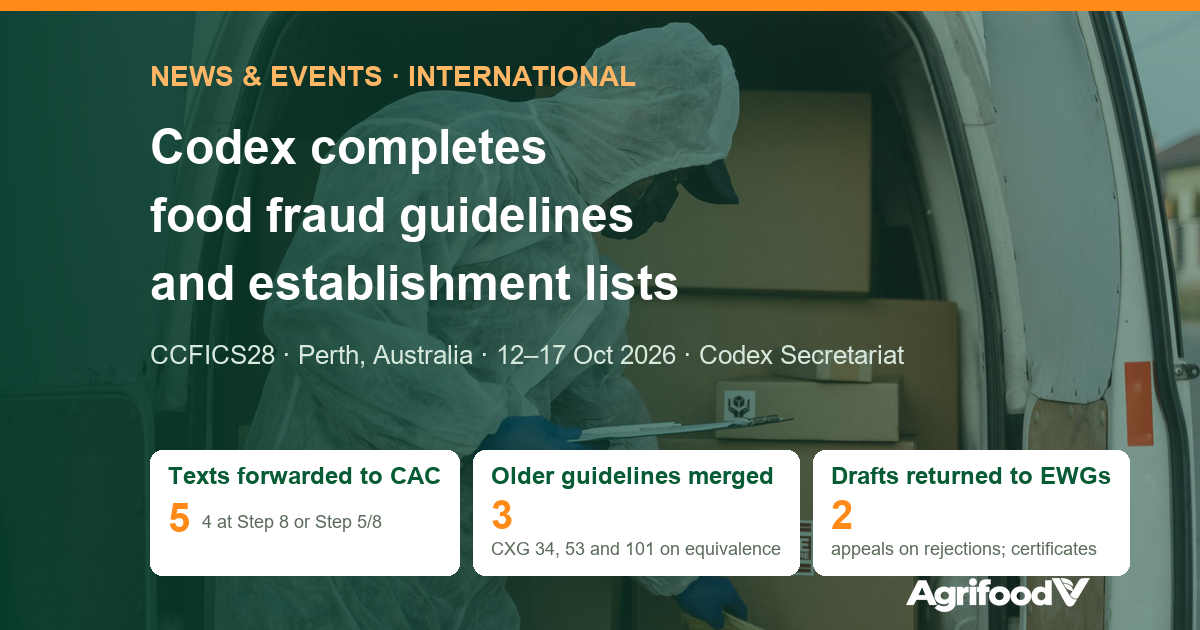
The 28th Session of the Codex Committee on Food Import and Export Inspection and Certification Systems (CCFICS28) met in Perth, Australia, from 12 to 17 October 2026 and needed an extra day of plenary because of a heavy agenda. According to the Codex Secretariat’s report of 18 October 2026, the Committee completed the guidelines on the prevention and control of food fraud and forwarded to the Codex Alimentarius Commission (CAC) the principles on recognition of equivalence, on digitalization of food control systems, and an annex on lists of establishments approved for export. These are the texts that competent authorities in importing countries will rely on when inspecting Vietnamese agricultural and food products.
Key points
- CCFICS28 met in hybrid format in Perth, hosted by Australia’s Department of Agriculture, Fisheries and Forestry and chaired by Tom Black.
- The guidelines on the prevention and control of food fraud, adopted at Step 5 by CAC49, were completed and forwarded to CAC for final adoption.
- Three other texts were forwarded to CAC at Step 5/8: principles on recognition of equivalence (consolidating CXG 34-1999, CXG 53-2003 and CXG 101-2023), principles on digitalization of national food control systems, and an annex to CXG 89-2016 on establishment listing.
- Two drafts were returned to electronic working groups: the appeals mechanism for rejected imported food and the standardization of sanitary attestations in official certificates.
Background: the committee that writes the rules for inspection and certification
CCFICS is the Codex committee that develops principles and guidelines for food import and export inspection and certification systems, including the format of official certificates and the exchange of information between exporting and importing countries. According to the notice published by the U.S. Codex Office in the Federal Register on 20 August 2026, the 28th Session took place in Perth from 12 to 17 October 2026 with nine drafts and discussion papers on its agenda.
At the opening, CAC Chairperson Allan Azegele stressed that food fraud poses significant challenges to the integrity of food supply chains, consumer confidence and fair trade, and said the text was very close to finalization.
Outcome for each text
According to the closing report published by the Codex Secretariat on 18 October 2026, the outcomes were as follows:
| Text | Outcome at CCFICS28 |
|---|---|
| Guidelines on the prevention and control of food fraud | Completed and forwarded to CAC for final adoption; a physical working group met just before the plenary to resolve outstanding issues |
| Principles and guidelines for the recognition of equivalence of sanitary measures, technical requirements and national food control systems | Forwarded to CAC at Step 5/8; revocation of CXG 34-1999, CXG 53-2003 and CXG 101-2023 recommended, as they are consolidated in the new text |
| Principles on digitalization of national food control systems | Forwarded to CAC at Step 5/8; FAO will use them as the basis for its support to developing countries |
| Revision of the principles for traceability/product tracing, CXG 60-2006 | Forwarded to CAC at Step 5; some issues remain and are expected to be concluded at the next session |
| Annex to CXG 89-2016 on the design, implementation and update of establishment listing | Forwarded to CAC at Step 5/8 |
| Guidance on an appeals mechanism in the context of rejection of imported food (annex to CXG 47-2003) | Returned to the electronic working group; cross-references to CXG 25-1997 to avoid duplication |
| Guidance on the standardization of sanitary requirements in official certificates (annex to CXG 38-2001) | Returned to the electronic working group |
Source: Codex Secretariat, news item of 18 October 2026. Step 5/8 is the accelerated procedure under which CAC may give final adoption at its next session if there is no objection.
The Committee also added three issues to the list of emerging global issues (Appendix A) and set up a new electronic working group to prepare a paper on principles for the use of artificial intelligence and advanced analytical tools in national food control systems.
Three points that touch Vietnamese exports directly
Lists of export establishments. The new annex to CXG 89-2016 sets common principles for how an importing country establishes, maintains and updates the list of establishments approved to export. This is an issue on which Viet Nam is being named: at the WTO SPS Committee meeting of 5–7 November 2025, among 71 specific trade concerns (a record at the time), 11 were raised for the first time, including Viet Nam’s delay in listing establishments for the export of fishery products. The meeting of 24–26 June 2026 recorded a new record of 79 concerns. Once Codex has common guidance, both the Vietnamese competent authority and importing partners have a basis to require more transparent procedures and clearer timelines.
Food fraud. The Codex guidelines are designed to supplement existing Codex texts and to be considered within national food control systems. After adoption by CAC, regulators have a basis to build fraud vulnerability assessment requirements into plant inspection programmes and import controls.
Certificates and appeals. Two drafts were returned, but the direction is clear: sanitary attestations in official certificates, paper and electronic, will be standardized, and importing countries are given guidance on an appeals mechanism for rejected consignments.
What comes next
The forwarded texts will be considered at the next session of the Codex Alimentarius Commission (CAC50). The WTO SPS Committee week runs from 2 to 6 November 2026 in Geneva, with the formal meeting on 4–6 November 2026, where concerns about Vietnamese products may be raised again.
What companies should do
The following are AgrifoodV’s recommendations, not the content of the Codex texts.
- Review export establishment registrations for each market (code, product scope, expiry date), because the listing process will be standardized and any gap between the file and the actual plant will be easier to detect.
- Prepare a fraud vulnerability assessment for key raw materials and products (origin, additives, adulteration, labelling) and keep it as a separate record; importers and certification bodies will ask for it once the Codex guidelines take effect.
- Get ready for electronic certificates: align product names, HS codes, production sites and sanitary attestations across internal records, certificates and bills of lading so nothing breaks when importing countries move to digital systems.
- Follow the SPS week of 2–6 November 2026 through the Viet Nam SPS Office to learn which markets raise concerns about your products.
AgrifoodV supports companies in building plant documentation, traceability and fraud control systems that meet importing-country requirements.
References
- Codex Alimentarius Secretariat (FAO/WHO). CCFICS28 concludes after “a very big but a very productive week”, 18 October 2026. codex.fao.org.
- Codex Alimentarius Secretariat (FAO/WHO). Interconnectedness is a key factor in inspection and certification work, as Committee meets for 28th Session, 12 October 2026. codex.fao.org.
- U.S. Codex Office, U.S. Department of Agriculture. Codex Alimentarius Commission: Meeting of the Codex Committee on Food Import and Export Inspection and Certification Systems, Federal Register, FR Doc. 2026-17036, 20 August 2026. federalregister.gov.
- WTO. SPS Committee addresses record number of trade concerns, transparency and SPS mentoring, 24 June 2026. wto.org.
- WTO. News item on the SPS Committee meeting of 5–7 November 2025 (71 specific trade concerns, 11 new). wto.org.
- WTO. Sanitary and phytosanitary measures, topic page and SPS Committee calendar for November 2026. wto.org.
Cover image: Tima Miroshnichenko / Pexels.
Article by AgrifoodV, compiled from the sources above (accessed 27 October 2026). This content is not a substitute for legal advice.
Looking at Vietnam as a sourcing origin or a place to build a value chain?
Tell us your product, target market and expected volumes. In a 30–45 minute online call, AgrifoodV reviews buyers, standards, processing capacity and growing areas with you, starting from the market.
Book a call →Sourcing from Vietnam© 2026 AgrifoodV. Nội dung được phép trích dẫn khi ghi rõ nguồn và đặt liên kết tới bài gốc; không sao chép toàn văn. Xem Điều khoản sử dụng nội dung.