AgrifoodV ·
Vietnamese aloe vera is still sold mostly as fresh leaves for a few thousand dong per kilogram, while industrial buyers in South Korea, Japan, the EU and the United States pay for aloin-free gel, dried powder and standardised extracts. The gap between those two prices has nothing to do with the plant variety and everything to do with the plant: the hours between cutting and filleting, how the yellow latex is kept out of the gel, and an aloin record for every lot. This article brings together growing areas, processing, hydroxyanthracene rules in the main markets, duties by product form and the decisions an investor must take before siting a plant.
Key points
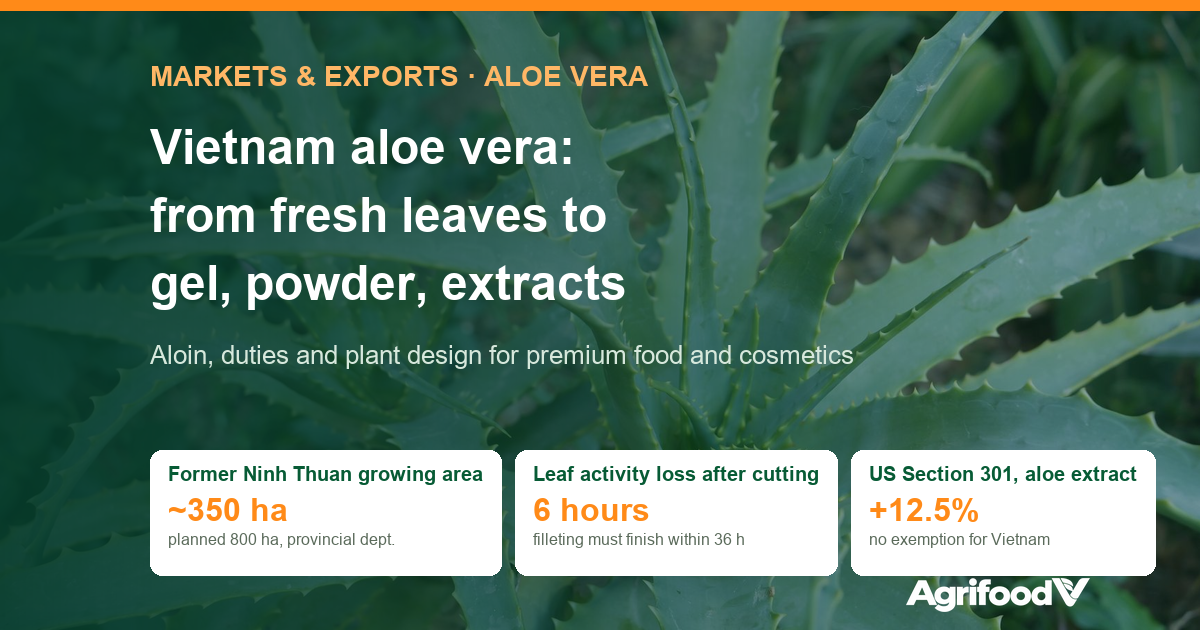
- The country’s largest aloe area lies in the former Ninh Thuan province (now part of Khanh Hoa): about 350 ha, planned to reach 800 ha; farm-gate leaf prices were VND 2,200–2,800/kg in June 2025.
- Leaves start losing activity 6 hours after cutting at ambient temperature and must be filleted within 36 hours. A gel plant therefore has to sit inside the growing area; leaves cannot be collected from far away.
- Aloin and other hydroxyanthracene derivatives are the specification that decides market access: the EU prohibits aloe leaf preparations containing them in food, the United States lists non-decolorised whole-leaf extract under Prop 65, and South Korea caps aloin in gel used for health functional foods at 10 mg/kg.
- Duties into the EU, Japan, South Korea and China fall to 0% under the right agreement; aloe extract into the United States carries an extra 12.5% under Section 301, and sweetened aloe drinks into Japan must be declared under the CPTPP.
Growing area: one province, one species, one leaf price
Aloe vera (also known as Aloe barbadensis Miller) is grown mainly in the former Ninh Thuan province, now part of Khanh Hoa. According to the Ninh Thuan Department of Agriculture and Environment (quoted by VTC News, June 2025), the area is about 350 ha; the 2021–2025 plan with a 2030 horizon raises it to about 800 ha, concentrated around Phan Rang–Thap Cham. Plants are harvested 6–8 months after planting, live 2–5 years and give 10–11 leaf cuts a year. Farm-gate leaf prices in June 2025 were VND 2,200–2,800/kg. Ninh Thuan aloe has carried a certification mark since 2019; AgrifoodV has found no geographical indication and no 2026 area or output figures for Khanh Hoa after the provincial merger.
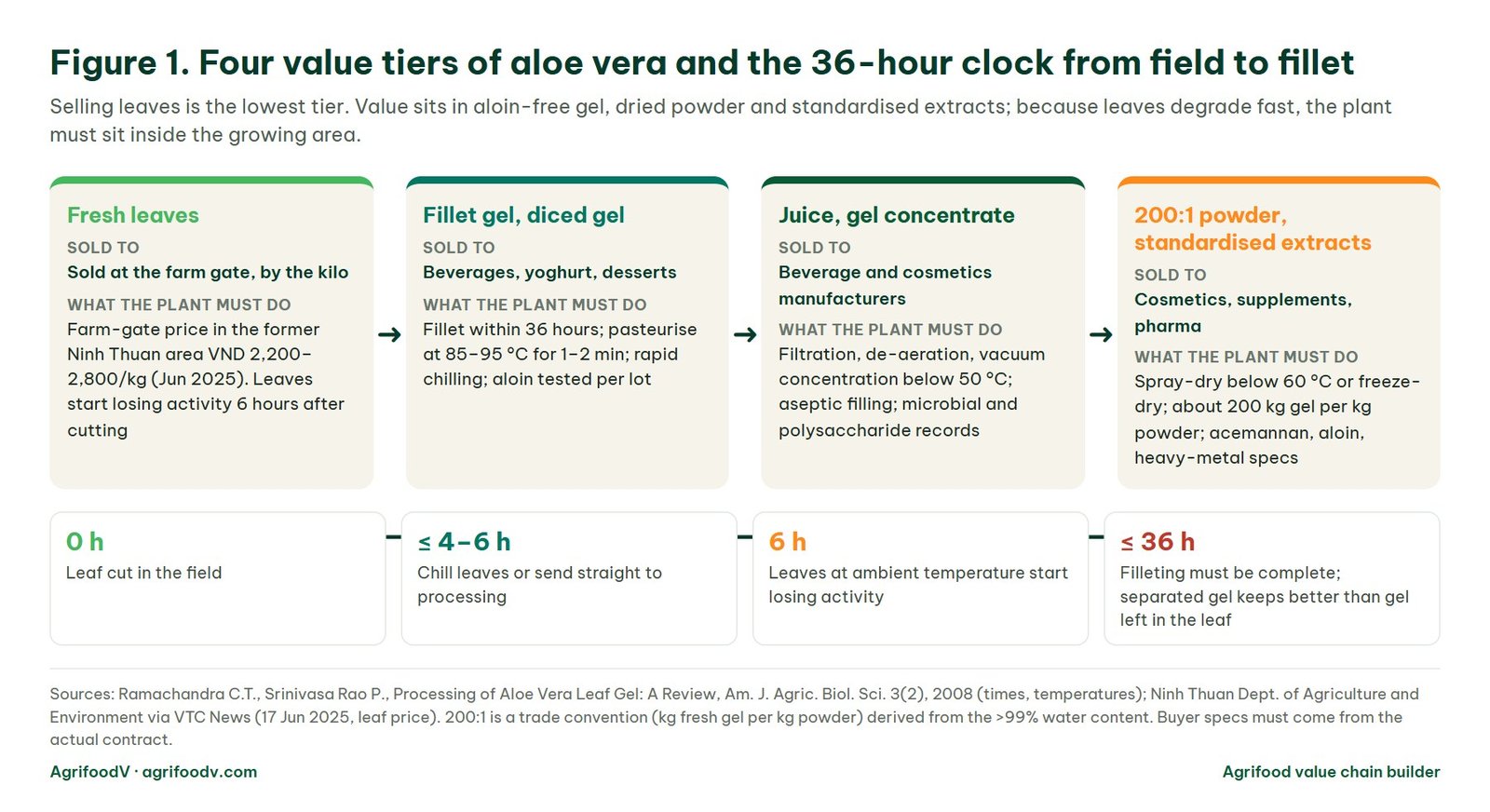
The figure that matters is not the 350 ha but the leaf price. A leaf is more than 99% water; selling leaves means selling water and freight. The crop’s value sits in the three tiers above: fillet gel and diced gel for the beverage and yoghurt industries; juice and gel concentrate for beverage and cosmetics plants; 200:1 dried powder and standardised extracts for cosmetics and food supplements. Each tier demands a different plant configuration, a different set of specifications and a different legal framework, as shown in figure 1.
From leaf to gel: the 36-hour clock and the latex problem
An aloe leaf has three parts: the green rind, a layer of yellow latex just under the rind containing aloin and other anthraquinones, and the clear inner pulp holding the gel, whose main polysaccharide is acemannan. According to the review by Ramachandra and Srinivasa Rao (American Journal of Agricultural and Biological Sciences, 2008), leaves begin to lose biological activity 6 hours after cutting if kept at ambient temperature; they must be chilled within 4–6 hours or sent straight to processing, and filleting must be complete within 36 hours of harvest. Gel separated from the leaf keeps better than gel left inside it, so transporting leaves over long distances, even chilled, still costs activity. This is the technical basis for an investment conclusion: the gel pre-processing plant must sit inside the growing area, while concentration, drying and extraction can be located elsewhere because they receive stabilised gel or concentrate.
The main steps of a gel line, from the same source:
- Filleting. Trim the base, tip and leaf margins and strip the rind so that the yellow latex does not enter the gel. Hand filleting is labour-intensive but gives gel with less anthraquinone; whole-leaf grinding gives higher throughput but needs activated-carbon filtration to remove aloin and aloe-emodin, and the carbon also strips many other gel constituents.
- Grinding, homogenisation. Keep it to 10–20 minutes to avoid enzymatic browning; adjust pH to 3.0–3.5 with citric acid and vitamin C; de-aerate to prevent oxidation.
- Pasteurisation. HTST at 85–95 °C for 1–2 minutes followed by rapid chilling to 5 °C; gel keeps its activity when heated at 65 °C for under 15 minutes, while higher temperatures or longer times sharply reduce it.
- Concentration. Vacuum concentration below 50 °C for a short time.
- Drying. Spray drying with product temperature below 60 °C, or freeze drying at −45 to −30 °C. Freeze drying preserves quality best but costs up to about 10 times forced-air drying; spray drying has high capacity but loses volatiles. Microwave and radio-frequency drying can deacetylate the polysaccharides and are unsuitable.
The “200:1” or “100:1” ratio on the aloe powder market is the number of kilograms of fresh gel used per kilogram of powder, derived from the gel’s water content of over 99%; it is not a purity grade. Buyers of powder and extracts also specify polysaccharide or acemannan content, aloin, heavy metals, microbiology and drying method; the exact specifications sit in each contract and AgrifoodV has found no public source to cross-check them.
| Product stream | Industrial buyers | Decisive technical point |
|---|---|---|
| Diced aloe gel in syrup | Beverage, yoghurt and dessert manufacturers; mainly South Korea, Japan, South-East Asia, EU | Consistent firmness, microbiology, aloin per lot; pasteurisation and rapid chilling |
| Juice, gel concentrate | Beverage plants, cosmetics ingredient suppliers | Concentration below 50 °C, aseptic filling, polysaccharide records |
| Dried gel powder 200:1, 100:1 | Cosmetics, food supplements, pharma | Spray drying below 60 °C or freeze drying; acemannan, aloin, heavy metals |
| Standardised extracts | Food supplements, pharma; each country has its own legal framework | Standardised actives, safety file; no claims that have not been authorised |
Aloin and hydroxyanthracenes: the specification that decides market access
Every premium market revolves around one group of compounds: hydroxyanthracene derivatives, including aloin A, aloin B and aloe-emodin, found in the yellow latex of the leaf. This is not a sensory or quality attribute but an exclusion criterion: above the destination market’s threshold, the product cannot be sold, however high its polysaccharide content.
| Market | Current rules for aloe gel and preparations | Basis |
|---|---|---|
| EU | Annex III Part A of Regulation (EC) No 1925/2006 (consolidated text of 26 November 2025) prohibits in food: aloe-emodin, emodin, danthron and all preparations in which they are present; and preparations from the leaf of Aloe species containing hydroxyanthracene derivatives. The law sets no ppm threshold. The inner-leaf gel of Aloe barbadensis is listed in the Novel Food Catalogue as “not novel in food” | CELEX 02006R1925-20251126 (amendment M10 = Regulation (EU) 2021/468); Novel Food Catalogue, entry POL-NF-00105 |
| United States | The FDA (2002) removed aloe from the list of over-the-counter drug active ingredients because no safety data were submitted; California added “Aloe vera, non-decolorized whole leaf extract” to the Prop 65 list with effect from 4 December 2015. The IASC industry association runs a voluntary certification programme with a maximum of 10 ppm aloin for orally consumed products | 67 FR 31125; OEHHA; IASC (via trade press) |
| South Korea | Aloe gel for health functional foods: total aloin A and B not above 10 mg/kg on a 100% gel basis; aloe for general foods is limited to peeled leaves of Aloe vera and Aloe ferox, with no separate aloin limit yet. In 2025 the Ministry of Food and Drug Safety (MFDS) proposed adding an iodine–starch test for aloe gel to stop starch adulteration | MFDS, Public Notice 2025-318 (23 July 2025); Food Today (September 2026) citing the Health Functional Food Code |
| Japan | “Aloe vera extract” appears on the list of existing food additives that MHLW announced in 2009 as not confirmed to be in circulation; AgrifoodV has found no document confirming the current status of gel used as an ordinary food | MHLW, annex to the notice of 14 October 2009 (medium-confidence source) |
| China | Aloe vera gel is referred to as a new food resource under a 2009 Ministry of Health notice; AgrifoodV has not read the full text and does not print the conditions of use | Not verified |
Two points in the EU rules need careful reading. First, Regulation (EU) 2021/468 contains no number; the 1 ppm level for total aloin A and B, aloe-emodin and emodin applied by European laboratories is a limit of quantification agreed in 2020 by the Standing Committee on Plants, Animals, Food and Feed to interpret the word “containing”, according to a secondary source whose original document AgrifoodV has not been able to read. In practice, inspectors treat a product above 1 ppm aloin as containing hydroxyanthracene derivatives. Second, the EU General Court in Case T-302/21 (judgment of 13 November 2024) annulled the three prohibition entries covering aloe-emodin, emodin and aloe leaf preparations, together with the placing of Rheum, Cassia and Rhamnus under scrutiny; but the European Commission appealed to the Court of Justice (Case C-48/25 P, lodged on 24 January 2025) and the case was still pending as of October 2026. Under Article 60 of the Statute of the Court of Justice, a General Court decision declaring a regulation void takes effect only from the date the appeal is dismissed. The consolidated text of 26 November 2025 therefore still carries the prohibition entries, and exporters must treat the ban as applicable until a final ruling.
The consequence for the plant: inner-leaf gel with hydroxyanthracenes removed is a permitted product in the EU and a certifiable one in the United States and South Korea; non-decolorised whole-leaf preparations are banned in the EU, carry a warning in California and are not certified by the IASC. A plant that wants to sell into these markets must fillet by hand or use controlled filtration, and must be able to measure aloin below 1 ppm for every lot, on site or through an accredited laboratory.
Duties by product form: the United States and Japan are where mistakes happen
The duties below apply to goods of Vietnamese origin, checked on 25 October 2026 on TARIC (EU), the HTSUS and the Section 301 notice (United States), the Japan Customs tariff schedule and the Korea Customs Service yesFTA portal; China’s figures come from a secondary look-up site. Aloe has no HS code of its own: extracts and gel powder fall under 1302.19 alongside many other plant extracts, diced gel in syrup under 2008.99 and drinks under 2202.99.
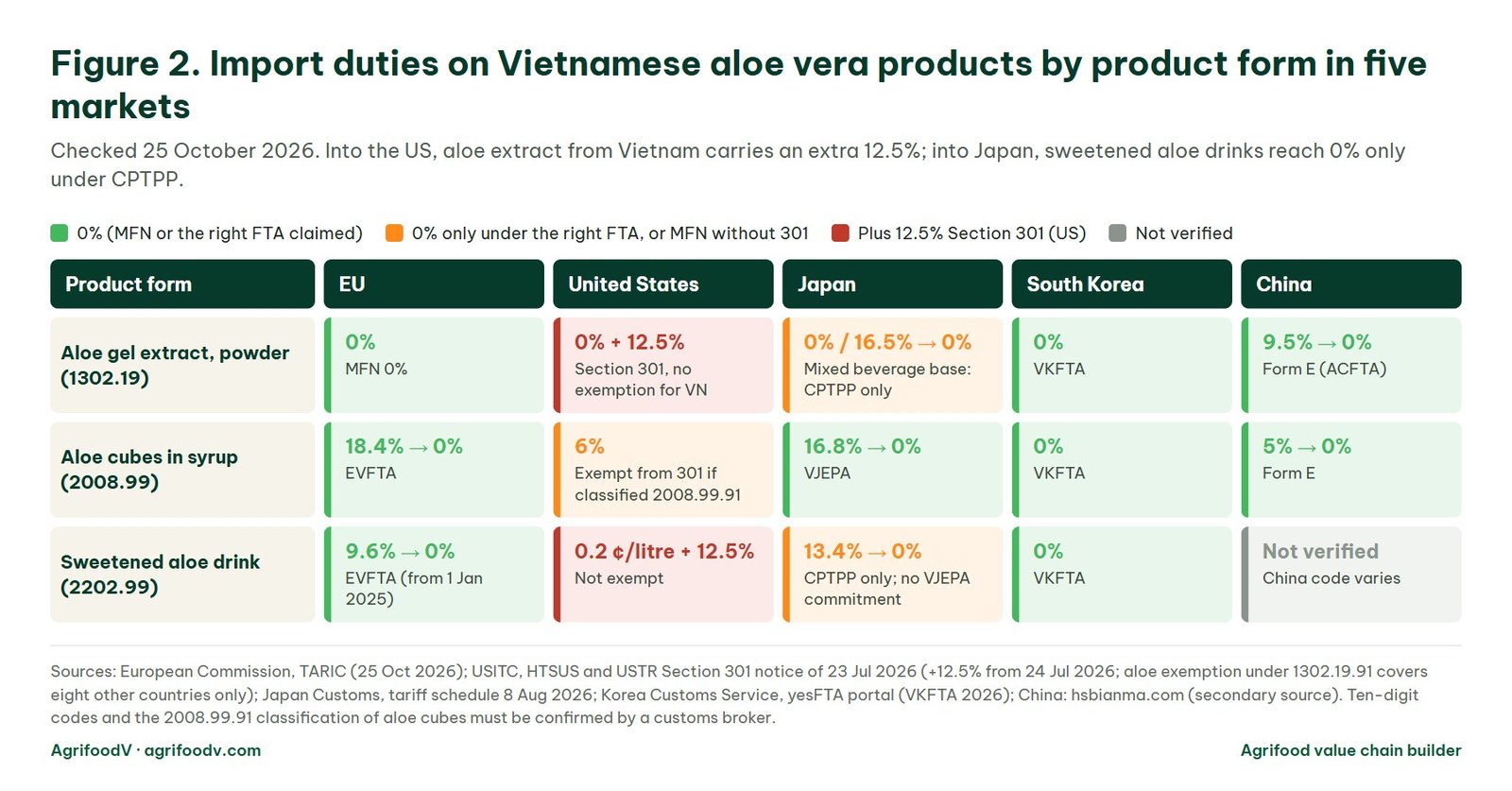
- EU, South Korea and China go to 0%. Extracts under 1302.19 are already 0% MFN into the EU; diced gel in syrup at 18.4% and sweetened drinks at 9.6% fall to 0% under the EVFTA. South Korea is 0% under the VKFTA for all three streams. China’s 9.5% and 5% fall to 0% with a Form E certificate of origin.
- The United States penalises deep processing. From 24 July 2026 Vietnamese goods carry an extra 12.5% under Section 301. The exemption list has a dedicated aloe line under 1302.19.91, but it applies to eight other countries only, not Vietnam; Vietnamese aloe extract and gel powder therefore pay 0% + 12.5%. Aloe drinks under 2202.99.91 pay 0.2 cents per litre + 12.5%. Diced aloe classified under 2008.99.91 (6% duty) is on the exemption list, but that classification must be confirmed by a customs broker.
- Japan: the agreement is what matters. Single-plant beverage bases (1302.19-110) go to 0% under the VJEPA, but mixed beverage bases (1302.19-120, 16.5%) and sweetened aloe drinks (2202.99-100, 13.4%) have no VJEPA commitment; only a CPTPP declaration brings them to 0%. Declaring the wrong agreement wipes out the whole tariff advantage.
World market: who supplies, who buys
Global gel supply is dominated by the Americas: according to PROTA, Mexico, the Dominican Republic and Venezuela supply about 60% of the gel on the world market, with the rest coming from Asia and Australia, where China and Thailand are the most important sources. The figure is old (around 2004–2008) and AgrifoodV has no updated number. Because aloe has no HS code of its own, trade data under 1302.19 lump together all plant extracts and cannot isolate aloe. According to CBI (Netherlands, updated January 2026), China is the main aloe supplier to Italy, Morocco supplies more than 90% of the aloe imported into France, and cheap freeze-dried powder from Mexico and Asia is squeezing Spanish growers.
In South Korea, the nearest market and the one most familiar with Vietnamese diced aloe, Food Today (September 2026) cites customs data showing that the number of imported processed-food lots containing aloe vera rose from 2 in 2022 to 65 in 2025 and 115 in the first nine months of 2026; at the same time, the Korea Consumer Agency has since 2021 asked the MFDS to re-evaluate whole-leaf aloe in health functional foods. AgrifoodV’s reading: the nearby market is opening up for diced aloe and aloe drinks, but it is also tightening exactly the specification that Vietnamese plants measure least.
Vietnam’s competitors in gel and powder are Mexico, Thailand and China; in diced gel they are Thailand and China. Vietnam has no scale advantage, so its edge has to come from consistent specifications, a short distance from field to plant and lot-level traceability, as discussed in the article on raw-material growing areas for a processing plant.
What companies should do
AgrifoodV’s recommendations:
- Choose the product tier and the market first: diced gel and juice for South Korea, Japan and the EU; dried powder and concentrate for cosmetics and food-supplement manufacturers in the EU and South Korea; the United States is worth considering only for diced gel that can be classified under the Section 301 exemption line. Each choice implies a different plant configuration.
- Place the filleting and pasteurisation unit inside the growing area, no more than a few hours’ transport from the fields; only concentration, drying and extraction may be located further away. Schedule leaf cutting in shifts so that leaves reach the plant within 4–6 hours.
- Treat aloin as an exclusion criterion from the process design stage: choose hand filleting or controlled filtration, invest in the capacity to measure aloin below 1 ppm for every lot, and keep retained samples and records to answer EU inspectors and Korean buyers.
- Make no claims on packaging, sales material or websites beyond what the destination market’s regulator permits; in the EU, every health claim must be on the authorised list.
- Calculate duties by product form and by agreement: the CPTPP for drinks and mixed bases into Japan, the EVFTA for the EU, Form E for China; for the United States, add 12.5% to quoted prices for extracts, powder and drinks.
- Design a multi-product plant from the outset. Year-round harvesting is an advantage of aloe, but the dicing, concentration and drying lines should be shareable with the region’s other fruits, following the method in the article on processing plant capacity and seasonality.
AgrifoodV supports companies with market analysis and import requirements, processing plant direction and organising supervised, traceable raw-material growing areas. Read more: the design brief for an export processing plant.
Aloe vera sector series
In-depth articles on diced aloe and aloe drinks, aloin and market-by-market rules, dried powder, acemannan, cosmetics ingredients, growing areas and the world market, updated as new articles are published:
References
- Ninh Thuan Department of Agriculture and Environment via VTC News. Từ cát nóng thành “vàng xanh”: nông dân Ninh Thuận giàu lên nhờ nha đam [From hot sand to “green gold”: Ninh Thuan farmers prosper from aloe], 17 June 2025. vtcnews.vn.
- Tap chi Cong Thuong. Ninh Thuận: nha đam phủ xanh vùng cát trắng [Ninh Thuan: aloe greens the white sands] (certification mark, 2019). tapchicongthuong.vn.
- Ramachandra C.T., Srinivasa Rao P. Processing of Aloe Vera Leaf Gel: A Review. American Journal of Agricultural and Biological Sciences 3(2): 502–510, 2008. doi.org/10.3844/ajabssp.2008.502.510.
- European Union. Regulation (EC) No 1925/2006 on the addition of vitamins and minerals and of certain other substances to foods, Annex III, consolidated text CELEX 02006R1925-20251126 (including amendment M10 = Regulation (EU) 2021/468 of 18 March 2021). eur-lex.europa.eu.
- General Court of the European Union. Judgment of 13 November 2024, Case T-302/21, Aboca and Others v Commission, CELEX 62021TJ0302. eur-lex.europa.eu.
- Court of Justice of the European Union. Appeal C-48/25 P brought by the European Commission on 24 January 2025 (OJ C/2025/1416, 10 March 2025); status “pending” on InfoCuria, checked 27 October 2026. eur-lex.europa.eu; curia.europa.eu.
- European Union. Statute of the Court of Justice (Protocol No 3), Article 60, consolidated text CELEX 12016E/PRO/03. eur-lex.europa.eu.
- European Commission. Novel Food Catalogue, entry POL-NF-00105 Aloe barbadensis, inner part of the leaves (gel): “Not novel in food” (checked 27 October 2026). ec.europa.eu.
- FoodChain ID. Hydroxyanthracene derivatives: EU limit of quantification of 1 ppm agreed at SCoPAFF (secondary source). foodchainid.com.
- FDA, United States. Status of Certain Additional Over-the-Counter Drug Category II and III Active Ingredients (aloe, cascara sagrada), 67 FR 31125, 9 May 2002. govinfo.gov.
- OEHHA, California. Aloe vera, non-decolorized whole leaf extract, Proposition 65 list, effective 4 December 2015. oehha.ca.gov.
- NutraIngredients-USA. Prop 65 listing shouldn’t apply to properly made aloe products, IASC says, 9 December 2015 (IASC certification programme, maximum 10 ppm aloin). nutraingredients-usa.com.
- Ministry of Food and Drug Safety, South Korea (MFDS). Public Notice No. 2025-318, draft amendment to the Standards and Specifications for Health Functional Foods (iodine–starch test for aloe gel), 23 July 2025. mfds.go.kr.
- Food Today (South Korea). Article on aloin control in aloe gel for health functional foods (10 mg/kg) and aloe in general foods, 9 September 2026. foodtoday.or.kr.
- NutraIngredients-Asia. Aloe leaf side-effect fears: Korea Consumer Agency calls for re-evaluation of use in health functional foods, 13 September 2021. nutraingredients-asia.com.
- MHLW, Japan. List of existing food additives not confirmed to be in circulation, annex to the notice of 14 October 2009. mhlw.go.jp.
- PROTA (Plant Resources of Tropical Africa). Aloe vera. uses.plantnet-project.org.
- CBI, Netherlands Ministry of Foreign Affairs. The European market potential for aloe vera, updated 15 January 2026. cbi.eu.
- European Commission. TARIC, codes 1302 19, 2008 99, 2202 99, country of origin Vietnam (checked 25 October 2026). ec.europa.eu.
- USITC. Harmonized Tariff Schedule of the United States (checked 25 October 2026); USTR. Section 301 final action notice, 23 July 2026 (country exemption list). hts.usitc.gov; ustr.gov (PDF).
- Japan Customs. Import tariff schedule of 8 August 2026, Chapters 13, 20 and 22. customs.go.jp.
- Korea Customs Service. yesFTA portal, VKFTA rates for 2026 (checked 25 October 2026). customs.go.kr.
- hsbianma.com. Chinese import duties for codes 1302.19.99 and 2008.99.90 (secondary source, 23 August 2026). hsbianma.com.
Article by AgrifoodV, compiled from the sources above (accessed 25–27 October 2026). Area and leaf-price figures are for the former Ninh Thuan province as reported by the press quoting provincial authorities; no 2026 totals for Khanh Hoa are available. Processing parameters come from a 2008 scientific review, partly citing manufacturers; powder and extract specifications must follow the actual contract. Trade data under HS 1302.19 cover many plant extracts, not aloe alone. The EU 1 ppm level and the IASC 10 ppm standard are taken from secondary sources; the legal status in Japan and China could not be verified against original documents. Chinese duty rates come from a secondary look-up site; ten-digit HS codes must be confirmed by a customs broker. The EU rules on hydroxyanthracenes are under litigation; US duty rates and Section 301 duties may change. This content is not a substitute for legal advice. Cover image: Bruce Josef / Pexels.
Looking at Vietnam as a sourcing origin or a place to build a value chain?
Tell us your product, target market and expected volumes. In a 30–45 minute online call, AgrifoodV reviews buyers, standards, processing capacity and growing areas with you, starting from the market.
Book a call →Sourcing from Vietnam© 2026 AgrifoodV. Nội dung được phép trích dẫn khi ghi rõ nguồn và đặt liên kết tới bài gốc; không sao chép toàn văn. Xem Điều khoản sử dụng nội dung.