AgrifoodV ·
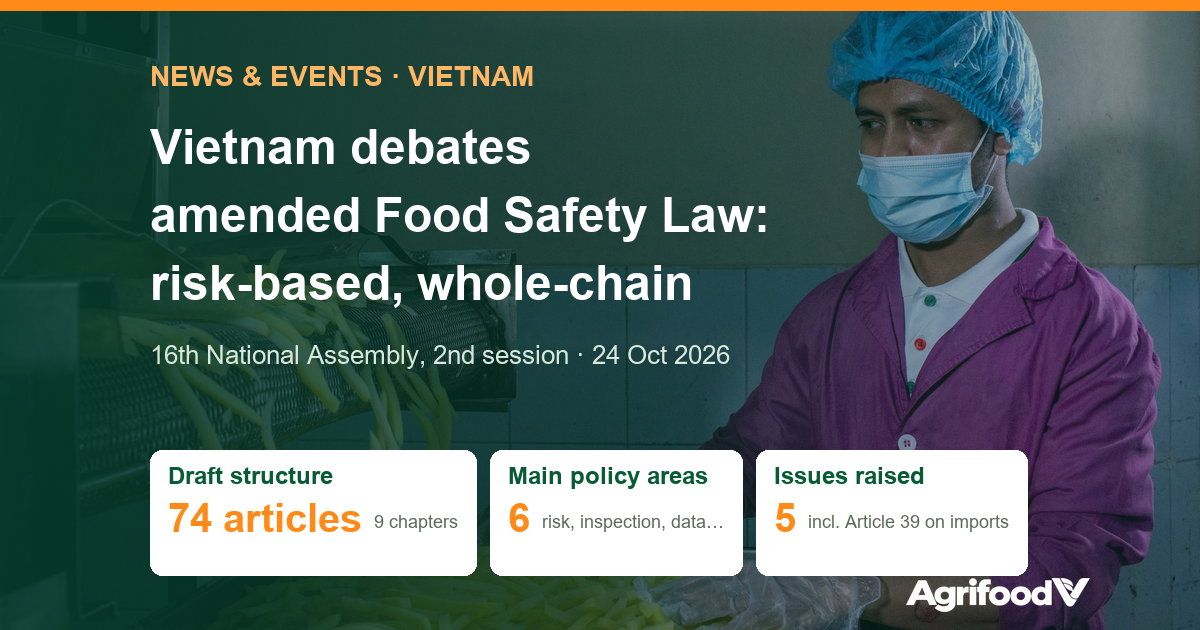
On the morning of 24 October 2026, at its second session, Vietnam’s 16th National Assembly heard the Government’s submission and the verification report on the draft Law on Food Safety (amended), and debated it in groups the same afternoon. The draft has 9 chapters and 74 articles. It moves food control from pre-market checks to post-market inspection, with risk-based management across the whole chain, starting from crop growing, livestock farming and aquaculture. For processors and raw-material growing areas, this framework law will redefine who inspects, what is inspected and which data must be ready.
Key points
- Minister of Health Dao Hong Lan, authorised by the Prime Minister, presented the submission; Nguyen Thanh Hai, Chair of the Committee for Science, Technology and Environment, presented the verification report.
- The draft sets limits for veterinary drug residues, pesticide residues and contaminants from the primary production stage, together with a food safety data system linked from central to local level.
- The Ministry of Health becomes the focal agency; other ministries continue to coordinate on primary production, counterfeit food, commercial fraud and inspection of exported and imported food.
- The verifying committee asked for a review of the two layers of pre-market checks on imported food (Article 39) and of the renewal of product declaration registrations after 5 years (Article 47).
Background: a 2010 law after more than 15 years in force
According to the submission as summarised on the National Assembly portal, after more than 15 years the Law on Food Safety shows four groups of shortcomings: management is fragmented across ministries and sectors; control methods do not fit practice or international norms; data are fragmented from central to local level; and there is a legal gap for food sold through e-commerce platforms. The drafting agency said it consulted industry associations and international organisations in line with WTO and WHO procedures.
The schedule for 24 October is set out in Press Release No. 8 of the session: the submission and verification report were heard in plenary in the morning, and the draft was debated in groups in the afternoon together with two other bills. The official sources reviewed do not state when the National Assembly will vote on the law.
Six main areas of the draft
| Area | What matters for agri-food companies |
|---|---|
| Risk-based, whole-chain control | Control from crop growing, livestock, aquaculture, harvesting, fishing and slaughter until the product reaches the market; residue limits apply from primary production; risk assessment tools follow Codex guidance |
| Fewer procedures, shift to post-market inspection | The law defines the scope, principles and measures of post-market inspection, the duties of inspection teams and inspection frequency on the market; authorities and testing laboratories actively sample food in circulation |
| Digital data | The data system covers product life cycle, food businesses, testing organisations, inspection and monitoring history and results, and food poisoning cases, shared through the national database |
| E-commerce, food delivery, canteens | Responsibilities of online sellers, delivery services and platform owners for monitoring, traceability and food poisoning incidents |
| Single focal agency | The Ministry of Health assists the Government in unified management; People’s Committees at each level manage food safety through a single focal point |
| Food classification | Risk analysis principles and a roadmap to classify food as high-risk or low-risk, with control measures to match |
Source: National Assembly portal, news of 24 October 2026 on the submission and verification report.
Five issues the verifying committee wants reviewed
The Committee for Science, Technology and Environment agreed the law needs amending and noted the shift to risk-based management: targeted pre-market checks for high-risk products, post-market inspection for low-risk products, and inspection frequency based on product characteristics, risk level and compliance history. It raised five issues:
- Feasibility: local staffing, testing capacity, post-market inspection and equipment have not been fully assessed.
- Balancing control and development: review the two layers of pre-market checks on imports in Article 39 and the renewal of product declaration registrations after 5 years in Article 47, since blanket application would sharply increase paperwork and business costs.
- Delegated legislation: put settled content into the law itself and set clear limits on what is delegated to secondary regulations.
- Legal consistency: the Law on Product and Goods Quality uses three risk levels, while the draft uses two; definitions of functional foods, supplemented foods and health supplements still differ between laws.
- Single focal agency: the Ministry of Health is the focal agency but several ministries still share management; the focal role must come with full accountability.
Views from the group debate
Speaking in the group debate on the afternoon of 24 October, Prime Minister Le Minh Hung called for stronger post-market inspection and clear rules on the frequency of inspection, sampling and testing; said the law should not repeat matters already covered by sector laws such as the Law on Veterinary Medicine, the Law on Plant Protection and Quarantine, the Law on Fisheries and the Law on Crop Production; and asked for timely suspension of serious violators. In Group 10, one deputy proposed turning the provision that “encourages” green agriculture and the circular economy into specific support policies for businesses.
A point for exporters: according to the submission, inspection of exported and imported food and control of primary production remain with the sector ministries under sector laws and the Government’s assignment of duties. The new law will therefore act mainly through data, risk classification and domestic post-market inspection, and does not replace importing-country requirements.
What companies should do
The following are AgrifoodV’s recommendations, not content of the draft law.
- Build residue records from the growing area. With residue limits applying from primary production, plants need records of pesticide and veterinary drug use and test results for each growing area and each purchased lot.
- Assess the risk group of your products. The list of high-risk foods has not been published in the sources reviewed; companies should review it against the hazard analysis in their own HACCP plan to anticipate the remaining pre-market checks.
- Digitise your compliance history. Inspection frequency is expected to depend on compliance history; inspection records, sampling results and corrective actions should be stored systematically and be retrievable at once.
- Follow the revised draft after the debate, especially Article 39 (imports, relevant to imported raw materials, additives and packaging) and Article 47 (renewal of product declarations), and submit comments through industry associations.
If your company needs to review its plant’s risk control system and records before the new law takes effect, see AgrifoodV’s processing plant advisory services.
References
- National Assembly of Vietnam portal, Quốc hội nghe Tờ trình và Báo cáo thẩm tra dự án Luật An toàn thực phẩm (sửa đổi) [National Assembly hears the submission and verification report on the draft Law on Food Safety (amended)], 24 October 2026. quochoi.vn/tintuc/…ItemID=102434 (accessed 29 October 2026).
- National Assembly of Vietnam portal, Thông cáo báo chí số 8, Kỳ họp thứ Hai, Quốc hội Khóa XVI [Press Release No. 8, Second Session, 16th National Assembly], 24 October 2026. quochoi.vn/tintuc/…ItemID=102471 (accessed 29 October 2026).
- National Assembly of Vietnam portal, Thủ tướng Lê Minh Hưng: Tăng cường hậu kiểm, quy định rõ tần suất kiểm tra, lấy mẫu, kiểm định chất lượng thực phẩm [Prime Minister Le Minh Hung: strengthen post-market inspection, set clear frequencies for inspection, sampling and testing of food], 24 October 2026. quochoi.vn/tintuc/…ItemID=102472 (accessed 29 October 2026).
- National Assembly of Vietnam portal, Siết trách nhiệm quản lý, tháo gỡ điểm nghẽn chính sách trong bảo đảm an toàn thực phẩm [Tightening management responsibility and removing policy bottlenecks in food safety] (Group 10 debate), 24 October 2026. quochoi.vn/tintuc/…ItemID=102478 (accessed 29 October 2026).
Article by AgrifoodV, compiled from the sources above (accessed 29 October 2026). This content is not a substitute for legal advice.
Cover image: Tanvir Khondokar / Pexels
Looking at Vietnam as a sourcing origin or a place to build a value chain?
Tell us your product, target market and expected volumes. In a 30–45 minute online call, AgrifoodV reviews buyers, standards, processing capacity and growing areas with you, starting from the market.
Book a call →Sourcing from Vietnam© 2026 AgrifoodV. Nội dung được phép trích dẫn khi ghi rõ nguồn và đặt liên kết tới bài gốc; không sao chép toàn văn. Xem Điều khoản sử dụng nội dung.