AgrifoodV ·
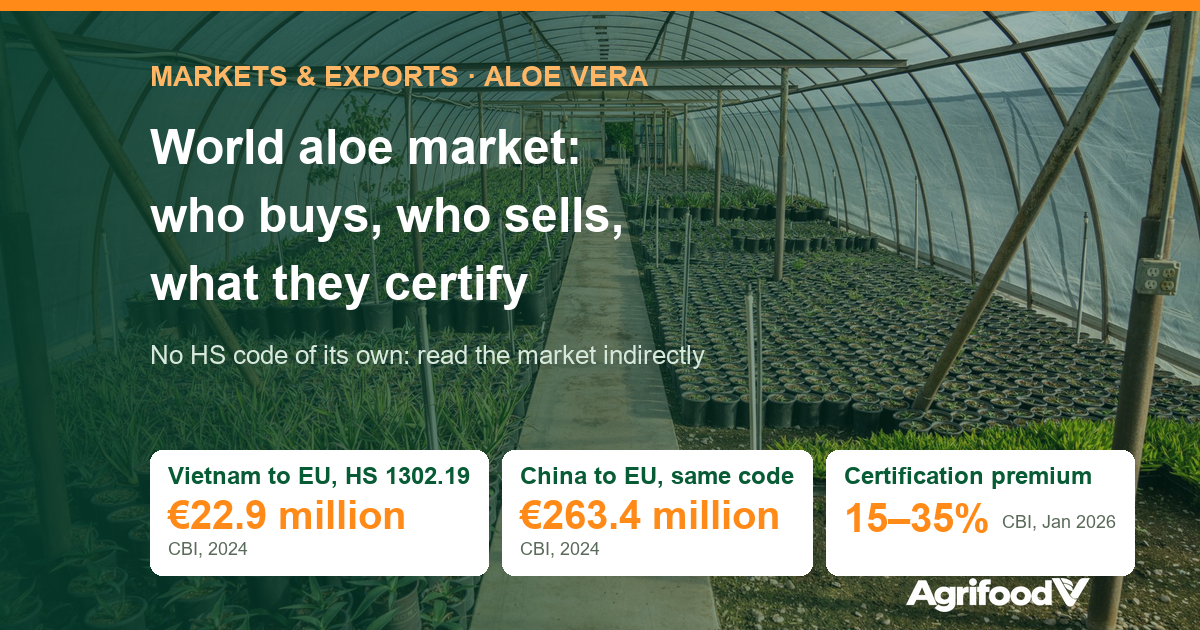
Nobody has a clean figure for world trade in aloe vera. Aloe has no HS code of its own in the EU or the US, and the industry association has stopped estimating the size of the market. Companies therefore have to read the market indirectly: who supplies the EU under a combined extract code, what buyers in each country use aloe for, which rules close the door, and which certifications earn a higher price. This article puts those pieces together for Vietnamese companies.
Key points
- Aloe is usually declared under HS 1302.19, a combined code for many plant extracts. According to CBI (January 2026), EU imports under this code from Vietnam were €22.9 million in 2024, up from €287,000 in 2020; China €263.4 million, India €84.5 million.
- European buyers use aloe in food supplements, beverages, functional foods and cosmetics; the Netherlands, Germany and Spain are the main markets.
- Common legal gates: the EU bans aloe leaf preparations containing hydroxyanthracene derivatives (2021/468) and does not allow aloin to be added as such to food (1334/2008). In 2025 South Korea proposed tighter specifications for aloe gel to stop starch adulteration.
- According to CBI, IASC, EU Organic, GLOBALG.A.P. and Fairtrade certifications usually bring price premiums of 15–35%.
Why there is no clean market figure
CBI, the import promotion agency of the Netherlands Ministry of Foreign Affairs, states that aloe is usually traded under HS 1302.19 “other vegetable saps and extracts”, a code that also contains ginseng, chamomile, green tea and rosemary extracts; it does not isolate aloe. The US tariff has no separate line either: line 1302.19.91 is split only into cashew nut shell liquid, certified organic and other. South Korea is a rare exception, with a 10-digit code 1302.19.9010 for aloe extract.
The “USD 13 billion aloe market” figure that is often repeated goes back to a statement by the International Aloe Science Council (IASC) in November 2012, extrapolated from market reports and an assumed share of cosmetics containing aloe. In 2016 IASC said it had no plans to estimate it again. AgrifoodV does not use this figure, nor commercial market reports that do not publish their methods.
Who sells: China and India lead, Vietnam grows fast but fluctuates
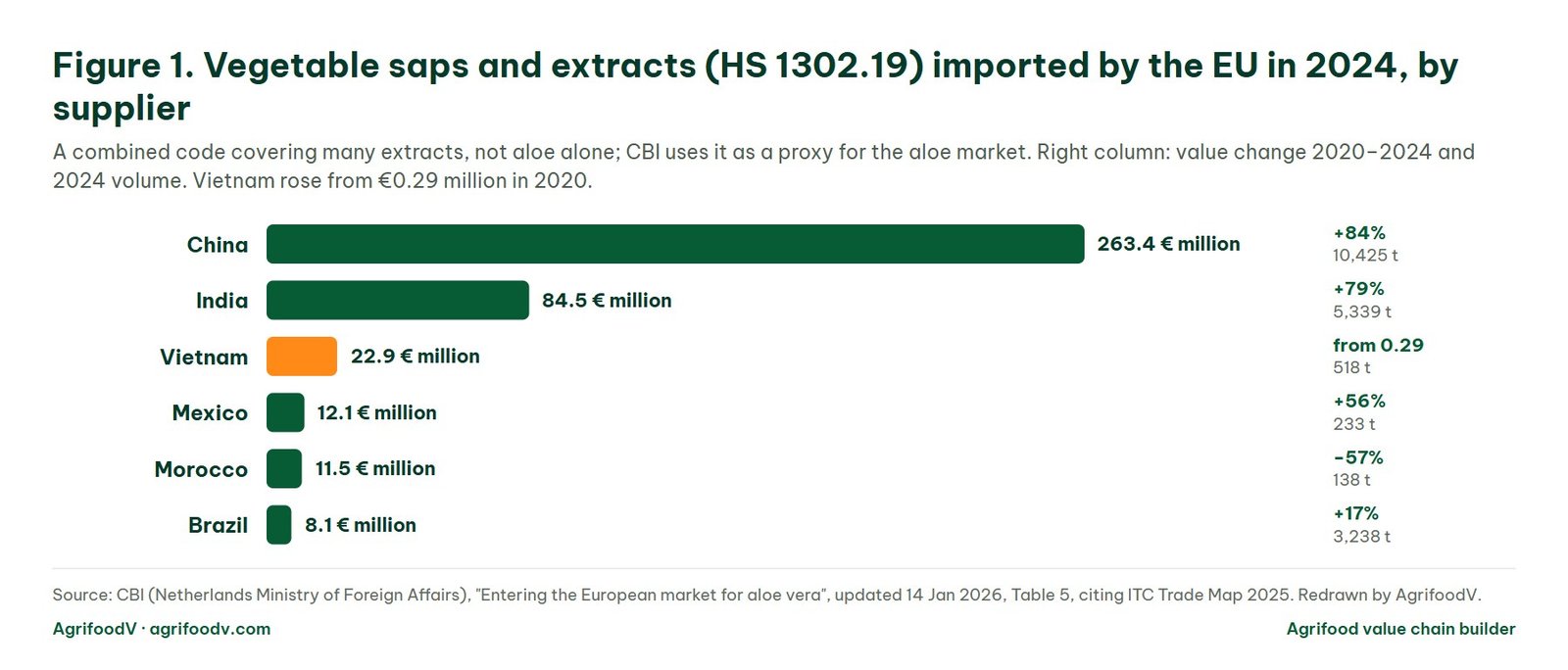
With the combined-code caveat above, CBI’s table shows the picture of supply into the EU in 2024: China €263.4 million (10,425 tonnes), India €84.5 million (5,339 tonnes), Vietnam €22.9 million (518 tonnes), Mexico €12.1 million, Morocco €11.5 million (down 57% from 2020), Brazil €8.1 million. Vietnamese goods under this code go mainly to the Netherlands (€14 million) and Italy (€7 million), which together take 98.9% of the value. CBI notes that Vietnamese supply has grown fast but volumes swing sharply from year to year, and advises suppliers to demonstrate consistent quality, food safety and traceability. CBI describes the Netherlands as a re-export hub, so goods arriving in the Netherlands do not necessarily stay there.
On growing areas, CBI notes that aloe is widely cultivated in China and India, and that Costa Rica, South Africa, Vietnam and Kenya are starting to grow it; Mexico uses EU Organic and Ecocert certification to ask for higher prices. In Vietnam, cultivation is concentrated in former Ninh Thuan province (now part of Khanh Hoa), about 350 ha according to the Ninh Thuan Department of Agriculture and Environment, with a farm-gate leaf price of VND 2,200–2,800 per kg in June 2025 (according to VTC News).
Who buys, and the legal gate for each buyer group
EU. According to CBI, the main applications of aloe in the European health products sector are food supplements, functional beverages and functional foods; the Netherlands, Germany and Spain are the main markets, with potential in Italy, France and the UK; Spain is also an end market for aloe drinks and cosmetics. Three texts decide the right to sell. Regulation (EU) 2021/468 added “preparations from the leaf of Aloe species containing hydroxyanthracene derivatives” to the prohibited list of Regulation (EC) 1925/2006, in force from 8 April 2021. Regulation (EC) 1334/2008 on flavourings (consolidated 16 February 2026), Annex III Part A, lists aloin among the substances that shall not be added as such to food. And for food supplements, CBI notes that national plant lists differ: the BELFRIT list (Belgium, France, Italy) allows 6 aloe species but sets no maximum aloin level; Germany allows only gels and extracts, not latex. The EU has authorised no health claims for botanicals, including aloe.
South Korea. Aloe gel is a health functional food ingredient with its own specification in the health functional food standards of the Ministry of Food and Drug Safety (MFDS). On 23 July 2025, MFDS published a draft amendment (notice No. 2025-318) adding a negative iodine–starch reaction requirement for aloe gel, to stop cheap starch being mixed into the gel. AgrifoodV has not verified whether the draft has been adopted. Even so, the direction is clear: Korean buyers will ask for evidence of no adulteration for every lot.
United States. California added “aloe vera, non-decolorized whole leaf extract” to the Proposition 65 list from 4 December 2015. The IASC limit of 10 ppm aloin is a voluntary association standard, not federal law, but it is what US buyers often ask about. The pillar article Vietnam Aloe Vera: From Fresh Leaves to Gel, Powder and Extracts for Premium Markets covers aloin and filleting in more detail.
Duties by product form
| Product (HS) | EU | United States | Japan | South Korea |
|---|---|---|---|---|
| Extract, gel powder (1302.19) | 0% | Free of general duty + 12.5% Section 301 (the aloe-specific exemption does not apply to Vietnam) | 0% for other extracts; mixed beverage bases must claim CPTPP | 1302.19.9010: 0% (VKFTA) |
| Aloe dice in syrup (2008.99) | 0% with an EVFTA certificate of origin | 2008.99.91: 6%, this line is on the Section 301 exemption list (classification to be confirmed) | 16.8% → 0% (VJEPA) | 0% (VKFTA) |
| Sweetened aloe drinks (2202.99) | 9.6% → 0% (EVFTA, from 1 January 2025) | 0.2 cents/litre + 12.5% Section 301 | 13.4%; no VJEPA commitment, claim CPTPP to get 0% | 0% (VKFTA) |
Sources: TARIC (reference date 25 October 2026); USITC HTS 2026 and the USTR Section 301 notice of 23 July 2026; Japan Customs tariff schedule 8 August 2026; Korea Customs yesFTA portal. The 10-digit HS code must be confirmed by a customs broker for each product.
Certifications buyers require, and the value Vietnam is leaving on the table
According to CBI, European buyers want aloe with a defined composition and chemical profile (aloin, acemannan), low moisture for powders, and low residues and contaminants. Commonly requested food safety certifications are ISO 22000, FSSC 22000, IFS Food and BRCGS; ISO 9001 for herbal medicine buyers. The aloe sector also has its own IASC Aloe Vera Quality Standard for raw materials. According to secondary sources, IASC-certified products must contain no more than 10 ppm aloin, and IASC does not certify non-decolorized whole leaf products. Organic goods must show the name and code of the control body and the certificate number on the label; each container carries a lot number. The document package usually includes a technical data sheet, a safety data sheet and a certificate of analysis. CBI estimates that IASC, EU Organic, GLOBALG.A.P. and Fairtrade certifications usually bring price premiums of 15–35%.
Set against a farm-gate leaf price of VND 2,200–2,800 per kg, the gap lies in what travels with the lot, not in the aloe plant itself. According to the scientific review by Ramachandra and Rao (2008), the gel is more than 99% water, the leaf starts losing activity after about 6 hours at ambient temperature, and filleting should be completed within 36 hours. This means the largest share of value (aloin-free gel, dried powder, extracts with a certificate of analysis and certifications) can only be captured by a plant sitting next to the growing area, with traceability from leaf lot to shipment lot.
What companies should do
AgrifoodV recommendations:
- Do not base an investment plan on the “global aloe market” figure of commercial reports. Use importing-country data (CBI, Korea’s 10-digit code) and real buyer orders.
- Choose the buyer group first: food supplements in the EU, drinks and dice in Japan and Korea, functional food ingredients in Korea, cosmetics. Each group has its own specifications and certifications.
- Test aloin on every lot and keep the results with the growing-area code; for Korean buyers, prepare evidence of no starch adulteration.
- Prioritise certifications that someone pays for: IASC, EU Organic, one GFSI standard (FSSC 22000, BRCGS or IFS).
- For Japan, claim CPTPP for sweetened drinks; for the US, include the full 12.5% for extracts.
AgrifoodV supports companies in market research, buyer selection and preparing the required files before investing in an aloe processing plant.
References
- CBI (Netherlands Ministry of Foreign Affairs). “Entering the European market for aloe vera”, updated 14 January 2026, Table 5 (citing ITC Trade Map 2025). cbi.eu.
- CBI. “The European market potential for aloe vera”, updated 15 January 2026. cbi.eu.
- NutraIngredients. “IASC says global aloe market continues to expand”, 26 September 2016. nutraingredients.com.
- European Union. Regulation (EC) 1925/2006, consolidated 26 November 2025 (as amended by Regulation (EU) 2021/468), Annex III. eur-lex.europa.eu.
- European Union. Regulation (EC) 1334/2008 on flavourings, consolidated 16 February 2026, Annex III Part A. eur-lex.europa.eu.
- Ministry of Food and Drug Safety of Korea (MFDS). Draft amendment to the “Standards and specifications for health functional foods”, notice No. 2025-318, 23 July 2025. mfds.go.kr.
- OEHHA (California). Aloe vera, non-decolorized whole leaf extract, Proposition 65 list from 4 December 2015. oehha.ca.gov.
- FoodNavigator. “Aloe council responds to CSPI’s ‘avoid’ advisory on ingredient”, 26 August 2013 (IASC aloin standard, secondary source). foodnavigator.com.
- USITC. Harmonized Tariff Schedule 2026, lines 1302.19.91, 2008.99.91, 2202.99.91; USTR, Section 301 notice of 23 July 2026. hts.usitc.gov; ustr.gov.
- European Commission. TARIC, reference date 25 October 2026. ec.europa.eu. Japan Customs, tariff schedule 8 August 2026: customs.go.jp. Korea Customs, yesFTA portal: customs.go.kr.
- C.T. Ramachandra, P. Srinivasa Rao. “Processing of Aloe Vera Leaf Gel: A Review”, American Journal of Agricultural and Biological Sciences 3(2):502–510, 2008. DOI: 10.3844/ajabssp.2008.502.510.
- VTC News. Article on aloe vera in Ninh Thuan, 17 June 2025. vtcnews.vn.
Article by AgrifoodV, compiled from the sources above (accessed 30 October 2026). HS 1302.19 figures refer to a combined code, not aloe alone. Whether MFDS draft 2025-318 has been adopted, IASC’s current certification criteria and the 2026 leaf price are not verified. HS codes and duty rates must be confirmed by a customs broker for each product. The article does not assess health effects of aloe. This content is not a substitute for legal advice. Cover image: Mark Stebnicki / Pexels.
Looking at Vietnam as a sourcing origin or a place to build a value chain?
Tell us your product, target market and expected volumes. In a 30–45 minute online call, AgrifoodV reviews buyers, standards, processing capacity and growing areas with you, starting from the market.
Book a call →Sourcing from Vietnam© 2026 AgrifoodV. Nội dung được phép trích dẫn khi ghi rõ nguồn và đặt liên kết tới bài gốc; không sao chép toàn văn. Xem Điều khoản sử dụng nội dung.