AgrifoodV ·
An oleoresin is the solvent extract of a spice, keeping both the aroma compounds and the pungent and colouring compounds. Buyers do not pay for “pepper”, “ginger” or “chilli” but for the piperine, capsaicinoid, gingerol or carotenoid content written into the contract, together with proof that residual solvents are within limits. This is the deepest processing tier in the spice industry, and one where Vietnam is almost absent: according to UN Comtrade, Vietnam’s exports of the product group that includes oleoresins were below USD 1 million in 2023, while India reported more than USD 535 million in 2024. This article covers the products, the standards, the solvent rules and the duties, so investors know what an oleoresin plant has to meet.
Key points
- Each oleoresin is sold on one main specification: piperine (pepper, assayed under ISO 11027:2026), capsaicinoids and colour (chilli, paprika), gingerols and shogaols (ginger). “Standardisation” means blending batches to the exact contracted content.
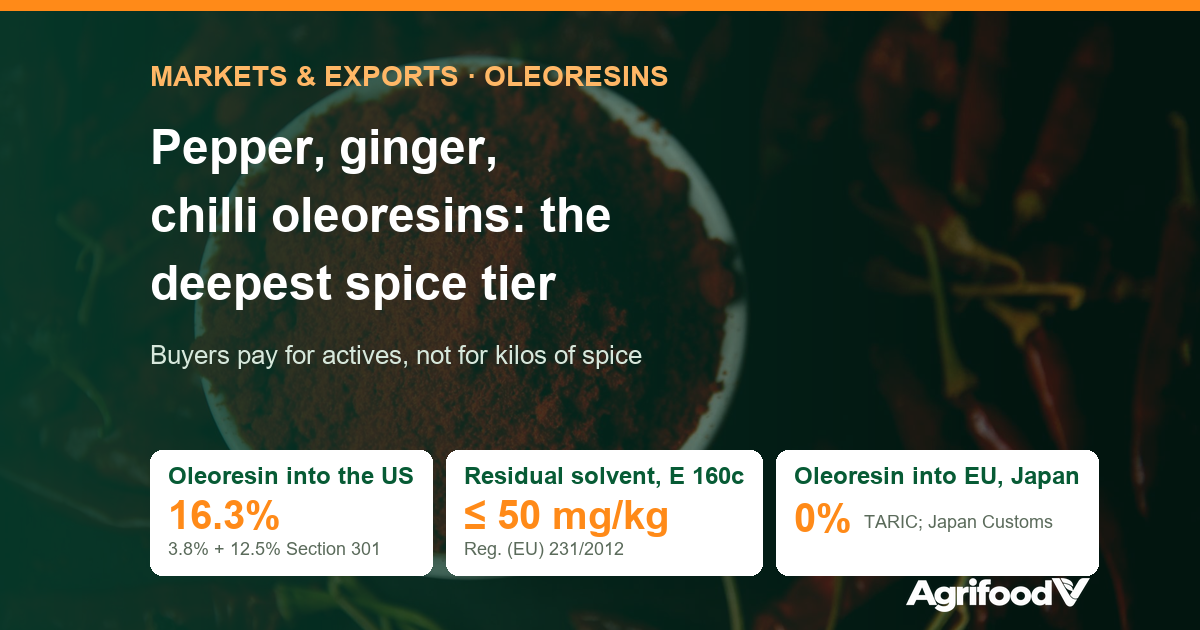
- The EU only allows the extraction solvents listed in Directive 2009/32/EC; CO₂ is in the group permitted for all uses. Paprika extract used as the colour E 160c has its own limits: total residual solvents ≤ 50 mg/kg, capsaicin ≤ 250 mg/kg.
- The US recognises “solvent-free” oleoresins of pepper, capsicum, paprika, ginger and turmeric as safe (21 CFR 182.20), but Vietnamese oleoresins entering the US pay 3.8% plus 12.5% under Section 301, i.e. 16.3%, while whole and ground pepper are exempt.
- In the EU (code 3301 90 30) and Japan (3301.90), oleoresins are duty-free.
What an oleoresin is, and which specification buyers pay for
Regulation (EU) 231/2012 on food additive specifications describes paprika extract (synonym “paprika oleoresin”) as the product obtained by solvent extraction of ground Capsicum annuum pods, containing the main colouring principles of the spice. The same logic applies across the group: the dried raw material is ground, extracted with a solvent, and the solvent is then removed, leaving a viscous liquid that carries the volatile essential oil and the non-volatile resinous fraction where the pungent and colouring compounds sit. Food manufacturers use oleoresins because they give consistent flavour and colour from lot to lot and are easier to dose than dried spices.
The selling specification is therefore the active compound, not sensory impression:
- Black pepper: piperine. ISO 11027:2026 (second edition, replacing the 1993 edition) sets the high-performance liquid chromatography method for piperine in whole pepper, ground pepper and pepper oleoresins.
- Chilli: pungency measured as total capsaicinoids under ISO 7543-2 (liquid chromatography) or as the Scoville index under ISO 3513 (sensory). For paprika used as a colour, the specification is carotenoids: E 160c must contain at least 7% carotenoids, of which capsanthin and capsorubin are not less than 30%.
- Ginger: the pungent gingerols and shogaols. A study published in Molecules in 2018 showed that under hot-air drying, gingerols fall and shogaols rise with drying temperature and time; at 180 °C both groups decline. The composition of a ginger oleoresin is thus set in the raw-material dryer, before the extractor.
“Standardised” in a product name means the plant blends extraction batches of different strength into lots at the contracted level, with a certificate of analysis. This article gives no extraction yields: yields depend on variety, dryness, solvent and equipment, and can only be established by trials on real raw material.
Solvents: the legal boundary sits inside the plant
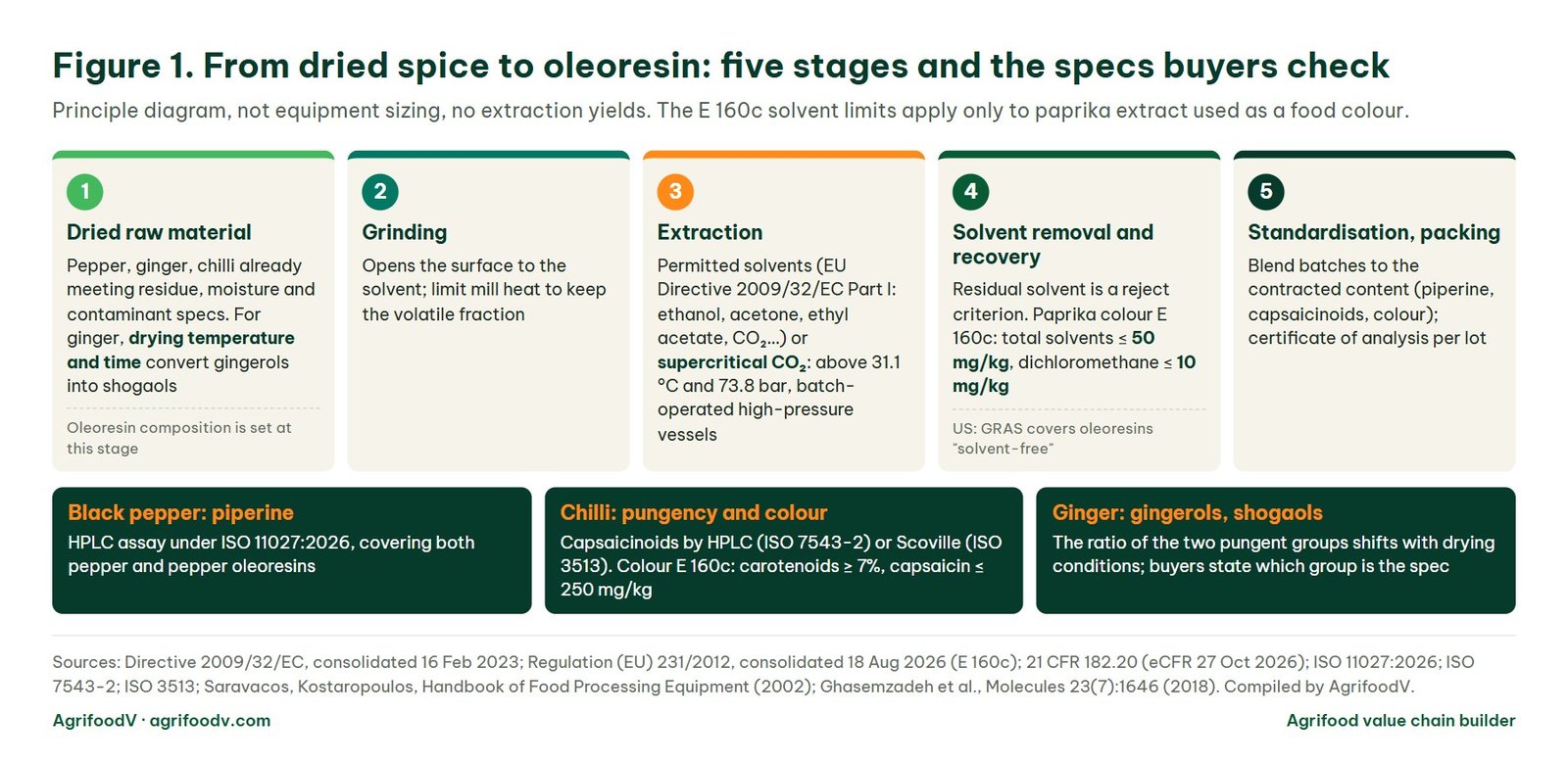
EU. Directive 2009/32/EC on extraction solvents used in the production of foodstuffs (consolidated 16 February 2023) splits solvents into three groups. Part I covers propane, butane, ethyl acetate, ethanol, CO₂, acetone and nitrous oxide, permitted for all uses under good manufacturing practice. Part III lists the solvents allowed in preparing flavourings from natural flavouring materials, with maximum residues in the final food: hexane 1 mg/kg, diethyl ether 2 mg/kg, dichloromethane 0.02 mg/kg, methanol 1.5 mg/kg. For paprika extract used as the colour E 160c, Regulation 231/2012 (consolidated 18 August 2026) allows only eight solvents and caps residues: ethyl acetate, methanol, ethanol, acetone, hexane and propan-2-ol together at no more than 50 mg/kg, dichloromethane at no more than 10 mg/kg; capsaicin at no more than 250 mg/kg, plus limits for arsenic, lead, mercury and cadmium. The same chilli can therefore yield a colour oleoresin and a pungent oleoresin, two products with two sets of specifications.
When an oleoresin is used for flavour, Regulation (EC) 1334/2008 on flavourings (consolidated 16 February 2026) classes it as a “flavouring preparation”, and “extraction, including solvent extraction under the solvents legislation” is on the list of traditional food preparation processes in Annex II. If a label says “natural” flavouring with a named source, for example natural ginger flavouring, at least 95% of the flavouring component must come from that source (Article 16). Capsaicin is in Annex III Part A, meaning it may not be added to food as such: pungency has to come from a chilli preparation.
United States. 21 CFR 182.20 recognises as safe (GRAS) “essential oils, oleoresins (solvent-free), and natural extractives” from a list of plants that includes black pepper, white pepper, capsicum, paprika, ginger, turmeric and Saigon cassia (Cinnamomum loureirii). The words “solvent-free” turn residual solvent into a reject criterion.
Supercritical CO₂. CO₂ becomes supercritical above 31.1 °C and 73.8 bar; it then dissolves low-polarity compounds such as essential oils well, and leaves completely on depressurisation, with no residue. According to Saravacos and Kostaropoulos’ handbook of food processing equipment, most supercritical extraction equipment is batch-operated because solids are hard to feed continuously into high-pressure vessels, the vessels are made of stainless steel 316 or special alloys, and the pressure parts require a hazard analysis. It is a more expensive technology choice than organic solvent extraction, in exchange for a simpler solvent file.
Market and duties
Extracted oleoresins fall under HS subheading 3301.90, which also covers some other essential-oil products, so the figures only indicate scale. According to UN Comtrade, reporting countries exported about USD 1.23 billion of 3301.90 goods in 2024; India reported USD 535.9 million, about 44%. Vietnam self-reported about USD 0.65 million in 2023; importing countries reported buying about USD 0.29 million from Vietnam in 2024. This processing tier is almost empty in Vietnam, even though Vietnam is the world’s largest pepper exporter.
| Product (HS) | EU | United States | Japan |
|---|---|---|---|
| Extracted oleoresins (3301.90) | 3301 90 30: 0% (MFN since 2001) | 3301.90.10: 3.8% + 12.5% Section 301 = 16.3% | 3301.90: 0% |
| Other vegetable extracts (1302.19) | 1302 19 70: 0% | 1302.19.91: duty-free + 12.5% Section 301 | 1302.19-239: 0% |
| For comparison: other ground spices (0910.99), pepper (0904) | 0910 99 99: MFN 12.5% → 0% with EVFTA origin | Spices 0904–0910 exempt from the 12.5% Section 301 duty | Bulk spices: 0% |
Sources: TARIC (reference date 25 October 2026); USITC HTS 2026 and USTR Section 301 notice of 23 July 2026; Japan Customs tariff schedule, 1 April 2026. Ten-digit HS codes must be confirmed by a customs broker.
The two market groups pose different problems. In the EU and Japan, oleoresins have no duty advantage over raw spices because both are close to 0%; the advantage lies in logistics and in selling to food and flavour manufacturers rather than traders. In the US, deep processing makes the goods more expensive: pepper oleoresin pays 16.3% while ground pepper is exempt. The argument “make oleoresin to avoid US duties” is wrong in 2026.
The raw material decides the oleoresin
An extract carries whatever in the raw material dissolves in the solvent, so buyers test oleoresins for heavy metals, pesticide residues and residual solvents, as in the arsenic, lead, mercury and cadmium limits of the E 160c specification. An oleoresin plant therefore cannot run on reject-grade material: it needs dried pepper, ginger and chilli with lot-by-lot residue results, controlled drying and retained samples, as described in Raw-material receiving and storage: intake checks, residues and retained samples. The wider picture of the spice chain, from raw material to products meeting EU, US and Japanese standards, is in the pillar article Spice and herb processing plants for export.
What companies should do
AgrifoodV recommendations:
- Choose the product by buyer before choosing the technology: pepper oleoresin on piperine, pungent chilli oleoresin on capsaicinoids, paprika extract for colour on carotenoids and the E 160c specification, ginger oleoresin on gingerols or shogaols. Each has its own specification set and its own customers.
- Choose solvents by destination market: use only solvents listed in Directive 2009/32/EC when selling into the EU, and build a process that proves “solvent-free” when selling into the US. Consider supercritical CO₂ when customers require a clean solvent file.
- Invest in a liquid chromatography laboratory before investing in an extraction line: without lot-by-lot assays of piperine, capsaicinoids, gingerols and residual solvents, there is no standardisation.
- Run the US case separately: at 16.3% duty, Vietnamese oleoresins struggle to compete in the US; the EU, Japan and Asian flavour manufacturers are a more sensible starting point.
- Contract dried raw-material growing areas with residue results and controlled drying, especially for ginger.
AgrifoodV helps companies prepare the design brief for a deep-processing spice plant, from product and market selection to growing-area requirements.
References
- European Union. Directive 2009/32/EC on extraction solvents used in the production of foodstuffs, consolidated 16 February 2023, Annex I. eur-lex.europa.eu.
- European Union. Regulation (EU) 231/2012 laying down specifications for food additives, consolidated 18 August 2026, entry E 160c (paprika extract, capsanthin, capsorubin). eur-lex.europa.eu.
- European Union. Regulation (EC) 1334/2008 on flavourings, consolidated 16 February 2026, Articles 3 and 16, Annexes II and III. eur-lex.europa.eu.
- United States. 21 CFR 182.20, Essential oils, oleoresins (solvent-free), and natural extractives (eCFR, up to date as of 27 October 2026). ecfr.gov.
- ISO. ISO 11027:2026, Pepper and pepper oleoresins — Determination of piperine content — Method using high-performance liquid chromatography (March 2026). iso.org.
- ISO. ISO 7543-2:1993, Chillies and capsicums — Determination of total capsaicinoid content — HPLC method; ISO 3513:1995, Chillies — Determination of Scoville index. iso.org.
- Ghasemzadeh A., Jaafar H.Z.E., Baghdadi A., Tayebi-Meigooni A. Formation of 6-, 8- and 10-Shogaol in Ginger through Application of Different Drying Methods. Molecules 23(7):1646, 2018. DOI: 10.3390/molecules23071646.
- Saravacos G.D., Kostaropoulos A.E. Handbook of Food Processing Equipment, Kluwer/Plenum, 2002, chapter Equipment for Novel Food Processes, section Supercritical Fluid Extraction.
- United Nations. UN Comtrade, HS 330190, exports 2023–2024 (checked 30 October 2026). comtradeplus.un.org.
- European Commission. TARIC, codes 3301 90 30, 1302 19 70, 0910 99 99, origin Vietnam (reference date 25 October 2026). ec.europa.eu.
- USITC. Harmonized Tariff Schedule of the United States 2026; USTR. Notice of final action under Section 301 on goods from Vietnam, 23 July 2026. hts.usitc.gov; ustr.gov.
- Japan Customs. Import tariff schedule, Chapters 13 and 33 (edition of 1 April 2026). customs.go.jp.
Article by AgrifoodV, compiled from the sources above (accessed 30 October 2026). UN Comtrade figures for HS 3301.90 combine oleoresins with some other essential-oil products and are used only to compare scale; no unit prices are calculated. The article gives no extraction yields and no equipment sizing. The E 160c solvent limits apply only to paprika extract used as a food colour in the EU. HS codes and duty rates must be confirmed by a customs broker for each product. This content is not a substitute for legal advice. Cover image: Bonaventure Fernandez / Pexels.
Looking at Vietnam as a sourcing origin or a place to build a value chain?
Tell us your product, target market and expected volumes. In a 30–45 minute online call, AgrifoodV reviews buyers, standards, processing capacity and growing areas with you, starting from the market.
Book a call →Sourcing from Vietnam© 2026 AgrifoodV. Nội dung được phép trích dẫn khi ghi rõ nguồn và đặt liên kết tới bài gốc; không sao chép toàn văn. Xem Điều khoản sử dụng nội dung.