AgrifoodV ·
Cassia, star anise, lemongrass and ginger oils are not bought by smell. Flavour and fragrance buyers purchase against the chemical profile of each lot, checked against the ISO standard for that specific oil, and against the regulatory file for where the oil will end up: food flavouring, fragrance or chemical use. This article covers the four ISO standards, the principle of steam distillation at plant scale, three layers of rules in the EU and the US, and duties by market.
Key points
- Each oil has its own ISO standard: cassia ISO 3216:1997, star anise ISO 11016:1999, ginger ISO 16928:2014, lemongrass ISO 3217:1974 (Cymbopogon citratus) and ISO 4718:2004 (C. flexuosus).
- In the EU, oils used as food flavourings fall under Regulation (EC) 1334/2008: coumarin, estragole, methyleugenol and safrole may not be added as such and are capped in finished foods. Oils used outside food are chemicals under REACH.
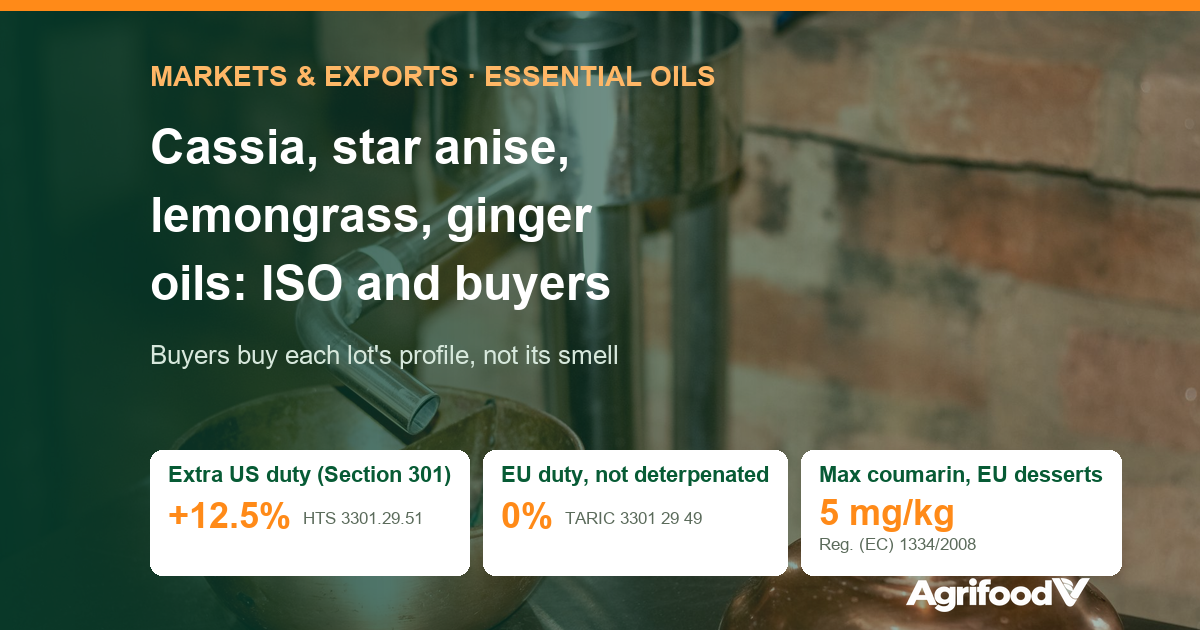
- Into the US, essential oils (HTS 3301.29.51) carry an extra 12.5% under Section 301, while dried cassia and star anise are exempt. Into the EU, non-deterpenated oils pay 0%.
- In 2023 Vietnam exported about USD 21.84 million of essential oils (HS 3301); China took about 54% of subheading 3301.29.
Four oils, four ISO standards
Essential oil standards are drafted by ISO Technical Committee ISO/TC 54, one document per oil. For the four oils with raw material in Vietnam, the current documents are: ISO 3216:1997 for cassia oil, full title “Oil of cassia, Chinese type”, covering Cinnamomum aromaticum Nees, syn. C. cassia, reviewed and confirmed in 2023; ISO 11016:1999 for star anise oil (Illicium verum); ISO 16928:2014 for ginger oil; ISO 3217:1974 for lemongrass oil from C. citratus and ISO 4718:2004 for lemongrass oil from C. flexuosus. Java citronella oil has a separate document, ISO 3848:2016, and is a different commodity.
These standards describe organoleptic characteristics, physical constants and the main constituents measured by gas chromatography. The documents are copyrighted and AgrifoodV does not reproduce their ranges. What companies need to know is how buyers use them: the contract names the reference standard, the certificate of analysis for each lot must fall within its ranges, and the buyer will re-test samples on arrival. A lot that smells right but is off on its main constituents is still a failed lot.
The domestic raw-material base is real and sizeable. According to Bao Lao Cai, Lao Cai province produced about 1,200 tonnes of cassia oil in 2025 (another article in the same paper gives more than 1,300 tonnes) and exported 642 tonnes of essential oil in the first four months of 2026. Dried star anise exports reached 14,307 tonnes and USD 58.7 million in 2025, mostly to India (Vietnam Pepper and Spice Association). AgrifoodV has not found published figures for Vietnamese lemongrass oil or ginger oil.
Industrial distillation: the principle, and where plants lose control
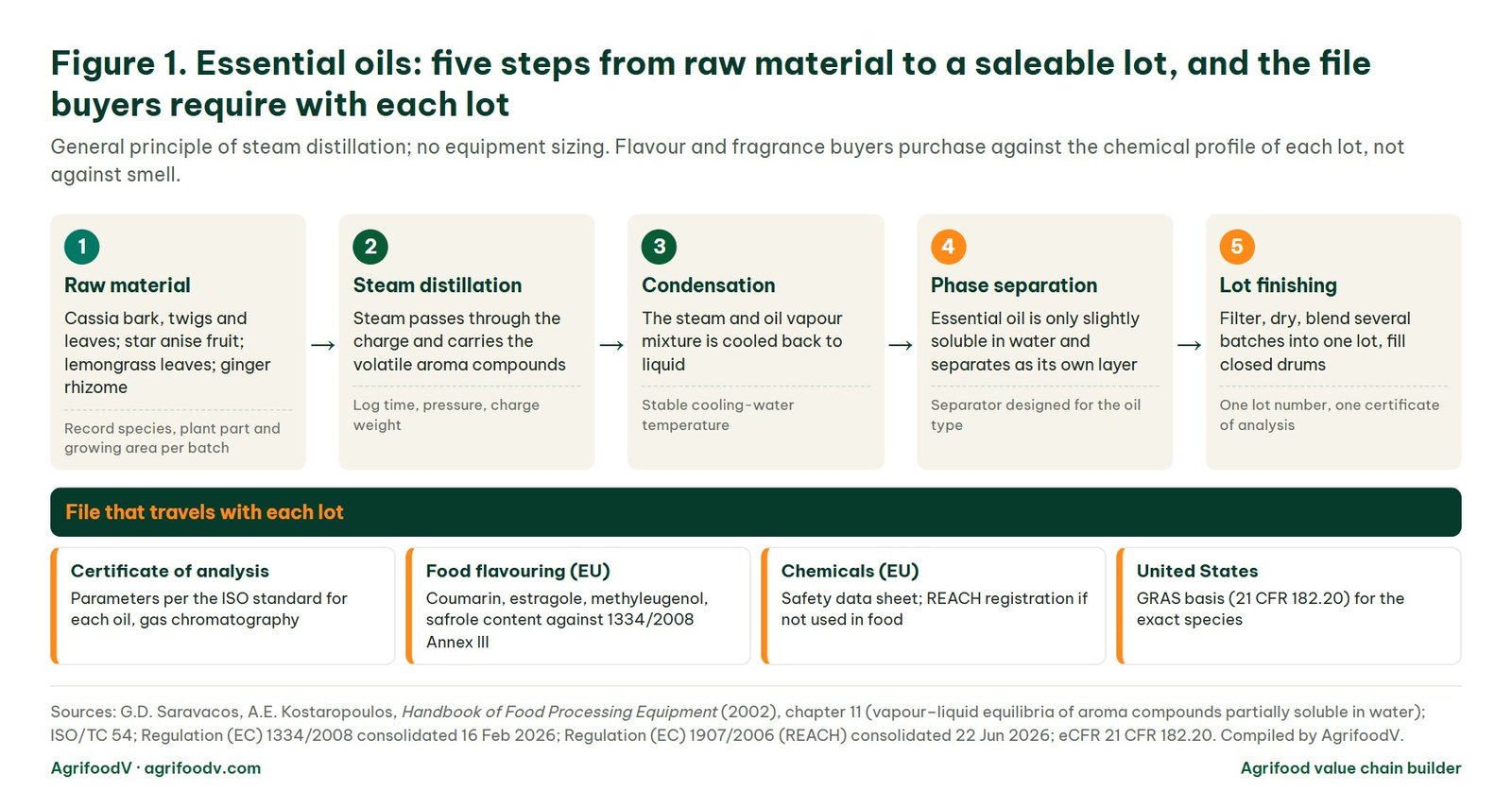
All four oils are produced by steam distillation. Handbook of Food Processing Equipment by G.D. Saravacos and A.E. Kostaropoulos (2002) explains the physics: organic aroma compounds are only partially soluble in water, at low concentrations they are highly volatile in the presence of water, and on condensation the mixture separates into two liquid layers. Steam passes through the charge and carries the aroma compounds with it; the vapour is cooled back to liquid; oil and water separate in the separator.
At plant scale, oil composition depends on things outside the still: the plant part (bark, twigs and leaves, fruit, rhizome), how fresh or dry the charge is, distillation time, and how batches are combined into lots. Because buyers test by lot, the plant needs to record these parameters for each batch, blend several batches into one homogeneous lot before sampling for analysis, and keep retained samples by lot number. That is also how a lot is traced back when a claim comes in.
Three layers of rules: food flavouring, chemicals, and GRAS in the US
EU, food flavouring. Regulation (EC) 1334/2008 (consolidated 16 February 2026), Annex III Part A, lists substances that shall not be added as such to food, including coumarin, estragole, methyleugenol and safrole. Part B sets maximum levels for these substances in finished compound foods when they come from flavourings or food ingredients with flavouring properties. For coumarin: 50 mg/kg in traditional or seasonal bakery ware with a reference to cinnamon on the label, 20 mg/kg in breakfast cereals, 15 mg/kg in other fine bakery ware, 5 mg/kg in desserts. Estragole is capped at 10 mg/kg and methyleugenol at 1 mg/kg in non-alcoholic beverages. The German Federal Institute for Risk Assessment (BfR) reports that cassia cinnamon is high in coumarin, on average about 3,000 mg/kg. The consequence: European flavour houses will ask for the content of these substances in each lot of oil to calculate how much they may use.
EU, chemicals. Under Regulation (EC) 1907/2006 (REACH, consolidated 22 June 2026), Article 6, any manufacturer or importer of a substance in quantities of one tonne or more per year must register it with the European Chemicals Agency. Article 2(5)(b) exempts substances to the extent they are used in food, including as flavourings. The same drum of cassia oil needs no REACH registration if it goes into food flavourings; if it goes into perfume, cosmetics or detergents, the EU importer must register it. Exporters need to know where their oil ends up before quoting, because the cost of the file differs.
United States. The list in 21 CFR 182.20 (essential oils generally recognised as safe for their intended use) names cassia, including Cinnamomum loureirii under the name “Saigon”, ginger and lemongrass (C. citratus, C. flexuosus). Star anise (Illicium verum) appears in 21 CFR 182.10 as a spice, but has no separate entry in the 182.20 essential oil list. For star anise oil, companies should ask the US buyer which basis they rely on before signing a contract.
Duties: near zero in the EU and Japan, the US taxes oil more than raw spice
| Market | Code and duty on essential oils of Vietnamese origin | Compared with raw spice |
|---|---|---|
| EU | 3301 29 49 (cassia, star anise, ginger, lemongrass, not deterpenated): 0%. Deterpenated oils 3301 29 91: 2.3%, 0% with an EVFTA certificate of origin | Dried cassia, star anise, ginger are also 0%: duty makes no difference |
| United States | 3301.29.51: free of general duty, but an extra 12.5% under Section 301 | Spices 0904–0910 are exempt from the 12.5%: oil is taxed more heavily |
| Japan | 3301.29-100 (cassia, star anise, lemongrass): 0%. 3301.29-990 (ginger): 3.2%, 0% under VJEPA | Close to 0% for both forms |
| South Korea | 3301.29: 5% general, 0% preferential for Vietnam (TRAINS data for 2021) | Re-check the 10-digit schedule |
| China | 3301.29: 15–20% general (2023); ACFTA rate by line not verified | The largest buyer |
Sources: TARIC (reference date 25 October 2026); USITC HTS 2026 and the USTR Section 301 notice of 23 July 2026; Japan Customs tariff schedule 1 April 2026; UNCTAD TRAINS via WITS. The 10-digit HS code must be confirmed by a customs broker for each product.
In the US, distilling makes the product more expensive, not cheaper: a tonne of dried cassia entering the US does not pay the 12.5%, while the oil distilled from it does. In the EU and Japan duties are close to zero; the real gate is lot specifications and the file. Where essential oils sit on the spice value ladder is covered in the pillar article Spice and Herb Processing Plants in Vietnam: Meeting EU, US and Japan Standards.
What companies should do
AgrifoodV recommendations:
- Choose the end buyer first: food flavouring, fragrance or chemicals. Each route has a different file in the EU (1334/2008 or REACH) and a different basis in the US.
- Buy the ISO standard for the exact oil, set an in-house specification on it, and invest in a gas chromatography laboratory or contract a competent laboratory to test every lot.
- Record for each batch: species, plant part, growing area, moisture at charging, distillation time; blend batches into homogeneous lots; keep retained samples by lot number, as described in the article on receiving raw materials, residue checks and retained samples.
- For EU food flavouring buyers, have coumarin (cassia oil), estragole and methyleugenol results ready for every lot.
- For the US market, build the full 12.5% into the price before offering oil instead of dried spice.
AgrifoodV supports companies in designing deep-processing spice plants around the requirements of industrial buyers, from product choice to the lot file.
References
- ISO. ISO 3216:1997 Oil of cassia, Chinese type (Cinnamomum aromaticum Nees, syn. Cinnamomum cassia Nees ex Blume), confirmed 2023. iso.org. ISO/TC 54 catalogue (ISO 11016:1999, ISO 16928:2014, ISO 3217:1974, ISO 4718:2004, ISO 3848:2016): iso.org.
- G.D. Saravacos, A.E. Kostaropoulos. Handbook of Food Processing Equipment, Kluwer Academic/Plenum, 2002, chapter 11 (Mass transfer equipment: distillation, vapor/liquid equilibria).
- European Union. Regulation (EC) 1334/2008 on flavourings, consolidated 16 February 2026, Annex III. eur-lex.europa.eu.
- European Union. Regulation (EC) 1907/2006 (REACH), consolidated 22 June 2026, Article 2(5) and Article 6. eur-lex.europa.eu.
- German Federal Institute for Risk Assessment (BfR). FAQ on coumarin in cinnamon and other foods, 27 September 2012. bfr.bund.de.
- United States. 21 CFR 182.20 and 182.10, eCFR as of 1 October 2026. ecfr.gov.
- USTR. Notice of final action under Section 301 on goods from Vietnam, Federal Register 23 July 2026. ustr.gov.
- European Commission. TARIC, code 3301 29, reference date 25 October 2026. ec.europa.eu.
- Japan Customs. Import tariff schedule, Chapter 33 (1 April 2026). customs.go.jp.
- UN Comtrade. Vietnam exports under HS 3301, 2023 (queried 17 October 2026). comtradeplus.un.org.
- Bao Lao Cai. Articles of 28 January 2026 and 27 March 2026 on cassia and cassia oil output and exports. baolaocai.vn; baolaocai.vn.
- Vietnam Pepper and Spice Association (VPSA), via Thue & Hai quan Online, 12 January 2026: star anise exports in 2025. thuehaiquan.tapchikinhtetaichinh.vn.
Article by AgrifoodV, compiled from the sources above (accessed 30 October 2026). The article does not reproduce specification ranges from copyrighted ISO standards; companies should buy the official documents. Duties for South Korea and China and figures for lemongrass and ginger oil are not fully verified, as noted in the text. HS codes and duty rates must be confirmed by a customs broker for each product. This content is not a substitute for legal advice. Cover image: Tiago Antonio / Pexels.
Looking at Vietnam as a sourcing origin or a place to build a value chain?
Tell us your product, target market and expected volumes. In a 30–45 minute online call, AgrifoodV reviews buyers, standards, processing capacity and growing areas with you, starting from the market.
Book a call →Sourcing from Vietnam© 2026 AgrifoodV. Nội dung được phép trích dẫn khi ghi rõ nguồn và đặt liên kết tới bài gốc; không sao chép toàn văn. Xem Điều khoản sử dụng nội dung.