AgrifoodV ·
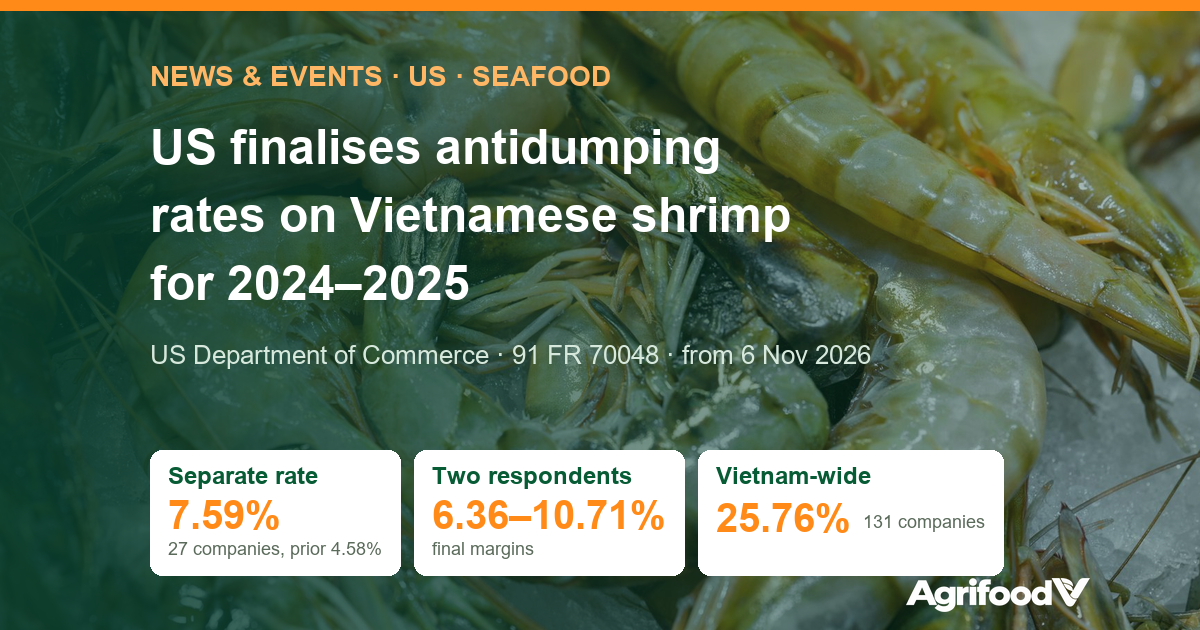
The US Department of Commerce has published the final results of the 2024–2025 administrative review of the antidumping duty order on certain frozen warmwater shrimp from Vietnam, in the Federal Register on 6 November 2026. The two mandatory respondents received margins of 10.71% and 6.36%, and the 27 other companies granted a separate rate received 7.59%, up from 4.58% in the previous review. The 131 companies that did not establish eligibility for a separate rate remain subject to the Vietnam-wide rate of 25.76%.
Key points
- Period of review: entries into the US from 1 February 2024 to 31 January 2025, case A-552-802. The results apply from 6 November 2026.
- Final margins: 10.71% and 6.36% for the two mandatory respondents; 7.59% for 27 companies not individually examined but eligible for a separate rate. The preliminary results of May 2026 were 10.76%, 6.30% and 7.56%.
- The Vietnam-wide rate of 25.76% is unchanged and applies to 131 companies and to every Vietnamese exporter without a separate rate.
- The next review (1 February 2025 – 31 January 2026) was initiated on 31 March 2026.
Background: an order since 2005, reviewed every year
The antidumping duty order on frozen warmwater shrimp from Vietnam dates from 1 February 2005. Each year, when a party requests it, the Department of Commerce (International Trade Administration, ITA) reviews the entries made during the period to set the final duty assessed and the cash deposit rate for later shipments. Because the US treats Vietnam as a non-market economy, normal value is built from surrogate values from a third country for each factor of production: raw shrimp, feed, chemicals, labour and energy.
The preliminary results of the 2024–2025 review were published on 13 May 2026. Commerce extended the deadline by 53 days, signed the final results on 2 November 2026 and published them on 6 November 2026 (91 FR 70048).
Final margins for 2024–2025
| Company group | Preliminary (13 May 2026) | Final (6 November 2026) |
|---|---|---|
| First mandatory respondent (group of affiliated companies) | 10.76% | 10.71% |
| Second mandatory respondent | 6.30% | 6.36% |
| 27 separate-rate companies not individually examined | 7.56% | 7.59% |
| Vietnam-wide entity (131 companies) | 25.76% | 25.76% (not reviewed) |
Source: Federal Register, 91 FR 27002 (13 May 2026) and 91 FR 70048 (6 November 2026). Company names are listed in the appendices of the original notices.
The 7.59% separate rate is the weighted average of the two respondents’ margins. In the previous review (2023–2024, final results published on 23 February 2026), both respondents received adverse facts available, so Commerce reused the 4.58% rate calculated in the 2016–2017 review for 24 separate-rate companies; the cash deposit rate after the export subsidy offset was then 4.28%. The separate rate has therefore risen by about 3 percentage points, while the number of companies with a separate rate has grown from 24 to 29 (including the two respondents).
The technical points behind the numbers
The accompanying Issues and Decision Memorandum addresses seven issues raised by the parties, including the surrogate value for shrimp feed, an error in the raw shrimp surrogate value calculation, the average-to-average comparison method, the by-product offset and the export subsidy offset. For one respondent, Commerce applied partial adverse facts available to five chemicals that the company had not described as requested: these chemicals were assigned the highest surrogate value on the record.
In a non-market economy case, the quality of a plant’s records on raw material, chemical and by-product consumption directly drives the margin.
Cash deposits and duty assessment timing
- From 6 November 2026, imports from the two respondents are subject to cash deposits at the new margins. Exporters that received a separate rate in an earlier completed segment but are not listed in this review keep their existing deposit rate. Vietnamese exporters without a separate rate deposit 25.76%; third-country exporters without their own rate use the rate of their Vietnamese supplier.
- For the two respondents, duties on entries during the period are assessed importer by importer; for the 27 separate-rate companies, duties are assessed at 7.59%. Sales not reported in the respondents’ data are liquidated at the Vietnam-wide rate of 25.76%. Goods produced by a respondent but sold through an intermediary without knowledge that they were destined for the US may also be liquidated at the Vietnam-wide rate if the intermediary has no rate of its own.
- Assessment instructions go to US Customs and Border Protection (CBP) no earlier than 35 days after publication. If a summons is filed at the US Court of International Trade, liquidation is suspended until the period to request a statutory injunction (within 90 days of publication) has expired.
- Importers must file a certificate of non-reimbursement of duties; without it, Commerce may presume reimbursement and assess double antidumping duties.
The final results table lists only dumping margins, without the cash deposit column adjusted for subsidy offsets shown in the previous review, even though the export subsidy offset was one of the issues addressed. The actual deposit rate for each company should therefore be checked against CBP instructions.
What companies should do
The following are AgrifoodV recommendations, not content of the US Department of Commerce notice.
- Check the legal entity name in Appendices II and III of the notice, including abbreviations and trade names. Use exactly that name on invoices and documents so that shipments receive the correct separate rate and are not placed under the 25.76% rate.
- Review prices and terms with importers: a 7.59% rate instead of 4.58% changes the customer’s deposit cost; both sides should agree who bears the difference at liquidation.
- Standardise production consumption records: describe every chemical, additive, by-product and feed source in full, because this is exactly where the margin was pushed up in this review.
- Follow the 2025–2026 review now under way: companies named in the initiation list need to file their separate-rate documents on time.
Companies assessing trade remedy risk when choosing export markets may refer to AgrifoodV market advisory services. A similar case for pangasius is covered in antidumping duties on pangasius fillets for 2023–2024.
References
- US Department of Commerce (ITA), Certain Frozen Warmwater Shrimp From the Socialist Republic of Vietnam: Final Results of Antidumping Duty Administrative Review; 2024-2025, FR Doc. 2026-22660, 91 FR 70048, 6 November 2026. govinfo.gov (accessed 19 November 2026).
- US Department of Commerce (ITA), Preliminary Results and Rescission, in Part, of Antidumping Duty Administrative Review; 2024-2025, FR Doc. 2026-09465, 91 FR 27002, 13 May 2026. govinfo.gov (accessed 19 November 2026).
- US Department of Commerce (ITA), Final Results of and Final Rescission of Review, in Part, of Antidumping Duty Administrative Review; 2023-2024, FR Doc. 2026-03511, 91 FR 8429, 23 February 2026. govinfo.gov (accessed 19 November 2026).
- US Department of Commerce (ITA), Initiation of Antidumping and Countervailing Duty Administrative Reviews, FR Doc. 2026-06127, 91 FR 15951, 31 March 2026. govinfo.gov (accessed 19 November 2026).
Article by AgrifoodV, compiled from the sources above (accessed 19 November 2026). The comparison table was prepared by AgrifoodV from the preliminary and final notices. This content is not a substitute for legal advice.
Cover image: Engin Akyurt / Pexels
Looking at Vietnam as a sourcing origin or a place to build a value chain?
Tell us your product, target market and expected volumes. In a 30–45 minute online call, AgrifoodV reviews buyers, standards, processing capacity and growing areas with you, starting from the market.
Book a call →Sourcing from Vietnam© 2026 AgrifoodV. Nội dung được phép trích dẫn khi ghi rõ nguồn và đặt liên kết tới bài gốc; không sao chép toàn văn. Xem Điều khoản sử dụng nội dung.