AgrifoodV ·
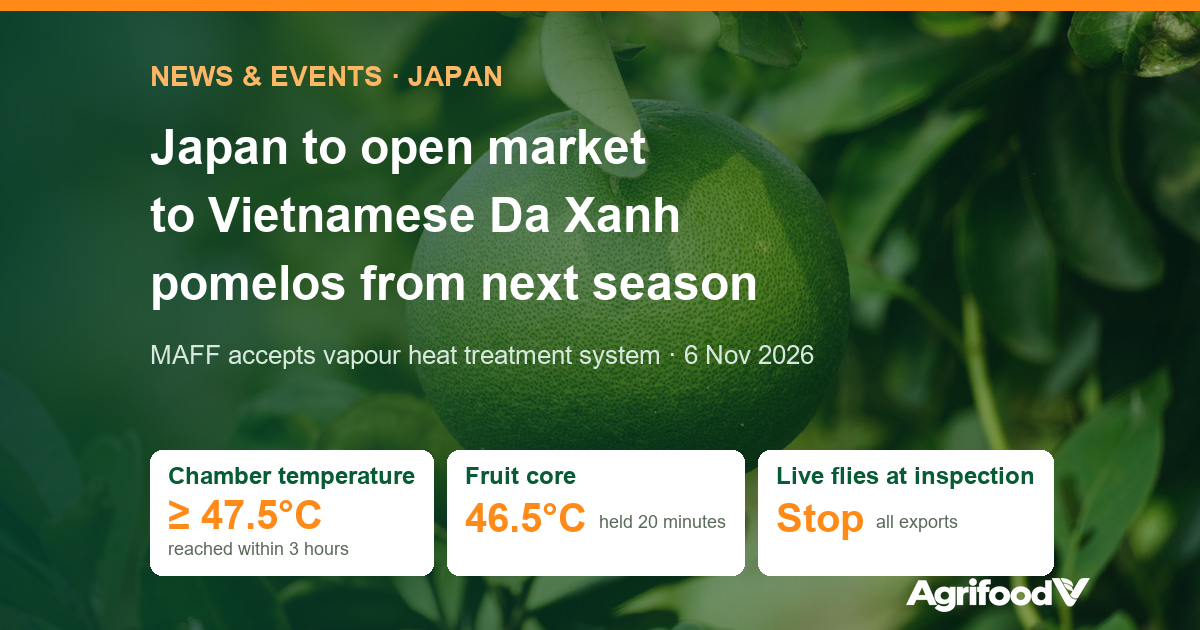
On 6 November 2026, Japan’s Ministry of Agriculture, Forestry and Fisheries (MAFF) concluded that Vietnam’s quarantine treatment system meets the requirements for exporting fresh green-skinned (Da Xanh) pomelos to Japan. On the same day, the two countries’ ministers confirmed that Vietnamese pomelos are expected to enter the Japanese market from next season. The technical conditions are now clear: Da Xanh variety only, mandatory vapour heat treatment at a designated facility, and if live fruit flies are found during export inspection, all exports are suspended.
Key points
- Vietnam asked Japan to open its market to fresh pomelos on 3 February 2021. The file has passed four of the five steps in MAFF’s procedure; the remaining step is the close of public comments.
- The mandatory measures target two pests: the oriental fruit fly species complex (Bactrocera dorsalis) and Bactrocera correcta.
- Vapour heat treatment: the fruit core must reach 46.5°C and be held for at least 20 minutes; shipments may travel only as cargo (by sea or air).
- Japan’s Prime Minister stated on 9 November 2026 that, from next season, Japanese grapes and Vietnamese pomelos are expected to be exported to each other’s markets.
Background: five years for one fruit
According to MAFF’s progress-tracking page, the request from Vietnam’s plant quarantine authority for fresh pomelos was received in February 2021. In September 2025, MAFF identified two fruit fly species as the pests requiring negotiated risk management measures. On 30 October 2026, MAFF consulted stakeholders. On 6 November 2026, MAFF’s Plant Protection Division published its evaluation of the system for implementing the measures in Vietnam and concluded that the system is appropriate.
Also on 6 November 2026, Japan’s Minister of Agriculture, Forestry and Fisheries Takebe Arata received Vietnam’s Minister of Agriculture and Environment Trinh Viet Hung. A MAFF press release dated 9 November 2026 states that the two sides confirmed that exports of Vietnamese pomelos to Japan and Japanese grapes to Vietnam are expected to become possible from next season. Speaking at a joint press announcement with General Secretary and President To Lam on 9 November 2026, Prime Minister Takaichi Sanae repeated this point.
Earlier, on 11 May 2026, Minister Trinh Viet Hung instructed the Department of Crop Production and Plant Protection to work with the Japanese side and aim to complete the procedures for announcing market access within 2026. According to MAFF’s document, the opening remains “under consideration with a view to permitting imports”; no official date of application has been set.
Technical conditions required by Japan
The 6 November 2026 evaluation sets out the main components of the risk management measures Japan requires:
| Stage | Requirement |
|---|---|
| Variety | Da Xanh pomelo only. Growers and facilities must be guided to prevent mixing with other pomelo varieties. |
| Transport | Cargo only, by sea or by air. |
| Vapour heat treatment | At a designated facility. Within the first 3 hours, raise the chamber temperature stepwise to 47.5°C or higher and hold it until the end of treatment. Use steam at 50–70% relative humidity to raise the fruit core to 43.0°C, then saturated steam until the fruit core reaches 46.5°C. Keep the chamber and fruit core at or above this temperature for 20 minutes. |
| Packing | In a packing area directly connected to the treatment facility and recognised as fruit-fly-proof; packing materials must have measures against re-infestation. |
| Export inspection | If live fruit flies are found, all exports are suspended. |
Source: Plant Protection Division, MAFF, evaluation dated 6 November 2026. Table summarised by AgrifoodV; not an official translation.
Besides the two fruit flies, MAFF lists 16 other pests associated with Vietnamese pomelos, including mealybugs, scale insects, stink bugs, mites, fruit-boring pests and pathogens such as Phyllosticta citriasiana and Phytophthora. For this group, MAFF notes that risk management measures are already established, so no separate negotiation is needed. These pests remain subject to quarantine; standard treatments simply already exist.
Why Japan accepted Vietnam’s system
MAFF explains the basis for its evaluation: every year Japan checks a similar vapour heat treatment chain for Vietnamese mangoes and dragon fruit exported to Japan, and regards this chain as established. The Vietnamese side confirmed it will apply the same system to pomelos. The measures are also based on disinfestation trials conducted by Vietnam on the two fruit fly species.
This has a practical consequence: capacity to export pomelos to Japan will be tied to the number of vapour heat treatment facilities already designated for mangoes and dragon fruit. Pomelos will share this infrastructure, so treatment schedules and capacity must be planned alongside the seasons of those two fruits.
Other products Vietnam is waiting on
MAFF’s progress page also shows four other Vietnamese market-access requests still at the first step (receipt of request): fresh chilli (since February 2009), fresh star apple (June 2016), fresh passion fruit (July 2016) and rice straw (December 2017). In the case of passion fruit, after more than ten years the file has not yet moved to the step of identifying the pests that require negotiation.
What companies should do
AgrifoodV recommendations:
- Review growing areas by variety. Japan accepts only Da Xanh pomelos. Growing areas with mixed varieties need separate lots, harvest records and clear lot labels to prove there is no mixing.
- Engage early with vapour heat treatment facilities that already export mangoes and dragon fruit to Japan: ask about available slots, treatment prices and trial runs. Pomelos have thick peel and large fruit; batch times and post-treatment fruit quality should be tested before quoting prices.
- Tighten fruit fly control in the orchard. A single detection of live flies at export inspection leads to a full suspension, affecting every exporter, not only the non-compliant lot.
- Cost the product on a cargo basis (sea or air), adding treatment and re-infestation-proof packing costs, and compare against retail prices of imported fruit in Japan before committing volumes.
- Follow MAFF’s public comment step and announcements from the Department of Crop Production and Plant Protection; sign contracts with fixed delivery dates only once the official market-access instrument is in force.
Companies that need to build growing areas meeting Japanese market requirements may refer to AgrifoodV’s growing-area advisory services. Violations recorded for Vietnamese food imported into Japan in July–October 2026 are summarised in our article of 7 November 2026.
References
- Ministry of Agriculture, Forestry and Fisheries of Japan (MAFF), Plant Protection Division, ベトナム産ザーサイン種ポメロ生果実の輸入におけるリスク管理措置の実施体制評価について(概要) [Evaluation of the system for implementing risk management measures for imports of fresh Da Xanh pomelos from Vietnam], 6 November 2026. maff.go.jp (PDF) (accessed 23 November 2026).
- MAFF, ベトナムからの輸入解禁要請について [Progress of market-access requests from Vietnam], with the notice of receipt of the request (3 February 2021) and the notice identifying the pests requiring negotiation (September 2025). maff.go.jp (accessed 23 November 2026).
- MAFF, press release 武部農林水産大臣とチン・ヴィエット・フン・ベトナム農業・環境大臣との会談について [Meeting between Minister Takebe and Minister Trinh Viet Hung], 9 November 2026. maff.go.jp (accessed 23 November 2026).
- Prime Minister’s Office of Japan, 日・ベトナム首脳会談(2) [Joint press announcement after the Japan–Vietnam summit], 9 November 2026. kantei.go.jp (accessed 23 November 2026).
- Ministry of Agriculture and Environment of Vietnam, Việt Nam – Nhật Bản hướng tới mở cửa thị trường trái cây song phương [Vietnam and Japan move towards bilateral fruit market opening], 11 May 2026. mae.gov.vn (accessed 23 November 2026).
Article by AgrifoodV, compiled from the sources above (accessed 23 November 2026). The table and summary of technical conditions were prepared by AgrifoodV from MAFF’s Japanese-language document and are not an official translation. This content is not a substitute for legal advice.
Cover image: Duy Le Duc / Pexels
Looking at Vietnam as a sourcing origin or a place to build a value chain?
Tell us your product, target market and expected volumes. In a 30–45 minute online call, AgrifoodV reviews buyers, standards, processing capacity and growing areas with you, starting from the market.
Book a call →Sourcing from Vietnam© 2026 AgrifoodV. Nội dung được phép trích dẫn khi ghi rõ nguồn và đặt liên kết tới bài gốc; không sao chép toàn văn. Xem Điều khoản sử dụng nội dung.