AgrifoodV ·
Lychee wine and fermented lychee beverages are niche products: they extend the selling window of a fruit harvested over just a few weeks, but they are only worth investing in when a company has a brand and a distribution channel. Before sizing a line, the plant must answer three legal questions for the target market: what the product may be called, which additives it may contain, and who is allowed to import and sell it. In the EU the word “wine” is reserved for grape products; in the US, lychee wine is a “fruit wine” and needs an approved label before customs release.
Key points
- EU: “wine” is a product of the fermentation of fresh grapes or grape must (Regulation (EU) 1308/2013, Annex VII Part II). Member States may allow “wine” in a composite name with a fruit, such as “lychee wine”; each Member State decides.
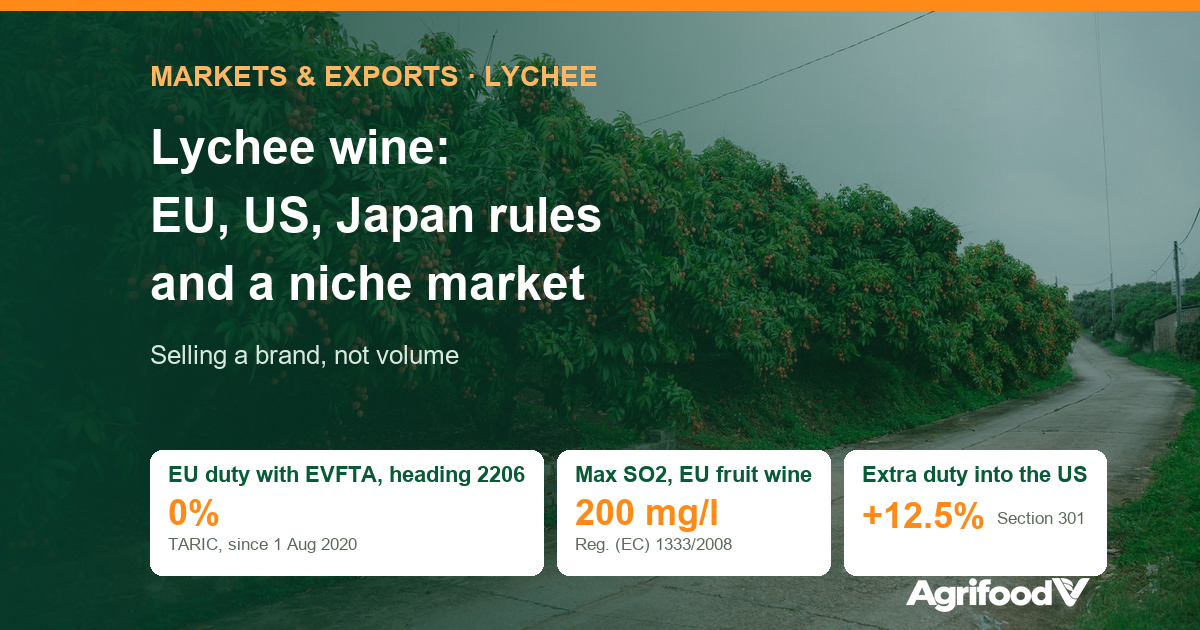
- EU: fruit wines fall under heading 2206; MFN duty is EUR 7.70/hl (still, containers up to 2 litres) and EUR 19.20/hl (sparkling), 0% for Vietnamese goods under EVFTA since 1 August 2020. SO₂ maximum 200 mg/l under Regulation (EC) 1333/2008.
- US: beverages of 7–24% alcohol are “wine” under 27 CFR Part 4; lychee wine must be designated “lychee wine” and needs a certificate of label approval (COLA) before leaving customs custody. Duty on 2206.00.90 is 4.2 cents/litre, plus 12.5% under Section 301.
- There are no reliable published data on the lychee wine market that AgrifoodV could verify; investment decisions must rest on distribution agreements, not on market-size estimates.
Why lychee wine is a niche product
Vietnamese lychee is harvested mainly from May to July. According to the Bac Ninh Department of Industry and Trade (via The Saigon Times, 24 August 2025), in the 2025 season VietGAP and GlobalG.A.P.-certified lychee sold at VND 25,000–35,000/kg, while uncertified lychee fetched only VND 5,000–15,000/kg and went mostly to drying, juicing, peeling and freezing. The implication is that processing raw material today is largely off-grade fruit, without dedicated growing areas. Export lychee wine cannot be made that way: the raw fruit must be as clean of residues as fresh export fruit, because the final product is still subject to the maximum residue levels of the importing market.
Unlike lychee juice or frozen lychee sold to beverage and ice-cream plants, lychee wine is sold to consumers, through licensed importers and distributors of alcoholic beverages. The value lies in the brand, the origin story and the sales channel, not in volume. Lychee wine therefore fits as one product line in a multi-product lychee processing plant, fermenting lychee juice prepared during the season all year round, rather than as a stand-alone plant. Sizing capacity around the season is covered in Plant capacity: size it from the growing area and the season, not the machines.
Technology: keeping the lychee aroma is the hardest part
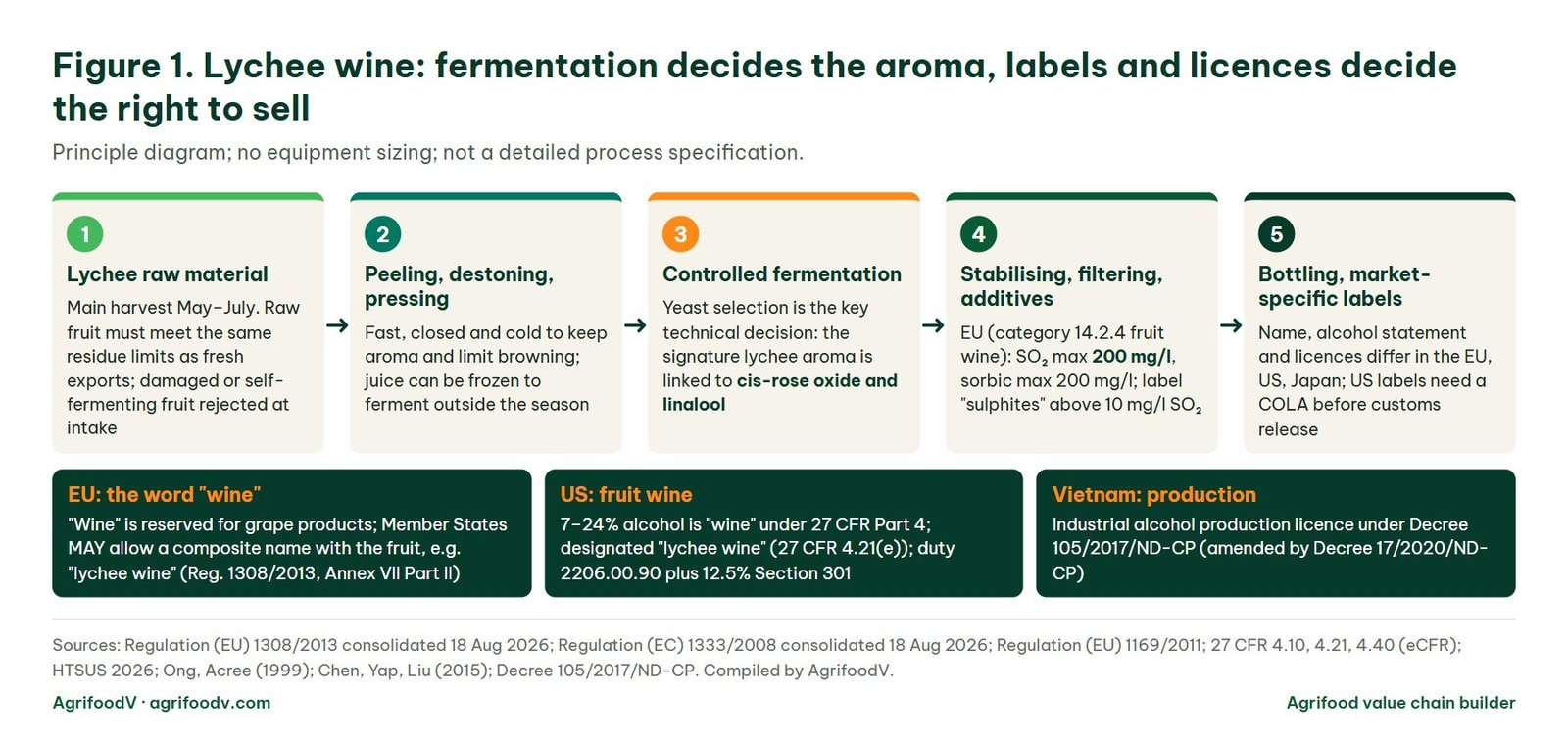
The signature lychee aroma is linked to a few terpene-type odorants. Ong and Acree (1999) found that cis-rose oxide had the highest odour activity among the odorants common to fresh and canned lychee. During fermentation, the yeast strain decides which odorants survive. In a trial by Chen, Yap and Liu (2015) on lychee juice, a Torulaspora delbrueckii strain fermented to 7.6% alcohol and retained high odour activity values for cis-rose oxide (16.5) and linalool (3.5); two other non-Saccharomyces strains gave low alcohol (3.4% and 0.8%) and produced a lot of ethyl acetate. These are laboratory-scale results, not an industrial process, but they show that yeast selection is the key technical decision rather than a detail.
At principle level, the line consists of receiving and rejecting damaged fruit; peeling, destoning and pressing quickly, closed and cold to limit browning and aroma loss; fermentation with controlled temperature and yeast strain; stabilising, filtering and using additives within the limits of the target market; and bottling and labelling for each market. AgrifoodV does not size equipment in this article.
Rules by market
| Topic | EU | United States |
|---|---|---|
| Name | “Wine” only for grape products; Member States may allow a composite name with the fruit (“lychee wine”), without confusion with grape wine | “Fruit wine” (27 CFR 4.21(e)); the word “wine” qualified by the fruit: “lychee wine”; below 14% alcohol it may be labelled “fruit table wine” |
| HS code and duty | 2206 00 59 (still, up to 2 litres): EUR 7.70/hl; 2206 00 39 (sparkling): EUR 19.20/hl; Vietnamese goods 0% under EVFTA since 1 August 2020 | 2206.00.90: 4.2 cents/litre; 2206.00.60 (effervescent): 13.9 cents/litre; plus 12.5% Section 301; may also be subject to federal excise tax |
| Additives | Category 14.2.4 (fruit wine): SO₂ max 200 mg/l, sorbic acid and potassium sorbate max 200 mg/l | Under the rules of the Alcohol and Tobacco Tax and Trade Bureau (TTB) and FDA; to be checked against the specific formulation |
| Label | Above 1.2% alcohol: ingredient list and nutrition declaration not mandatory; alcoholic strength and allergens (sulphites above 10 mg/l) still required | 7–24% alcohol: labelling under 27 CFR Part 4, COLA required before leaving customs custody |
| Domestic taxes | Excise duty levied by each Member State | The tariff notes that goods in this heading may be subject to federal excise tax (26 U.S.C. 5041); states levy their own taxes |
Sources: Regulation (EU) 1308/2013 (consolidated 18 August 2026); Regulation (EC) 1333/2008 (consolidated 18 August 2026); Regulation (EU) 1169/2011 (consolidated 1 April 2025), Article 16(4); TARIC, reference date 30 October 2026; 27 CFR 4.10, 4.21, 4.40 (eCFR, version of 1 October 2026); HTSUS 2026 Rev. 21, Chapter 99 U.S. note 52; USTR (23 July 2026). 10-digit HS codes to be confirmed by a customs broker.
US details to note. The definition of “wine” in 27 CFR 4.10 covers only beverages from 7% to 24% alcohol; a fermented lychee product below 7% alcohol does not fall within this labelling framework, and its regulatory framework must be established before it is offered. On Section 301, AgrifoodV did not find heading 2206 in the exemption lists of U.S. note 52, Chapter 99 of the HTSUS, so Vietnamese lychee wine pays an additional 12.5% on top of the normal duty.
Japan. According to Japan Customs’ tariff schedule of 8 August 2026, “other” fermented beverages under code 2206.00-229 carry a WTO rate of 42.40 yen/litre; AgrifoodV has not been able to verify the VJEPA and CPTPP preferential rates for this line. The Japanese tariff classifies fermented beverages by reference to the Liquor Tax Act; domestic liquor tax and the licence conditions for the importer have not been read by AgrifoodV in the original texts, and Vietnamese companies should confirm them with the importer before making offers.
Vietnam. Industrial-scale alcohol production requires a licence under Decree 105/2017/ND-CP on alcohol trading, amended by Decree 17/2020/ND-CP: the Ministry of Industry and Trade issues licences for capacities of 3 million litres per year or more, and provincial Departments of Industry and Trade for capacities below 3 million litres per year. Companies should check for the latest amendments before filing.
Market: selling a brand, not volume
AgrifoodV has not found reliable published data on the size of the world lychee wine market or on imports by country; HS heading 2206 combines cider, perry, mead, sake and all other fermented beverages, so trade data cannot isolate lychee wine. This article therefore gives no market-size figure. What is certain is that buyers in the EU, the US and Japan buy fruit wine through importers of alcoholic beverages, under approved labels and by brand; a plant without a distribution partner has no market, even with a compliant product. The full range of lychee products is covered in the pillar article Vietnam Lychee Export: Markets, Duties, Standards and Deep Processing.
What companies should do
AgrifoodV recommendations:
- Choose the market and the distribution partner before investing; sign with a licensed importer of alcoholic beverages in the target market and let them confirm the name, label and procedures.
- Treat lychee wine as one line in a multi-product lychee processing plant: prepare lychee juice in season, ferment all year round.
- Use raw fruit with growing-area codes and residue control equal to fresh export fruit; do not use off-grade fruit of unknown origin.
- Trial yeast strains at pilot scale and measure aroma compounds per lot (sensory panel and chromatography) before fixing the process.
- Design a separate label for each market: EU (alcoholic strength, sulphites, composite name permitted in the country of sale), US (COLA before shipment).
AgrifoodV supports companies with market and regulatory research and the choice of product form before investing in a new lychee product line.
References
- European Union. Regulation (EU) 1308/2013 establishing a common organisation of the markets in agricultural products, consolidated version of 18 August 2026, Annex VII Part II point 1. eur-lex.europa.eu.
- European Union. Regulation (EC) 1333/2008 on food additives, consolidated version of 18 August 2026, Annex II Part E, category 14.2.4. eur-lex.europa.eu.
- European Union. Regulation (EU) 1169/2011 on the provision of food information to consumers, consolidated version of 1 April 2025, Articles 9, 16 and Annex II. eur-lex.europa.eu.
- European Commission. TARIC, codes 2206 00 59 and 2206 00 39, origin Vietnam (reference date 30 October 2026). ec.europa.eu.
- United States. 27 CFR Part 4, sections 4.10 (definitions), 4.21(e) (fruit wine), 4.40 (COLA), eCFR version of 1 October 2026. ecfr.gov.
- USITC. HTSUS 2026, Rev. 21, heading 2206 and Chapter 99 U.S. note 52; USTR, notice of Section 301 action on goods of Vietnam, 23 July 2026. hts.usitc.gov; ustr.gov.
- Japan Customs. Customs tariff schedule, Chapter 22 (version of 8 August 2026). customs.go.jp.
- Ong, P. K. C., Acree, T. E. Similarities in the aroma chemistry of Gewürztraminer variety wines and lychee (Litchi chinesis Sonn.) fruit. Journal of Agricultural and Food Chemistry 47(2):665–670, 1999. DOI: 10.1021/jf980452j.
- Chen, D., Yap, Z. Y., Liu, S.-Q. Evaluation of the performance of Torulaspora delbrueckii, Williopsis saturnus, and Kluyveromyces lactis in lychee wine fermentation. International Journal of Food Microbiology 206:45–50, 2015. DOI: 10.1016/j.ijfoodmicro.2015.04.020.
- Government of Vietnam. Decree 105/2017/ND-CP on alcohol trading; Decree 17/2020/ND-CP amending it. thuvienphapluat.vn.
- The Saigon Times (via Tuoi Tre). Bắc Ninh dự kiến tiêu thụ vải thiều kỷ lục với hơn 205.000 tấn [Bac Ninh expects record lychee sales of over 205,000 tonnes], 24 August 2025. tuoitre.vn.
Article by AgrifoodV, compiled from the sources above (accessed 25–30 October 2026). Japan’s preferential duty for heading 2206 and Japan’s liquor licensing procedures have not been checked by AgrifoodV against the original texts. Fermentation research results are laboratory-scale. HS codes and duty rates should be confirmed by a customs broker for each product. This content is not a substitute for legal advice. Cover image: HONG SON / Pexels.
Looking at Vietnam as a sourcing origin or a place to build a value chain?
Tell us your product, target market and expected volumes. In a 30–45 minute online call, AgrifoodV reviews buyers, standards, processing capacity and growing areas with you, starting from the market.
Book a call →Sourcing from Vietnam© 2026 AgrifoodV. Nội dung được phép trích dẫn khi ghi rõ nguồn và đặt liên kết tới bài gốc; không sao chép toàn văn. Xem Điều khoản sử dụng nội dung.