AgrifoodV ·
The journey of building an export processing plant · Article 12/29 · Stage 4: Technical utilities. See the full journey
A processing plant returns almost all the water it takes in back to the environment, along with peel, fibre, fats and cleaning chemicals. Many projects only think about the treatment plant when the environmental dossier is sent back for more information; by then there is no land left, the drains have been cast in concrete and every waste stream runs into one pipe. Article 12 closes the technical-utilities stage with the questions the investor must answer while drawing the master site plan: how much wastewater, how dirty, how the streams are separated, which column it must be treated to, and where peel, pulp and seeds will go.
Key points
- Most food plants discharge roughly 90% of the water they take in; the size of the treatment plant must be derived from the water balance and the load of each process step, not guessed.
- Separating streams at source is cheaper than treating a mixed stream; collecting organic matter as solids is much cheaper than treating it in wastewater.
- New projects in Vietnam apply QCVN 40:2025/BTNMT; limits depend on the receiving water (columns A, B, C) and the discharge flow.
- In fruit and vegetable plants, solid waste can account for 30–60% of the incoming fruit mass; a disposal route for each type must be fixed before commissioning.
Estimate the load before drawing the treatment plant
W.E. Whitman, author of the chapter “Effluent Treatment” in Handbook of Food Factory Design (2013), notes that most food factories discharge roughly 90% of the water they take in. The data needed to design a treatment plant include: the flow from each process and its variation through the day, fat, dissolved and dispersed solids, temperature and pH of each stream, runoff from roofs and yards, and foul water from staff facilities. He also asks: have strong wastes been segregated, does the product mix change through the year, what are the requirements five and ten years ahead, is the discharge quality required likely to change in the next five years, and where on the site is there space for a treatment plant.
C.G.J. Baker and H.M.S. Lababidi, in the chapter “Protecting the Environment” in the same book, point out that wash water from fruit and vegetable plants may contain high levels of solids, high BOD, cleaning agents and pesticide residues. For projects in Vietnam, wastewater from soaking, washing, peeling, juice pressing and equipment cleaning in fruit and vegetable plants has a BOD5 of 240 to 19,000 mg/L, a COD of 395 to 37,000 mg/L and a pH ranging from 3.5 to 11.9. Such a wide range shows that figures from another plant cannot be used as design input.
K.P. Sutton, in the chapter “Site Considerations”, advises asking the receiving sewerage operator in writing, at the site-selection stage, whether it will accept the plant’s additional effluent and on what conditions; if discharges would exceed the permitted levels, an on-site treatment plant is needed, and permission for it should be established at the outset.
Separate streams at source
According to Whitman, it is usually considerably more expensive to treat a kilogram of organic material as liquid waste than as solid waste, so every opportunity to sweep up, suck up or stop material before it reaches the drain should be taken. Recovering material from a single stream is also much easier than from a mixed one. In the broiler-plant example the book gives, knowing the strength of each stream and separating flows concentrated half the organic matter into a quarter of the flow; a screen placed on that stream is smaller and easier to manage than one for the combined flow. Some almost clean streams can be reused, reducing both water demand and the volume to be treated.
Foul drainage must be kept separate from trade waste until the point of discharge; runoff and cooling water should also be kept separate. Sutton stresses that the trade-effluent drainage may combine with other drains only downstream of an agreed monitoring point, and that boiler and cooling-tower blowdown and vehicle wash-down water are also effluents that require consent to discharge. Design practice in Vietnam turns this into four separate drain lines on the site plan: stormwater runoff, domestic wastewater, process wastewater containing fats, oils and grease, and strong streams that need separate treatment at source. Gravity drains fall at about 1–2% to a collection sump at the lowest level of the site, located outside the production building and away from raw-material and finished-goods vehicle routes.
On location, Whitman warns that aerated biological treatment can carry airborne bacteria into production areas unless the plant is substantially downwind of and well screened from the factory. Practice in Vietnam adds a green buffer strip around the treatment plant to reduce odour and blower noise. In AgrifoodV’s assessment, this is a decision for the master site plan in Article 6 and the zoning in Article 7, not something to leave to the environmental contractor.
The treatment train and a worked example
Whitman divides treatment into three stages. Primary treatment is physical: coarse grids, rotary screens, brush screens (low-cost and widely used in fruit and vegetable plants), fat traps and flotation. This is followed by a holding tank of at least 4 hours’ capacity, preferably 24 hours, to even out flow, adjust pH and take samples. Secondary treatment is biological: aerobic plants generally run at 10–25 °C and anaerobic plants at 25–40 °C; acidic fruit and vegetable effluent often needs caustic soda to bring the pH into the range 7.0–8.5, and a COD:N:P ratio of about 100:5:1 provides sufficient nutrients. Tertiary treatment includes lagoons 0.5–2 m deep with 2–3 days’ residence, or pressurised sand filters.
Anaerobic treatment deserves attention for seasonal plants. According to Whitman, once anaerobic digesters have stabilised they can be shut down and restarted, which suits short vegetable-processing campaigns; successful applications have mainly been with wastes high in carbohydrate; designs typically remove more than 80% of the organic load with liquid residence times of 6–20 hours, and the biogas is about 50% methane. He also lists substances from his experience that disrupt biological treatment: chlorine solutions, orange oil, salt, diesel oil and caustic soda. If the treatment plant fails, the receiving authority may refuse the effluent, which means the factory has to stop.
Design practice in Vietnam includes a worked example for a pangasius fillet plant processing 50 tonnes of raw fish per day, showing how to go from a water consumption norm to the discharged load:
| Stage | COD (mg/L) | COD load (kg/day) | TSS (mg/L) |
|---|---|---|---|
| Raw wastewater (540 m³/day) | 2,500 | 1,350 | 1,000 |
| After dissolved air flotation (DAF) | 1,375 | 742.5 | 200 |
| After upflow anaerobic sludge blanket (UASB) | 247.5 | 133.7 | 150 |
| After aeration tank and settling | 60 | 32.4 | 40 |
| After sand filtration (final) | 45 | 24.3 | 25 |
Source: Compiled from plant design practice in Vietnam (worked example: 12 m³ of water per tonne of fish, 90% becoming wastewater; DAF removes 45% of COD, 80% of TSS and 85% of fats, oils and grease; UASB removes 82% of COD).
Two lessons follow from the calculation. First, 540 m³/day multiplied by concentration gives a load of 1,350 kg COD per day; it is the load, not the flow, that determines the size of the biological tanks. Second, the purely physical flotation step removes almost half the COD load and four-fifths of the solids before the effluent reaches the biology. The final 45 mg/L COD and 25 mg/L TSS are below the column A limits of QCVN 40:2025/BTNMT for flows up to 2,000 m³/day (65 and 40 mg/L). The investor should rerun this calculation with the water norms and measurements of their own line.
Regulations and procedures in Vietnam
QCVN 40:2025/BTNMT on industrial wastewater, issued with Circular 06/2025/TT-BTNMT, took effect on 1 September 2025 and supersedes QCVN 40:2011/BTNMT as well as the separate regulation for seafood-processing effluent, QCVN 11-MT:2015/BTNMT. New projects apply the new regulation; facilities already operating or approved before then may keep the old regulations until 31 December 2031. Limits depend on the function of the receiving water (column A for sources used for domestic water supply, columns B and C for other cases) and on the discharge flow:
| Parameter (mg/L) | F ≤ 2,000 m³/day (A / B / C) | F > 2,000 m³/day (A / B / C) |
|---|---|---|
| BOD5 | 40 / 60 / 80 | 30 / 50 / 60 |
| COD | 65 / 90 / 130 | 60 / 70 / 90 |
| TSS | 40 / 80 / 120 | 30 / 60 / 80 |
Source: QCVN 40:2025/BTNMT, Table 1 (TOC may be used instead of COD); pH 6–9 and temperature not above 40 °C in all three columns.
Plants in industrial parks that connect to a central treatment plant must meet the conditions of the connection agreement with the infrastructure operator. From 1 January 2026, the environmental protection fee on wastewater is calculated under Decree 346/2025/ND-CP, replacing Decree 53/2020/ND-CP. On procedure, projects that must prepare an environmental impact assessment (EIA) report under the Law on Environmental Protection No. 72/2020/QH14 must have the appraisal result approved before implementation; only after the environmental protection works are completed does the investor apply for an environmental permit, and waste treatment works may only be test-operated once the permit has been granted. In AgrifoodV’s assessment, the investor should put this sequence into the master schedule, because commissioning the processing line while the treatment plant is not yet permitted to test-operate is a situation with no way out.
Solid waste: peel, pulp, seeds and packaging
Regulation (EC) 852/2004, Annex II, Chapter VI requires food waste, non-edible by-products and other refuse to be removed from rooms where food is present as quickly as possible and deposited in closable containers, with refuse stores designed so they can be kept clean and free of animals and pests. Section 117.37(f) of 21 CFR requires rubbish and offal to be conveyed, stored and disposed of so as to minimise odour, avoid becoming an attractant, harbourage or breeding place for pests, and protect against contamination of food, water supplies and ground surfaces.
Sutton advises locating the waste-holding area as remote from production and storage areas as possible, with access for site vehicles and waste contractors’ vehicles; drainage from this area connects to the effluent system, with a low bund wall against spills and rodent control. The disposal route for each type of waste should be identified early, with wastes that could be sold for animal feed segregated, and handed only to licensed contractors. Baker and Lababidi set out the order of priority: reduce at source, reuse, recycle, then end-of-pipe treatment; landfill is the last resort.
In Vietnam, processing pineapple, passion fruit, mango, orange and dragon fruit generates peel, core, seeds and pomace amounting to 30–60% of the incoming fruit mass, with high moisture, sugar and acid, so it sours very quickly; pangasius filleting produces 60–65% by-products. This mass is comparable to the main product stream, so in AgrifoodV’s assessment it must be treated as a material stream in its own right, with its own mass balance, storage and buyers. How to turn by-products into products will be discussed in the processing-lines stage, starting with Article 13 on process flow diagrams and mass balance.
What companies should do
AgrifoodV recommends:
- Reserve land for the treatment plant downwind in the master site plan, with room to expand, and draw the four separate drain lines before the floor slab is cast.
- Prepare a water and load balance (kg COD and kg TSS per day) for each process step, then put the load, not just the flow, into the EIA dossier and the connection negotiations.
- Confirm the discharge column (A, B or C) and the industrial park’s connection conditions in writing before designing the treatment plant.
- List every solid waste stream (peel, seeds, pomace, sludge, packaging) with a specific licensed receiver before commissioning.
AgrifoodV supports companies in developing the design brief, reviewing environmental infrastructure options and setting the design direction for processing plants.
The journey of building an export processing plant (12/29)
- Previous article: Article 11: Ventilation, air conditioning and positive pressure: controlling air in the production hall
- Next article: Article 13: Process flow diagrams and mass balance: seeing the whole processing line before choosing machines (planned for 27 November 2026)
References
- Whitman, W.E. “Effluent Treatment”, Chapter 18 in Baker, C.G.J. (ed.), Handbook of Food Factory Design. Springer Science+Business Media New York, 2013, pp. 443–462 (section 18.1 and Table 18.1, pp. 443–446; 18.3 primary treatment, pp. 447–449; 18.3.2 holding tanks and stream separation, pp. 452–453; 18.4 secondary treatment, pp. 453–454; 18.4.2 anaerobic digestion, pp. 456–458; 18.5.2 lagoons, sand filters, pp. 459–461). DOI: 10.1007/978-1-4614-7450-0_18.
- Baker, C.G.J. and Lababidi, H.M.S. “Protecting the Environment”, Chapter 8 in Baker, C.G.J. (ed.), Handbook of Food Factory Design. Springer Science+Business Media New York, 2013, pp. 199–232 (sections 8.2.1, 8.2.3–8.2.4, pp. 200–204). DOI: 10.1007/978-1-4614-7450-0_8.
- Sutton, K.P. “Site Considerations”, Chapter 11 in Baker, C.G.J. (ed.), Handbook of Food Factory Design. Springer Science+Business Media New York, 2013, pp. 283–298 (sections 11.4.2.7 drainage and 11.4.2.8 solid wastes, pp. 290–292). DOI: 10.1007/978-1-4614-7450-0_11.
- Ministry of Natural Resources and Environment, Circular 06/2025/TT-BTNMT of 28 February 2025 promulgating QCVN 40:2025/BTNMT – National Technical Regulation on Industrial Wastewater, effective from 1 September 2025 (Table 1; Article 3 transitional provisions; Article 4 roadmap). congbao.chinhphu.vn.
- Government Decree 346/2025/ND-CP on the environmental protection fee on wastewater, effective from 1 January 2026, replacing Decree 53/2020/ND-CP.
- Law on Environmental Protection No. 72/2020/QH14 (environmental impact assessment, environmental permits) and Decree 08/2022/ND-CP detailing it, as amended and supplemented.
- Regulation (EC) No 852/2004 of the European Parliament and of the Council of 29 April 2004 on the hygiene of foodstuffs, Annex II, Chapter VI; consolidated version of 24 March 2021. eur-lex.europa.eu.
- 21 CFR 117.37 “Sanitary facilities and controls”, point (f), Electronic Code of Federal Regulations, up to date as of 13 November 2026. ecfr.gov.
- Compiled from plant design practice in Vietnam (drain separation, treatment-plant location, worked example for a 50 tonne/day pangasius plant, characteristics of fruit, vegetable and seafood wastewater and solid waste).
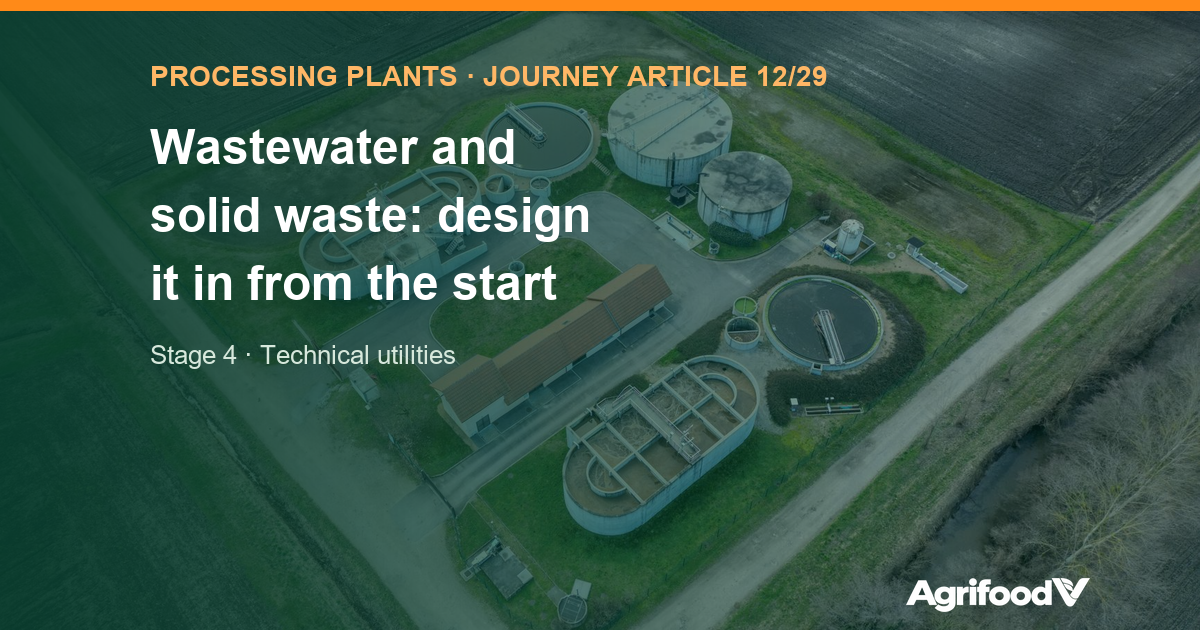
Article by AgrifoodV, compiled and interpreted from the sources above (accessed 17 November 2026). This content is not a substitute for design advice or legal advice for any specific project. Cover image: Corentin Jacquemaire / Pexels.
Looking at Vietnam as a sourcing origin or a place to build a value chain?
Tell us your product, target market and expected volumes. In a 30–45 minute online call, AgrifoodV reviews buyers, standards, processing capacity and growing areas with you, starting from the market.
Book a call →Sourcing from Vietnam© 2026 AgrifoodV. Nội dung được phép trích dẫn khi ghi rõ nguồn và đặt liên kết tới bài gốc; không sao chép toàn văn. Xem Điều khoản sử dụng nội dung.