AgrifoodV ·
Lychee bears fruit for about two months a year. A line that runs lychee only will stand idle for most of the remaining time, while depreciation and fixed costs run for the full twelve months. This article reads the lychee and longan harvest calendar from published sources, explains why the two fruits should be designed onto one line, and sets out the design principles that let a fruit plant live with a short season.
Key points
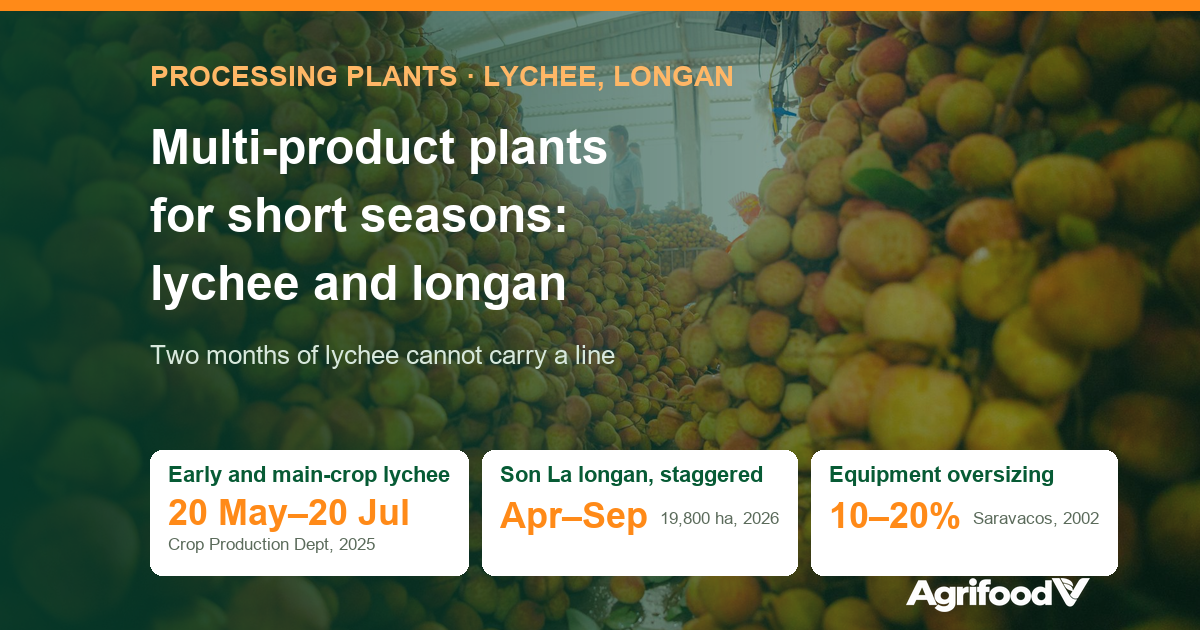
- Early lychee is harvested from about 20 May to 15 June, main-crop lychee from 10 June to 20 July (Department of Crop Production and Plant Protection, 2025): about two months of fresh fruit.
- Longan follows: Hung Yen’s main crop runs July to September; Son La has about 19,800 ha of longan with a staggered harvest from April to September.
- Regulators in several countries group lychee and longan together: the 2014 US quarantine rule, Australia’s import conditions, US tariff line 2008.99.35 “Lychees and longans”. A line can also share most of its process steps.
- Even with lychee and longan combined, the fresh-fruit calendar is empty for about half the year: the design must plan for semi-finished products and other fruit from the start.
The season calendar: lychee and longan run back to back, but do not fill the year
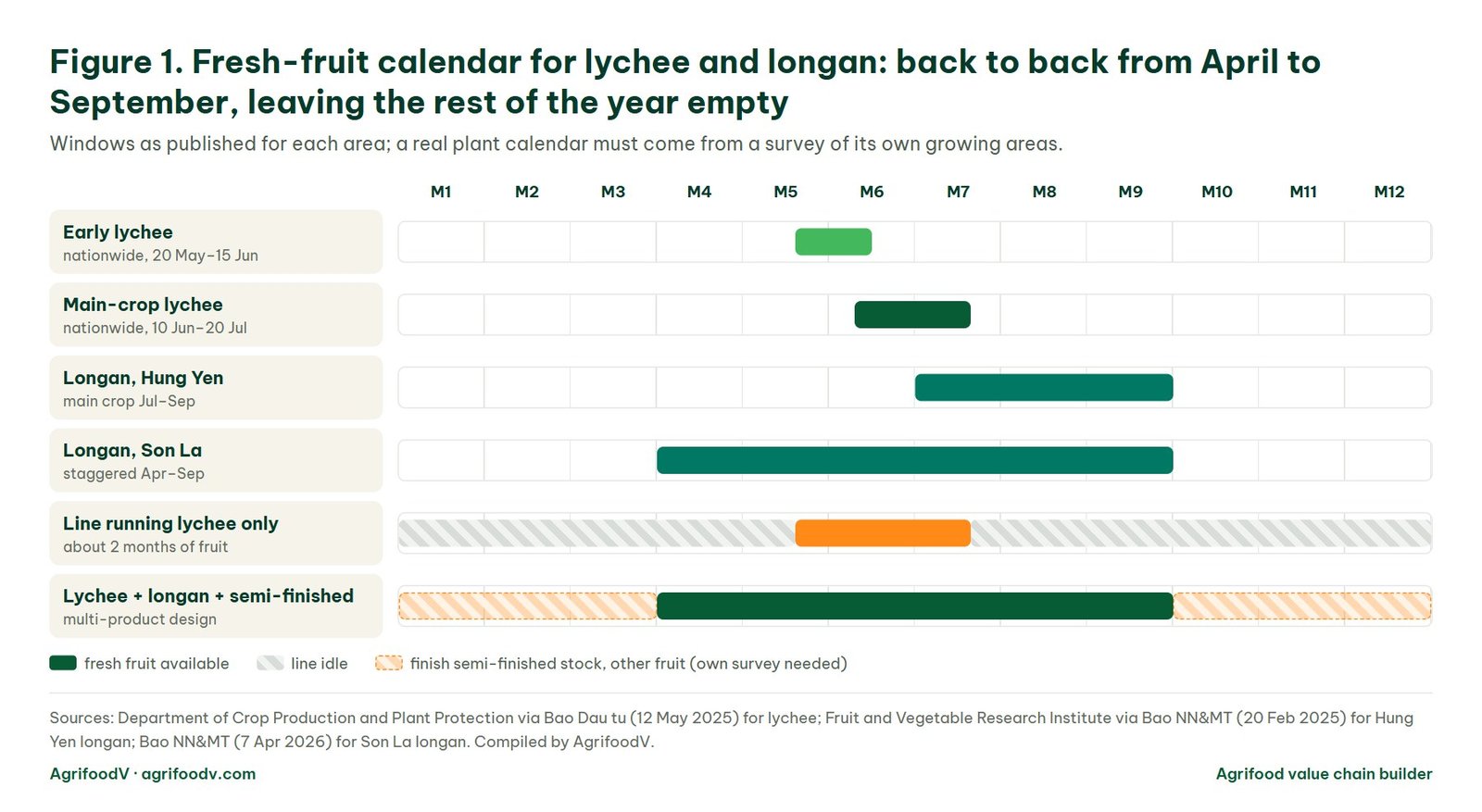
According to the Department of Crop Production and Plant Protection (Ministry of Agriculture and Environment), national lychee output in 2025 was forecast at about 303,000 tonnes; early lychee is harvested from 20 May to 15 June, main-crop lychee from 10 June to 20 July. In Bac Ninh, the largest lychee area (including Luc Ngan), the main 2026 harvest ran from 15 May to 20 July. Output also swings strongly between years: 2026 was estimated at only 200,000–220,000 tonnes because of poor flowering.
Longan comes straight after lychee. Hung Yen has more than 5,860 ha of longan, about 5,700 ha of it bearing, with 2025 output estimated at over 50,000 tonnes, of which about 20% is dried into longan flesh (Ministry of Industry and Trade, 22 August 2025). The main crop there is harvested in July to September (Fruit and Vegetable Research Institute). Son La has nearly 19,800 ha of longan with output of about 175,000 tonnes, and staggered-crop techniques have stretched the harvest from April to September (Bao Nong nghiep va Moi truong, 7 April 2026). The same province has more than 16,400 ha of mango with output above 97,000 tonnes.
Put together, lychee and longan give a fresh-fruit window from about April to September, provided the plant can buy from the staggered-crop longan areas as well. The other half of the year is still empty. That is why the question “how many tonnes for a lychee plant” has to be asked again as “what does this plant run, and in which months”.
Why lychee and longan should share one line
The two fruits have a similar structure: a thin peel and an aril around a large seed. Most process steps can be shared, and regulators in several countries group them together. The 2014 rule of the US Animal and Plant Health Inspection Service (APHIS) admitted Vietnamese lychee and longan in a single document; Australia’s import conditions are written jointly for “fresh longan and lychee”; the US tariff has one line, 2008.99.35, for processed “lychees and longans”. The differences are in the details, and they decide which parts of the line must be kept separate.
| Step or product | Shared by lychee and longan | What must be designed separately |
|---|---|---|
| Receiving, pre-cooling, grading | Receiving area, cold store, weighing, size grading | Purchasing calendar and growing-area codes for each fruit |
| Peeling, destoning, aril recovery | Same principle, adjusted to fruit size | Fruit size and aril thickness differ: test with real fruit before fixing the equipment |
| Frozen aril, canned, dried | IQF quick-freezing equipment, thermal processing, drying shared | In the EU, the SO₂ levels of 10 mg/kg for fresh fruit and 100 mg/kg for preparations name lychee explicitly, not longan (Regulation 1333/2008) |
| Duty into the US | Canned lychee and longan share line 2008.99.35: 7% + 12.5% Section 301 | Fresh and frozen lychee are exempt from the 12.5%; dried, canned and juice forms are not |
Sources: Federal Register 79 FR 52543 (4 September 2014); BICON (Australia), import conditions for fresh longan and lychee; Regulation (EC) 1333/2008 consolidated 18 August 2026, Annex II Part E; USITC HTS 2026 and the USTR Section 301 notice of 23 July 2026. The 10-digit HS code must be confirmed by a customs broker.
Three design principles for a short season
Flexibility by raw material. Handbook of Food Processing Equipment (Saravacos and Kostaropoulos, 2002) notes that in some food plants processing operations must be modified according to the nature of the raw material, and adjustments to equipment and lines should be possible without disrupting the whole operation; the design should also allow for periodic cleaning. The same chapter observes that design difficulties show most clearly in seasonal processing such as fruit and vegetables, and that in some cases one facility is used for different products. For a lychee and longan plant, this means changeover and cleaning time between the two fruits must be built into the schedule at the design stage.
Split capacity rather than concentrating it in one machine. According to the same book, if greater flexibility is wanted, two smaller units are better than one large one; equipment is normally oversized by 10–20% to cover breakdowns and production peaks. Lychee peaks in a few weeks, while staggered-crop longan brings less fruit per day: two smaller units let the plant run one when fruit is scarce and both at the peak.
Semi-finished products as the buffer. The book mentions surge tanks and temporary storage for the smoother operation of several processing lines. AgrifoodV’s view: for lychee and longan, the largest buffer is semi-finished product. In season, the plant does the first step (IQF frozen aril, puree or juice in aseptic packaging); off season, it finishes and packs to order (blending, canning, small packs). This extends the months in which the finishing line has work, but requires cold storage, aseptic storage and more working capital, so it must be assessed together with the financing plan.
Choosing other fruit to fill the calendar: by shared steps, not just by month
A third fruit should be chosen on two criteria: it falls into the empty months, and it reuses most of the steps already invested in. Son La is an example of an area with many fruits: the province has an estimated 85,050 ha of fruit trees and output of about 510,000 tonnes in 2025 (Bao Nong nghiep va Moi truong, 16 May 2025). However, AgrifoodV has not found an official monthly harvest calendar for each fruit there. The real calendar of a plant, the share of fruit meeting processing grade and the share going to the fresh market must come from the investor’s own survey, as discussed in the article Raw-material growing areas: area, harvest calendar and growing-area codes. How to size capacity backwards from the growing area is covered in Plant capacity: size it from the growing area and the season, not the machines.
Each additional fruit also brings its own market file: growing-area codes, residues, permitted additives, duties. Lychee markets and standards are summarised in the pillar article Vietnam Lychee Export: Markets, Duties, Standards and Deep Processing.
What companies should do
AgrifoodV recommendations:
- Draw a twelve-month calendar before choosing equipment: one row per fruit and per sourcing area, with the months of fruit taken from field surveys, not provincial averages.
- Design the line around the lychee and longan pair, choose peeling and destoning equipment adjustable to fruit size, and test it with real fruit of both kinds before signing the contract.
- Build changeover and cleaning time between fruits into the running schedule.
- Choose the semi-finished range (IQF aril, aseptic puree) according to buyers already in hand, and plan cold storage, aseptic storage and working capital together with the line.
- Add a third fruit only when it already has a growing area and a buyer.
AgrifoodV supports companies in writing the design brief for a multi-product plant from the growing-area calendar, before equipment is chosen.
References
- Department of Crop Production and Plant Protection, via Bao Dau tu. Tập trung chế biến sâu, nâng cao chuỗi giá trị cho vải thiều [Focus on deep processing to raise the lychee value chain], 12 May 2025. baodautu.vn.
- Nhan Dan. Vụ vải thiều Bắc Ninh năm 2026: sản lượng giảm, giá cao kỷ lục [Bac Ninh lychee season 2026: lower output, record prices], 30 July 2026. nhandan.vn.
- Bao Phap luat Viet Nam. Article on the 2026 lychee season, 3 May 2026. baophapluat.vn.
- Ministry of Industry and Trade. Khai mạc Phiên chợ nhãn lồng và nông sản tiêu biểu tỉnh Hưng Yên năm 2025 [Opening of the Hung Yen longan and farm produce fair 2025], 22 August 2025. moit.gov.vn.
- Bao Nong nghiep va Moi truong. Cần hướng đi mới cho vùng nhãn Hưng Yên [A new direction for the Hung Yen longan area] (citing the Fruit and Vegetable Research Institute), 20 February 2025. nongnghiepmoitruong.vn.
- Bao Nong nghiep va Moi truong. Sơn La sẵn sàng đón vụ trái cây 2026 [Son La ready for the 2026 fruit season], 7 April 2026. nongnghiepmoitruong.vn.
- Bao Nong nghiep va Moi truong. Đất dốc nở hoa, trái cây Sơn La vươn khơi hội nhập [Son La fruit reaching out to world markets], 16 May 2025. nongnghiepmoitruong.vn.
- USDA APHIS. Importation of Litchi and Longan Fruit From Vietnam Into the Continental United States, Federal Register 79 FR 52543, 4 September 2014. federalregister.gov.
- Australian Department of Agriculture. BICON, Fresh longan and lychee for human consumption (version of 25 April 2020, republished by Vietnam’s Plant Protection Department). ppd.gov.vn.
- European Union. Regulation (EC) 1333/2008 on food additives, consolidated 18 August 2026, Annex II Part E. eur-lex.europa.eu.
- USITC. Harmonized Tariff Schedule 2026, line 2008.99.35; USTR, Section 301 notice of 23 July 2026. hts.usitc.gov; ustr.gov.
- G.D. Saravacos, A.E. Kostaropoulos. Handbook of Food Processing Equipment, Kluwer Academic/Plenum, 2002, chapter 1 (Design of food processes and food processing plants).
Article by AgrifoodV, compiled from the sources above (accessed 30 October 2026). Local area and output figures come from press reports citing provincial agencies and sources may differ; monthly harvest calendars for fruits other than lychee and longan have no published source. The article does not size equipment and makes no profit forecast. This content is not a substitute for legal advice. Cover image: HONG SON / Pexels.
Looking at Vietnam as a sourcing origin or a place to build a value chain?
Tell us your product, target market and expected volumes. In a 30–45 minute online call, AgrifoodV reviews buyers, standards, processing capacity and growing areas with you, starting from the market.
Book a call →Sourcing from Vietnam© 2026 AgrifoodV. Nội dung được phép trích dẫn khi ghi rõ nguồn và đặt liên kết tới bài gốc; không sao chép toàn văn. Xem Điều khoản sử dụng nội dung.