AgrifoodV ·
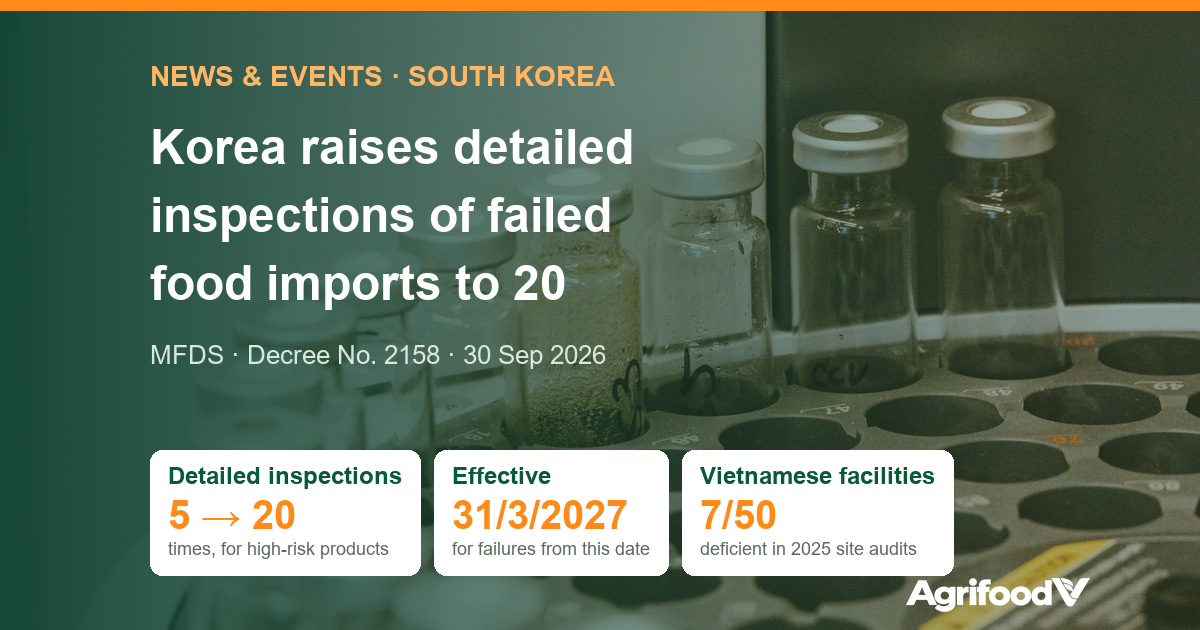
South Korea’s Ministry of Food and Drug Safety (MFDS) promulgated on 30 September 2026 an amendment to the Enforcement Rule of the Special Act on Imported Food Safety Control. Food products with a history of non-compliance may, when imported again, be subject to detailed inspection up to 20 times instead of the current maximum of 5. The new rule applies to shipments found non-compliant from 31 March 2027, and directly affects Vietnamese companies exporting processed food, fruit and vegetables, and seafood to Korea.
Key points
- Instrument: Prime Ministerial Decree No. 2158 of 30 September 2026, amending the Enforcement Rule of the Special Act on Imported Food Safety Control.
- Products with a non-compliance history: detailed inspection up to a cumulative 5 times; where there is a risk of harm, MFDS may inspect up to 20 times.
- This provision takes effect after 6 months, on 31 March 2027, and applies to non-compliance decisions from that date.
- In 2025, MFDS carried out on-site inspections of 370 facilities in 26 countries; 7 of the 50 facilities found deficient were in Vietnam.
Background: from the April draft to the September rule
MFDS consulted on the draft from 20 April to 1 June 2026. According to the draft press release, the current mechanism applies the same number of detailed inspections to every shipment with a non-compliance history, regardless of the risk level of the failed parameter. The amendment aims to increase inspections for products that failed on high-risk parameters.
On 30 September 2026, the rule was formally issued. According to Korea’s national law database (law.go.kr), it is Prime Ministerial Decree No. 2158. Most provisions took effect on the date of promulgation; the amendment to Annex 9 on inspection methods and two related annexes take effect after 6 months, recorded by the system as 31 March 2027.
Detailed inspection: from 5 times to a maximum of 20
Detailed inspection (정밀검사) is Korea’s highest level of inspection for imports: sampling for physical, chemical or microbiological analysis, including document review and on-site inspection. The amended Annex 9 sets the following for products with a non-compliance history:
| Item | Before the amendment | From 31 March 2027 |
|---|---|---|
| Number of detailed inspections | Cumulative maximum of 5 | Still a maximum of 5; up to 20 where there is a risk of harm |
| Re-imported within 1 year of the non-compliance decision | MFDS may select shipments for detailed inspection at its discretion | |
| Re-imported after more than 1 year | Counted by number of import declarations | |
| Risk grading | No grading | By failed parameter, set by MFDS in a notice |
Source: Annex 9 of the Enforcement Rule of the Special Act on Imported Food Safety Control, version amended 30 September 2026 (effective 31 March 2027) and the previous version; MFDS press release of 30 September 2026.
According to MFDS, the risk grading for each failed parameter and the number of inspections for each grade will be set out in detail in the “Regulation on Declaration and Inspection of Imported Food”, an MFDS notice. As of writing, AgrifoodV has not seen this notice issued. This means it is not yet known which parameters, for example pesticide residues, pathogenic microorganisms or additives, will fall into the group subject to more inspections.
The transitional provision states that the new rule applies to non-compliance decisions made through import inspection (Article 21 of the Act) or through market inspection and sampling (Article 25) from 31 March 2027. Shipments found non-compliant before that date remain under the previous mechanism.
Other changes in the same instrument
- Internet purchasing agents must direct buyers in their advertising to the “해외직구식품 올바로” portal (safety information on food bought directly from abroad); violations are subject to administrative sanctions. According to MFDS, the portal lists 4,999 products containing hazardous ingredients as of September 2026.
- Broader grounds for approving a change of use of imported raw materials: manufacturers facing raw-material shortages due to major disasters or epidemics may receive raw materials imported by other companies.
- Food import business offices may be located in startup incubation centres; the hygiene training certificate no longer has to be submitted if the authority can verify it in the system; the procedure for changing the registration of excellent importers is simplified.
What it means for Vietnamese products
Repeated detailed inspections lengthen clearance times and add storage and testing costs for Korean importers. With the number of inspections rising to as many as 20, a single failure on a high-risk parameter may affect many subsequent shipments of the same product.
Alongside border inspections, MFDS inspects production facilities directly in exporting countries. According to its press release of 3 February 2026, in 2025 the agency inspected 370 facilities in 26 countries and found 50 facilities in 13 countries with inadequate hygiene management: 29 were rated non-compliant (below 70 points) and had imports suspended; 21 were rated as needing improvement (70–85 points), received improvement orders, and all their products were subject to detailed inspection. Vietnam had 7 facilities on the list (6 non-compliant, 1 needing improvement), the second-highest number after China. The main deficiencies cited were lighting in production areas, toilets and changing rooms, product testing management and the sealing of production areas.
What companies should do
The following are AgrifoodV’s recommendations, not the content of the legal documents.
- Review the non-compliance history of each product exported to Korea together with the importer. Products that have been flagged need a dedicated control plan before 31 March 2027.
- Test before shipping against Korean parameters (residue limits under the PLS list, microbiology, additives) at an accredited laboratory, and keep results by lot.
- Follow the risk-grading notice that MFDS will issue, to know which parameters will be inspected most often and prioritise control of exactly those parameters.
- Prepare for on-site inspections: the deficiencies MFDS cited in 2025 relate mainly to plant conditions and testing records, which can be self-assessed and corrected in advance.
AgrifoodV supports companies in reviewing plant conditions, quality control systems and testing records to meet the requirements of importing markets.
References
- Ministry of Food and Drug Safety (MFDS). 식약처, 위해 수입식품 안전관리 강화…현장 걸림돌 규제 합리적 개선 [Strengthening safety control of hazardous imported food and rationalising regulations], press release of 30 September 2026, with PDF. mfds.go.kr.
- Korea National Law Information Center. 수입식품안전관리 특별법 시행규칙 [Enforcement Rule of the Special Act on Imported Food Safety Control], Prime Ministerial Decree No. 2158 of 30 September 2026, addenda and Annex 9 (effective 31 March 2027). law.go.kr.
- MFDS. 수입식품 정밀검사 위해도별 강화, 위생교육 규제는 합리화 [Risk-based detailed inspection of imported food – draft], press release of 20 April 2026. mfds.go.kr.
- MFDS. 작년 한해 수입식품등 해외제조업소 현지실사, 50곳 적발하여 수입중단 등 조치 [On-site inspections of foreign manufacturing facilities in 2025], press release of 3 February 2026, with list. mfds.go.kr.
Cover image: Jess Loiterton / Pexels.
Article by AgrifoodV, compiled from the sources above (accessed 23 October 2026). This content is not a substitute for legal advice.
Looking at Vietnam as a sourcing origin or a place to build a value chain?
Tell us your product, target market and expected volumes. In a 30–45 minute online call, AgrifoodV reviews buyers, standards, processing capacity and growing areas with you, starting from the market.
Book a call →Sourcing from Vietnam© 2026 AgrifoodV. Nội dung được phép trích dẫn khi ghi rõ nguồn và đặt liên kết tới bài gốc; không sao chép toàn văn. Xem Điều khoản sử dụng nội dung.