AgrifoodV ·
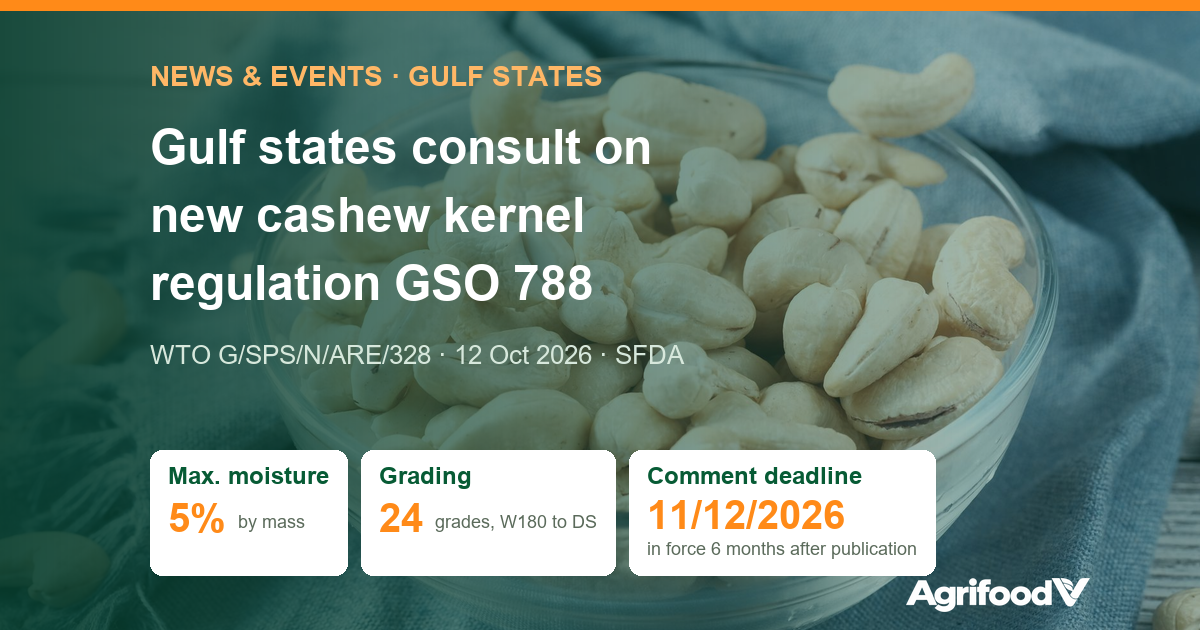
On 12 October 2026, seven member states of the GCC Standardization Organization (GSO) jointly notified the WTO of a new draft regulation on cashew kernels, with the Saudi Food and Drug Authority (SFDA) as the responsible agency. The draft carries the number GSO 788 and is set to replace GSO 788:1997, which has been in place for almost thirty years; it would enter into force six months after publication. Vietnamese companies exporting cashew kernels to the UAE, Saudi Arabia and other Gulf markets can submit comments until 11 December 2026.
Key points
- WTO notification G/SPS/N/ARE/328 (together with BHR/280, KWT/210, OMN/176, QAT/179, SAU/631, YEM/120), dated 12 October 2026, applies to all trading partners.
- Main requirements: moisture content of no more than 5%, completely free from rancid kernels, no living insects or moulds; 24 grades from W180 to DS.
- Pesticide residues, contaminants and microbiological limits refer to the Gulf regulations GSO 382, GSO 193 and GSO 1016.
- Comment deadline: 11 December 2026. Adoption date to be determined; entry into force expected six months after publication.
Background: replacing a 1997 regulation
According to the GSO standards database, the Gulf regulation currently in force for cashew kernels is GSO 788:1997, approved on 15 October 1997 under ICS 67.080 (fruits and vegetables). The new draft keeps the number GSO 788 and references the international standard ISO 6477:1988 on cashew kernels. In their WTO notification, the Gulf states state that there is no corresponding Codex standard for this product.
The notification is submitted jointly by seven WTO members: the UAE, Bahrain, Kuwait, Oman, Qatar, Saudi Arabia and Yemen. The stated objective is food safety. The SPS Office of Vietnam (Ministry of Agriculture and Environment) included the notification in its summary of SPS notifications for 1 to 15 October 2026.
What the draft requires for cashew kernels
Cashew kernels are defined as the product obtained by roasting, shelling and peeling the fruits of the cashew nut tree. The general requirements are:
- Kernels must be reasonably dry and have the characteristic shape; they may be whole or in pieces, scorched or unscorched.
- Completely free from rancid kernels; moisture content of no more than 5% by mass, determined by the drying method of GSO ISO 1026.
- Free from living insects and moulds, and from visible dead insects, mites, insect fragments, rodent contamination and insect damage. If magnification above 10x is used, this must be stated in the test report.
- Pesticide residues according to GSO 382, contaminants and toxins according to GSO 193, microbiological limits according to the Gulf regulation on microbiological criteria (GSO 1016).
- Clean, sound and leak-proof packaging; transport and storage according to GSO 2504 and GSO 168.
In addition to the mandatory information under GSO 9 (labelling of prepackaged foods) and GSO 150-2 (expiration dates), the label must show the product name, storage instructions and the grade designation. Buyers may require further marking, such as the year of harvest.
Grading table for whole kernels
The draft divides cashew kernels into 24 grades: white wholes, scorched wholes (SW), lower-grade wholes (SSW or SWIA, D), white pieces (B, S, LWP, SWP, BB) and scorched or lower-grade pieces (SB to DS). Pieces are classified by sieve apertures of 4.75 mm, 2.80 mm and 1.70 mm. For white whole kernels, the draft sets the number of kernels per kilogram as follows:
| Grade | Kernels/kg in the draft | Grade | Kernels/kg in the draft |
|---|---|---|---|
| W180 | 265–396 | W320 | 660–706 |
| W210 | 440–465 | W400 | 770–880 |
| W240 | 485–530 | W450 | 880–990 |
| W280 | 575–620 | W500 | 990–1,100 |
Source: Table 1, English version of draft GSO 788 “Cashew Kernels” attached to notification G/SPS/N/SAU/631.
White whole kernels must be white, very pale or light ash-grey in colour, free from insect damage and black or brown spots, and completely free from skin (testa). Tolerance at the time of packing: broken kernels plus kernels of the next lower grade may not together exceed 5% by mass; for the last three lower-grade piece categories in the table (DSP, DB, DS), the tolerance is 10%.
Points companies may raise in comments
A reading of the English version shows several inconsistencies that companies and associations may raise in their comments:
- The whole-kernel table numbers the grades 1 to 7 but lists 8 grade designations (W500 is added), so the numbering of the subsequent grades needs to be clarified.
- The kernels-per-kilogram ranges of some grades do not connect (for example, W180 ends at 396 while W210 starts at 440), which may lead to disputes when a lot falls into a gap.
- Clause 4.7 on microbiology refers to “Clause 11.2”, whereas the list of referenced documents places GSO 1016 under clause 2.11.
On the same day, 12 October 2026, the Gulf states also notified a revised draft of regulation GSO 193 on contaminants and toxins in food and feed (G/SPS/N/ARE/177/Add.28). According to the summary of the SPS Office of Vietnam, this revision sets limits for many food groups, including nuts, for parameters such as aflatoxins and ochratoxin A. The cashew draft refers to this document, so both should be followed together.
For the UAE, the Vietnam – UAE Comprehensive Economic Partnership Agreement (CEPA) has been in force since 3 February 2026, according to the UAE Ministry of Economy and Tourism. Tariff preferences do not replace technical requirements: cashew shipments still have to meet the GSO regulation at customs clearance.
What companies should do
The following are AgrifoodV’s recommendations, not content of the legal text.
- Compare your plant’s grade table with the 24 grades in the draft, especially the kernels-per-kilogram ranges for W180, W210 and W500, and how grade names appear on carton labels.
- Submit comments through the SPS Office of Vietnam in English, at least 3 days before the 11 December 2026 deadline, as requested in the Office’s summary; or send them directly to the SFDA SPS enquiry point listed in the notification.
- Test each lot for moisture, aflatoxins, pesticide residues and microbiological parameters at an accredited laboratory, and keep the records to present when importers ask.
- Review warehousing and packaging: rancid kernels and insects are two zero-tolerance defects, and both depend directly on packaging integrity and storage conditions before shipment.
AgrifoodV supports companies in analysing import-market requirements and preparing compliance documentation for each export product.
References
- WTO, SPS Committee. Notification G/SPS/N/ARE/328, G/SPS/N/BHR/280, G/SPS/N/KWT/210, G/SPS/N/OMN/176, G/SPS/N/QAT/179, G/SPS/N/SAU/631, G/SPS/N/YEM/120 – Cashew Kernels, 12 October 2026. docs.wto.org.
- GSO. Draft GSO 788 – Cashew Kernels, English version, 10 pages, attached to the notification above. members.wto.org.
- GSO. GSO 788:1997 – Cashew Kernels, standard information page (approved 15 October 1997). gso.org.sa.
- SPS Office of Vietnam, Ministry of Agriculture and Environment. Tổng hợp thông báo dự thảo và thông báo có hiệu lực về các biện pháp SPS từ ngày 01/10 – 15/10/2026 [Summary of draft and adopted SPS notifications, 1–15 October 2026] (with PDF annex). spsvietnam.gov.vn.
- UAE Ministry of Economy and Tourism. UAE – Vietnam CEPA. moet.gov.ae.
Cover image: Towfiqu barbhuiya / Pexels.
Article by AgrifoodV, compiled from the sources above (accessed 25 October 2026). This content is not a substitute for legal advice.
Looking at Vietnam as a sourcing origin or a place to build a value chain?
Tell us your product, target market and expected volumes. In a 30–45 minute online call, AgrifoodV reviews buyers, standards, processing capacity and growing areas with you, starting from the market.
Book a call →Sourcing from Vietnam© 2026 AgrifoodV. Nội dung được phép trích dẫn khi ghi rõ nguồn và đặt liên kết tới bài gốc; không sao chép toàn văn. Xem Điều khoản sử dụng nội dung.