AgrifoodV ·
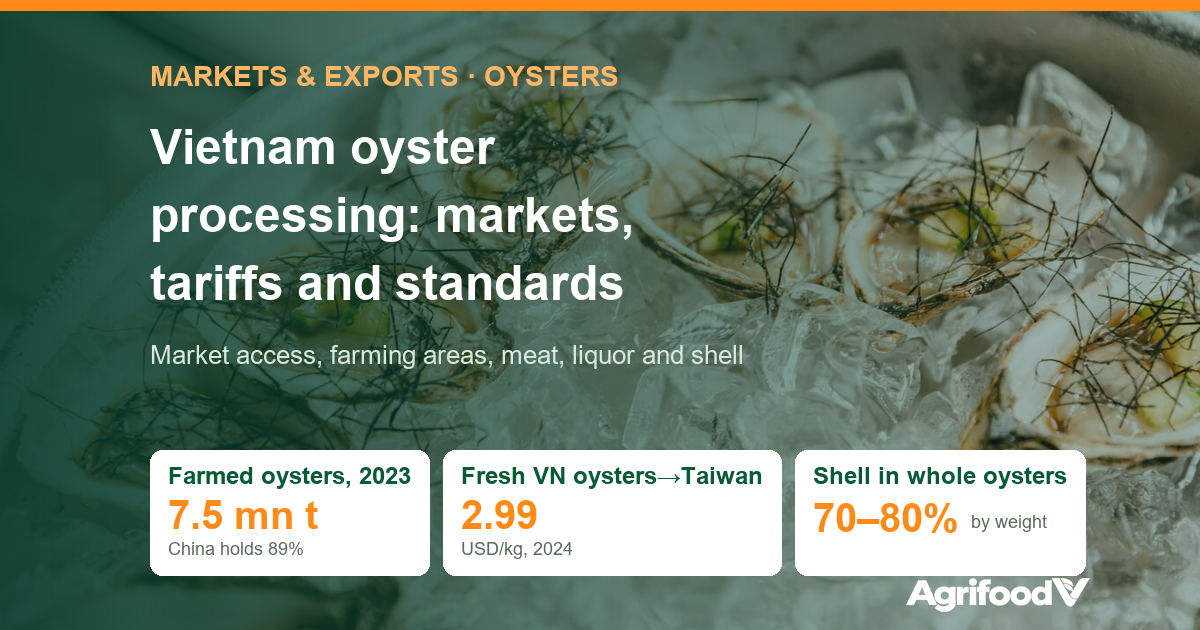
The world farms more than 7.5 million tonnes of oysters a year, yet only about USD 0.6 billion worth of oysters crosses borders, because nearly nine-tenths of output is in China and is consumed there. Vietnam has farming areas, seed stock and skilled farmers, but sells almost exclusively fresh whole oysters at around USD 3/kg to Taiwan and Thailand. This article brings together the markets, import access, duties, farming areas and product lines that can be made from oysters, so that investors choose the right market before choosing the plant.
Key points
- In 2024, fresh Vietnamese oysters entered Taiwan at an import price of about USD 2.99/kg; frozen Korean oysters entered the US at USD 8.26/kg; dried oysters entered Hong Kong at an average of USD 29.15/kg. The price gap lies in the product form and in market access, not in the oyster.
- For oysters, the farming area comes before the plant. The EU accepts only frozen or processed bivalve molluscs from Vietnam; the US and Japan (oysters for raw consumption) do not yet accept Vietnamese oysters because Vietnam has no agreement with them or is not yet on their list of approved countries.
- The door that is widening is frozen oysters for cooking for Japan and Hong Kong. Korea supplies 97% of Japan’s import volume, and Hiroshima’s 2025 oyster crop suffered 80–90% mortality.
- Shell accounts for about 70–80% of the weight of whole oysters. An oyster plant in fact handles three material streams: meat, oyster liquor and shell, each of which is a product sector in its own right.
World oyster market: very large production, very small trade
According to EUMOFA (European Commission), citing FAO, world farmed oyster production exceeded 7.5 million tonnes in 2023, up 50% from 2014. China accounts for 89%, Korea 4%, and the US and Japan 2% each. The EU farms only about 107,000 tonnes, 85% of it in France.
Trade is far smaller. Adding up the four oyster codes on UN Comtrade (0307.11 live and fresh, 0307.12 frozen, 0307.19 dried, salted or smoked, and 1605.51 prepared), global exports were worth about USD 640 million in 2023 and USD 606 million in 2024. Each segment has a clear leader:
| Segment (HS code) | Leading exporters in 2024 | Major importers |
|---|---|---|
| Live, fresh oysters (0307.11) | France USD 138.05 million (USD 8.06/kg); Canada 61.90 million; Ireland 40.40 million | US, Italy, France, Hong Kong, China (2023 data) |
| Frozen oysters (0307.12) | Korea USD 45.43 million (USD 7.08/kg); Japan 27.74 million | Japan USD 27.22 million; US 16.68 million; Taiwan 12.62 million |
| Dried, salted, smoked oysters (0307.19) | Spain USD 41.57 million (mainly pickled and marinated products) | Hong Kong USD 11.80 million (USD 29.15/kg) |
| Prepared, canned oysters (1605.51) | China USD 60.86 million (USD 8.73/kg); Korea 28.60 million | US USD 37.23 million (USD 6.89/kg) |
Korea aims to raise oyster output from about 310,000 tonnes (2022) to 400,000 tonnes and exports to USD 160 million by 2030, double the roughly USD 80 million at which exports have stood still for ten years. Japan is both a competitor and a market: Hiroshima accounts for about 60% of Japan’s farmed oyster output, and in the 2025 season mass mortality reached 80–90% in some areas.
Where Vietnam sells oysters, and at what price
According to VASEP, in the first five months of 2024 Vietnam exported almost USD 7 million of oysters, 82% of it to Taiwan, mainly fresh chilled oysters. Cross-checked against importing-country data on UN Comtrade, in 2024 Taiwan imported 3,780 tonnes of live, fresh oysters from Vietnam at USD 2.99/kg and Thailand imported 2,563 tonnes at USD 3.02/kg. Frozen and prepared oysters amount to less than USD 1 million a year: Japan imported 59 tonnes of frozen Vietnamese oysters (USD 5.17/kg), and Qatar and Saudi Arabia a few dozen tonnes.
The reverse flow is more noteworthy. Also in 2024, China declared exports of 3,517 tonnes of live, fresh oysters to Vietnam through official channels, at a unit price of only about USD 1.05/kg. Cheap imported oysters drag down domestic prices: in August 2025, traders buying oysters at the rafts in Quang Ninh at times paid only VND 3,500–5,500/kg.
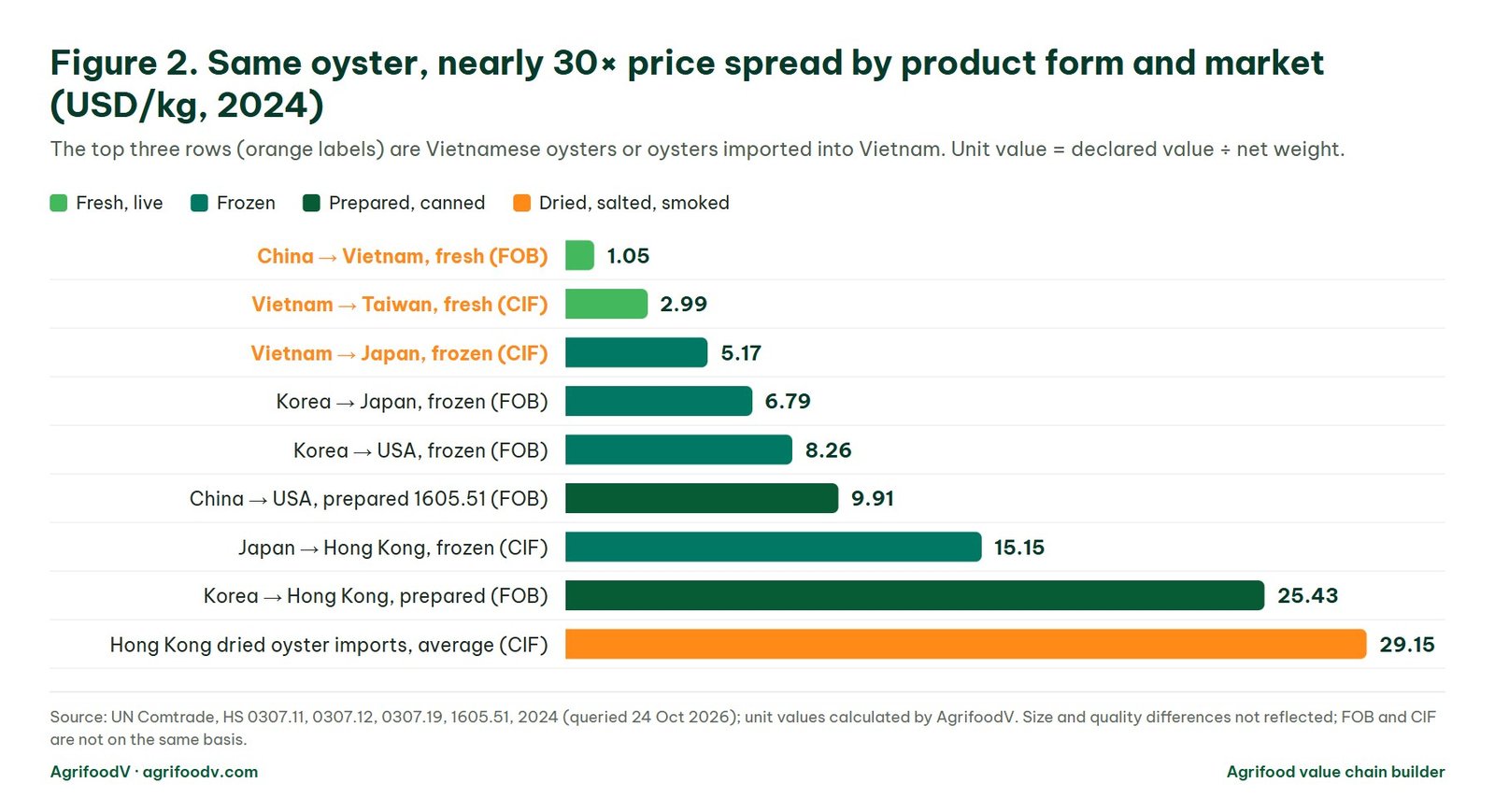
The lesson from the price table: for the same oyster, selling it whole and fresh to traders is the lowest rung of the value ladder. The higher rungs require freezing, cooking, drying or processing and, more importantly, access to markets that pay high prices.
Import access: unlike pangasius, for oysters the farming area comes before the plant
Oysters feed by filtering seawater, so they accumulate whatever is in the water: enteric bacteria, Vibrio, norovirus, algal toxins and heavy metals. Major markets therefore assess the exporting country’s harvest-area monitoring system first, and only then the plant. A compliant plant is not enough to export.
| Market | Status for Vietnamese oysters | Main requirements |
|---|---|---|
| EU | Vietnam is listed in Annex VIII to Implementing Regulation (EU) 2021/405, but only for frozen or processed bivalve molluscs; live oysters are excluded | Harvest areas covered by the bivalve mollusc monitoring programme (Circular 33/2015/TT-BNNPTNT) and classified by E. coli; establishment on the EU list; every consignment checked |
| US | Live, fresh and frozen oysters cannot yet enter: Vietnam has no shellfish agreement with FDA and is not on the ICSSL | Cooked and canned oysters (1605.51) follow FDA seafood HACCP; low-acid canned foods are subject to separate rules; Import Alert 16-50 currently lists 4 Vietnamese companies |
| Japan | Oysters for raw consumption: Vietnam is not on the list of countries whose certificates are accepted (applies from 1 June 2020). Frozen oysters for cooking: a small trade flow already exists | Food Sanitation Act; for raw-consumption oysters: E. coli MPN ≤ 230/100 g, Vibrio parahaemolyticus MPN ≤ 100/g |
| China | Chinese customs data for 2024 record no oyster imports from Vietnam; whether Vietnamese oysters are on GACC’s list of permitted species has not been verified | Establishments must register with GACC under Decree 280 (in force 1 June 2026), nominated by the Vietnamese competent authority |
| Taiwan, Thailand, ASEAN | Fresh whole oysters are being exported at around USD 3/kg | Companies on Taiwan’s approved list (794 Vietnamese seafood companies, December 2024); standard certificates |
| Hong Kong, Singapore | Vietnam is not yet among the main suppliers; Hong Kong pays USD 11/kg for frozen oysters and USD 29/kg for dried oysters | Singapore: frozen oysters need a health certificate, are classed as high risk and are subject to mandatory inspection; live oysters must come from SFA-approved sources |
Depuration (letting live oysters filter clean, disinfected seawater for about 42–48 hours) reduces bacteria but does not reliably remove norovirus and algal toxins. Equipment cannot replace a farming-area monitoring programme.
Import duties in the main markets
The rates below apply to goods of Vietnamese origin and were checked on 25 October 2026. Important: a 0% duty does not mean that every product form can be exported; market access (previous section) is decided first.
| Market | Frozen oysters (0307.12) | Dried, salted, smoked oysters (0307.19) | Prepared, canned oysters (1605.51) |
|---|---|---|---|
| EU (EVFTA) | MFN 9% → 0% | MFN 9% → 0% | MFN 20% → 0% |
| US (no FTA) | 0% +12.5% Section 301 | 0% +12.5% Section 301 | 1605.51.50 (ordinary canned): 4.7% +12.5% = 17.2% |
| Japan | WTO 7%; no VJEPA preference; CPTPP 0% | dried, salted: WTO 10.5% → 0% (VJEPA or CPTPP) | in airtight containers: 9.6%; no VJEPA preference; CPTPP 0% |
| China (ACFTA, RCEP) | MFN 10% → 0%* | MFN 10% → 0%* | MFN 5% → 0%* |
| Korea | MFN 20%; VKFTA rate to be checked by tariff line | MFN 20% | MFN 20% |
| Taiwan (no FTA) | 20% | 15–30% depending on tariff line | 10–15% depending on tariff line |
| Hong Kong, Singapore | No customs duty on these food products (Singapore levies GST) | ||
| UAE, Saudi Arabia | 5% (GCC common external tariff) | ||
* China’s preferential rates are taken from a commercial tariff look-up site and have not been checked against the original legal text; the MFN rates match the UNCTAD TRAINS database. Rates for Korea, Taiwan, the UAE and Saudi Arabia are 2023 MFN rates (WITS). Two common mistakes: for Japan, CPTPP must be claimed because VJEPA does not reduce duties on frozen oysters and oysters in airtight containers; for the US, Vietnamese oysters bear an extra 12.5% under Section 301 from 24 July 2026.
Farming areas: real scale, but no official oyster-specific data
- National data. The statistics office and the Department of Fisheries have not published separate figures for oyster farming area and output. Molluscs as a group cover more than 41,500 ha of farms producing about 265,000 tonnes a year (Ministry of Agriculture and Environment, 2025).
- Quang Ninh. The country’s largest Pacific oyster farming area, concentrated in Van Don; press reports in 2021 cited about 4,000 ha. Typhoon Yagi in September 2024 cost Van Don about 25,638 tonnes of harvest-ready oysters; almost a year later the province had almost no oysters to sell, and the number of shucking workshops at one point fell from 53 to 10.
- Southern provinces. Long Son (Ho Chi Minh City), Khanh Hoa, Dak Lak (formerly Phu Yen), An Giang (formerly Kien Giang) and Ca Mau have oyster farming, but there are no separate hectare or tonnage figures for oysters.
- Government direction. Decision 1664/QD-TTg (4 October 2021) sets a 2030 target for marine aquaculture of 300,000 ha and 1.45 million tonnes, including 550,000 tonnes of molluscs inshore and 100,000 tonnes offshore, together with the task of building concentrated mollusc seed production areas for Quang Ninh and neighbouring provinces.
For a plant, what matters is not the total area but the share that is already in the monitoring programme of the Ministry of Agriculture and Environment, has several years of monitoring results and is recognised by importing countries. The list of oyster harvest areas currently in this programme should be checked directly with the authorities before choosing a site.
An oyster plant is three material streams: meat, oyster liquor and shell
Studies show that shell accounts for about 70–80% of the weight of whole oysters, and meat from about 5% (lean or wild oysters) to 12–14% (farmed oysters in the fattening season). This means plant capacity must be calculated in kilograms of meat and month by month, not in annual average tonnes of whole oysters. The water held between the two shells (oyster liquor) has not been measured separately in any published study; the industry estimates it at about 8–12%, and each project must weigh it on its own oysters.
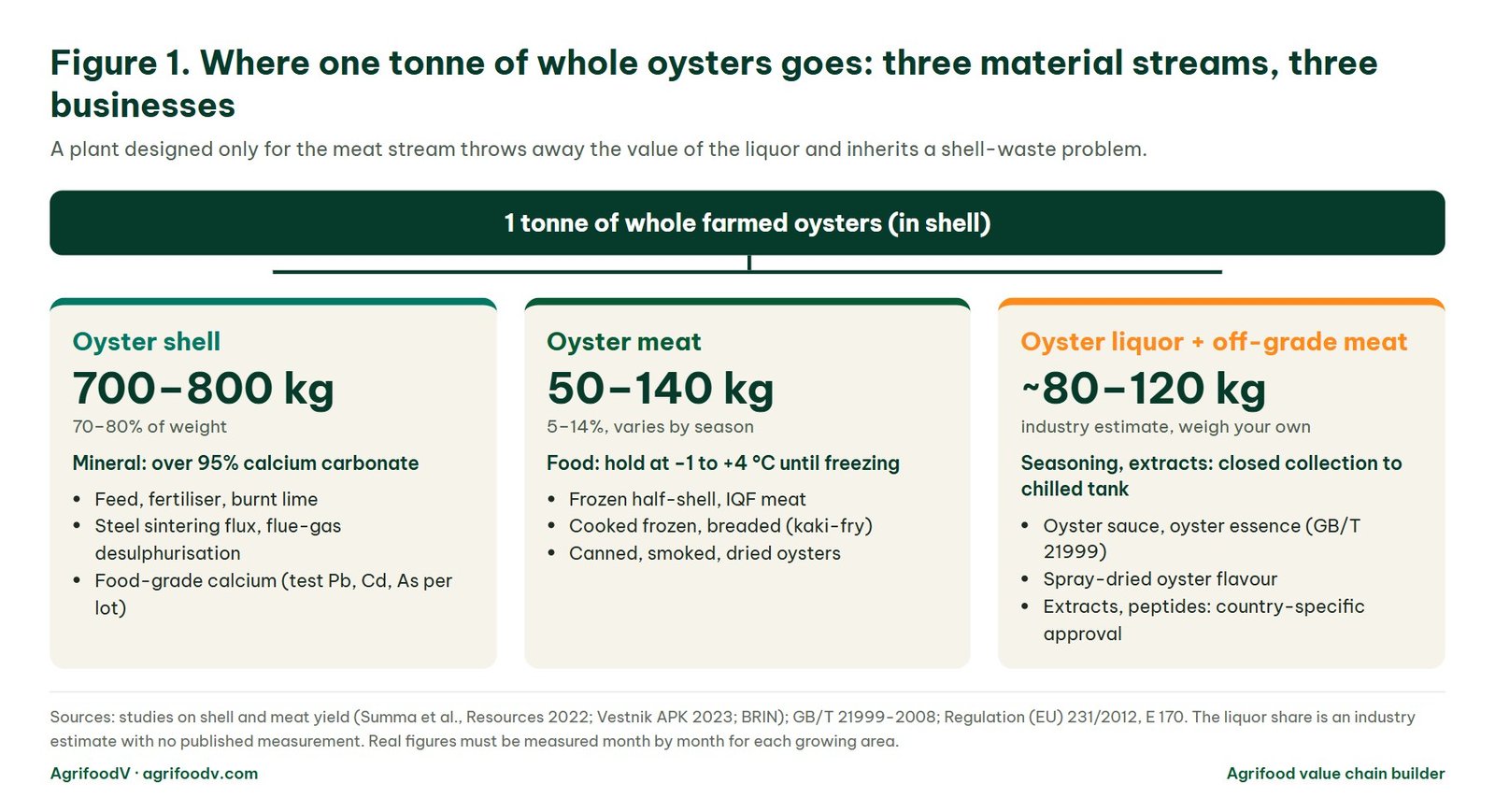
From these three streams, the product range can be divided into three tiers:
- Food from oyster meat. Frozen half-shell oysters, IQF oyster meat, frozen cooked oysters and breaded fried oysters (kaki-fry) for Japan; canned and smoked oysters for the US; dried oysters for Hong Kong. From shucking to freezing, oyster meat must be held continuously at −1 to +4 °C.
- Seasonings and extracts from oyster liquor and lower-grade meat. Oyster sauce under Chinese standard GB/T 21999-2008 is made from concentrated oyster cooking liquor or enzyme-hydrolysed oyster meat. This is a high-volume, low-price segment: China’s largest oyster sauce producer sold nearly 931,000 tonnes in 2024 at an average ex-factory price of about USD 0.69/kg. Oyster extracts and peptides for food supplements carry much higher list prices, but those prices are less reliable, and the products must go through each country’s own procedures: in Vietnam, a health supplement product declaration under Decree 15/2018/ND-CP and GMP under Circular 18/2019/TT-BYT; in Korea, lactic-acid-fermented oyster extract has been recognised by MFDS as individually approved functional ingredient No. 2024-27.
- Minerals from oyster shell. Shell contains more than 95% calcium carbonate and is used in animal feed, fertiliser, quicklime and steelmaking flux and, if clean enough, as food-grade calcium. The risk is heavy metals. For comparison, the EU specification for the food additive calcium carbonate E 170 (whose definition covers only ground limestone or precipitated calcium carbonate) limits lead to 3 mg/kg, arsenic to 3 mg/kg and cadmium to 1 mg/kg; shell from areas near ports or estuaries must be tested batch by batch to prove an equivalent level of cleanliness. Korea generates about 300,000 tonnes of oyster shell a year and had to enact a law promoting the recycling of fishery by-products (in force 21 July 2022) before it could clear the backlog.
There is no need to run all three tiers from day one. But the day-one design must know where the oyster liquor and the shell will go; otherwise the liquor ends up in the wastewater and the shell becomes a waste heap next to the plant.
What companies should do
AgrifoodV recommendations:
- Choose the market and product form first: frozen oysters for cooking for Japan and Hong Kong; cooked and canned oysters for the US; fresh and frozen oysters for Taiwan and ASEAN. Each choice brings different requirements for farming areas, technology and documentation.
- Calculate duties under the correct agreement: oysters going to Japan should claim CPTPP origin (0%) instead of VJEPA; oysters going to the US bear an extra 12.5% under Section 301, which must be built into the quoted price.
- Verify the farming area before buying land: whether it is already in the bivalve mollusc monitoring programme, how many years of monitoring results exist, and whether importing countries have recognised it.
- Write meat yield, glycogen content and mortality on receipt into purchase contracts with farming areas; size capacity on the lean months, not the annual average; factor typhoon risk into chilled and frozen storage.
- Design the oyster liquor collection line and the shell conveyor from the start, even if the oyster sauce, extract and shell processing lines are left for a later phase.
- Do not buy expensive equipment before having a market: a high-pressure processing (HPP) machine is only worth the investment when selling premium half-shell oysters into a market that has opened to Vietnamese oysters.
AgrifoodV supports companies with market analysis and import requirements, processing plant direction and organising monitored, traceable raw-material growing areas. Further reading: The journey of building an export processing plant and raw-material growing areas for processing plants.
Oyster sector series
In-depth articles on markets, farming areas, food safety and value-added oyster products, updated as new articles are published:
References
- EUMOFA (European Commission). Species profile: Oysters (FAO data for 2023, EU prices 2023–2025). fishery-aquaculture-market-observatory.ec.europa.eu.
- UN Comtrade. Trade data for HS 0307.11, 0307.12, 0307.19 and 1605.51, 2023–2024 (queried 24 October 2026; unit prices calculated by AgrifoodV as value divided by net weight). comtradeplus.un.org.
- Korea Ministry of Oceans and Fisheries. Oyster farming industry development plan, 9 January 2025 (via SBS Biz). biz.sbs.co.kr.
- Jiji Press via Adnkronos. Hiroshima oyster farmers face catastrophic blow from mass deaths, 20 November 2025. english.adnkronos.com.
- VASEP. Oyster exports continue to grow, 23 July 2024. seafood.vasep.com.vn.
- Agriculture and Environment Newspaper. Vụ thu hoạch hàu đầu tiên sau bão Yagi, may chăng thì hòa vốn [The first oyster harvest after Typhoon Yagi: breaking even at best], 8 August 2025. nongnghiepmoitruong.vn.
- Vietnam Financial Times. Quảng Ninh sẽ sớm có chính sách hỗ trợ người nuôi trồng thủy sản bị thiệt hại do bão Yagi [Quang Ninh to soon adopt a support policy for aquaculture farmers hit by Typhoon Yagi], 16 September 2024. thoibaotaichinhvietnam.vn.
- European Union. Implementing Regulation (EU) 2021/405, Annexes VII and VIII, consolidated version CELEX 02021R0405-20260903. eur-lex.europa.eu.
- Ministry of Agriculture and Rural Development. Circular 33/2015/TT-BNNPTNT on food safety monitoring in the harvesting of bivalve molluscs. caselaw.vn.
- FDA. Interstate Certified Shellfish Shippers List (ICSSL), 2025; Import Alert 16-50, updated 10 September 2025. fda.gov; accessdata.fda.gov.
- Japan Ministry of Health, Labour and Welfare (MHLW). Import rules for oysters for raw consumption and list of countries whose certificates are accepted (updated 13 December 2023); compositional standards for oysters for raw consumption. mhlw.go.jp.
- General Administration of Customs of China. Regulations on the registration of overseas food manufacturers (Decree 280), in force 1 June 2026 (via Avinews, 17 July 2026). avinews.com.
- Singapore Food Agency (SFA). Safety of bivalve molluscs. sfa.gov.sg.
- Agriculture and Environment Newspaper. Gần 800 doanh nghiệp thủy sản Việt Nam được phép xuất khẩu vào Đài Loan [Nearly 800 Vietnamese seafood companies allowed to export to Taiwan], 11 December 2024. nongnghiepmoitruong.vn.
- Viet Nam News. Viet Nam’s mollusc exports to China soar in Q1 2025, 14 May 2025. vietnamnews.vn.
- Prime Minister of Vietnam. Decision 1664/QD-TTg of 4 October 2021 approving the scheme for developing marine aquaculture to 2030, with a vision to 2045. luatvietnam.vn.
- Shell and meat ratios of oysters: Summa et al., Resources 11:48 (2022); Vestnik APK (2023) on farmed C. gigas; Marine Research in Indonesia (BRIN) on C. cucullata. sfera.unife.it.
- Chinese national standard GB/T 21999-2008 Oyster sauce (reviewed 1 July 2025). openstd.samr.gov.cn. 2024 annual report of China’s largest listed oyster sauce producer (stock code 603288, published 3 April 2025). cninfo.com.cn.
- Government of Vietnam. Decree 15/2018/ND-CP guiding the Law on Food Safety; Ministry of Health, Circular 18/2019/TT-BYT on GMP for health supplements. thuvienphapluat.vn.
- Korea Ministry of Oceans and Fisheries. Enforcement Decree of the Act on the Promotion of Recycling of Fishery By-products, in force 21 July 2022 (via FutureChosun, 13 July 2022). futurechosun.com.
- European Union. Regulation (EU) 231/2012 laying down specifications for food additives, entry E 170 calcium carbonate, consolidated version CELEX 02012R0231-20260818. eur-lex.europa.eu.
- European Commission. TARIC, codes 0307 12 00, 0307 19 00 and 1605 51 00, origin Vietnam (checked 25 October 2026). ec.europa.eu/taxation_customs.
- USITC. Harmonized Tariff Schedule of the United States 2026, 0307.12, 0307.19, 1605.51. hts.usitc.gov. USTR. Notice of Actions in Section 301 Investigations, Federal Register 2026-15181, 28 July 2026. federalregister.gov.
- Japan Customs. Customs tariff schedule as of 1 April 2026, Chapters 3 and 16. customs.go.jp (Ch. 3); customs.go.jp (Ch. 16).
- World Bank, UNCTAD. WITS/TRAINS, MFN rates reported for 2023 by China, Korea, Taiwan, the UAE and Saudi Arabia. wits.worldbank.org. China’s 2026 tariff schedule (ACFTA, RCEP) via the hsbianma.com look-up site: hsbianma.com.
- Hong Kong Customs and Excise Department (GovHK), dutiable commodities; Singapore Customs, Duties and Dutiable Goods Overview. gov.hk; customs.gov.sg.
Article by AgrifoodV, compiled from the sources above (accessed 24–25 October 2026). The shell, meat and liquor ratios are reference ranges for farmed oysters; actual figures must be measured month by month in the specific farming area. Unit prices calculated from UN Comtrade are value divided by the net weight declared by the reporting country and do not reflect differences in size and quality. Prices for oyster extracts and peptides come only from commercial listings and should not be used as a basis for investment. Market regulations and duty rates may change; companies should check the legislation in force before setting export targets. This content is not a substitute for legal advice. Cover image: RDNE Stock project / Pexels.
Looking at Vietnam as a sourcing origin or a place to build a value chain?
Tell us your product, target market and expected volumes. In a 30–45 minute online call, AgrifoodV reviews buyers, standards, processing capacity and growing areas with you, starting from the market.
Book a call →Sourcing from Vietnam© 2026 AgrifoodV. Nội dung được phép trích dẫn khi ghi rõ nguồn và đặt liên kết tới bài gốc; không sao chép toàn văn. Xem Điều khoản sử dụng nội dung.