AgrifoodV ·
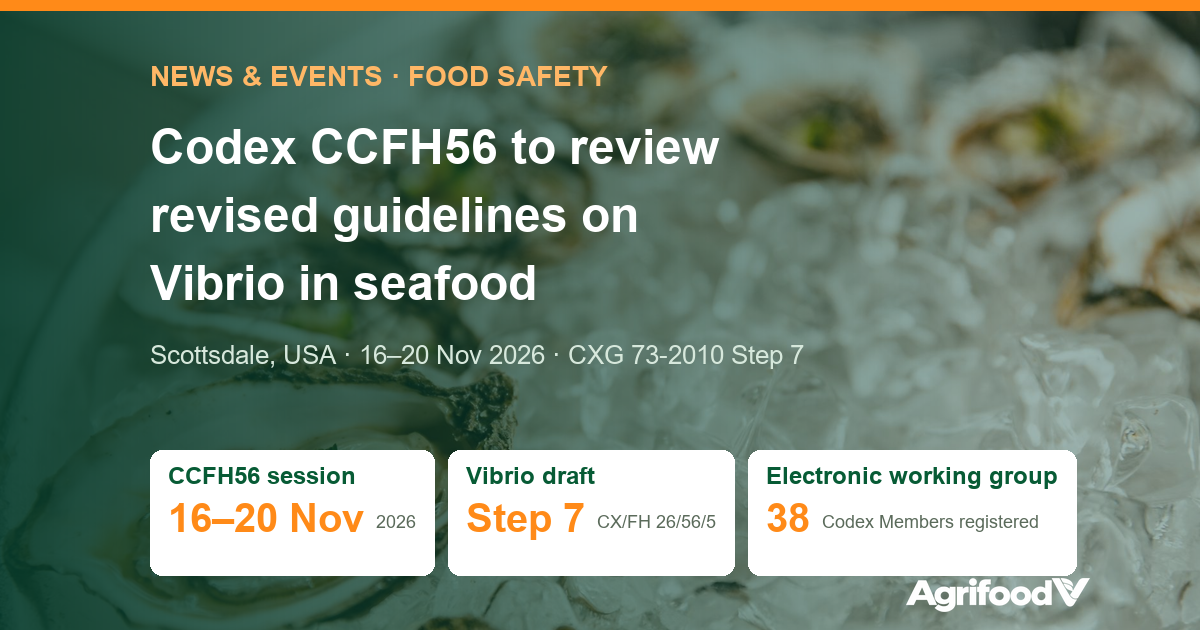
The Codex Committee on Food Hygiene (CCFH) will hold its 56th session from 16 to 20 November 2026 in Scottsdale, Arizona, United States. The key item for the seafood sector is the revision of the Guidelines on the application of general principles of food hygiene to the control of pathogenic Vibrio species in seafood (CXG 73-2010), now at Step 7 of the Codex procedure. The same session will also take up a proposed draft revision of the guidelines on viruses in food and proposals to revise the codes of practice on allergen management and on quick frozen foods: texts that competent authorities in importing countries often use as a reference.
Key points
- CCFH56 will hold discussions from 16 to 18 November and adopt its report on 20 November 2026; delegate registration closes on 2 November 2026.
- The revised Vibrio guidelines (document CX/FH 26/56/5, Step 7) were redrafted by an electronic working group chaired by Japan, mainly in the provisions on water used in harvesting, storage and processing.
- The draft removes specific parameters for depuration of molluscs and hydrostatic compression, replacing them with a requirement that interventions be validated for each operator’s own conditions.
- The Committee is also invited to consider new work to revise the code of practice on allergen management (CXC 80-2020) so that it is consistent with the newly adopted guidelines on precautionary allergen labelling.
The session and its agenda
According to the notice from the U.S. Codex Office published in the U.S. Federal Register on 1 October 2026 (FR Doc. 2026-20168), the CCFH56 agenda covers: matters referred by the Codex Alimentarius Commission (CAC) and other subsidiary bodies, including an overview of definitions of “ready-to-eat foods” in Codex texts; matters arising from international organizations, including the Joint FAO/WHO Expert Meetings on Microbiological Risk Assessment (JEMRA); the revision of the Vibrio guidelines; alignment of CCFH texts with the revised General principles of food hygiene (CXC 1-1969); the proposed draft revision of the guidelines on the control of viruses in food (CXG 79-2012); two discussion papers on revising the code of practice on food allergen management (CXC 80-2020) and the code of practice for the processing and handling of quick frozen foods (CXC 8-1976); and the forward workplan for new work.
The Codex meeting page lists physical working groups on 15 November for three items (Vibrio, alignment and viruses), plus a group on work priorities on the afternoon of 16 November. At the time of access, the meeting page had published only part of the working documents; the full texts of the draft on viruses and the two discussion papers were not yet available.
The Vibrio revision: from Step 5 to Step 7
According to document CX/FH 26/56/5 (August 2026), CCFH53 (2022) decided to revise CXG 73-2010 and CAC46 (2023) approved the work. CCFH54 (2024) forwarded the draft to CAC47, which adopted it at Step 5, but all references to water remained in square brackets pending completion of Annex II on fish and fishery products of the Guidelines for the safe use and reuse of water in food production and processing (CXG 100-2023). That annex was agreed by CCFH55 (December 2025) and adopted by CAC49 at Step 5/8 in 2026.
The electronic working group was chaired by Japan and co-chaired by Honduras, Morocco and New Zealand, with 38 Codex Members, 1 Member organization and 3 Observers registered. The draft went through two rounds of comments: the first from 9 March to 17 April 2026 (comments from 18 Members) and the second from 29 June to 24 July 2026 (13 Members).
| Topic | Change in draft CX/FH 26/56/5 |
|---|---|
| Water definitions | Restates the definitions of potable water, clean water and water fit for purpose from CXG 100-2023, because those in the Code of practice for fish and fishery products (CXC 52-2003) are not fully aligned |
| Water-use provisions | Two options: refer to CXG 100-2023 only (Option 1) or reproduce the relevant provisions in the guidelines (Option 2); CCFH56 will choose |
| Steam in direct contact | Adds a provision that potable water or clean water be used when steam comes into direct contact with seafood or food contact surfaces |
| Risk-reducing interventions | Removes specific parameters for hydrostatic compression and depuration of molluscs; operators apply interventions validated for their own conditions |
| Detection methods | Adds ISO 21872-1:2017/Amd 1:2023; the methods section becomes a separate annex |
| Scope of “seafood” | Definition kept unchanged, seaweed not included; CCFH56 asked to choose one consistent term throughout the text |
Source: Codex, CX/FH 26/56/5, August 2026.
The draft lists food groups linked to illness from V. parahaemolyticus, including finfish, crustaceans such as prawns, bivalve molluscs such as oysters and scallops, and cephalopods such as squid. Partial treatments for bivalve molluscs, for example freezing, high pressure and mild heating, must be validated as effective and implemented under the HACCP system.
A published position: the European Union
In its reply to circular letter CL 2026/68-FH at Step 6 (dated 9 October 2026), the EU and its Member States generally support the draft, prefer the consistent use of the term “seafood” and favour Option 2 (reproducing the water provisions). The EU asks for clarification of phrases such as “lowest temperature tolerable for the species” in the transport and storage of live seafood, and recalls that CCFH55 deleted the example of “artificial seawater” because the source of the base water was unclear.
Other items worth noting
Document CX/FH 26/56/2 (September 2026) states that CAC49 adopted the revised guidelines for the control of Campylobacter and Salmonella in chicken meat (CXG 78-2011), the revised guidelines on the control of Listeria monocytogenes (CXG 61-2007) and Annexes II and IV of CXG 100-2023. CAC49 also adopted the guidelines on precautionary allergen labelling (PAL) prepared by the Committee on Food Labelling (CCFL49); CCFH56 is therefore invited to consider new work to revise CXC 80-2020 for consistency. The Committee will also discuss harmonizing the definition of ready-to-eat foods across hygiene texts. CAC49 asked the Committee on Fish and Fishery Products (CCFFP) to develop sampling plans for histamine in 11 commodity standards for fish and fishery products.
In its report to the session (CX/FH 26/56/4), ISO states that the Vibrio detection standard ISO 21872-1 and the two standards for quantification and detection of hepatitis A virus and norovirus, ISO 15216-1 and 15216-2, are all to be revised.
What companies should do
The following are AgrifoodV’s recommendations, not the content of the Codex texts.
- Review water sources stage by stage. Facilities that buy, pre-process or depurate molluscs should map which water is used for washing, wet storage of live product, ice making and steam, with periodic test results, and check it against Annex II of CXG 100-2023.
- Prepare validation files for Vibrio interventions. With the model parameters removed from the draft, each facility using freezing, high pressure or depuration must demonstrate effectiveness with its own validation data and include it in its HACCP plan.
- Check laboratory methods. Ask your testing laboratory which version of ISO 21872-1 and ISO 15216 it uses, and whether it plans to update when these standards are revised.
- Follow the CCFH56 report after 20 November 2026 to see whether the Vibrio text moves to Step 8, and what new work is agreed on allergens and quick frozen foods.
If your company needs a review of the water system, HACCP plan and validation records of a seafood processing plant, see AgrifoodV’s processing plant advisory services.
References
- U.S. Codex Office (USDA), “Codex Alimentarius Commission: Meeting of the Codex Committee on Food Hygiene”, Federal Register, FR Doc. 2026-20168, published 1 October 2026. federalregister.gov/d/2026-20168 (accessed 31 October 2026).
- Codex Alimentarius, CCFH56 meeting page (Scottsdale, 16–20 November 2026). codex.fao.org/meetings/d/ccfh-56-1 (accessed 31 October 2026).
- Codex Alimentarius, CX/FH 26/56/5, “Draft revision of the Guidelines on the application of the general principles of food hygiene to the control of pathogenic Vibrio species in seafood (CXG 73-2010) (Step 7)”, August 2026. fh56_05e.pdf (accessed 31 October 2026).
- Codex Alimentarius, CX/FH 26/56/2, “Matters arising from the Codex Alimentarius Commission and/or other Codex subsidiary bodies”, September 2026. fh56_02e.pdf (accessed 31 October 2026).
- Codex Alimentarius, CX/FH 26/56/4, “Information from ISO regarding standardization in food chain microbiology”, September 2026. fh56_04e.pdf (accessed 31 October 2026).
- European Commission (DG SANTE), “European Union reply to CL 2026/68-FH”, 9 October 2026. food.ec.europa.eu – Codex CCFH (accessed 31 October 2026).
Article by AgrifoodV, compiled from the sources above (accessed 31 October 2026). This content is not a substitute for legal advice.
Cover image: RDNE Stock project / Pexels
Looking at Vietnam as a sourcing origin or a place to build a value chain?
Tell us your product, target market and expected volumes. In a 30–45 minute online call, AgrifoodV reviews buyers, standards, processing capacity and growing areas with you, starting from the market.
Book a call →Sourcing from Vietnam© 2026 AgrifoodV. Nội dung được phép trích dẫn khi ghi rõ nguồn và đặt liên kết tới bài gốc; không sao chép toàn văn. Xem Điều khoản sử dụng nội dung.