AgrifoodV ·
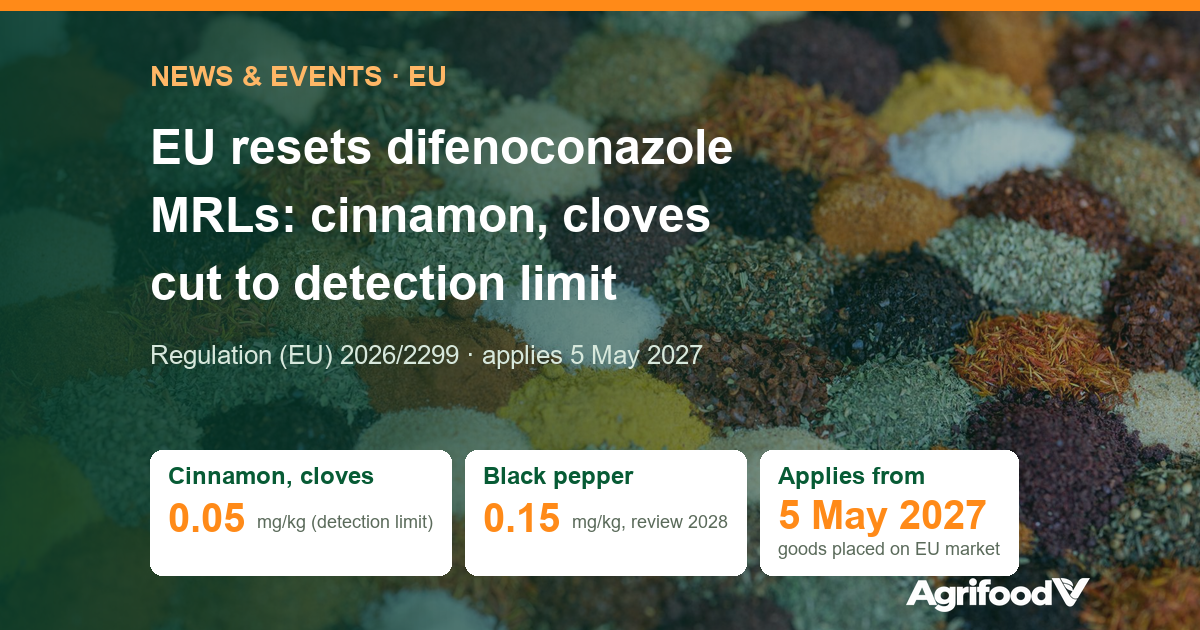
The European Commission adopted Regulation (EU) 2026/2299 on 15 October 2026, resetting all maximum residue levels (MRLs) for the fungicide difenoconazole in food. The new levels apply from 5 May 2027. For Vietnamese exports, the key point is that cinnamon and cloves are lowered to the limit of determination of 0.05 mg/kg, while durian, pineapple and lychee are set at 0.01 mg/kg and black pepper at 0.15 mg/kg.
Key points
- Regulation (EU) 2026/2299 was published in the Official Journal of the EU on 16 October 2026, enters into force on the twentieth day after publication and applies from 5 May 2027.
- Bark spices (cinnamon), bud spices (cloves), flower pistil spices and aril spices are lowered to the limit of determination of 0.05 mg/kg because data were insufficient to set a safe MRL.
- Pepper and other fruit spices have an MRL of 0.15 mg/kg with a data-gap footnote: the EU will review it in light of information submitted by 16 October 2028.
- Products placed on the EU market before 5 May 2027 remain subject to the old levels.
Why the EU has reset difenoconazole MRLs
Difenoconazole is a triazole fungicide whose MRLs were listed in Part A of Annex III to Regulation (EC) No 396/2005, i.e. as temporary levels. In 2024, the European Food Safety Authority (EFSA) completed its review of all existing MRLs for the substance under Article 12 of Regulation 396/2005. In 2025, EFSA also assessed an application for import tolerances on citrus fruits, tree nuts, mangoes, papayas, dry peas and soyabeans.
Based on these two opinions, Regulation 2026/2299 moves difenoconazole into Annex II (definitive levels) and deletes the difenoconazole column from Annex III. It also changes the residue definition for animal products to the metabolite difenoconazole-alcohol (CGA205375), expressed as difenoconazole. According to the recitals, the EU’s trading partners were consulted through the World Trade Organization.
New MRLs for products Vietnam exports
The table below extracts the levels set in the Annex to Regulation 2026/2299 for products that Vietnam exports to the EU. Values are in mg/kg; an asterisk (*) marks the limit of analytical determination, meaning practically no measurable residue is allowed.
| Product (Annex I code) | New MRL (mg/kg) | Note |
|---|---|---|
| Cinnamon (0830010), cloves (0850010) | 0.05* | Lowered to the limit of determination |
| Peppercorn, black, green and white (0820060) | 0.15 | Data gap, review by 16 October 2028 |
| Turmeric (0840030) | 1.5 | Data gap, review by 16 October 2028 |
| Durian, pineapple, lychee | 0.01* | Limit of determination |
| Passion fruit | 0.05 | |
| Mango / papaya | 0.2 / 0.3 | Based on import tolerance application |
| Banana | 0.1 | Data gap, review by 16 October 2028 |
| Okra | 0.6 | |
| Rice | 3 | Data gap, review by 16 October 2028 |
| Tea / coffee beans | 20 / 0.05* | |
| Cashew nuts, coconuts (tree nuts group) | 0.03 | Based on import tolerance application |
Source: Regulation (EU) 2026/2299, Annex, EUR-Lex. Partial extract only; levels for other products should be checked directly in the text.
Spices: the most affected group
The recitals state clearly that for bark spices, bud spices, flower pistil spices and aril spices, EFSA lacked information and could derive neither an MRL nor risk assessment values. The EU therefore lowered the levels for these groups to the limit of determination. In the Annex I classification, cinnamon belongs to bark spices and cloves to bud spices. From 5 May 2027, a cinnamon lot with measurable difenoconazole above 0.05 mg/kg will not comply with the EU MRL.
For pepper and other fruit spices and seed spices, the 0.15 mg/kg level carries a footnote: EFSA identified missing residue trial data, including analysis of metabolites. When reviewing the MRL, the Commission will take into account the information if submitted by 16 October 2028, or, if not submitted, its absence. In other words, this level may change after 2028.
Tropical fruit and other groups
Durian, pineapple and lychee are all set at the limit of determination of 0.01 mg/kg. The recitals set out the general principle: for products with no authorised use, no import tolerance and no Codex level, the MRL is set at the product-specific limit of determination. Mango (0.2 mg/kg) and papaya (0.3 mg/kg) are among the products covered by the import tolerance application assessed by EFSA in 2025. On the same day, the Commission also adopted Regulation (EU) 2026/2289 amending MRLs for six other substances, including prothioconazole in rice, following applications from the applicants concerned.
What companies should do
The following are AgrifoodV’s recommendations, not provisions of Regulation 2026/2299.
- Review spray programmes in cinnamon and clove growing areas. If farmers or cooperatives use products containing difenoconazole, plan substitutes or longer pre-harvest intervals ahead of the 2027 harvest.
- Add difenoconazole to pre-export testing for cinnamon, pepper, durian, pineapple and lychee; require laboratories to reach a limit of quantification below 0.01 mg/kg for fruit and 0.05 mg/kg for spices.
- Plan by the date goods are placed on the EU market, not by production date: goods placed on the EU market from 5 May 2027 must meet the new levels.
- Follow the 2028 review for pepper and fruit spices; sector associations may consider jointly submitting data if they wish to retain the current level.
Companies that need a residue control system from growing area to export lot can refer to AgrifoodV’s growing-area advisory services.
References
- European Commission, “Commission Regulation (EU) 2026/2299 of 15 October 2026 amending Annexes II and III to Regulation (EC) No 396/2005 … as regards maximum residue levels for difenoconazole in or on certain products”, Official Journal of the EU, L series, 16 October 2026. eur-lex.europa.eu/eli/reg/2026/2299/oj (accessed 1 November 2026).
- European Commission, “Commission Regulation (EU) 2026/2289 of 15 October 2026 … as regards maximum residue levels for acequinocyl, deltamethrin, dodine, maleic hydrazide, pinoxaden and prothioconazole in or on certain products”, Official Journal of the EU, L series, 16 October 2026. eur-lex.europa.eu/eli/reg/2026/2289/oj (accessed 1 November 2026).
- EFSA, “Review of the existing maximum residue levels for difenoconazole according to Article 12 of Regulation (EC) No 396/2005”, EFSA Journal 2024;22:e8987. doi.org/10.2903/j.efsa.2024.8987 (accessed 1 November 2026).
- EFSA, “Setting of import tolerances for difenoconazole in various crops”, EFSA Journal 2025;23:e9472. doi.org/10.2903/j.efsa.2025.9472 (accessed 1 November 2026).
Article by AgrifoodV, compiled from the sources above (accessed 1 November 2026). This content is not a substitute for legal advice.
Cover image: Engin Akyurt / Pexels
Looking at Vietnam as a sourcing origin or a place to build a value chain?
Tell us your product, target market and expected volumes. In a 30–45 minute online call, AgrifoodV reviews buyers, standards, processing capacity and growing areas with you, starting from the market.
Book a call →Sourcing from Vietnam© 2026 AgrifoodV. Nội dung được phép trích dẫn khi ghi rõ nguồn và đặt liên kết tới bài gốc; không sao chép toàn văn. Xem Điều khoản sử dụng nội dung.