AgrifoodV ·
An importer in the Netherlands receives a container of frozen purée and pays 120 days later, or cancels an order of fresh fruit one week before loading: under EU law, either may be a prohibited practice. Directive (EU) 2019/633 on unfair trading practices in the agricultural and food supply chain applies even when the supplier is outside the EU, as long as the buyer is established in the EU and the two parties fall into the right turnover bands.
Key points
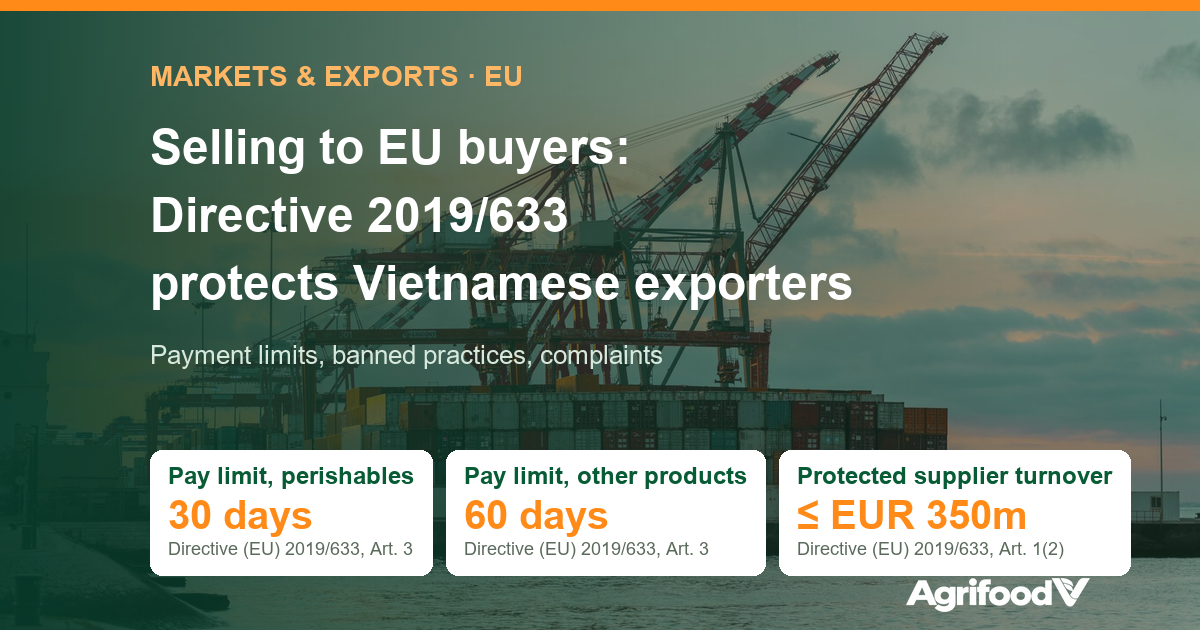
- The Directive applies to sales where the supplier or the buyer, or both, are established in the EU. A Vietnamese company selling directly to an EU legal entity that is larger than itself in the turnover bands (up to EUR 350 million) is protected.
- The buyer may not pay later than 30 days for perishable products or later than 60 days for other agri-food products. These rules are overriding mandatory provisions and apply whatever law the contract chooses.
- There are 10 practices that are always prohibited and 6 that are allowed only if agreed in advance. A supplier outside the EU files a complaint with the enforcement authority in the buyer’s country and may ask for its identity to be kept confidential.
- Regulation (EU) 2026/697 on cross-border enforcement cooperation applies from 10 September 2027 and has a chapter on suppliers outside the EU. The European Commission is preparing a revision of the Directive itself.
Who the Directive covers
Directive (EU) 2019/633 was adopted on 17 April 2019 and published in the Official Journal on 25 April 2019. Member States had to transpose it into national law by 1 May 2021 and apply it six months later; according to the European Commission’s Directorate-General for Agriculture (DG AGRI), all 27 Member States had transposed it by December 2022. On EUR-Lex the act has no amendments other than three language corrigenda, so the original text is the current text.
Three points decide whether a Vietnamese company is protected:
- Place of establishment. Article 1(2) states that the Directive applies to sales where either the supplier or the buyer, or both, are established in the Union. Article 2 defines supplier and buyer “irrespective of their place of establishment”. A sale to an importing company in Germany is in scope; a sale to a trading company in Singapore, with the goods entering the EU afterwards, has both parties outside the EU, so that transaction is not covered by the Directive.
- Products. “Agricultural and food products” are products listed in Annex I to the TFEU and products processed for use as food from those products. Fruit juice, purée, frozen fruit, cashew kernels, pepper, coffee and seafood all fall into this group.
- Turnover bands. A supplier is protected only when it sells to a buyer whose turnover exceeds the corresponding threshold.
| Supplier’s annual turnover | Protected when selling to a buyer with turnover of |
|---|---|
| Not exceeding EUR 2 million | More than EUR 2 million |
| More than EUR 2 million up to EUR 10 million | More than EUR 10 million |
| More than EUR 10 million up to EUR 50 million | More than EUR 50 million |
| More than EUR 50 million up to EUR 150 million | More than EUR 150 million |
| More than EUR 150 million up to EUR 350 million | More than EUR 350 million |
Turnover is calculated under the Annex to Recommendation 2003/361/EC, including the concepts of autonomous, partner and linked enterprises. A subsidiary of a large group must therefore add the group’s turnover and may exceed a threshold even if the exporting entity on its own is small. A supplier above EUR 350 million is not protected by the Directive, except when selling to public authorities.
How the 30-day and 60-day payment limits work
Article 3(1)(a) prohibits the buyer from paying later than the following limits:
- Perishable products: later than 30 days. Perishable products are products that, by their nature or at their stage of processing, are liable to become unfit for sale within 30 days after harvest, production or processing (Article 2(5)).
- Other agri-food products: later than 60 days.
- Starting point: for one-off orders, the date of delivery or the date on which the amount payable is set, whichever is later. For regular deliveries, the end of the agreed delivery period, which may not exceed one month. Where the buyer itself sets the amount payable, the period runs from the date of delivery or the end of the delivery period.
In AgrifoodV’s reading, fresh fruit and chilled, unpasteurised juice usually fall into the 30-day group; frozen purée, juice concentrate, cashew kernels and pepper usually fall into the 60-day group. Classification depends on the actual shelf life of each product and on how each national enforcement authority interprets it, so it should be stated clearly in the contract.
Article 3(4) makes these prohibitions overriding mandatory provisions that apply to any situation within the scope of the Directive, irrespective of the law chosen for the contract. The Directive limits how late a buyer may pay; it does not prevent the parties from agreeing faster payment methods such as a letter of credit or prepayment.
Ten prohibited practices and six that must be agreed in advance
DG AGRI counts 16 practices: 10 that are always prohibited and 6 that are allowed only if agreed in advance. Among the 10 always prohibited (Article 3(1)), late payment for perishable products and for other products counts as two; the remaining eight practices by the buyer are:
- cancelling orders of perishable products at such short notice that the supplier cannot reasonably find another outlet; notice of less than 30 days is always considered short notice;
- unilaterally changing terms on quantity, timing, place of delivery, quality standards, payment terms or prices;
- requiring payments that are not related to the sale of the products;
- making the supplier pay for deterioration or loss that occurs on the buyer’s premises or after ownership has passed to the buyer, when the supplier is not at fault;
- refusing to confirm the terms of the contract in writing when the supplier asks;
- unlawfully acquiring, using or disclosing the supplier’s trade secrets;
- threatening or carrying out commercial retaliation when the supplier exercises its rights, including filing a complaint or cooperating with an investigation;
- requiring the supplier to pay for examining customer complaints when the supplier is not at fault.
The six practices in Article 3(2) are lawful only if agreed in clear terms beforehand in the contract: returning unsold products without paying for them; charging for stocking, displaying or listing products; making the supplier bear the cost of promotional discounts; making the supplier pay for advertising; paying for marketing; paying for staff to fit out the point of sale. When the buyer asks for these payments, the supplier is entitled to a written cost estimate. Member States may adopt rules stricter than the Directive’s minimum.
Where to complain
Article 5(1) allows a supplier to complain to the enforcement authority of its own Member State or of the Member State where the buyer suspected of the infringement is established. Vietnam has no enforcement authority under the Directive, so for a Vietnamese company the practical address is the authority in the buyer’s country. DG AGRI publishes the list of authorities in the 27 Member States, for example the Federal Office for Agriculture and Food (BLE) in Germany, the Authority for Consumers and Markets (ACM) in the Netherlands, DGCCRF in France, the ICQRF department of the agriculture ministry in Italy and AICA in Spain.
- The complainant may ask for its identity, and any information whose disclosure would harm it, to be kept confidential (Article 5(3)).
- Supplier organisations, associations, and independent non-profit organisations representing suppliers may file a complaint at a company’s request (Article 5(2)). The Commission’s evaluation notes that such organisations, including those from third countries, could play a stronger role.
- The authority receiving a complaint must tell the complainant within a reasonable time how it intends to follow up; if it finds insufficient grounds, it must give its reasons.
What is changing in 2026–2027
Regulation (EU) 2026/697 of the European Parliament and of the Council, signed on 11 March 2026 and published in the Official Journal on 20 March 2026, applies from 10 September 2027. It sets up a mechanism for national enforcement authorities to request information from each other, carry out investigations on each other’s behalf and coordinate action against widespread infringements. Chapter VI deals with sales where the supplier or the buyer is outside the EU: an authority may request information from another Member State’s authority and alert the Commission when a practice towards a supplier outside the EU may concern buyers in at least three Member States (Article 26). Where a buyer outside the EU does not cooperate with an investigation, the authority may require it to designate a contact person established in the EU (Article 27).
The evaluation report COM(2025) 728, published on 1 December 2025, states that national authorities opened more than 4,500 investigations in 2021–2024; about one third of closed investigations found an infringement; 2022–2024 saw 754 cases and EUR 41.9 million in fines. The report also notes that many suppliers do not complain for fear of retaliation, and that awareness of the Directive among suppliers outside the EU is low. The Commission gathered feedback on revising the Directive until 27 February 2026; according to AGRINFO (an EU-funded information service for non-EU suppliers), the revised Directive is scheduled for adoption in Q4 2026. As of 29 October 2026, AgrifoodV has not found a published revision proposal on EUR-Lex.
What companies should do
The following are AgrifoodV’s recommendations.
- Be clear about the buying entity: a contract with a company established in the EU carries the Directive’s protection; a contract through a trading company outside the EU does not. Record your group turnover and your counterpart’s in the file to know which band you are in.
- Always ask the counterpart to confirm in writing the terms on price, quantity, quality standards, payment period and delivery date. Keep bills of lading, delivery records and price confirmations, because they are the starting point for the 30-day or 60-day limit.
- State in the contract whether the product is perishable, based on its actual shelf life, and spell out any fees for display, promotions or returns.
- When faced with price pressure, last-minute cancellations or late payment, consider complaining through an industry association to protect your identity, and consult a lawyer in the buyer’s country before filing.
AgrifoodV helps companies review market conditions and documentation before signing export contracts. Border inspection requirements in the EU are covered in EU increased controls on Vietnamese products in 2026; an example of a product line sold to EU buyers is Vietnamese passion fruit juice exports.
References
- European Parliament and Council. Directive (EU) 2019/633 of 17 April 2019 on unfair trading practices in business-to-business relationships in the agricultural and food supply chain, OJ L 111, 25 April 2019, Articles 1, 2, 3, 5. eur-lex.europa.eu (document information page: corrigenda only, no consolidated version).
- European Parliament and Council. Regulation (EU) 2026/697 of 11 March 2026 on cooperation among enforcement authorities responsible for the enforcement of Directive (EU) 2019/633, OJ L, 20 March 2026, Articles 2, 3, 26, 27, 33. eur-lex.europa.eu.
- European Commission. Commission Recommendation 2003/361/EC concerning the definition of micro, small and medium-sized enterprises, Annex, Articles 3, 4, 6. eur-lex.europa.eu.
- European Commission, DG AGRI. Unfair trading practices (scope, 16 practices, list of enforcement authorities in the 27 Member States). agriculture.ec.europa.eu.
- European Commission, DG AGRI. Commission carried out evaluation of the Directive on unfair trading practices, 1 December 2025 (report COM(2025) 728 and SWD(2025) 405). agriculture.ec.europa.eu.
- AGRINFO. Review of the Unfair Trading Practices (UTP) Directive, 12 December 2025. agrinfo.eu.
Article by AgrifoodV, compiled from the sources above (accessed 29 October 2026). EU acts were read on EUR-Lex; the expected adoption date of the revised Directive is taken from AGRINFO and may change. The classification of products as perishable is AgrifoodV’s reading, not guidance from an EU authority. The recommendations are AgrifoodV’s assessment. This content is not a substitute for legal advice. Cover image: thorl5 / Pexels.
Looking at Vietnam as a sourcing origin or a place to build a value chain?
Tell us your product, target market and expected volumes. In a 30–45 minute online call, AgrifoodV reviews buyers, standards, processing capacity and growing areas with you, starting from the market.
Book a call →Sourcing from Vietnam© 2026 AgrifoodV. Nội dung được phép trích dẫn khi ghi rõ nguồn và đặt liên kết tới bài gốc; không sao chép toàn văn. Xem Điều khoản sử dụng nội dung.