AgrifoodV ·
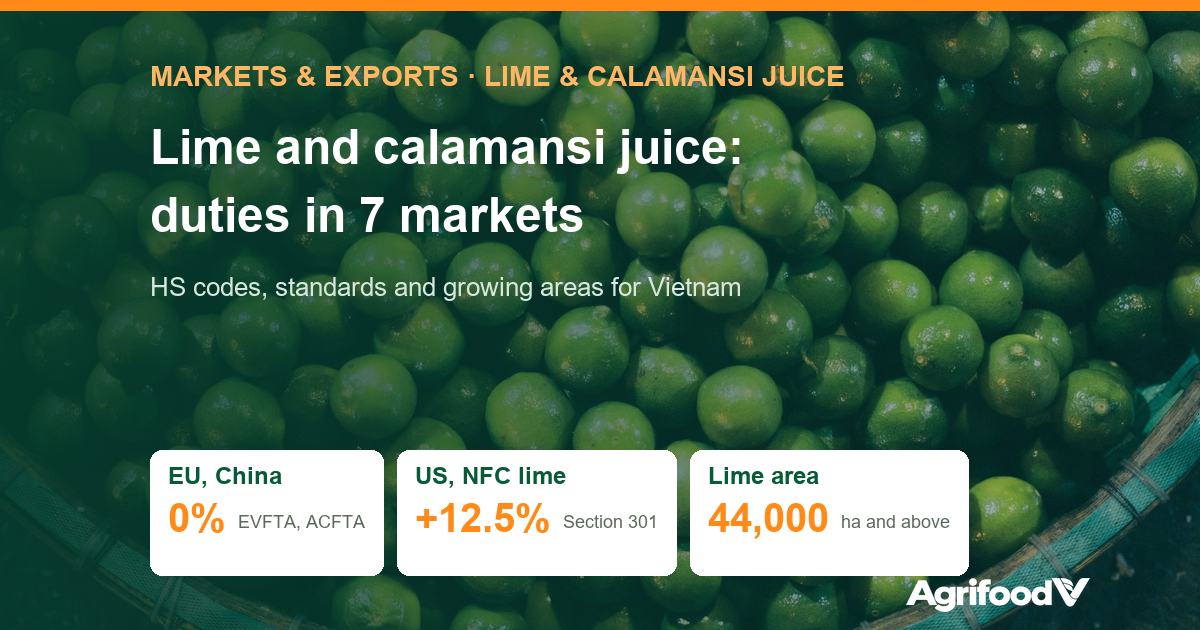
Vietnam has more than 44,000 ha of lime orchards and is already China’s second-largest supplier of single citrus juice after the Philippines. But for seedless lime juice, key lime juice and calamansi juice, duties and standards do not follow one common rule: the same drum of lime juice can face anything from 0% to 15% depending on whether the HS code puts it on the “lemon” line or the “other citrus” line. This article sets out tariff lines, duties, standards and growing-area data for seven markets: the EU, the US, Japan, South Korea, China, the UAE and Saudi Arabia.
Key points
- EU and China: 0% for both lime juice and calamansi juice under EVFTA and ACFTA. Japan is also 0%, but calamansi juice must be declared under CPTPP because VJEPA offers no preference on that line.
- The US adds 12.5% under Section 301 on Vietnamese goods from 24 July 2026. Lime juice concentrate above 20°Brix (HTS 2009.39.20) is exempt; NFC lime juice is not.
- South Korea still charges 5% on lime juice under VKFTA, while lemon juice is at 0%. In Saudi Arabia, lime juice classified on the “lemon” (ليمون) line pays 15% instead of 5%.
- There is no published figure for calamansi acreage nationwide. The protocol on fresh limes to China (signed 15 April 2026) covers fresh fruit only, not lime juice.
Seedless lime, key lime, calamansi: three fruits, at least two tariff lines
Seedless lime (Citrus latifolia) and key lime (Citrus aurantifolia) are the two species the US tariff schedule calls “lime”. Calamansi (Citrus × microcarpa) is a citrus fruit but belongs to neither species. At six digits, all three fall under subheading 2009.31 (juice of any other single citrus fruit, Brix value not exceeding 20) or 2009.39 (above 20°Brix, i.e. concentrate). The differences appear at national tariff-line level:
- The EU and China split out only “lemon juice” (柠檬汁). Lime, calamansi and kumquat juice all go to “other citrus fruit juices”.
- The US, Japan and South Korea have a separate “lime” line. Calamansi juice goes to “other citrus”. The US schedule explicitly places kumquats under “other”.
- The UAE and Saudi Arabia use the Arabic word ليمون, which can mean either lemon or lime. This is where classification is most likely to differ.
No market has a published classification ruling for calamansi juice. Placing calamansi on the “other citrus” line is an inference from the structure of the tariff schedules, not a customs authority decision.
Import duties in seven markets
The table applies to products without added sugar and is read directly from each country’s current tariff schedule (accessed 17 October 2026). “NFC” means not-from-concentrate juice.
| Market | NFC lime juice | Lime juice concentrate | Calamansi juice |
|---|---|---|---|
| EU | 0% EVFTA (MFN 15.2%) | 0% (MFN 15.2%; above 67°Brix 33.6%) | 0% (MFN 15.2%) |
| US | 1.7 cents/litre + 12.5% (2009.31.20.20) | 1.7 cents/litre, exempt from Section 301 (2009.39.20) | NFC 3.4 cents/litre + 12.5%; concentrate below 20°Brix 7.9 cents/litre, exempt from 301; above 20°Brix 7.9 cents/litre + 12.5% |
| Japan | 0% VJEPA (sucrose content not exceeding 10%) | 0% VJEPA; sucrose above 10%: 0% under CPTPP | 0% under CPTPP; no VJEPA preference (WTO 19.1%) |
| South Korea | 5% VKFTA (MFN 50%) | 5% VKFTA | NFC 5%; concentrate 0% |
| China | 0% ACFTA (MFN 5%; RCEP 12%) | 0% ACFTA (RCEP 9%) | 0% ACFTA |
| UAE | 0% if classified as “lemon”; 4.5% if classified as “other citrus” (MFN 5%) | 4.2% in 2026, 3.3% in 2027, 0% from 1 January 2031 | NFC 4.5% (to 0% on 1 January 2036); concentrate 4.2% |
| Saudi Arabia | 15% if classified as “lemon”; 5% if classified as “other citrus” | 5% | 5% |
Points that are often missed:
- US. The 12.5% Section 301 duty (heading 9903.05.84) applies to Vietnamese goods from 24 July 2026, stacked on top of the MFN duty. Only two relevant lines are exempt: lime juice concentrate above 20°Brix, and other single citrus juice in concentrated form below 20°Brix. Blended calamansi juice goes to 2009.90 and is not exempt.
- Japan. Declaring calamansi juice under VJEPA gives no preference; it must be declared under CPTPP with CPTPP proof of origin.
- South Korea. Lime juice pays 5% whether NFC or concentrate. For calamansi juice, concentrate gets 0%.
- Gulf. The Vietnam–UAE CEPA has been in force since 3 February 2026, but unsweetened citrus juices are phased down, not cut to 0% immediately. Saudi Arabia has no FTA with Vietnam.
Quality standards: Brix, sugar and labelling
| Market | Main requirements for lime and calamansi juice |
|---|---|
| Codex | CXS 247-2005: minimum Brix of reconstituted lime juice 8.0 (acid-corrected), the same as lemon. Kumquat has no figure; Brix is that of the juice expressed from the fruit itself. Calamansi is not listed. Sugar and acidifying agents may not both be added to the same juice. |
| EU | Directive 2001/112/EC (consolidated version of 14 June 2026): no sugar may be added to fruit juice, including lime juice; only nectars may be sweetened. Lime juice may be obtained from the whole fruit (lemon juice may not). Lime nectar must contain at least 25% juice; nectar from other citrus fruit, including calamansi, at least 50%. Lime is not in the minimum Brix table, so the Brix of the expressed juice applies. |
| US | No standard of identity for lime juice (21 CFR Part 146 covers lemon juice only). Under 21 CFR 101.30, the figure 4.5 for lime is % anhydrous citric acid, not °Brix; percentage juice on the label is calculated on acidity. Juice HACCP (Part 120) allows citrus juice processors to treat fruit surfaces to achieve a 5-log reduction, but finished-product E. coli testing is then mandatory. |
| Japan | The VJEPA preference for lime juice requires no added sugar and sucrose content not exceeding 10%, natural sugars included. |
| South Korea | MFDS Food Code (Notice 2026-55, effective 1 October 2026): “fruit and vegetable juice” must contain at least 95% juice, “fruit and vegetable drink” at least 10%, and concentrate must be reduced to no more than 50% of the original volume. There is no lime-specific provision. |
| China | GB 7101-2022 (beverages) covers only sensory, chemical, contaminant and microbiological parameters; it sets no juice content or Brix for lime. GB/T 31121-2014 remains in force, but we have not been able to read its parameter table for lime. |
| Gulf | The general regulation GSO 1820:2021 on fruit juices and nectars applies (a paid document; we have not read its content). No GSO standard specific to lime juice was found. |
Calamansi juice is highly acidic, so adjusting taste is the first technical question. In the EU, adding sugar means selling under the name nectar and meeting the minimum juice content.
Markets: China is the largest outlet today
2025 import data reported by the importing countries themselves to UN Comtrade, HS 200931 (juice of any single citrus fruit, Brix not exceeding 20):
| Importer | Total imports 2025 | Imports from Vietnam | Vietnam’s position |
|---|---|---|---|
| China | USD 40.3 million | USD 10.1 million, 8,875 t (2024: USD 7.5 million) | 2nd, 25% (after the Philippines, USD 17.2 million) |
| South Korea | USD 43.1 million | USD 0.88 million, 741 t | 4th, 2% |
| EU (extra-EU imports) | USD 27.2 million | USD 0.5 million, 290 t | 10th, 1.9% |
| US | USD 135.1 million | USD 0.05 million | Close to 0% (Mexico leads with USD 56.6 million) |
| Japan | USD 21.3 million | USD 0.08 million | Below 0.4% |
These figures need careful reading. HS 200931 covers juice of any single citrus fruit up to 20°Brix, so not all of the USD 10.1 million China imported from Vietnam is necessarily lime juice. The fact that the Philippines, an exporter of calamansi juice, ranks first suggests demand for calamansi juice on this line, but that is an inference, not separate data. In concentrate (200939), Vietnam is almost absent from the EU, the US, Japan and China; Saudi Arabia imported USD 0.08 million from Vietnam in 2025, ranking 3rd in a small market (USD 1.7 million).
Growing areas: lime figures exist, calamansi figures do not
Acreage. According to the Department of Crop Production and Plant Protection (as reported by Bao Ha Tinh and Thue Hai quan magazine in May 2026), Vietnam has more than 44,000 ha of limes, producing nearly 700,000 t a year, concentrated in the Mekong Delta and the Southeast. The figure does not separate seedless lime from key lime. Ben Luc alone (formerly Long An, now part of Tay Ninh) has about 3,600 ha of seedless lime and the geographical indication “Ben Luc – Long An”, according to secondary sources (press reports, year of data unclear).
No published figure for calamansi. We have found no data on calamansi area or fruit output at national or provincial level. Local statistics usually fold calamansi into “citrus”. Companies assessing a calamansi juice plant must survey the raw-material base themselves rather than rely on statistics.
Protocol with China. The phytosanitary protocol on fresh pomelos and fresh limes exported to China was signed on 15 April 2026 in Beijing and announced by the Ministry of Agriculture and Environment on 14 May 2026. Growing areas and packing houses must register through the Department of Crop Production and Plant Protection and be approved by the General Administration of Customs of China (GACC); GAP, IPM and fruit-fly trapping apply; provinces had to finish issuing codes by 30 May 2026. The protocol covers fresh fruit only, not lime or calamansi juice. The number of codes issued for limes has not been published.
Domestic legal framework. Decree 38/2026/ND-CP (24 January 2026) governs growing-area codes and packing-house codes; perennial-crop growing areas must be at least 10 ha, and a revoked code cannot be reissued for 12 months. For a lime juice plant, the value of growing-area codes lies in the cultivation records and control of pesticide residues, because residues in the fruit pass straight into the juice.
AgrifoodV’s view: once fresh limes have an official channel to China, first-grade fruit will go to the fresh market first. A lime juice plant needs to secure processing-grade fruit and offtake contracts in advance rather than rely on spot market prices.
What companies should do
AgrifoodV’s recommendations:
- Apply for an advance classification ruling for calamansi juice in the target market, and for lime juice in the UAE and Saudi Arabia. The gap between the “lemon” line and the “other citrus” line is 0% versus 4.5% in the UAE and 15% versus 5% in Saudi Arabia.
- Choose the product form by duty: for the US, prioritise lime concentrate above 20°Brix; for South Korea, sell calamansi juice as concentrate; for Japan, declare calamansi juice under CPTPP; for China, use C/O Form E rather than RCEP.
- Fix Brix, acidity, sugar and product name (juice or nectar) according to the importing country’s law before signing the contract, especially for the EU (no sugar added to fruit juice) and the US (percentage juice calculated on acidity).
- For calamansi juice, survey the raw-material base before investing in equipment, since there are no reliable statistics. Link the plant to coded growing areas with cultivation records to answer buyers’ questions on residues.
AgrifoodV supports companies with market analysis and import requirements, processing plant planning and organising coded, traceable raw-material growing areas. Read the two other pillar articles in this series: Vietnam passion fruit juice exports and pineapple juice exports and MD2 growing areas.
References
- European Commission. TARIC, headings 2009 31 and 2009 39, origin Vietnam (reference date 17 October 2026). ec.europa.eu/taxation_customs.
- USITC. Harmonized Tariff Schedule of the United States 2026 Revision 21 (effective 9 October 2026), lines 2009.31, 2009.39 and Chapter 99, U.S. note 52. hts.usitc.gov.
- USTR. Notice of actions under Section 301, Federal Register doc. 2026-15181, 91 FR 47318, published 28 July 2026. federalregister.gov.
- Japan Customs. Customs tariff schedule, Chapter 20 (version of 8 August 2026). customs.go.jp.
- Korea Customs Service. UNI-PASS 2026 tariff rate search and the yesFTA portal. customs.go.kr.
- Customs Tariff Commission of the State Council of China. 2026 Import and Export Tariff, issued with Notice No. 12/2025 (31 December 2025), lines 2009.3190 and 2009.3990. gss.mof.gov.cn.
- Dubai Customs. Notice No. 01/2026 (30 January 2026) on the entry into force of the Vietnam–UAE CEPA. dubaicustoms.gov.ae. UAE Ministry of Economy, CEPA tariff concessions for goods originating in Vietnam: tradestatfta.moec.gov.ae.
- Zakat, Tax and Customs Authority of Saudi Arabia (ZATCA). Integrated tariff, heading 20.09. eservices.zatca.gov.sa.
- Codex Alimentarius. CXS 247-2005, General Standard for Fruit Juices and Nectars. fao.org.
- EU. Directive 2001/112/EC relating to fruit juices, consolidated version CELEX 02001L0112-20260614. eur-lex.europa.eu.
- eCFR. 21 CFR 101.30, Part 120 and Part 146 (version of 15 October 2026). 101.30; Part 120; Part 146.
- Ministry of Food and Drug Safety of Korea (MFDS). Standards and Specifications for Food (Food Code), fruit and vegetable beverages. foodsafetykorea.go.kr.
- China National Center for Food Safety Risk Assessment. GB 7101-2022 Beverages. sppt.cfsa.net.cn. SAMR, status of GB/T 31121-2014: openstd.samr.gov.cn.
- GSO. GSO 1820:2021, General Standard for fruit juices, Fruit drink and Nectars. gso.org.sa.
- United Nations. UN Comtrade, imports under HS 200931 and 200939 in 2025 by reporting country (API query of 17 October 2026). comtradeplus.un.org.
- Ministry of Agriculture and Environment. Announcement of the protocol on phytosanitary requirements for fresh pomelos and fresh limes exported from Vietnam to China, 14 May 2026. mae.gov.vn. Center for WTO and International Trade: trungtamwto.vn.
- Tạp chí Thuế Hải quan. Rộng đường xuất khẩu bưởi, chanh sang Trung Quốc [Wider path for pomelo and lime exports to China], 14 May 2026. thuehaiquan.tapchikinhtetaichinh.vn. Bao Ha Tinh, 18 May 2026: baohatinh.vn.
- Government of Vietnam. Decree 38/2026/ND-CP of 24 January 2026 on growing-area codes and packing-house codes. ppd.gov.vn.
- Sai Gon Giai Phong. Chanh không hạt ở Long An có mặt tại Trung Đông [Long An seedless limes reach the Middle East] (secondary source for Ben Luc acreage). sggp.org.vn.
Article by AgrifoodV, compiled from the sources above (accessed 17–19 October 2026). The classification of calamansi juice, and of lime juice in the UAE and Saudi Arabia, on specific tariff lines is an inference from the structure of the tariff schedules; no customs classification ruling exists. Duty rates and regulations may change; companies should check the current tariff schedules and legal texts before signing contracts. This content is not a substitute for legal advice. Cover image: Dang Hong / Pexels.
Looking at Vietnam as a sourcing origin or a place to build a value chain?
Tell us your product, target market and expected volumes. In a 30–45 minute online call, AgrifoodV reviews buyers, standards, processing capacity and growing areas with you, starting from the market.
Book a call →Sourcing from Vietnam© 2026 AgrifoodV. Nội dung được phép trích dẫn khi ghi rõ nguồn và đặt liên kết tới bài gốc; không sao chép toàn văn. Xem Điều khoản sử dụng nội dung.