AgrifoodV ·
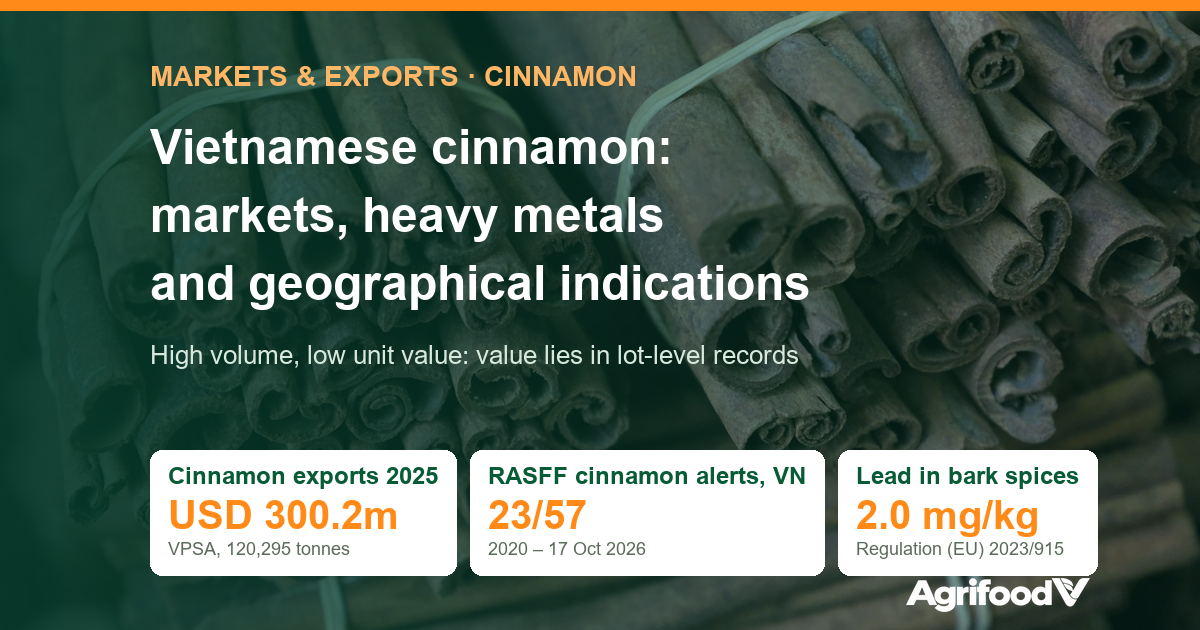
Vietnam sold more than 120,000 tonnes of cinnamon to the world in 2025 and supplies almost all of India’s cinnamon imports, yet in the EU Vietnamese cinnamon accounts for about a third of import volume but only about a quarter of import value. At the same time, Vietnam is the origin with the most cinnamon notifications in the EU’s RASFF system, and nearly half of those notifications concern lead or mercury. This article puts three stories side by side: the market, heavy metals and geographical indications, so that investors can see why the value of cinnamon lies in plants and growing areas that can prove what they sell, not in the name.
Key points
- Cinnamon exports in 2025 reached 120,295 tonnes and USD 300.2 million, the highest on record; in the first nine months of 2026 they reached 93,231 tonnes and USD 239.1 million (VPSA). India took 37.6% of the volume.
- In 2024, Vietnamese cinnamon made up about 36% of the volume but about 26% of the value of EU cinnamon imports from outside the bloc; the unit value was about USD 3,370 per tonne, against about USD 5,500 per tonne for Indonesia (UN Comtrade, importer-reported data).
- From 2020 to 17 October 2026, Vietnam was the origin of 23 of 57 cinnamon notifications in RASFF, 11 of them for lead or mercury, mostly on ground cinnamon. The EU limits lead in bark spices to 2.0 mg/kg.
- In the US, FDA Import Alert 99-42 (version of 20 October 2026) lists 8 Vietnamese cinnamon and cassia facilities; from 23 October 2026, detained lots must be tested for metals at a LAAF-accredited laboratory.
- Van Yen and Tra My cinnamon are on the list of Vietnamese geographical indications protected in the EU under the EVFTA; Bac Ha cinnamon bark was granted a geographical indication on 25 September 2026.
The market: large volumes, low unit values
According to the Vietnam Pepper and Spice Association (VPSA), Vietnam exported 120,295 tonnes of cinnamon in 2025, worth USD 300.2 million, up 20.4% in volume and 9.4% in value. India was the largest market with 45,184 tonnes (37.6%), followed by the United States with 13,583 tonnes and Bangladesh with 10,202 tonnes. In the first nine months of 2026, exports reached 93,231 tonnes and USD 239.1 million. The Ministry of Industry and Trade ranks Vietnam third in the world for cinnamon production and exports, after Indonesia and China; importer-reported data on UN Comtrade suggest Vietnam may lead in export volume, so a claim of being “the world’s largest” depends on the measure used.
India shows both the strength and the limit of the current model. In 2024, Vietnam supplied 90.2% of the volume and 85.4% of the value of India’s cinnamon imports (UN Comtrade, India’s reported data). According to UNCTAD tariff data that AgrifoodV has not been able to check against India’s original tariff schedule, cinnamon enters India at 0% under the ASEAN–India agreement, while pepper faces high duties. That is a market for raw-material cinnamon, bought on price.
The EU is a market for specifications. In 2024, the EU imported 17,603 tonnes of cinnamon from outside the bloc, worth USD 82.1 million. Vietnam supplied 6,409 tonnes, about 36% of the volume, but only about 26% of the value. The average CIF unit value of Vietnamese cinnamon was about USD 3,370 per tonne, and of Indonesian cinnamon about USD 5,500 per tonne; Sri Lankan cinnamon at about USD 10,300 per tonne is Ceylon cinnamon, a different species, and cannot be compared directly. Also from importer-reported data for 2024 (counting only lines with actual quantities), ground cinnamon had a unit value of about USD 3,652 per tonne, about 36% higher than whole cinnamon at about USD 2,685 per tonne. The gap is small, because ground cinnamon is also the product with the most notifications.
| Market | Duty on cinnamon (HS 0906) of Vietnamese origin | Heavy metals and contaminants to know |
|---|---|---|
| EU | 0% (MFN already 0%) | Lead in bark spices 2.0 mg/kg (Regulation (EU) 2023/915, point 3.1.12.3); mercury under the maximum residue levels of Regulation (EC) 396/2005 (amended by 2018/73); ethylene oxide 0.1 mg/kg |
| United States | Duty-free; raw spices 0904–0910 exempt from the 12.5% Section 301 duty | FDA alerts on lead in ground cinnamon (2024–2025); Import Alert 99-42 allows detention without physical examination for listed facilities |
| Japan | Duty-free | Residues under the positive list system, uniform limit 0.01 ppm |
| Codex (international reference) | — | Lead 2.5 mg/kg for bark spices, adopted at CAC48 (November 2025, according to a secondary source); no Codex product standard for cinnamon yet |
Heavy metals: the biggest problem for Vietnamese cinnamon in the EU
AgrifoodV searched the EU’s RASFF database by notification title: from 2020 to 17 October 2026 there were 57 notifications on cinnamon and cassia, of which Vietnam was the origin of 23 (about 40%, the most), India 8, Madagascar 4 and Indonesia 4. Notifications on Vietnamese cinnamon by year were 1, 2, 2, 3, 8, 5 and 2 (2026, to mid-October). The largest hazard group is heavy metals: 11 notifications for lead and/or mercury, 9 of which name the product as ground or powdered cinnamon. Other hazards include microorganisms (Clostridium perfringens, Bacillus cereus) in 5 notifications, ethylene oxide in 2, undeclared SO₂ or sulphites in 2, plus a few cases of pesticide residues, chlorate and PAHs. Because the search was based on titles, the real numbers may be higher.
The EU legal framework is fairly clear. Regulation (EU) 2023/915 on contaminants (consolidated version of 19 August 2026) sets a maximum lead level of 2.0 mg/kg for bark spices, higher than for fruit spices (0.60 mg/kg) and seed spices (0.90 mg/kg). The regulation sets no mercury limit for spices; mercury in spices is managed as residues of mercury compounds under Regulation (EC) 396/2005, as supplemented by Regulation (EU) 2018/73. One point worth noting: Implementing Regulation (EU) 2019/1793 (consolidated version of 30 June 2026) does not currently place Vietnamese cinnamon under increased official controls, while Indian cinnamon is being checked for ethylene oxide at a frequency of 20%. That advantage holds only if the number of notifications does not rise again.
In the US, pressure comes from two directions. FDA has warned consumers about certain ground cinnamon products containing lead since 2024; those notices do not name a country of origin, so it would be wrong to say that “FDA warned about Vietnamese cinnamon”. But in Import Alert 99-42 on heavy metals (published 20 October 2026), the Vietnam section lists 8 facilities with whole or ground cinnamon and cassia products, added in 2022, 2024 and 2025; the problem recorded is mainly lead, with arsenic and cadmium for some facilities. Goods from these facilities are detained without physical examination, and from 23 October 2026 all metal testing to support the release of detained lots must be done at a laboratory accredited under the LAAF programme (21 CFR 1.1107).
AgrifoodV’s view: the data show that the risk is concentrated in ground product. The source of the metal in each case is not published, so a plant should not guess but measure: analyse lead and mercury at each step (bark from each area, after cleaning, after grinding, after blending) to find out whether the metal comes from soil, dust, equipment or the mixing of lots. Only when the point of origin is known can the right measure be chosen.
Standards: cinnamon has no Codex standard
The Codex Committee on Spices and Culinary Herbs (CCSCH) has adopted standards for many spices, but the draft standard for dried bark spices, which includes cinnamon, was returned to Step 2/3 at its eighth session (October 2025) for redrafting, with an electronic working group chaired by Brazil for the next session. Meanwhile, buyers rely on ISO 6538 for cassia (China, Indonesia, Vietnam; the 1997 edition is widely cited and a revision is in the process of publication) and its equivalent TCVN 8957:2011, together with each customer’s own specification for moisture, volatile oil, extraneous matter, microbiology and heavy metals.
A topic often raised together with cinnamon is coumarin. The EU sets no coumarin limit for cinnamon itself; the limits apply to finished foods containing cinnamon, under Regulation (EC) 1334/2008 (BfR). That is an issue for bakery and food manufacturers, not a reason why cassia is rejected at EU borders.
Geographical indications: an asset that pays only with a file behind it
Vietnamese cinnamon has four geographical indications for which a certificate or grant date has been seen: Van Yen cinnamon (2010, an area now in Lao Cai province), Tra My cinnamon (October 2011, now in Da Nang city), Tra Bong cinnamon (23 November 2020, now in Quang Ngai province) and Bac Ha cinnamon bark (Certificate No. 00158, Decision 540/QD-SHTT of 25 September 2026 of the Intellectual Property Office of Vietnam, Lao Cai province). According to the WTO and Integration Center (VCCI), Van Yen and Tra My cinnamon are among the 39 Vietnamese geographical indications protected in the EU under Annex 12-A of the EVFTA; Tra Bong and Bac Ha are not on that list.
The growing areas already have a base for premium product. According to Lao Cai Newspaper (January 2026), the new Lao Cai province (including former Yen Bai) has 147,571.54 ha of cinnamon, of which 24,241.5 ha held organic or equivalent certification by the end of 2025; in 2025 the province harvested 47,569 tonnes of dried bark and 1,200 tonnes of essential oil (another article in the same newspaper gives about 42,000 tonnes of dried bark, so output figures should be read as estimates). The province aims to have 100 cinnamon products traceable and digitised by 2030.
AgrifoodV’s view: a geographical indication protects a name; it does not guarantee that a lot meets the 2.0 mg/kg lead limit or is free of ethylene oxide. Premium buyers in the EU pay for provable origin, meaning a chain of records linking growing area, harvest date, primary-processing lot and grinding lot with the test results for each lot. A lot of cinnamon powder carrying the Van Yen name that is notified for lead would damage the whole geographical indication, not just one company.
What companies should do
Recommendations from AgrifoodV:
- Separate strategy by market: India buys raw-material cinnamon on price; the EU, US and Japan buy specifications and documentation. A plant serving both groups must separate lots from receiving onwards.
- Treat lead, mercury, ethylene oxide and microbiology as release criteria for every lot of ground cinnamon, tested at an accredited laboratory; for US-bound goods, have a LAAF laboratory lined up.
- Map metals by process step: sample bark by area, after cleaning, after grinding and after blending; check the contact materials of the mills and the cleaning procedure between lots.
- Use geographical indications and organic certification as part of the traceability file, not as an advertising label; link growing-area data to production lots as analysed in the article from farm records to traceability.
- Inspect incoming raw material and retain samples for every lot, following the template in the article receiving, incoming inspection and sample retention.
The overall picture of an export spice and herb plant is set out in the pillar article spice and herb processing plants for EU, US and Japanese standards. AgrifoodV supports market and import-requirement analysis, processing plant development and traceable raw-material growing areas.
References
- Vietnam Pepper and Spice Association (VPSA) via Thue & Hai quan Online. Xuất khẩu quế đem lại 300 triệu USD [Cinnamon exports bring in USD 300 million], 8 January 2026. thuehaiquan.tapchikinhtetaichinh.vn.
- VPSA. Xuất khẩu Quế từ tháng 1 đến tháng 9 năm 2026 [Cinnamon exports January–September 2026], 6 October 2026. vpsaspice.org.
- Ministry of Industry and Trade (Vietnam Trade Promotion Agency). Xúc tiến xuất khẩu các sản phẩm quế, hồi và cây dược liệu [Promoting exports of cinnamon, star anise and medicinal plants]. moit.gov.vn.
- United Nations. UN Comtrade, HS 0906, 0906.19, 0906.20, importer-reported data for 2024 (accessed 10–17 October 2026; unit values calculated by AgrifoodV using only lines with actual quantities). comtradeplus.un.org.
- European Commission. RASFF Window, notifications on cinnamon and cassia 2020 – 17 October 2026 (searched by AgrifoodV by title). webgate.ec.europa.eu.
- European Union. Regulation (EU) 2023/915 on maximum levels for contaminants, Annex I point 3.1.12, consolidated version CELEX 02023R0915-20260819 (read 29 October 2026). eur-lex.europa.eu.
- European Union. Regulation (EU) 2018/73 amending Annexes II and III to Regulation (EC) 396/2005 as regards maximum residue levels for mercury compounds, 16 January 2018 (OJ L 13, 18 January 2018). eur-lex.europa.eu.
- European Union. Implementing Regulation (EU) 2019/1793 on increased official controls, consolidated version CELEX 02019R1793-20260630 (read 29 October 2026). eur-lex.europa.eu.
- FDA, United States. Import Alert 99-42, Detention without physical examination of foods due to heavy metal (toxic element) contamination, published 20 October 2026. accessdata.fda.gov.
- FDA, United States. FDA alert concerning certain cinnamon products due to presence of elevated levels of lead, 2024–2025. fda.gov.
- USTR. Section 301 notice of final action, 23 July 2026; USITC, HTSUS 2026. ustr.gov (PDF); hts.usitc.gov.
- European Commission, TARIC (HS 0906, origin Vietnam, accessed 17 October 2026); Japan Customs, tariff schedule of 1 April 2026, Chapter 9. ec.europa.eu; customs.go.jp.
- FAO/Codex. News on the CCSCH8 session on spice standards, 20 October 2025. fao.org.
- BfR (Germany). FAQ on coumarin in cinnamon and other foods, 27 September 2012. bfr.bund.de.
- Intellectual Property Office of Vietnam. Bảo hộ chỉ dẫn địa lý “Bắc Hà” cho sản phẩm quế vỏ [Protection of the “Bac Ha” geographical indication for cinnamon bark], 5 October 2026. ipvietnam.gov.vn.
- Industry and Trade Magazine. Quế Trà Bồng: từ non cao đi khắp năm châu [Tra Bong cinnamon: from the highlands to five continents], 22 June 2025; Ministry of Industry and Trade. Ngọt thơm sản phẩm quế Yên Bái [The sweet aroma of Yen Bai cinnamon]. tapchicongthuong.vn; moit.gov.vn.
- WTO and Integration Center (VCCI). Key EVFTA commitments on Geographical Indications (list of 39 Vietnamese geographical indications in Annex 12-A). wtocenter.vn.
- Lao Cai Newspaper. 100 sản phẩm quế của Lào Cai sẽ được truy xuất nguồn gốc, số hóa vào năm 2030 [100 Lao Cai cinnamon products to be traceable and digitised by 2030], 28 January 2026. baolaocai.vn.
Article by AgrifoodV, compiled from the sources above (accessed 10–29 October 2026). RASFF notification counts were searched by AgrifoodV by title and may be incomplete. Unit values and shares are AgrifoodV calculations on importer-reported data and do not reflect quality differences. No national figure for Vietnam’s total cinnamon area has been published by a ministry that AgrifoodV could verify; Lao Cai’s output has two different figures in the same newspaper. India’s tariff and the Codex lead level come from secondary sources; the list of geographical indications protected in the EU follows the WTO and Integration Center (VCCI) and has not been checked against the text of the Agreement; the grant years of the Van Yen and Tra My geographical indications are taken from press reports, and their certificate numbers have not been verified. This content is not a substitute for legal advice. Cover image: Alfredo Marco Pradil / Pexels.
Looking at Vietnam as a sourcing origin or a place to build a value chain?
Tell us your product, target market and expected volumes. In a 30–45 minute online call, AgrifoodV reviews buyers, standards, processing capacity and growing areas with you, starting from the market.
Book a call →Sourcing from Vietnam© 2026 AgrifoodV. Nội dung được phép trích dẫn khi ghi rõ nguồn và đặt liên kết tới bài gốc; không sao chép toàn văn. Xem Điều khoản sử dụng nội dung.