AgrifoodV ·
Diced aloe in syrup and aloe juice are the two highest-volume products made from aloe leaves, but large buyers in the beverage and yoghurt industries do not buy “aloe”; they buy a set of specifications: cubes that stay firm after heat treatment, aloin below the limit in every lot, and pH and heat processes proven by records. Those three parameters are decided between the moment the leaf is cut in the field and the moment the product is filled. This article walks through the industrial process stage by stage, with the figures that have been published and the points each plant must validate for itself.
Key points
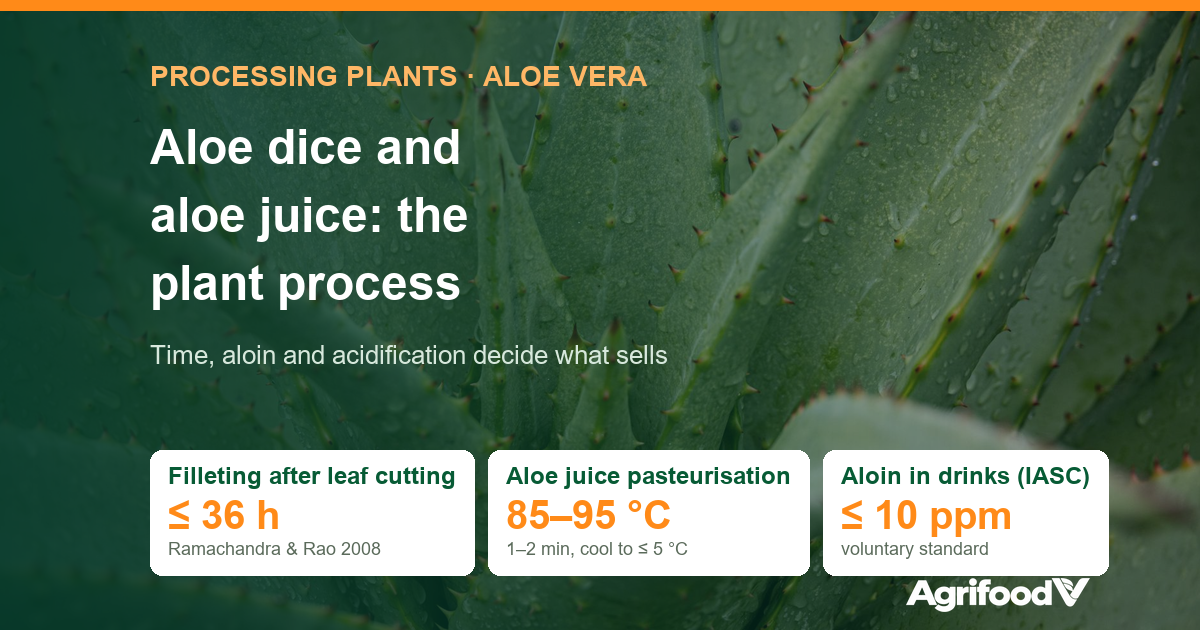
- Leaves begin to lose activity 6 hours after cutting at ambient temperature, must be chilled within 4–6 hours and filleted within 36 hours. Aloe dice and aloe juice plants must be located inside the growing area.
- Aloin sits in the yellow latex layer under the rind: peeling, edge trimming and fillet washing are the main controls, not filtration afterwards. The voluntary IASC standard for drinkable products is a maximum of 10 ppm aloin; the EU prohibits aloe leaf preparations containing hydroxyanthracene derivatives.
- Aloe juice according to the scientific literature: homogenise within 10–20 minutes, adjust pH to 3.0–3.5, pasteurise at 85–95 °C for 1–2 minutes, then cool rapidly to 5 °C. Dice packed in cups or cans need their own validated heat process based on cube size and packaging.
- For the US, a product acidified to pH 4.6 or below may fall under “acidified foods”: the plant must register with FDA and file its process before shipping the first lot.
Two products, one raw material: the inner leaf fillet
An aloe leaf consists of the green rind, a yellow latex layer under the rind that contains aloin and anthraquinones, and the clear inner fillet that holds the gel, whose main polysaccharide is acemannan. According to the review by Ramachandra and Srinivasa Rao (2008), the gel is more than 99% water. Aloe dice keep the fillet structure intact and are sold on firmness and cube size; aloe juice is gel that has been ground and homogenised, and is sold on clarity, viscosity and flavour. Both go into beverage, yoghurt and dessert plants as ingredients, so buyers require lot-by-lot records just as they do for fruit puree. Where these two products sit on the aloe value ladder is set out in the pillar article Vietnamese aloe vera: from fresh leaf to gel, powder and extracts for premium food and cosmetics markets.
The process stage by stage
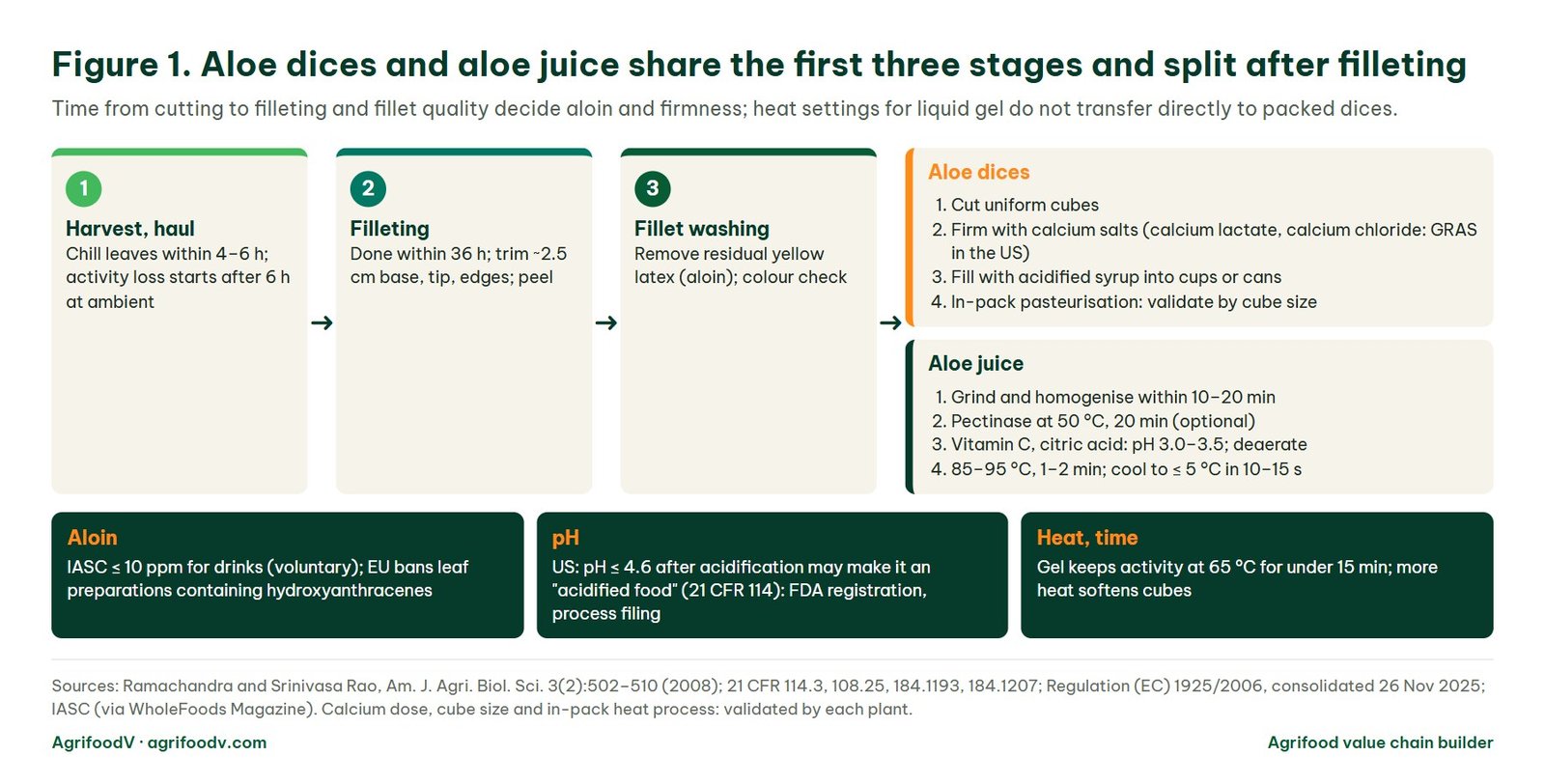
| Stage | Published parameters | Records the plant must keep |
|---|---|---|
| 1. Cutting, transport | Activity loss begins after 6 hours at ambient temperature; chill leaves within 4–6 hours | Cutting time, arrival time, leaf temperature at intake, field lot |
| 2. Filleting | Completed within 36 hours of harvest; trim about 2.5 cm from the base, the tip and the leaf edges; peel so that the yellow latex does not mix into the gel | Waiting time, fillet yield, check for yellow colour on fillets |
| 3a. Aloe dice | Calcium salts (calcium lactate, calcium chloride) are firming agents recognised as safe in the US; calcium chloride at no more than 0.22% in beverages and 0.2% in processed fruit when used | Cube size, calcium concentration and treatment time, firmness before and after heat treatment |
| 3b. Aloe juice | Grind and homogenise within 10–20 minutes to avoid browning; pectinase at 50 °C for 20 minutes does not reduce polysaccharide activity; add vitamin C and citric acid, adjust pH to 3.0–3.5; deaerate | pH, Brix, viscosity per batch; time from grinding to heat treatment |
| 4. Heat treatment | Liquid form: 85–95 °C for 1–2 minutes, rapid cooling to 5 °C in 10–15 seconds; gel retains activity when heated at 65 °C for under 15 minutes | Time–temperature charts, heat process validation study for packed dice |
| 5. Release testing | Aloin: IASC maximum 10 ppm for drinkable products (voluntary); the EU does not allow leaf preparations containing hydroxyanthracenes | Aloin, microbiology, equilibrium pH, solids and liquid weight for every lot |
Two notes on reading the table. The heat parameters in the review apply to liquid gel flowing through a heat exchanger. Dice already filled in cups or cans are pasteurised in the pack, so the time for the cube centre to reach temperature depends on cube size, the solids-to-liquid ratio and the type of packaging; this process must be validated separately, not copied from the liquid product. Second, cube firmness is traded off against heat: the more heat, the softer the cube. The specific calcium concentration and treatment time are not in any public source that AgrifoodV could verify, and are each plant’s own know-how.
Aloin: controlled at the filleting table, not in the laboratory
Ramachandra and Srinivasa Rao describe two ways of obtaining gel: hand filleting gives gel with fewer anthraquinones but is labour-intensive; whole-leaf grinding gives higher yield but requires activated carbon filtration to remove aloin and aloe-emodin, and the carbon also strips out many other components of the gel. Aloe dice allow only the first method, because the cube must keep its structure. That makes the filleting table the most important control point in the whole plant: peeling skill, depth of edge trimming and fillet wash water.
Aloin limits apply to the finished product. In the EU, Annex III Part A of Regulation (EC) 1925/2006 (consolidated 26 November 2025) prohibits in food “preparations from the leaf of Aloe species containing hydroxyanthracene derivatives”; the text gives no ppm figure. In the US, the International Aloe Science Council (IASC) runs a voluntary certification programme with a maximum of 10 ppm aloin for drinkable products. The legal status in each market is covered in the pillar article; the point here is that the aloin sampling plan must follow fillet lots, so that when a lot exceeds the limit it can be traced back to the shift, the table and the field.
Acidification: for the US market it is a legal procedure
Lowering pH to 3.0–3.5 with citric acid is a technical step to protect colour and inhibit microorganisms. For the US, it also determines which legal category the product falls into. Under 21 CFR 114.3, “acid foods” are foods with a natural pH of 4.6 or below; “acidified foods” are low-acid foods to which acids or acid foods are added, with a water activity above 0.85 and a finished equilibrium pH of 4.6 or below. Products stored, distributed and retailed under refrigeration are outside this scope.
If the natural pH of the gel in a raw-material lot is above 4.6, acidified aloe dice or juice sold at ambient temperature will be acidified foods. In that case, under 21 CFR 108.25, the plant must register the establishment with FDA on Form 2541 within 10 days of first processing, file its scheduled processes on Form 2541e within 60 days of registration and before packing any new product, and acidification, pH control and heat treatment must be supervised by a person who has completed an FDA-approved course. The natural pH of aloe gel varies by lot and season; the plant must measure and record it itself to know which category its product falls into, and then engage an expert to establish the heat process correctly.
On tariffs, according to AgrifoodV’s data set checked on 25 October 2026: sweetened aloe drinks entering Japan must be declared under CPTPP to get 0% (VJEPA has no commitment and the general rate is 13.4%); in the US, aloe drinks pay an additional 12.5% under Section 301, while aloe dice in syrup, if classified under 2008.99.91, are on the exemption list, and the classification should be confirmed by a customs broker. How to draw up a product specification sheet for buyers is explained in the article From market requirements to product specifications: Brix, product form, packaging.
What companies should do
AgrifoodV recommendations:
- Locate the plant within a radius where leaves reach the filleting table the same day, and size filleting capacity for the harvest peak; fillet waiting time is a figure to record for every lot.
- Invest in the filleting table before the equipment: standardise edge trimming, peeling and wash water, and test aloin by fillet lot from the very first trial run.
- Validate the heat process for each cube size and each type of packaging, measure firmness before and after heat treatment, and do not copy aloe juice parameters over to aloe dice.
- If targeting the US, measure the natural pH of the gel over at least one season, determine whether the product is an acidified food, and complete FDA registration before making offers.
AgrifoodV supports companies in reviewing processes, layout and documentation for processing plants to the requirements of the target market.
References
- Ramachandra C.T., Srinivasa Rao P. “Processing of Aloe Vera Leaf Gel: A Review”. American Journal of Agricultural and Biological Sciences 3(2):502–510, 2008. DOI: 10.3844/ajabssp.2008.502.510.
- United States. 21 CFR 114.3, Acidified foods: definitions. law.cornell.edu.
- United States. 21 CFR 108.25, Acidified foods: emergency permit control, establishment registration and process filing (Forms FDA 2541, 2541e). law.cornell.edu.
- United States. 21 CFR 184.1193 (calcium chloride) and 184.1207 (calcium lactate), substances generally recognised as safe. law.cornell.edu; law.cornell.edu.
- European Union. Regulation (EC) 1925/2006, Annex III Part A (amended by Regulation (EU) 2021/468), consolidated 26 November 2025. eur-lex.europa.eu.
- WholeFoods Magazine. “Aloe Vera: Here to Stay” (IASC certification programme, maximum 10 ppm aloin for drinkable products). wholefoodsmagazine.com.
- USTR. Notice of final action under Section 301 concerning Vietnam, Federal Register 23 July 2026 (exclusion list, Annexes I and II). ustr.gov.
- Japan Customs. Customs tariff schedule, Chapter 22 (version of 8 August 2026). customs.go.jp.
Article by AgrifoodV, compiled from the sources above (accessed 29 October 2026). The heat, pH and time parameters in this article are figures published in the scientific literature and in legislation; the operating regime for each product must be validated by the plant. HS codes and tariff rates should be confirmed by a customs broker for each product. This content is not a substitute for legal advice. Cover image: Magda Ehlers / Pexels.
Looking at Vietnam as a sourcing origin or a place to build a value chain?
Tell us your product, target market and expected volumes. In a 30–45 minute online call, AgrifoodV reviews buyers, standards, processing capacity and growing areas with you, starting from the market.
Book a call →Sourcing from Vietnam© 2026 AgrifoodV. Nội dung được phép trích dẫn khi ghi rõ nguồn và đặt liên kết tới bài gốc; không sao chép toàn văn. Xem Điều khoản sử dụng nội dung.