AgrifoodV ·
Fresh lychee has roughly eight weeks to sell, and every premium market sets its own quarantine gate for fresh fruit. Frozen IQF lychee takes a different route: in most major markets, hard-frozen product does not go through the irradiation or fumigation required for fresh fruit, and in 2026 it is the only processed form of lychee that the United States exempts from the additional Section 301 duty. In return, the plant must solve three problems: keeping the colour, keeping the aroma and proving safety for a product that has no kill step anywhere on the line.
Key points
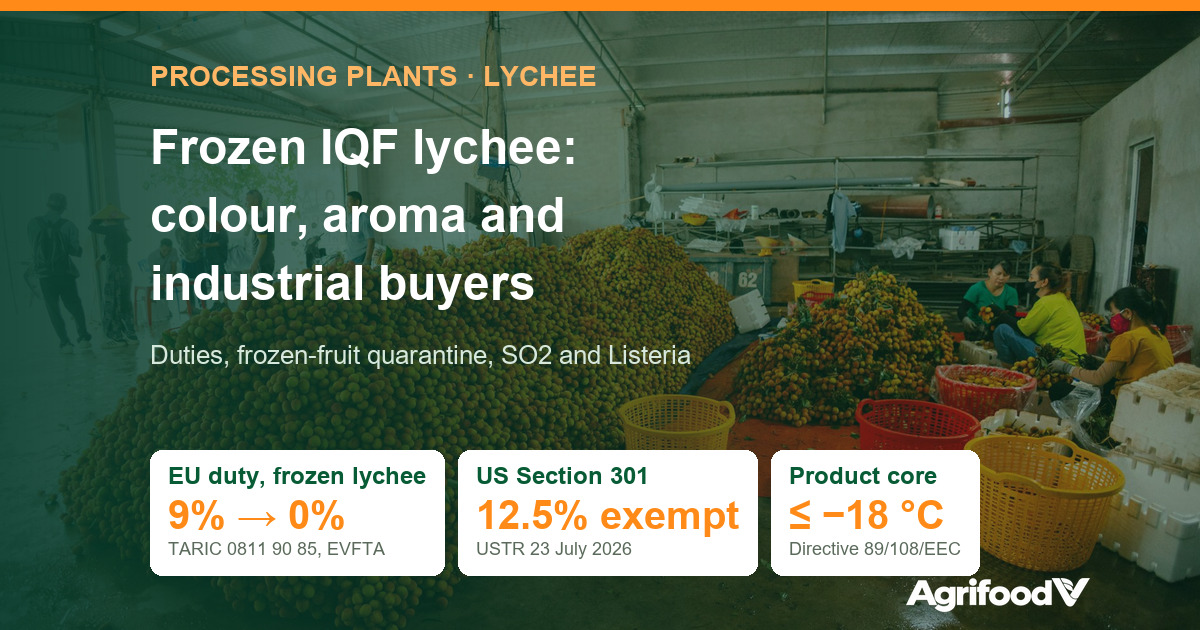
- Duties on frozen lychee of Vietnamese origin fall to 0% in the EU (MFN 9%), Japan, Korea and China when the correct agreement is claimed; the US charges MFN 14.5% but exempts the 12.5% Section 301 duty.
- Japan admits fruit that is frozen hard or at −17.8 °C or below even for fruit otherwise prohibited; the US still requires an import permit for frozen fruit and vegetables. Frozen does not automatically mean quarantine-free.
- The EU does not allow SO₂ on frozen fruit (only on white vegetables and frozen potatoes); ascorbic acid and citric acid may be used as needed.
- According to EFSA, freezer enclosures are an environment where Listeria persists and is very hard to eliminate once established. For peeled lychee, plant sanitation is itself a safety specification of the product.
Why frozen is a separate gate for lychee
The pillar article on Vietnamese lychee showed that fresh fruit must be irradiated for the US and Australia, fumigated with methyl bromide for Japan, and that no document opening Korea to fresh Vietnamese lychee has been found. Frozen product follows a different set of rules. According to the Plant Protection Station of Japan’s Ministry of Agriculture, Forestry and Fisheries, fruit in a prohibited category may still be imported if the inspector confirms it is completely frozen or at −17.8 °C or below; the shipment must still pass an inspection of its frozen state. The US admits frozen fruit and vegetables under 7 CFR 319.56-12, but with an import permit and APHIS holding conditions; the specific conditions for Vietnamese lychee must be checked in the APHIS fruit and vegetable import database. For China, according to a US Department of Agriculture report (September 2024, secondary source), the General Administration of Customs removed the quarantine market-access requirement for frozen fruit, but producers and cold stores must still register on the CIFER system.
| Market | Duty on frozen lychee of Vietnamese origin | Conditions for frozen product |
|---|---|---|
| EU | 0811 90 85: MFN 9% → EVFTA 0% | Stored at ≤ −18 °C at all points (Directive 89/108/EEC); no SO₂ |
| United States | 0811.90.80: MFN 14.5%; exempt from the 12.5% Section 301 duty | Import permit under 7 CFR 319.56-12; facility registration with FDA |
| Japan | 0811.90: 12% or 7.2% depending on line → VJEPA 0% | Frozen hard or ≤ −17.8 °C at inspection; frozen food stored at ≤ −15 °C |
| Korea | 0811909000: VKFTA 0% | Frozen at ≤ −17.8 °C and kept so until arrival, with a phytosanitary certificate (APQA document 2016, secondary source) |
| China | MFN 30% → ACFTA 0% (secondary tariff lookup) | Facility registration on CIFER under Decree 280 |
AgrifoodV’s view: for the US, frozen is the only processed form of lychee that does not carry the extra 12.5%; for Japan and Korea, frozen avoids the fresh-fruit treatment problem. That is why the IQF line deserves to be costed before drying or canning when an investor chooses markets.
Colour: a race against time, not a chemical problem
The red colour of lychee peel fades quickly after harvest as anthocyanins break down, a process linked to polyphenol oxidase activity as the peel loses water (Fruits, CIRAD). The traditional way to hold the colour of fresh lychee is sulphur fumigation, but for frozen product going to the EU that door is closed: Regulation (EC) 1333/2008, Annex II, category 04.1.3 (frozen fruit and vegetables) allows SO₂ only for white vegetables including mushrooms (50 mg/kg) and frozen potatoes (100 mg/kg). The same category allows ascorbic acid, citric acid and their salts at quantum satis. The US does not allow SO₂ on fruit sold as fresh (21 CFR 182.3862), and sulphites remaining in a processed finished product must be declared on the label (21 CFR 101.100(a)(4)).
The consequence is that the colour of IQF lychee is decided before the fruit enters the freezer: fruit picked at the right maturity, cooled early, delivered to the plant the same day and moved through peeling and pitting without waiting. For whole frozen lychee in the shell, the peel keeps darkening on thawing; for peeled aril, the risks are brown spots and drip. AgrifoodV has not found published data on drip loss or colour stability of IQF lychee under different freezing regimes, so these parameters must be tested on raw material from the plant’s own growing area.
Aroma and texture: freezing speed and a stable cold store
Slow freezing forms large ice crystals that pierce cell walls; on thawing, cell sap drains out with sugars, acids and aroma compounds. The International Institute of Refrigeration (IIR) classifies freezing speed in four levels: slow at 0.1–0.2 cm per hour (freezing in a cold store), quick at 0.5–3 cm per hour (blast tunnels, plate freezers), rapid at 5–10 cm per hour (individual freezing in fluidised-bed equipment) and ultra-rapid above 10 cm per hour (spraying or immersion in refrigerant). For individually frozen product, the IIR considers speeds above 5 cm per hour satisfactory. Fluidised-bed freezing equipment suits small pieces up to about 3 cm in diameter; strawberries need about 9–13 minutes (Saravacos and Kostaropoulos, 2002). Peeled lychee aril is close to that size limit, so the choice between fluidised-bed and belt freezing equipment has to be based on trials.
EU law defines “quick-frozen” as passing through the zone of maximum crystallisation as rapidly as possible and then being kept continuously at −18 °C or lower at all points, with only brief upward fluctuations of up to 3 °C allowed in transport (Directive 89/108/EEC, Articles 1 and 5). The Codex code of practice CXC 8-1976 treats freezing as complete only when the product core reaches −18 °C after thermal stabilisation. Much of the value of quick freezing can be lost in storage: temperature fluctuations make small crystals melt and recrystallise as large ones. Lychee aroma after thawing therefore depends on the whole cold chain, not only on the freezing equipment.

Safety: a product with no kill step
Frozen vegetables are usually blanched; peeled lychee is not. After washing, every microorganism on belts, trays and freezer enclosures goes straight into the bag. EFSA’s 2020 assessment of Listeria monocytogenes in frozen fruit and vegetables found that the bacterium persists on conveyor belts despite daily cleaning, and that freezer enclosures are a humid environment that is almost impossible to clean completely once contaminated; EFSA regards environmental monitoring as a key activity for the sector. If frozen lychee is sold as ready-to-eat (for smoothies or desserts without heating), lots entering the EU must meet the Listeria criteria of Regulation (EC) 2073/2005. In Japan, frozen food eaten without heating must have a total bacterial count of no more than 100,000/g and be coliform-negative (Ministry of Health, Labour and Welfare Notice 370/1959). How to zone dirty and clean areas for such a line is analysed in the article on one-way flow and clean/dirty zoning.
What industrial buyers buy
Customers for IQF lychee are manufacturers of beverages, ice cream, desserts and bakery products, buying in bulk packs for further processing. For product not sold to consumers, Directive 89/108/EEC (Article 9) requires the name of the product, net quantity, lot number and the name and address of the manufacturer or of a seller established in the EU; retail product must also carry the words “quick-frozen”, the storage period, the storage temperature and a statement “do not refreeze after defrosting” (Article 8). Beyond the legal minimum, buyers judge a plant on consistency between lots: fruit size, breakage, clumping, brown spots, foreign matter and a pesticide residue file, with the EU default of 0.01 mg/kg for active substances without a specific limit (Regulation (EC) 396/2005).
What companies should do
Recommendations from AgrifoodV:
- Choose the market before the equipment: the US (MFN 14.5%, Section 301 exempt), the EU and Japan (0% under agreements) take the same product but differ on labelling, microbiology and storage temperature.
- Do not rely on SO₂ for colour in EU-bound product. Invest in time instead: coded growing areas close to the plant, same-day cooling, and enough people or machines at the peeling step for the peak of the season.
- Trial fluidised-bed and belt freezing on the area’s own lychee aril, measuring freezing speed, drip and colour after thawing before fixing the configuration.
- Design the high-risk zone into the drawings: one-way flow, freezer enclosures and belts that are easy to clean, and a documented environmental Listeria monitoring programme.
- Keep the finished-goods store stable; log temperatures automatically from the freezer to the container.
AgrifoodV supports processing plant development and market-by-market analysis of import requirements. Further reading: the design brief for an export processing plant.
References
- European Union. Directive 89/108/EEC on quick-frozen foodstuffs, consolidated version CELEX 01989L0108-20130701. eur-lex.europa.eu.
- European Union. Regulation (EC) 1333/2008 on food additives, Annex II, category 04.1.3, consolidated version CELEX 02008R1333-20260818 (read 29 October 2026). eur-lex.europa.eu.
- European Union. Regulation (EC) 2073/2005 on microbiological criteria, consolidated version CELEX 02005R2073-20260701. eur-lex.europa.eu.
- Codex Alimentarius. CXC 8-1976, Code of Practice for the Processing and Handling of Quick Frozen Foods; CXS 320-2015, Standard for Quick Frozen Vegetables. fao.org.
- EFSA BIOHAZ Panel. The public health risk posed by Listeria monocytogenes in frozen fruit and vegetables including herbs, blanched during processing. EFSA Journal 2020;18(4):6092. pmc.ncbi.nlm.nih.gov.
- Saravacos G.D., Kostaropoulos A.E. Handbook of Food Processing Equipment, chapter 9 “Refrigeration and Freezing Equipment” (citing the IIR classification of freezing speed). Kluwer Academic/Plenum, 2002.
- Plant Protection Station, Ministry of Agriculture, Forestry and Fisheries of Japan. FAQ on plant imports, question 14 (frozen fruit). maff.go.jp.
- Ministry of Health, Labour and Welfare of Japan. Standards for frozen food under Notice 370/1959 (excerpt). mhlw.go.jp.
- United States. 7 CFR 319.56-12 (frozen fruits and vegetables); 21 CFR 182.3862 and 101.100(a)(4) (sulphites). law.cornell.edu; ecfr.gov.
- Animal and Plant Quarantine Agency of Korea (APQA). Plant Quarantine Procedures of Korea, 2016. aseankorea.org.
- USDA FAS. GAIN Report CH2024-0119 on China’s list of imported foods, 23 September 2024 (secondary source on frozen fruit).
- European Commission, TARIC (code 0811 90 85, origin Vietnam); USITC, HTSUS and USTR, Section 301 notice of 23 July 2026; Japan Customs, tariff schedule of 8 August 2026; Korea Customs Service, yesFTA portal (accessed 25 October 2026). ec.europa.eu; ustr.gov (PDF); customs.go.jp.
- Fruits (CIRAD). Study on post-harvest browning of lychee peel and the effect of SO₂. revues.cirad.fr.
Article by AgrifoodV, compiled from the sources above (accessed 25–29 October 2026). China’s tariff rates and the conditions of Korea and China for frozen fruit come from secondary sources; conditions for importing frozen Vietnamese lychee into the US must be checked in the APHIS database for each shipment. AgrifoodV has no published figure for Vietnam’s frozen lychee output. Ten-digit HS codes must be confirmed by a customs broker. This content is not a substitute for legal advice. Cover image: HONG SON / Pexels.
Looking at Vietnam as a sourcing origin or a place to build a value chain?
Tell us your product, target market and expected volumes. In a 30–45 minute online call, AgrifoodV reviews buyers, standards, processing capacity and growing areas with you, starting from the market.
Book a call →Sourcing from Vietnam© 2026 AgrifoodV. Nội dung được phép trích dẫn khi ghi rõ nguồn và đặt liên kết tới bài gốc; không sao chép toàn văn. Xem Điều khoản sử dụng nội dung.