AgrifoodV ·
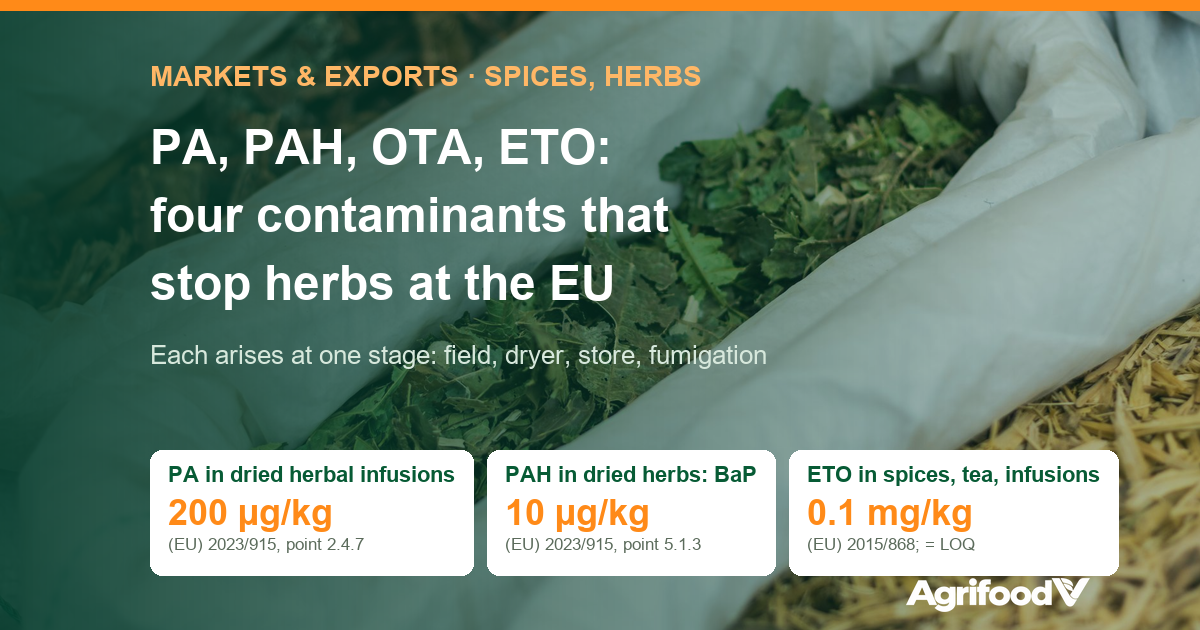
A lot of dried herbs can pass every microbiological criterion and still be refused by the EU, simply because a few weeds were harvested with the crop, smoke from a direct-fired dryer passed over the leaves, or the goods were fumigated once in a transit warehouse. The four contaminant groups pyrrolizidine alkaloids (PA), PAH, ochratoxin A (OTA) and ethylene oxide (ETO) arise at four different stages of the chain, and the EU sets separate limits for each product group. This article places the limits in the latest consolidated texts next to the stage where each contaminant arises, so that processors know which controls sit inside the plant and which must start in the growing area.
Key points
- PA (Regulation (EU) 2023/915, consolidated 19 August 2026): dried herbal infusions 200 µg/kg, dried herbs 400, Camellia tea 150, botanical food supplements 400. Spices in general have no PA limit; only cumin, at 400.
- PAH: dried herbs and dried spices share the same limits of 10 µg/kg benzo(a)pyrene and 50 µg/kg for the sum of 4 PAH. OTA: dried herbs 10, dried spices 15, dried chilli 20 µg/kg.
- ETO: may not be used to treat food in the EU; spices, tea and herbal infusions have a maximum residue level of 0.1 mg/kg, equal to the limit of quantification, including 2-chloroethanol.
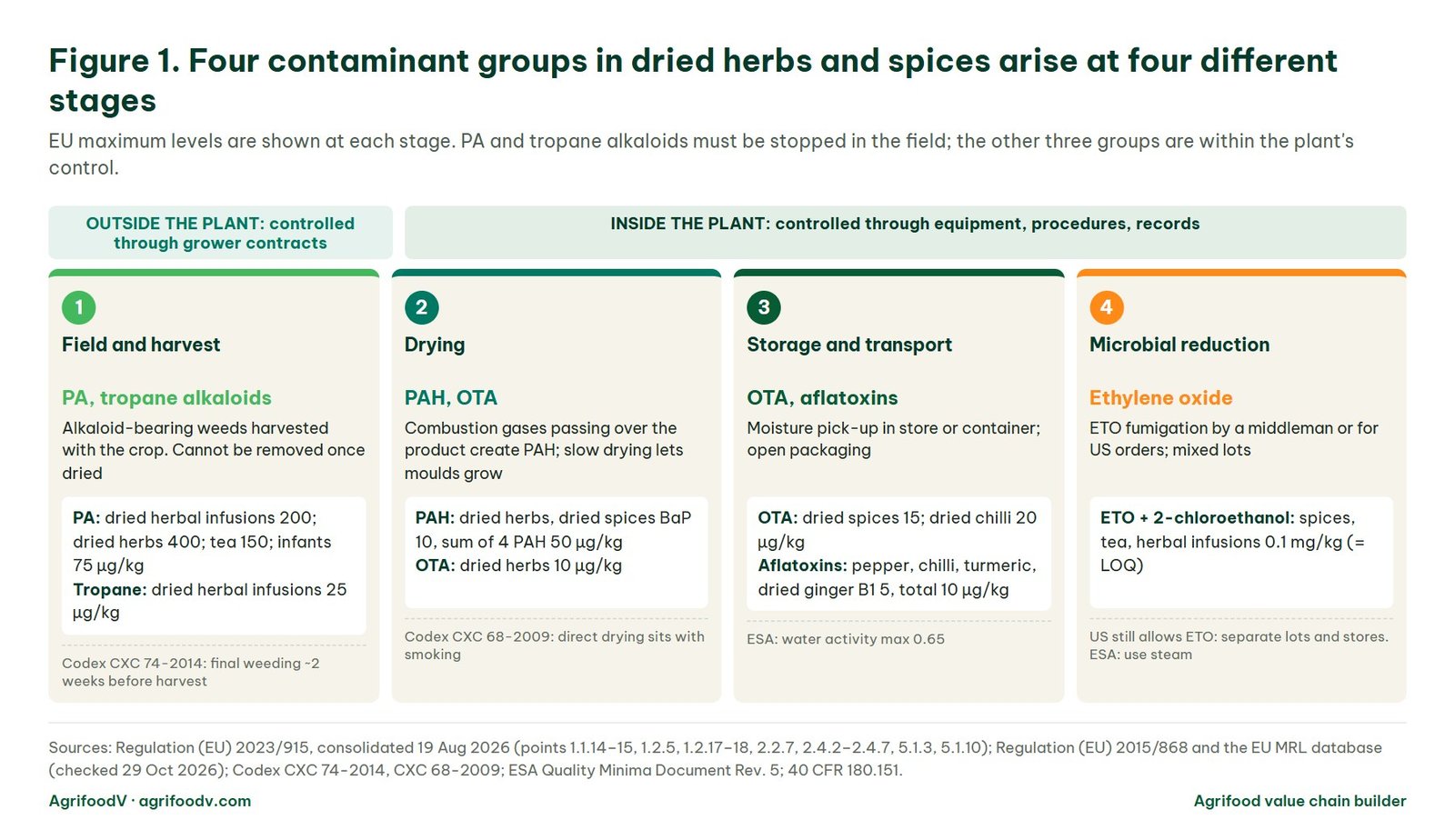
- PA comes from weeds in the field, PAH from dryer smoke, OTA from slow drying and damp storage, ETO from fumigation. Three of the four groups cannot be removed in the plant once the product is contaminated.
Four contaminant groups, four stages of origin
The pillar article Spice and herb plants for export: from raw material to products meeting EU, US and Japanese standards showed that premium buyers buy against standards for microbiology, contaminants, cleanliness and documentation. With contaminants, the difficulty is that the sources are spread along the chain, as Figure 1 shows. A plant fully controls only its own drying, storage and microbial reduction; PA has to be stopped in the field.
EU limits by product group
The levels below are read directly from Regulation (EU) 2023/915 on contaminants (consolidated 19 August 2026) and the European Commission’s pesticide residue database (checked 29 October 2026). The PA limit applies to the sum of 21 alkaloids plus 14 co-eluting alkaloids, calculated as lower bound: results below the limit of quantification count as zero.
| Contaminant | Product | Maximum level | Point |
|---|---|---|---|
| PA (µg/kg) | Dried herbal infusions and ingredients for herbal infusions (except the group below) | 200 | 2.4.7 |
| Dried herbal infusions of rooibos, anise (Pimpinella anisum), lemon balm, chamomile, thyme, peppermint, lemon verbena | 400 | 2.4.8 | |
| Dried herbs (borage, lovage, marjoram, oregano: 1,000) | 400 | 2.4.2, 2.4.3 | |
| Dried Camellia sinensis tea (for infants and young children: 75, including herbal infusions) | 150 | 2.4.4, 2.4.5 | |
| Food supplements containing botanical preparations, including extracts; cumin | 400 | 2.4.10, 2.4.9 | |
| Tropane alkaloids (µg/kg) | Dried herbal infusions (anise seeds only: 50) | 25 | 2.2.7, 2.2.8 |
| PAH (µg/kg) | Dried herbs; dried spices (except cardamom, smoked Capsicum); botanical food supplements | BaP 10; sum of 4 PAH 50 | 5.1.3, 5.1.10, 5.1.16 |
| OTA (µg/kg) | Dried herbs 10; dried ginger root for herbal infusions 15; dried liquorice root 20 | 10–20 | 1.2.5, 1.2.6, 1.2.19 |
| Dried spices 15; dried Capsicum fruit (chilli, chilli powder, paprika) 20 | 15–20 | 1.2.17, 1.2.18 | |
| Aflatoxins (µg/kg) | Dried chilli, pepper, nutmeg, turmeric and mixtures; dried ginger | B1 5; total 10 | 1.1.14, 1.1.15 |
| ETO (mg/kg) | Spices, tea, herbal infusions (fresh herbs: 0.05) | 0.1 (equal to LOQ) | Annex V, Regulation (EC) 396/2005 |
Two details are often missed. For instant herbal infusions made from powdered extracts, the PA and tropane alkaloid limits apply with a concentration factor of 4. And the “dried herbs” limits do not automatically apply to “spices”: pepper, cinnamon, star anise and ginger have no specific PA limit, but they do have PAH, OTA and (for some) aflatoxin limits.
PA: a contaminant born in the field
According to Codex Code of Practice CXC 74-2014 on weed control to reduce PA (adopted in Vietnam as TCVN 12053:2017), more than 6,000 plant species worldwide are expected to contain PA, the liver is the main target organ, and eradicating these species entirely is not feasible. For crops harvested for leaves, flowers or roots for herbal infusions, PA enters the lot when PA-containing weeds are harvested with the crop. Codex recommends weeding before planting, periodically during early growth, and a final weeding about two weeks before harvest where feasible, to significantly reduce the chance of toxic plant parts ending up in the product.
The EU also controls PA at the border. Implementing Regulation (EU) 2019/1793 (consolidated 30 June 2026) currently checks 30% of dried oregano lots and 50% of cumin lots from Türkiye for PA. Vietnamese goods are not on that list, but a plant has no way to remove PA from dried leaves: an over-limit lot can only be destroyed or sent to another market. PA control is therefore a matter of grower contracts, weeding logs and visual checks for foreign plant material at intake, as analysed in the article Raw-material intake and storage: incoming checks, residues, retained samples.
PAH and OTA: contaminants of the dryer and the warehouse
Codex Code of Practice CXC 68-2009 on reducing PAH from smoking and direct drying puts direct drying (combustion gases in contact with the product) in the same risk group as smoking: combustion generates PAH, and the type and amount of contaminants depend on fuel and temperature. For thin leaves, flowers and bark with a large surface area, drying in a wood- or coal-fired kiln where smoke passes over the product is the fastest way to exceed the 10 µg/kg benzo(a)pyrene limit. RASFF data checked by AgrifoodV show traces of this step in Vietnamese goods: between 2020 and October 2026, Vietnamese star anise had 2 notifications, one for anthraquinone and one for anthraquinone plus PAH (2022); Vietnamese cinnamon had 1 PAH notification out of 23 notifications.
OTA forms when moulds grow during slow drying or damp storage. The European Spice Association’s Quality Minima Document (ESA QMD, Rev. 5) recommends a maximum water activity of 0.65 for spices and herbs, and limits extraneous matter to 1% for spices and 2% for herbs. AgrifoodV’s view: indirect dryers (hot air through a heat exchanger, with no smoke touching the product), water activity measurement before bagging, and a dry, humidity-controlled warehouse are three investments that address PAH and OTA at the same time.
ETO: a risk that travels with microbial reduction
Ethylene oxide may not be used as a plant protection product or a food treatment in the EU. The 0.1 mg/kg residue level for spices, tea and herbal infusions is simply the limit of quantification of the test, applied to the sum of ethylene oxide and 2-chloroethanol (Regulation (EU) 2015/868). ESA states explicitly that raw material fumigated with ETO before entering the EU is also prohibited. Regulation 2019/1793 currently checks 20% of lots of pepper, dried chilli and cinnamon from India for ETO. For Vietnamese goods, RASFF recorded 2 ETO notifications on cinnamon between 2020 and October 2026, including a 2021 lot at 14 mg/kg, 140 times the maximum level.
The risk lies in the fact that other markets still allow it. The US permits ETO fumigation of spices, with tolerances of 7 ppm ethylene oxide and 940 ppm 2-chloroethanol (40 CFR 180.151). A plant that makes goods for both the US and the EU, or buys raw material from intermediaries with fumigation chambers, must separate lots and storage and hold a written commitment on the treatment method for each lot. ESA supports microbial reduction with steam under pressure, a method accepted in every major market.
What companies should do
AgrifoodV recommendations:
- Place the product in the correct group of Regulation 2023/915 before signing the contract: the same leaf sold as a “herbal infusion” faces a PA limit of 200 µg/kg, as a “dried herb” 400, and for infants 75.
- Write weeding into grower contracts: weeding logs, a final weeding before harvest, and rejection at intake of lots with foreign plant material; sample PA by growing-area lot, not by blended finished lot.
- Stop direct smoke drying, measure water activity for every batch (ESA target 0.65), and test PAH and OTA under a sampling plan with higher frequency at the start of the season.
- Do not use ETO anywhere in the chain for the EU; require suppliers to commit to their microbial reduction method, and test ETO and 2-chloroethanol on lots bought from intermediaries.
AgrifoodV supports companies in reviewing drying, storage and contaminant control plans in the plant to the requirements of the target market.
References
- European Union. Regulation (EU) 2023/915 on maximum levels for certain contaminants in food, Annex I points 1.1, 1.2, 2.2, 2.4, 5.1, consolidated 19 August 2026. eur-lex.europa.eu.
- European Union. Regulation (EU) 2015/868 amending Annexes II, III and V to Regulation (EC) 396/2005 as regards maximum residue levels, including ethylene oxide (applicable from 30 December 2015). eur-lex.europa.eu.
- European Commission, DG SANTE. EU Pesticides Database, ethylene oxide maximum residue levels by product (API v3.0, checked 29 October 2026). food.ec.europa.eu.
- European Union. Implementing Regulation (EU) 2019/1793, Annexes I and II and the footnote on ethylene oxide, consolidated 30 June 2026. eur-lex.europa.eu.
- Codex Alimentarius. Code of Practice for Weed Control to Prevent and Reduce Pyrrolizidine Alkaloid Contamination in Food and Feed, CXC 74-2014 (equivalent to TCVN 12053:2017). copy published at gov.si.
- Codex Alimentarius. Code of Practice for the Reduction of Contamination of Food with Polycyclic Aromatic Hydrocarbons (PAH) from Smoking and Direct Drying Processes, CXC 68-2009. List of codes of practice at fao.org.
- European Spice Association (ESA). Quality Minima Document, Rev. 5 (adopted 27 October 2015, reviewed 26 March 2018). esa-spices.org.
- United States. 40 CFR 180.151, Ethylene oxide; tolerances for residues. law.cornell.edu.
- European Commission. RASFF Window, notifications on cinnamon and star anise of Vietnamese origin from January 2020 to 17 October 2026 (searched by AgrifoodV through the public interface). webgate.ec.europa.eu.
Article by AgrifoodV, compiled from the sources above (accessed 29 October 2026). RASFF notification counts reflect lots detected, not violation rates, because RASFF does not publish the number of lots imported. Whether a product is classed as a “herbal infusion”, a “dried herb” or a “spice” should be confirmed with the buyer and the competent authority. This content is not a substitute for legal advice. Cover image: Evandro Paula Alves / Pexels.
Looking at Vietnam as a sourcing origin or a place to build a value chain?
Tell us your product, target market and expected volumes. In a 30–45 minute online call, AgrifoodV reviews buyers, standards, processing capacity and growing areas with you, starting from the market.
Book a call →Sourcing from Vietnam© 2026 AgrifoodV. Nội dung được phép trích dẫn khi ghi rõ nguồn và đặt liên kết tới bài gốc; không sao chép toàn văn. Xem Điều khoản sử dụng nội dung.